Category Archives: Archaeology

Nefertiti smuggled from Egypt?

The title tells a lot. “Secret note reveals how Germany smuggled Queen Nefertiti bust from Egypt.” Here are a few excerpts:
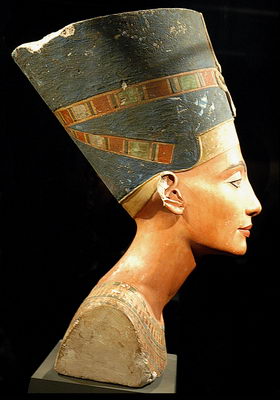
Nefertiti bus in Berlin. Photo by Ferrell Jenkins.

Nefertiti bust in Berlin. Photo by Ferrell Jenkins.

German archaeologists cheated Egyptian customs officers in order to smuggle the 3,400-year-old bust of Queen Nefertiti to Berlin, according to a secret document unearthed in archives….

The document is sure to stoke the row between German and Egypt over the removal of antiquities at the beginning of the 20th century.

The document, discovered in the German Oriental Institute, shows that the archaeologist Ludwig Borchardt deliberately hid the true value of the Nefertiti bust when he submitted the inventory of his finds to the Egyptian authorities in 1913….

The agreement was that Germany and Egypt would divide the spoils equally between them. But, says the witness, Borchardt “wanted to save the bust for us”. So it was tightly wrapped up and placed deep in a box in a poorly lit chamber to fool the chief antiquities inspector, Gustave Lefebvre….

It was enough to get Nefertiti out of the country into Germany. Now her long swan-like neck and exquisite features have come to symbolise the join between ancient and modern ideas of feminine beauty. Over half a million visitors a year are drawn to see her at Berlin’s Egyptian Museum.

But Egypt wants Nefertiti back and a document showing that the bust only left the country because of skulduggery could well strengthen Cairo’s case. Zahi Hawass, secretary-general of the Supreme Council of Antiquities in Egypt, has already threatened trouble. “We will make the lives of these (German) museums miserable,” he said.

At the very least Cairo wants Nefertiti back on loan to mark the opening of a new Grand Egyptian Museum, near the pyramid at Giza, in 2012.

For the full print story read here.

Nefertiti was the wife (Queen) of Pharaoh Akhenaten in 14th century B.C. Egypt.

HT: J. T. Lauer
Antonia Fortress discussion

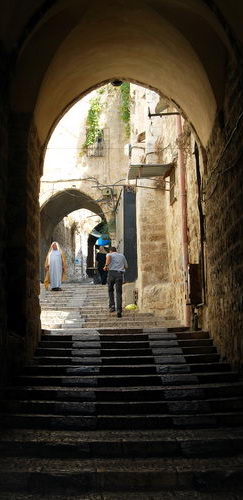
A street in the Moslem Quarter of Jerusalem. Photo by F. Jenkins.

A street in the Moslem Quarter of Jerusalem. Photo by F. Jenkins.

Todd Bolen calls attention to an article by Ehud Netzer in the curent Biblical Archaeology Review on the location of the Antonia Fortress. Read the post here.

Leen Ritmeyer posted a response to Netzer and included some of his great diagrams here.

With Todd’s photo and Leen’s diagrams you will have some great material to help you understand the location of the Antonia.

The Antonia may not be the place where Jesus appeared before Pontius Pilate, as we once thought, but it is the place where Paul stayed under the custody of the Romans before his transfer to Caesarea Maritima.

English versions refer to the building as the barracks (Acts 21:37). Paul’s speech on the stairs was from the steps leading from the temple precinct to the Antonia.

Our photo above was made in the Moslem Quarter of Jerusalem near the site of the Antonia.  I think the street is Bab Hutta. These little side streets are always so intriguing.

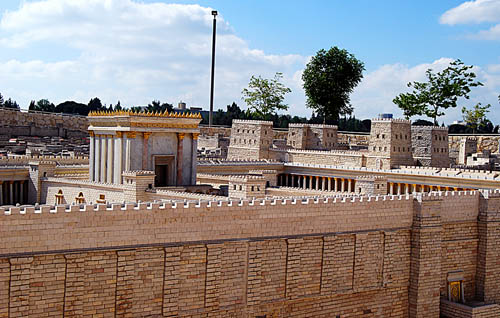
The photo below shows the Temple Mount in the Second Temple model at the Israel Museum. The Antonia is the large building on the right, the northwest corner of the Temple Mount.

The Temple Mount and the Antonia Fortress. Photo by F. Jenkins.

The Temple Mount and the Antonia Fortress. Photo by F. Jenkins.

Roman period figurine discovered in Jerusalem

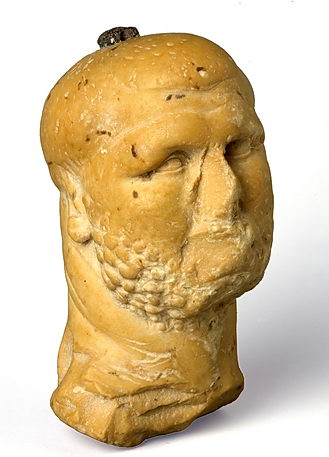
The Israel Antiquities Authority announced a few days ago the discovery of a figurine in the image of a bearded man, probably a boxer. The artifact was uncovered in the Givati car park excavation south of the Dung Gate, and is dated to the second or third century A.D.

Clara Amit, IAA.

Head of Roman Boxer found at Jerusalem. Photo: Clara Amit, IAA.

Notice a few comments from the press release.

The stylistic motifs that are manifested in the image, such as its short hair style, the prominent lobes and curves of the ears, as well as the almond-shaped eyes suggest that the object most likely portrays an athlete, probably a boxer. Boxing was one of the most popular fields of heavy athletics in Roman culture and more than once Roman authors mention the demand by the Roman public in general, and the elite in particular, for boxing matches. Besides the prestige and the substantial amounts of money the victors of boxing competitions won, they were also afforded the support of the emperor himself, as in the famous case of Melancomas who was Titus’ favorite boxer.

According to the researchers the two tiny holes that were drilled in its nape and which contained the remains of metal that was inserted in them indicate that this is a suspended weight that was used with hanging scales that are characteristic of the Roman period. Miniature bronze images of athletes, philosophers, satyrs etc were among the most popular of the suspended weights that were used in the regions that were under the control of the  Roman Empire – from Pompeii to Sepphoris.

I have seen busts of boxers or wrestlers with “cauliflower ears” in museums.  One such bust is in the museum at Thessalonica.

In a different setting, writing to the church in Greco-Roman Corinth, Paul says,

Therefore I run in such a way, as not without aim; I box in such a way, as not beating the air;  but I discipline my body and make it my slave, so that, after I have preached to others, I myself will not be disqualified. (1 Corinthians 9:26-27).

Read the complete report here.

Visiting the Valley of the Kings

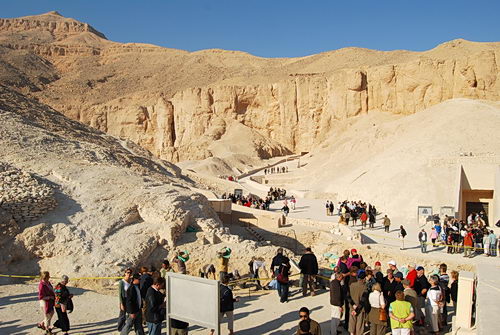
While at Luxor we visited the Valley of the Kings. This is where the Pharaoh’s of the New Kingdom Period of Egyptian history are buried. There are no pyramids during this periods, but at least sixty four tombs are known in the Valley of the Kings. Our group visited two or three.

The Valley of the Kings is located on the West Bank of the Nile River a short distance from the Nile valley.

The Valley of the Kings. Photo by Ferrell Jenkins.

The Valley of the Kings. Photo by Ferrell Jenkins.

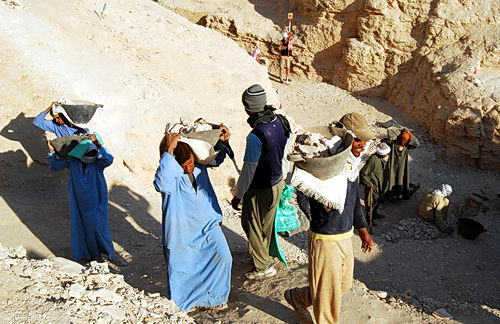
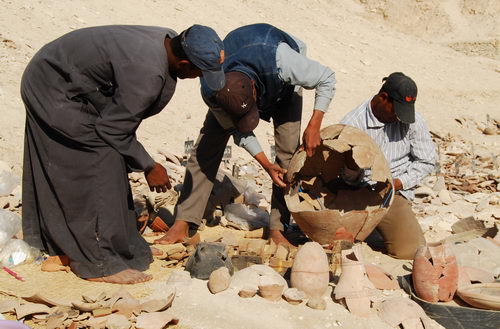
New archaeological excavations continue in the Valley of the Kings. It was fascinating to see workers carrying buckets filled with debris. This is reminiscent of old photos of workers in Mesopotamia or Palestine in the early nineteenth century. Beginning with the excavation of Masada by Yigal Yadin, volunteers are used. Students often pay their own transportation, room and board, to work on a dig. It is a form of educational slavery, one might say.

Workers at archaeologicaly site in the Valley of the Kings. Photo by Ferrell Jenkins.

Workers at archaeological site in the Valley of the Kings. Photo by Ferrell Jenkins.

Some archaeologists were busy surveying. Others were photographing small items. I saw four individuals washing and restoring broken pottery.

Pottery reconstruction in the Valley of the Kings. Photo by Ferrell Jenkins.

Pottery reconstruction in the Valley of the Kings. Photo by Ferrell Jenkins.

Travel can be exciting and educational.

Visiting the Ptolemaic Temple at Edfu

At Edfu, 64 miles south of Luxor, we visited the temple of the sun god Horus who is represented by the falcon. Begun by Ptolemy III in 237 B.C. and completed by 57 B.C., it is the finest example of the ancient Egyptian temples that I have seen. At Luxor we saw Alexander the Great represented as a Pharaoh. His successors, the Ptolemies, brought this practice to an extreme in the temple at Edfu. Ptolemy is pictured repeatedly on the limestone walls standing before Horus; Horus is always the taller figure. Idolatry was not something new to the Greeks, of course (Acts 17; 1 Corinthians 8:5-6).

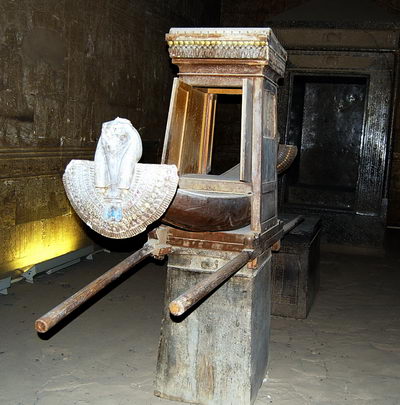
There is a scene inside the temple showing 12 priests carrying an ark on poles. This box on a boat contained the important books pertaining to the temple and the religion of Horus. I think it dates to the time of Pharaoh Neco (late seventh century BC). Neco was the Pharaoh who killed Josiah, the king of Judah, at Megiddo. He continued to Carchemish where he met defeat at the hands of Nebuchadnezzar, king of Babylon. A replica of the ark is on display in the most holy place in the temple.

The ark at Edfu. Photo by Ferrell Jenkins.

The ark at Edfu. Photo by Ferrell Jenkins.

A visit to Edfu demonstrates that, in the Ptolemaic period, we are no longer observing an Egypt ruled by Egyptians but one ruled by foreigners. The prophecy of Ezekiel had been fulfilled.

Thus says the Lord GOD, “I will also destroy the idols And make the images cease from Memphis. And there will no longer be a prince in the land of Egypt; And I will put fear in the land of Egypt. (Ezekiel 30:13).

Descendants of Ham no longer controlled the land, but it was dominated by foreigners who were descendants of Japheth. In the 7th century A.D. the country came under the control of Arab rulers who were descendants of Shem. This same rule by foreigners now continues in the present Egyptian government headed in recent time by presidents Nasser, Sadat, and Mubarak. The modern Egyptians are simply caretakers of the ruins of ancient Egypt.

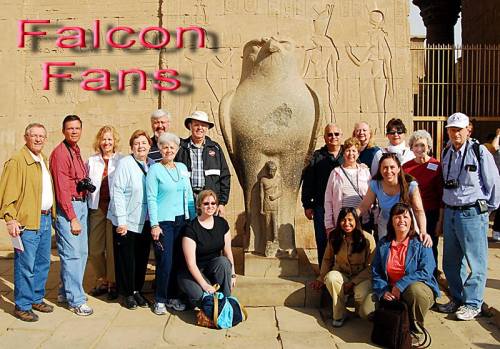
We do a lot of studying and learning on the tour, but we also have fun. Of our 42 person on the tour, about 15 have attended Florida College. Two board members are among the group. The college mascot for the sport teams is the Falcon. We posed with Horus, the falcon god, for a photo.

Note: I left the boat at Aswan to come to a nice Internet Cafe. It seems that I failed to include the photo referenced above on my flash drive. I will try to get it on later.

Note: We are back in Cairo. Here is the photo.

Florida College Falcon fans at Edfu, Egypt. Photo by Sharon Cobb.

Florida College Falcon fans at Edfu, Egypt. Photo by Sharon Cobb.

Comment about Lachish

I note that we have an interesting comment on the post about Lachish on July Fourth. You might enjoy reading it.

More illustrations of apocalyptic imagery

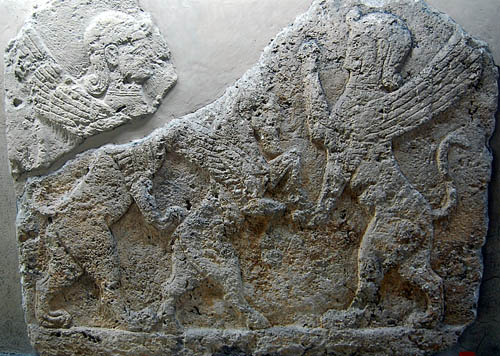
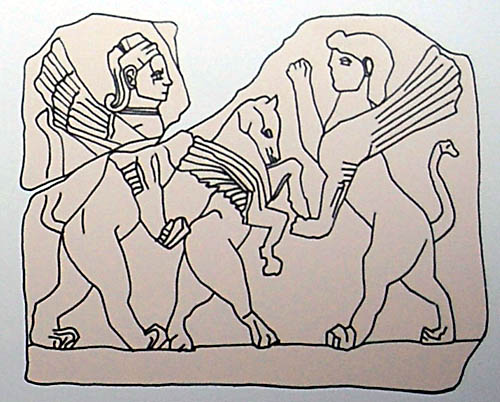
We mentioned in earlier posts on apocalyptic literature that composite images were common among the Assyrians, Babylonians, and Persians. This was also true of the Hittites who lived in the upper Euphrates area. The Anatolian Civilization Museum at Ankara contains many of the reliefs from Carchemish on the Euphrates. The one below shows two human-headed sphinx standing. There is also a winged horse standing between them. They appear to be dancing.

Human-headed sphinxs standing; winged horse standing. Photo by F. Jenkins.

Human-headed sphinx standing; winged horse standing. Photo by F. Jenkins.

This drawing from the Museum may show the image more clearly. Notice the bird head on the tail of the sphinx on the right.

Drawing of the human-headed sphinx and standing horse.

Drawing of the human-headed sphinx and standing horse.

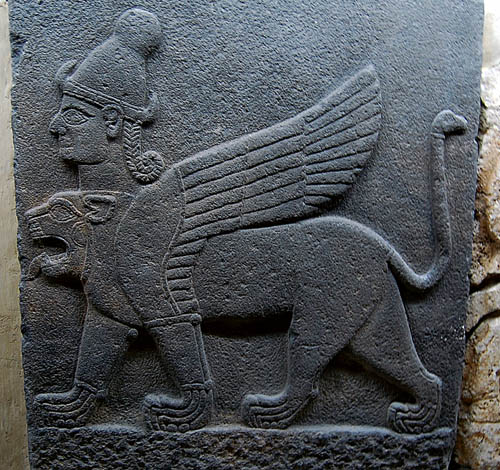
This one is of special interest. It shows a lion with wings and a human head.  The tail shows the head of a bird. There are four images in composite form. This basalt orthostat also comes from Carchemish.

Three-headed sphinx.

Three-headed sphinx.

Judeans who were taken captive to Babylon traveled in this region on their way to their place on the Chebar (Kebar) River in southern Mesopotamia. We know that Nebuchadnezzar made his headquarters at Riblah in the land of Hamath. Because this region was part of the Fertile Crescent we can be sure that the Judeans traveled in the area on their long trip from Judea to Babylon. See 2 Kings 25:6-7.

We are not saying that Ezekiel borrowed his composite creatures from the culture around him. We are saying that such was common and that it would not have been unusual or strange to Ezekiel or his hearers/readers.

Notice, again, Ezekiel’s description of the creatures he saw:

These are the living beings that I saw beneath the God of Israel by the river Chebar;  so I knew that they were cherubim.  Each one had four faces and each one four wings, and beneath their wings was the form of human hands.  As for the likeness of their faces, they were the same faces whose appearance I had seen by the river Chebar. Each one went straight ahead. (Ezekiel 10:20-22 NASB)

For the images in the book of Daniel we could show numerous composite creatures from Babylon.

Apocalyptic imagery is not strange

Visits to the great museums of the world provide many illustrations that help us understand the background of biblical images. This is especially true when we think of the apocalyptic imagery in Ezekiel, Daniel, Zechariah, and Revelation. The Greek name of the Book of Revelation is apocalypsis. In the opening sentence of the book we are told that it is an apocalypse.

In two previous posts we have called attention to the cherubim of the Bible. In this post I want to further this discussion and call attention to the multi-headed creatures that we encounter in apocalyptic literature. In the great throne scene of Revelation 4 we see four living creatures.

The first living creature was like a lion, the second creature like an ox, the third creature had a face like a man’s, and the fourth creature looked like an eagle flying. Each one of the four living creatures had six wings and was full of eyes all around and inside. They never rest day or night, saying: “Holy Holy Holy is the Lord God, the All-Powerful, Who was and who is, and who is still to come!” (Revelation 4:7-8 NET)

In Ezekiel we see figures representing four living beings with human form. Each living being had four faces and four wings. Each face was of a different creature.

Their faces had this appearance: Each of the four had the face of a man, with the face of a lion on the right, the face of an ox on the left and also the face of an eagle. (Ezekiel 1:10 NET)

One notes immediately that in early Christian art the Four Evangelists (or we might say, the four writers of the gospels) were likened to the same creatures.

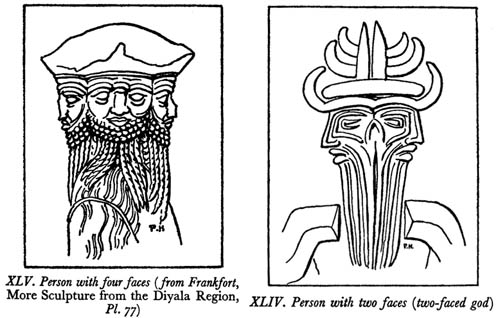
Andre Parrot, in Babylon and the Old Testament, calls attention to the imagery used in Ezekiel. He provides two drawings of images uncovered by the archaeological spade in Mesopotamia. One shows a two-faced image; the other a four-faced image.

Drawings from Parrot, Babylon and the Old Testament.

Drawings from Parrot, Babylon and the Old Testament.

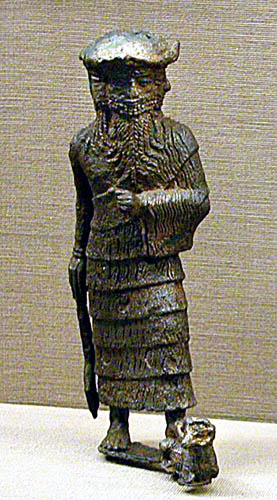
The location of the images is not given. The four-faced image seems to be an image that is now on display at the Oriental Institute of the University of Chicago. This is a museum you must not miss if you visit the Chicago area. Here is a nice photo made by David Padfield.

Four-faced image from Mesopotamia. Photo by David Padfield.

Four-faced image from Mesopotamia. Photo by David Padfield.

One notices immediately that these two-faced and four-faced images all have human heads. We need only turn to the sculpture of Assyria, Babylon, and Persia to find many composite creatures bearing features of four or more creatures. That will have to wait for another time.

In closing I must return to the title of this post. “Apocalyptic imagery is not strange.” That is, it was not strange to those to whom the apocalyptic books of the Bible are addressed. It may be strange to us at first glance, but that can easily change by investigating the culture in which these books were written and read.

More about the Cherubim

To the illustration from Byblos included with W. F. Albright’s article I would like to add a few photographic illustrations that might be helpful in understanding the concept of the Cherub as well as the general concept of composite beasts in the Apocalyptic books of Ezekiel, Daniel,  Zechariah, and Revelation.

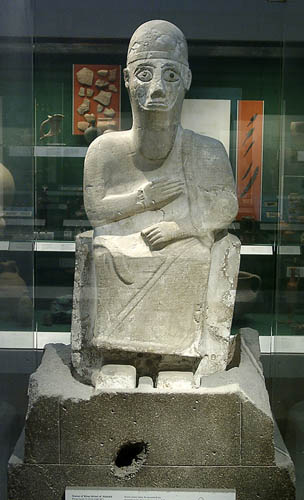
Throne of King Idrimi of Alalakh. Photo by Ferrell Jenkins.

Throne of King Idrimi of Alalakh. Photo by F. Jenkins.

The photo above shows the front of the Statue of King Idrimi of Alalakh, now displayed in the British Museum. An associated cuneiform inscription tells that this king, following a popular revolt, was forced into exile. He went first to Emar on the Euphrates, then to Canaan, where he joined other refugees from Syria and lived with the Hapiru. Seven years later he recaptured the district of Mukish and was acclaimed king of Alalakh.

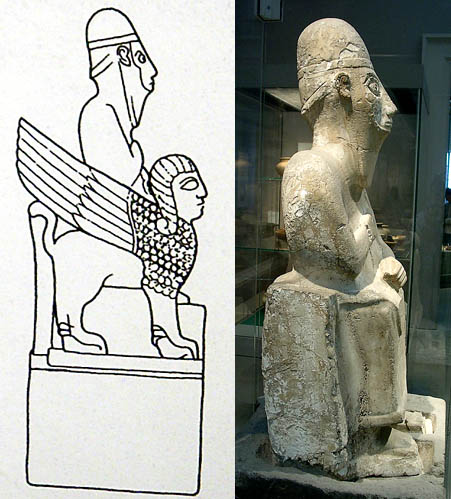
King Idrimi of Alalakh. Photo by F. Jenkins.

King Idrimi of Alalakh. Photo by F. Jenkins.

The drawing on the left (above) shows the suggested reconstruction of the throne of King Idrimi of Alalakh (1570-1500 BC) . Alalakh is located in North Syria, near the Orontes River. Due to political changes, Alalakh, Tell Atshana [Açana], is now in southern Turkey. See The New International Dictionary of Biblical Archaeology or The Biblical World for more information about the excavations at Alalakh.

This photo on the right (above) shows the right side of the statue as it is displayed in the British Museum.

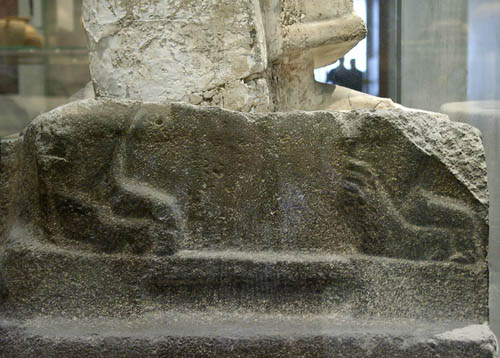
Right side base of throne of the King of Alalakh.

Right side base of throne of the King of Alalakh.

The photo above shows the base of the right side of the statue. The front and hind feet of the “creature” upon which the throne stands are clearly visible.

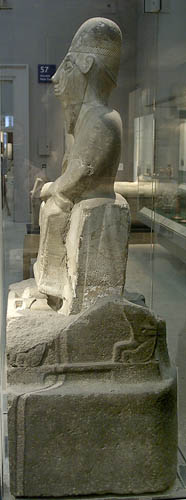
Left side of the throne.

Left side of the throne.

The photo to the right shows the left side of the throne. The front and hind legs of the animal can be seen.

Recall these references from the Bible describing the LORD as riding on a cherub.

And He rode on a cherub and flew; And He appeared on the wings of the wind. (2 Samuel 22:11)

He rode upon a cherub and flew; And He sped upon the wings of the wind. (Psalm 18:10)

These are the living beings that I saw beneath the God of Israel by the river Chebar; so I knew that they were cherubim. (Ezekiel 10:20; see entire chapter)

We are saying that images such as the one discussed here provide an idea of the imagery involved in the biblical description of the cherubim.

Perhaps later we will be able to include some photos of representations of the cherubim upon the ark of the covenant.

What Were the Cherubim?

What Were the Cherubim?
By W. F. Albright

Today we think of a cherub as a tiny winged boy, following the tradition of Renaissance artists. This conception was directly borrowed from pictures of Graeco-Roman “loves” or Erotes, familiar to us from the excavations of Pompeii. The actual appearance of the cherubim of the Old Testament was already forgotten before the time of Christ, and Josephus (first century A.D.) says that “no one can tell what they were like.”

Since the veil of the Tabernacle was decorated with embroidered cherubim, and the walls and the religious objects of Solomon’s temple lavishly adorned with them. we ought to be able to identify them in contemporary Syro-Palestinian art. The account of the Ark of the Covenant shows that only a creature with wings can be considered. If, therefore, we study all known representations of animals and hybrid creatures, partly animal, we find one which is much more common than any other winged creature, so much so that its identification with the cherub is certain: that is the winged sphinx or winged lion with human head. In Egypt the wingless sphinx and the griffin appear; in Babylonia and Assyria the winged bull with a human head prevails; but in Syria and Palestine it is the winged sphinx which is dominant in art and religious symbolism.

King Hiram of Byblus [Byblos] seated on his cherub-throne, tenth century B.C. Drawing by A. H. Detweiler.

The God of Israel was often designated as “He who sitteth (on) the cherubim” (I Sam. 4:4, etc.). The conception underlying this designation is well illustrated by representations of a king seated on a throne supported on each side by cherubim, which have been found at Byblus [Byblos], Hamath, and Megiddo, all dating between 1200 and 800 B.C. One shows King Hiram of Byblus (period of the Judges) seated upon his cherub throne. Pottery incense altars found at Taanach and Megiddo are archaeological parallels to the wheeled lavers (“bases”) of Solomon’s temple, which were decorated with lions and cherubs, according to I Kings 7:36.

The primary function of the cherub in Israelite religious symbolism is illustrated by two biblical passages. A very ancient hymn, found twice in the Bible, has the words, “And He rode upon a cherub and did fly” (I Sam. 22:11 [2 Sam. 22:11], Ps. 18:11 [English, Ps. 18:10]); the second is Ezek. 10:20. The conception of the deity as standing or as enthroned on an animal or hybrid creature was exceedingly common in the ancient Near East, but it was most common in Syria and Northern Mesopotamia between 2000 and 700 B.C. In Babylonia the figure of a deity is replaced in certain cases by a winged shrine and later by a thunderbolt. So in Israelite symbolism between 1300 and 900 B.C., the invisible Glory (Jehovah) was conceived as enthroned upon the golden cherubim or standing on a golden bull.

– – – – – – – – – –

This article was published in The Biblical Archaeologist, Feb., 1938, and is included in the Biblical Archaeologist Reader I: 95-97. A few corrections and notes have been added in brackets.

The drawing by A.H. Detweiler shows King Hiram of Byblus [Byblos] seated on his cherub-throne, tenth century B.C.

I plan to follow this article with some photographs to help illustrate the subject.