Category Archives: Archaeology

The last day at Khirbet Qeiyafa

Luke Chandler reports on the last full day of excavation at Khirbet Qeiyafa (the Elah Fortress) here. Several good photos are included with the post. Thanks to Luke for the reports and photos.

I call attention to these reports to give our readers who may not be aware an idea of the difficulty and slowness of an archaeological dig. Information is accumulated over many years. The archaeologists may have some conclusions at the end of the season, but they may change next year as new information comes to light.

Now we must await a full report by the director of the dig. There may be a press relase within the next month or two, but the next step is the presentation at the annual meetings of the American Schools of Oriental Research and the Society of Biblical Literature in November. Maybe a popular article or two will follow. In the background there may be lab studies, calling in of experts in various fields to look at artifacts, etc.

There will likely be more questions than answers. In the years to come other scholars will interact with the conclusion drawn by the excavator. Hopefully this will provide background for a better understanding of the story of David and Goliath (the Israelites and the Philistines).
Jerusalem excavation at BiblePlace Blog

Todd Bolen has posted three photos showing some current excavations in Jerusalem here. The one of the excavations in the Western Wall plaza is especially helpful.

A unique panorama from Tell es-Safi/Gath

Prof. Aren Maeir has posted a unique panoramic photo by Gal Avraham of Area A at Tell es-Safi/Gath. It appears to be made from at least 7 different photographs. See them here.

Podcast on Tell es-Safi/Gath excavation

A brief report about the Tell es-Safi/Gath excavation has been posted on the ABC (Australian Broadcasting Company) here. A transcript is included for those who prefer to read.

Prof. Aren Maer has posted a great photo of the tell from ground level.

Tell es-Safi/Gath. Photo by Richard Wiskin.

Tell es-Safi/Gath. Photo by Richard Wiskin.

Check the web site here for a hi-res photo. Gath is the town named as the home of Goliath in the Bible.

Then a champion came out from the armies of the Philistines named Goliath, from Gath, whose height was six cubits and a span. (1 Samuel 17:4 NAU)

I wrote this post yesterday and waited till today to post it. Others have called attention to the podcast since that time.

UN reports Babylon damaged by US troops

According to a report on CNN.com U.S. troops are accused by a United Nations report of damaging ancient Babylon. Well, surprise!, surprise! I think its called war.

The troops and their contractors caused “major damage” by digging, cutting, scraping and leveling while they were revamping the site to meet military standards, the U.N. cultural agency, UNESCO, said in a report.

“Key structures that were damaged include the Ishtar Gate and the Processional Way,” the report added.

The Ishtar Gate, an entrance to the northern part of the city, is decorated with animals that portray the symbol of the god of the city of Babylon.

“Damage to the gate includes smashed bricks on nine of the bodies of the animals adorning the gate,” according to the report.

To those of us interested in the past this damage is to be regretted. Babylon is important in Biblical history. The report goes on to say that local residents had contributed to the damage through development. One could fill a book with accounts of this happening at important historic sites.

The report introduces another aspect.

During colonial times, archaeologists hauled off Babylon’s artifacts to Europe. Some of those artifacts can be seen in a museum in Berlin, Germany.

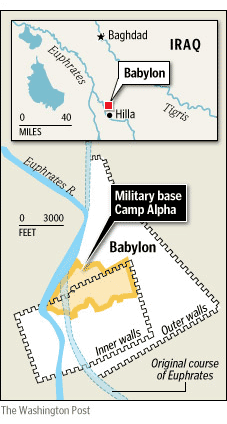
babylon-diagram-washingtonpostYes. Thankfully the German archaeologists excavated the Ishtar Gate and the Procession Street and took those things to Berlin for preservation and restoration. It is now possible to visit the Museum of the Ancient Near East (Vorderasiatisches Museum), also called the Pergamum Museum, and see the Ishtar Gate and the Procession Street. I note that the Museum site now has some small, but nice photos online here. You may also see panels from the Procession Street at other great museum of the world including several in the United States.

We have previously written about Babylon, with photos, here, here, and here.

We commented on those dreaded colonial archaeologists here.

Check these reports: The Irish Times; The Washington Post. I do not doubt damage, but the photos show the site much the same as it was in 1970 when I visited.

HT: Harriet; Biblical Paths.

Aerial views of Gath

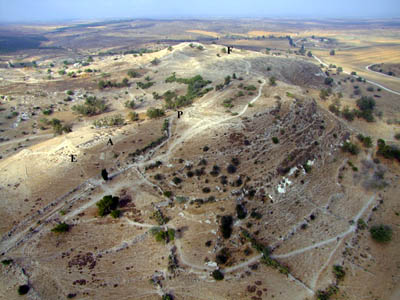
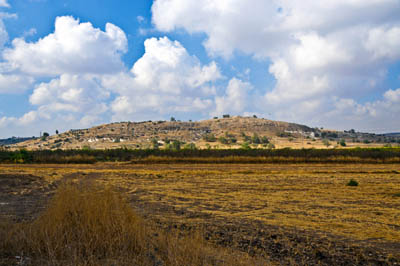
Prof. Aren Maeir has posted a great aerial photo of Tell es-Safi/Gath on his blog here. He also has a photo showing the air balloon with a remote camera used to make the photo. I am taking the liberty to post a small copy of the aerial photo in an effort to encourage you to look at the hi-res one on his blog. In this photo you can see the Mediterranean Sea in the distance. This illustrates clearly the terrain of the Shephelah and the coastal plain (of Philistia). The areas worked this summer are indicated by the letters E, A, P and F.

Aerial view of Tell es-Safi/Gath looking SW.

Aerial view of Tell es-Safi/Gath looking SW. Tell es-Safi/Gath Blog.

Aren promises to offer final reports on the accomplishments of the season shortly. We look forward to those.

Over the years I have encountered people who think ALL of the archaeological work has been done. When you see a large mound like Tell es-Safi/Gath from the air you begin to understand that there is still work to be done.

Here are a few of the interesting things we know about Gath from the Bible:

  • Gath was one of the five major cities of the Philistines (1 Samuel 6:17).
  • The ark of the covenant was brought here by the Philistines after being capture in battle with the Israelites (1 Samuel 5:8).
  • Goliath was from Gath (1 Samuel 17).
  • David once sought refuge from Achish king of Gath (1 Samuel 21).
  • When Saul and Jonathan died, David did not want it to be published among the Philistines. He said, “Tell it not in Gath, Proclaim it not in the streets of Ashkelon, Or the daughters of the Philistines will rejoice, The daughters of the uncircumcised will exult” (2 Samuel 1:20).
  • King Uzziah broke down the wall of Gath, and other Philistine cities, and built Judean cities (2 Chronicles 26:6).

Taking the family to the Explorations in Antiquity Center

We recently ran three posts about the Explorations in Antiquity Center, LaGrange, GA, here, here, and here. A couple of friends in Alabama were encouraged by the posts to take 9 of their grandchildren to visit the center. Olen and Jane have visited Israel and Jordan with me twice, and I think they have been in Turkey twice. So, they know what to look for, and they understood the value of such an experience as that provided by the Explorations in Antiquity Center for their grandchildren.

You may remember Jane from her Journeys With Jane blog. She described the experience in Georgia this way:

The experience was much more than we had even hoped for! It was a long (4 ½ hour) drive over there, included an overnight stay, and long drive back, but worth all the time involved. The exhibit itself is a bargain, and extremely educational for both adults and children. We are ready to go back whenever we have the opportunity. We are thankful for the safety during our travels on this brief “journey” and highly recommend it to anyone who is interested in the Bible or history of that era.

What was the best part?

The best part was the archaeological dig. We went to prepared areas and were instructed on archaeological techniques. Then we dug and sifted through our diggings to locate artifacts (some real and some replicas) which we would learn about later

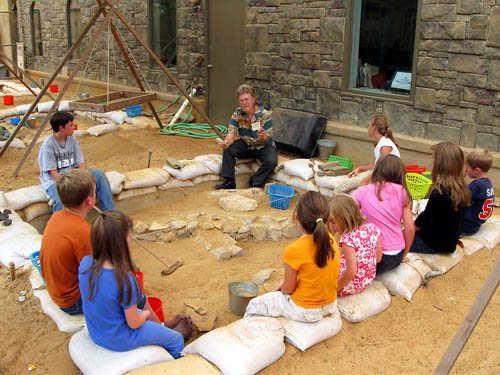
She says they were honored to have Dr. James Fleming, the founder of the Center, explain about the artifacts they discovered on the dig, and relate them to different periods of history. Here, the kids listen intently as Dr. Fleming talks with them.

Dr. Fleming explains the archaeological artifacts to the kids.

Dr. Fleming explains the archaeological artifacts to the kids at the Explorations in Antiquity Center. Photo courtesy Journeys With Jane.

You might enjoy seeing the other photos Jane has posted on her blog here.

I have no connection with, or financial interest in, the Explorations in Antiquity Center, but I am delighted to promote such a wonderful teaching center. The link to the Center website is here.

Keeping up with the digs

Not many digs this year are keeping the unfortunate, non-participants, informed about what is going on. I miss seeing anything from Dan, Gezer, and Hazor. Nothing new has appeared on the Khirbet Qeiyafa page since the middle of May. Maybe they have fewer workers and time does not permit. Of course, we have had a few notes from our friends who are working there. We had an earlier report on the Mt Zion Excavation.

The one real exception has been the excavation at Tell es-Safi/Gath. Prof. Aren Maer has kept us updated and included some nice photos along the way. Check here and read back through the season.

A 2009 Post season wrap-up on Ashkelon is available here.

Dr. Bryant G. Wood has provided a report here on the season at Khirbet el-Maqatir, a site that he thinks may be biblical Ai.

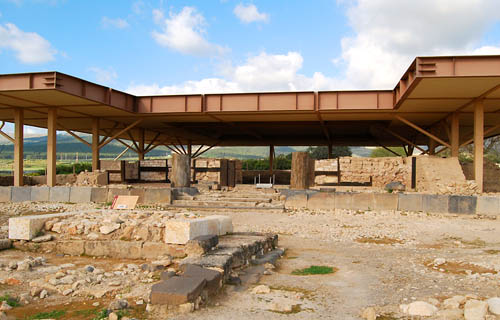
The photo below shows the Palace of the Canaanite Kings of Hazor. The palace which dates from the 14th-13th centuries B.C. (Late Bronze period) is said to be of a ceremonial nature. Excavators are still looking for the administrative palace at some other place on the tel. The palace, like the rest of Hazor, was destroyed by fire. It has been restored in order to give visitors some real insight into the size and function of the building.

The Late Bronze Canaanite Palace at Hazor. Photo by Ferrell Jenkins.

The Late Bronze Canaanite Palace at Hazor. Photo by Ferrell Jenkins.

Gordon Franz has posted an interesting interview with conservator Orna Cohen, the restorer of the palace, on his Life and Land Seminars page here. Orna was responsible for the restoration of the Roman Boat that many visitors to Israel have seen at Nof Ginosaur.

Video on the City of David

The Israel Antiquites Department has released a nice 9-minute video featuring archaeologists Ronnie Reich and Eli Shukron showing some of the highlights of the City of David excavation. The film features the following places:

  • The water system and Warren’s Shaft
  • The Canaanite pool channel
  • Gihon Spring
  • Hezekiah’s Tunnel
  • The Pool of Siloam
  • The Herodian Street
  • The drainage channel

The video runs a little slow on my computer, but if you give it a little time to load it is certainly worth the wait. The link is here.

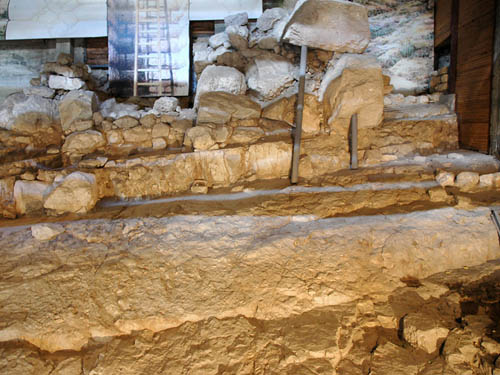
The photo below shows part of two towers that served as a fortification for the protection of Gihon Spring as early as the Canaanite time.

Foundation of the fortification tower at Gihon Spring. Photo by Ferrell Jenkins.

Foundation of the fortification towers at Gihon Spring. Photo by Ferrell Jenkins.

The information sign at the site says,

It was here that a rock-cut pool and the remains of the bases of two towers were located. These towers, built of large stones, constituted part of the fortifications protecting the pool and the spring as early as the Middle Bronze Age (18-15 centuries BCE). The spring water flowed through the channel to a large pool, from which scores of people could draw water simultaneously. The surplus water flowed through a channel to another pool in the south of the city.

This work has been carried out by Reich and Shukron.

HT: Joseph I. Lauer

Life at an archaeological dig can be fun

Luke and Royce Chandler, a couple of friends from Tampa, are participating in the dig at Khirbet Qeiyafa, a site above the Valley of Elah. It is also being called the Elah Fortress. The director of the dig, Prof. Yosef Garfinkel, thinks this is the site of Shaaraim (Joshua 15:36; 1 Samuel 17:52; 1 Chronicles 4:31).

Todd Bolen, of BiblePlaces.com has suggested the site should be identified with Ephes-dammim here, here, and here. Both places, Shaaraim and Ephes-dammim (1 Samuel 17:1) are associated with the conflict between David and Goliath. I will leave all of this for you to study as you wish.

Luke sent me a few photos to share with our readers.

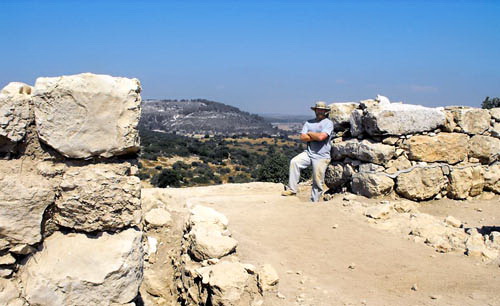
Luke is standing in the "Philistia Gate" with his left foot in the Iron Age threshold. Azekah can be seen in the distance.
Luke is standing in the “Philistia Gate” with his left foot in the Iron Age threshold. Azekah can be seen in the distance.The Valley of Elah is to the left.

Luke reports an interesting incident that happened at the dig last Wednesday.

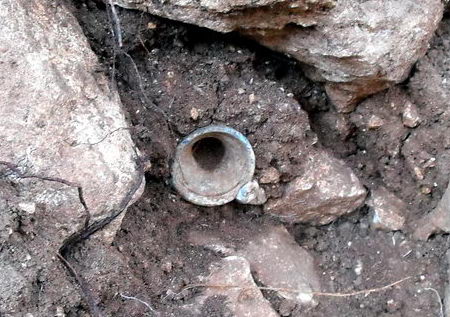
On this final day in the room, my father leaned his hand against the wall and accidentally caused a stone to fall out onto the ground. Behind where the stone had been, Royce saw a shiny turquoise circle. We called Guy Stiebel, the area archaeologist (also the chief excavator at Masada), to see it. When Guy saw the glass he took a keen interest. It turned out to be a complete ancient glass bottle that had been placed on its side into the wall during construction. Glassware such as this is common in burial locations, but very uncommon in this situation.

Read the full account here. Luke has several photos on his site. He received permission to include a photo of the glass bottle “in situ” (the place where it was found). He has given me permission to share it with our readers.

Glass bottle found in a wall at Khirbet Qeiyafa by Royce Chandler. Photo: Luke Chandler.

Glass bottle found in a wall at Khirbet Qeiyafa by Royce Chandler. Photo: Luke Chandler.

In 2008 one of the volunteers uncovered a large potsherd (broken piece of pottery) containing a Hebrew inscription. We are still awaiting a complete translation. We published a photo here.

We appreciate Luke sharing these experiences with us. By the time he and Royce get back home their wives will be expecting them to work in the flower beds!

You might also enjoy reading his account of walking through Hezekiah’s Tunnel (2 Kings 20:20), and seeing his video showing a stone from the Iron Age in the east wall of the Old City of Jerusalem, here.