Category Archives: Archaeology

Miniature carving of Alexander the Great

Israel National News reports the discover of a rare miniature carving of Alexander the Great. The article by Nissan Ratzlav-Katz says,

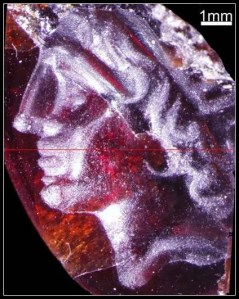
Excavations in Tel Dor have turned up a rare and unexpected work of Hellenistic art: a precious stone bearing the miniature carved likeness of Alexander the Great. Archaeologists are calling it an important find, indicating the great skill of the artist.

The Tel Dor dig, under the guidance and direction of Dr. Ayelet Gilboa of Haifa University and Dr. Ilan Sharon of Jerusalem’s Hebrew University, has just ended its summer excavation season. For more than 30 years, scientists have been excavating in Tel Dor, identified as the site of the Biblical town of Dor. The town’s location, on Israel’s Mediterranean Sea coast some 30 kilometers south of Haifa, made it an important international port in ancient times.

“Despite the tiny proportions – the length of the gemstone (gemma) is less than a centimeter and its width less than half a centimeter – the artist was able to carve the image of Alexander of Macedon with all of his features,” Dr. Gilboa said. “The king appears as young and energetic, with a sharp chin and straight nose, and with long, curly hair held in a crown.”

According to the archaeologists involved in the Tel Dor excavations, the discovery of the miniature Alexander gemstone carving in Israel is fairly surprising. The Land of Israel was not, for the Greek Empire, a central or major holding.

The article concludes,

Historically, Alexander himself passed through Dor in 332 BCE, during his voyage to Egypt. It appears that the city fell to him without resistance. Since that time until its conquest by the Hasmonean Jewish King Alexander Yannai around 100 BCE, Dor served as a stronghold of non-Jewish Hellenists in the Land of Israel.

The full article may be read here.

Miniature carving of Alexander from Tel Dor.

Carving of Alexander from Tel Dor.

Dor is mentioned in several Old Testament references including Joshua 17:10-11.

HT: Joseph I. Lauer

Persecution of Christians in Thessalonica

Earlier we posted information about the Arch of Galerius. Galerius was the Roman Emperor from 305 to 311 A.D. The arch was erected in Thessalonica to commemorate his victory over the Persians in 297 A.D. The reliefs on the arch are about this victory.

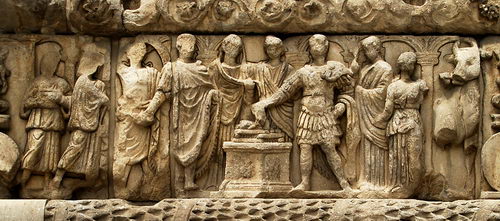
The most interesting portion of the relief to me is the one showing Galerius offering a sacrifice. The relief has been somewhat defaced, but it appears to me that he is pouring a libation on the altar. To the left, as we view the scene, is the Emperor Diocletian, the father in law of Galerius. The lady on the right is the wife of Galerius, daughter of Diocletian. Note the animal, awaiting his turn to be offered on a larger altar. The altar scene reminds us of the Emperor worship which was prevalent from the close of the first century onward.

Sacrifice scene on the Arch of Galerius in Thessaloniki. Photo by Ferrell Jenkins.

Sacrifice scene on the Arch of Galerius in Thessaloniki. Photo by Ferrell Jenkins.

Diocletian is noted for his decree in 303 A.D. that ordered the burning of all Bibles and church records. This is one reason we have so few manuscripts before the fourth century A.D. Some credit Galerius as the brain back of this decision. He was responsible for considerable persecution of Christians during his reign. This persecution would be that spoken of in the Book of Revelation that we associate with Emperor worship.

The Danish archaeologist Dyggve excavated a Palace, Hippodrome, and Mausoleum belonging to Galerius. He also was able to show that the Arch was part of the complex of buildings (Blue Guide Greece).

The Via Egnatia in Thessalonica

The Egnatian Way was one of the famous Roman roads used by the Apostle Paul in his travels to preach the gospel of Christ (Acts 16-17). F. F. Bruce gives a little history about the ancient road.

When Macedonia became a Roman province in 148 b.c., the Via Egnatia was constructed, running east from Dyrrhachium (modern Durres) and Apollonia (modern Poyani) on the Adriatic to Thessalonica, from which existing roads ran to the main Greek cities. The Via Egnatia was later extended farther to Neapolis (modern Kavalla), the port of Philippi, and later still to Byzantium on the Bosporus. When the Roman province of Asia was formed in 133 b.c., the Via Egnatia (with a short sea-crossing at either end) provided easy communication between Rome and the new province. (The Anchor Bible Dictionary, 6:649).

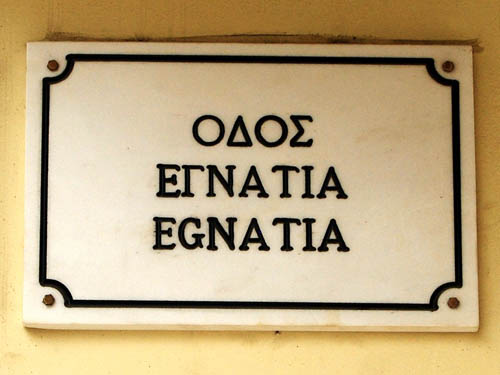
Very few remains from the first century have been exposed in Thessaloniki. Remember that the second largest city of Greece is built over the ancient city. One of the important streets running through the city is named Odos Egnatia (the Egnatian Way). The small street signs in Thessaloniki are located on building rather than on the corner of the street. This makes it difficult for a stranger to drive and read the street signs.

Street marker in Thessaloniki. Photo by Ferrell Jenkins.

Street marker in Thessaloniki. Photo by Ferrell Jenkins.

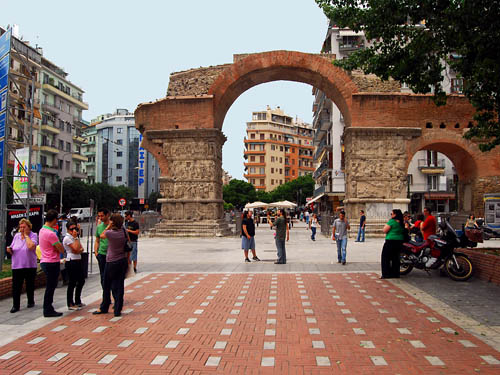
The Via Egnatia runs beside the monumental Arch of Galerius. This arch was built in A.D. 304 to commemorate the emperor’s victory over the Persians in A.D. 297 (Reddish & Fant 136).

Arch of Galerius (early 4th century A.D.). Photo by Ferrell Jenkins.

Arch of Galerius (early 4th century A.D.). Photo by Ferrell Jenkins.

Luke Chandler on Israel National Radio

We have had several things to say about Luke Chandler and his participation in the archaeological dig at Khirbet Qeiyafa (the Elah Fortress) a few weeks ago. This is because Luke is a friend and a former student. Luke has been interviewed by Gordon Govier on The Book and the Spade program. That interview emphasized the role of volunteers in archaeology.

Willner & Selevan

Willner & Selevan

Now he has been interviewed for the Judean Eve program on Israel National Radio to discuss the use of blogs in reporting on archaeological work. To hear this interview you must look for the program entitled Tell Me About Digs. Click on Part 2 to listen or download the mp3 file. Follow this link for the interview. Luke’s blog may be found at lukechandler.wordpress.com.

There is another interview on the same program with some guy named Herschel Shanks.

Khirbet Qeiyafa is an important site historically because of the part it plays in the account of the conflict between Israel and the Philistines (David and Goliath). See 1 Samuel 17 for the full story.

Good deal on Bible study CD

From time to time I order Bible software from Rejoice Christian Software. I have no stock in the company, but am delighted to recommend some of their deals to others.

zondervant0310274486Rejoice has Zondervan’s Understanding the Bible Library 6.0 available as a special for only $35.95, less than the price of two volumes in print. You may read about the program details here, but you must go to a special link which I received by Email for the low price. Click here. The Email says it is o.k. to email it to a friend. This is my Email to you.

This program is published by Zondervan. Therefore it uses the Pradis format. This is the only way to get some of the Zondervan titles in digital format.

Here are a few of the significant titles in this program.

  • New International Bible Dictionary. Ed. F. F. Bruce.
  • New International Bible Dictionary. Ed. J. D. Douglas.
  • New International Dictionary of Biblical Archaeology. Ed. Blaiklock and Harrison.
  • New International Encyclopedia of Bible Difficulties. Archer.
  • New International Encyclopedia of Bible Words. Richards.
  • Asbury Bible Commentary.
  • Five Bible versions.

It is unfortunate that I have to open my Libronix program and my Pradis program when I am researching something, but that’s the way it is. Yes, I already have most of these in print, but I love being able to search the entire book on the computer.

The offer is valid through August 22, 2009.

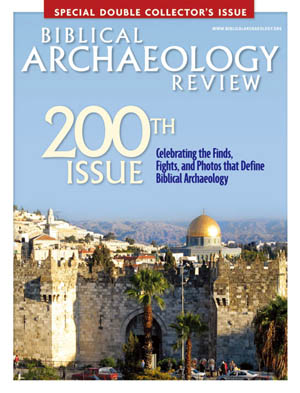
200th issue for Biblical Archaeology Review

bar_200_35040c100l-tYesterday I received the 200th issue of Biblical Archaeology Review. I have all issues of the magazine since that first small single color issue in March, 1975. When I bought the earlier issues in Libronix format for the computer I gave my paper copies to a young teacher.

Not everyone likes BAR. It has been a controversial magazine. No wonder. Editor Herschel Shanks has been controversial. But, I have enjoyed it all the way. I first met Herschel and his right hand gal, Suzanne Singer, at the ASOR meeting in New Orleans in 1979. I ate at the same round table with them, Prof. David Ussishkin, and Prof. William Sanford LaSor. Still, every time I see Herschel. I have to go through the introduction process.

Before BAR, unless we attended the annual meeting of the American Schools of Oriental Research, we had to depend on the reports in Biblical Archaeologist for popular articles on archaeology. My recollection is that the magazine was often late and the photography poor. Agree or disagree about Shanks and the magazine, one thing is for sure. It has made biblical archaeology a popular topic.

More information about this issue, with an opportunity to buy and subscribe, may be found at the magazine web site: Biblical Archaeology Review.

This special issue of BAR contains the following features:

  • A first personal article by Gabriel Barkay on “The Riches of Ketef Hinnom.” It was during this excavation that Iron Age tombs were found, one of which contained the tiny silver plaque with the oldest known text of a Bible reference.
  • Photos by the late photographer David Harris.
  • Ten top discoveries.
  • BAR’s Crusades, like the one to get the Dead Sea Scrolls published.
  • Letters we loved.
  • Much more.

In typical Shanks fashion, we are told that “The best is yet to come!”

Luke Chandler’s interview on The Book & the Spade

Over the past month we have called attention to Luke Chandler’s Blog while he was working as a volunteer at the Khirbet Qeiyafa excavation in Israel. Others have taken notice of his blog. Now Gordon Govier of The Book & the Spade radio program has interviewed Luke. There are two parts to the interview. Part one is already available on The Book & the Spade web site here. Part 2 will be available next week.

Luke’s report about the interview is here. Luke describes the interview:

The Book and Spade program is in its 26th year and has featured many well-known archaeologists and scholars, including Yossi Garfinkel (chief excavator of Khirbet Qeiyafa) who was interviewed on the program from Harvard last Fall. To put it in archaeological terms, I am not in the same stratum with these eminent scholars. I was invited to share my perspective as a volunteer excavator who participated in one of the hottest current digs.

The interview discussed a range of topics, from the experiences of a first-time excavator to the relevance of the site. It will be broadcast in two parts. Part 1 is freely available now, and for the duration of this week (August 11th and following). Part 2 of the interview will be broadcast next week.

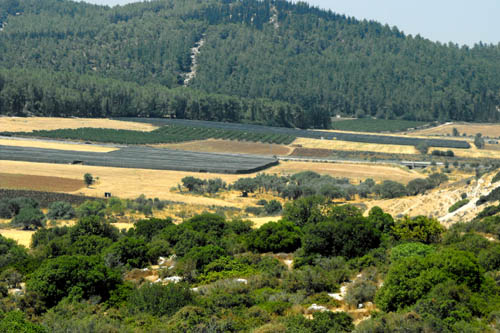
Luke has been kind enough to supply me with several photos during his time at Khirbet Qeifaya. The photo below was made from Khirbet Qeiyafa (the Elah Fortress). Notice the bridge in the extreme right of the photo. That bridge is build over the bed of the Brook of Elah. The brook is dry except during the rainy season.

Elah Valley from Khirbet Qeiyafa. Photo by Luke Chandler.

Elah Valley from Khirbet Qeiyafa. Photo by Luke Chandler.

For the background of this whole story read 1 Samuel 17.

Plea for help comes too late

The Times Online recently carried an article by Hannah Devli about a dig in southeastern Turkey under this headline: “Desperate plea for help came too late for ancient Assyrian leader.”

A letter scratched into a clay tablet reveals a desperate plea for reinforcements that came just too late. Alone, petrified and facing almost certain death, the ancient Assyrian leader Mannu-ki-Libbali scrawled a call for help to his commander, but his cry for extra troops came too late.

Soon after it was sent, the ancient city of Tushan was overrun by Babylonian invaders, its temples and palaces pillaged, then torn down or set aflame.

The letter, scratched into a clay tablet in 630BC, may never have reached its intended recipient. But more than 2,500 years later it has been unearthed almost intact by archaeologists, offering an unprecedented glimpse into the downfall of the one of the most powerful empires of the ancient world.
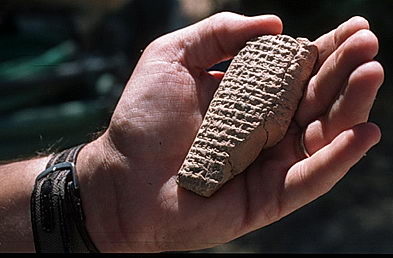
Assyrian tablet with plea of Mannu-ki-Libabli. Photo: Times Online.

Assyrian tablet with plea of Mannu-ki-Libabli. Photo: Times Online.

The archaeologists working at the site say that the author of the letter was a city treasurer who was responsible for building an army to defend the city of Tushan. The article continues…

John MacGinnis, an archaeologist from the University of Cambridge who led the excavation, said: “The letter is written during the process of downfall. The chances of finding something like this are unbelievably small.” Mannu-ki-Libbali laments that he has neither the equipment nor the troops needed for the onerous task ahead. He lists cohort commanders, craftsmen, coppersmiths, blacksmiths, bow makers and arrow makers as essential to building a resistance.

It is apparent that all of the above have already fled the city and that he has been left with a near-impossible task. “Nobody mentioned in this letter, not one of them is there!” he writes. “How can I command?”

He also lacked horses, containers, bandage boxes and chariots.

Expecting the imminent arrival of the Babylonians, armed with arrows, spears, boulders and battle rams, the letter ends with the despairing declaration: “Death will come out of it! No one will escape. I am done!”

Irving Finkel, a British Museum specialist in Assyrian history, said that the tablet captured an epic event. “It has almost a Hollywood quality, this sense of the enemy are coming. I can hear their hooves,” he said.

The Times Online article only mentions Cambridge archaeologist Dr. John MacGinnis as being involved in the dig. Checking on the web I discovered that this project has been carried out by teams from Akron University, Cambridge, Johannes Gutenberg University in Mainz, Marmara University in Istanbul, University of Helsinki, University of Copenhagen, University of Munich, and Sweet Briar College.

The site is known today as Ziyaret Tepe.

Here are some important links:

  • Johannes Gutenberg University (2008 report with photos). It appears that this university is no longer a participant.
  • Ziyaret Tepe website at the University of Akron. There we are told that Dr. Timothy Matney of Akron is the Project Director. This is a nice web site.
  • The Times Online full article is available here.

The cuneiform tablet is now in the Diyarbakir Museum. I had the opportunity to visit this small Museum in 2007.

This photo from the Johannes Gutenberg University shows the “discovery of a rare treasure trove of more than 20 bronze vessels under the paving stones in the courtyard.” Photo courtesy of the Ziyaret Tepe Archaeological Project. This discovery seems to have been in 2008.
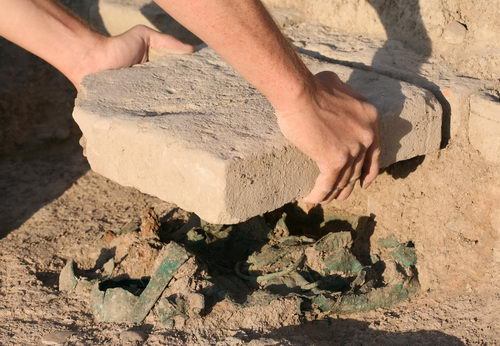
Bronze vessels under paving stones at Ziyaret Tepe in SE Turkey.

Bronze vessels under paving stones at Ziyaret Tepe in SE Turkey.

Why is this of interest to our readers? The Assyrians dominated the politics of the Middle East, including Israel and Judah, between 853 B.C. and 605 B.C. Numerous of the biblical kings had contact with the Assyrians. The Judean king at 630 B.C., the time of the cuneiform plea for help, was Josiah (2 Kings 22-23). Josiah was killed at Megiddo by Pharaoh Neco who was on his way to assist the Assyrians at Carchemish in 609 B.C. (2 Kings 23:28-30).

———–

HT: J. P. van de Giessen, Aantekeningen bij de Bijbel.

Video about Sodom

Dr. Steven Collins, Dean, College of Archaeology, Trinity Southwest University, has posted a short video on The Search for Sodom and Gomorrah at YouTube here. Collins is excavating Tall el-Hammam in the Jordan Valley (Transjordan) east of Jericho.

Numerous articles by Dr. Collins about the excavation at Tall el-Hammam have been posted at the Biblical Research Bulletin page.

Gary Byers of ABR has a good summary report on the excavation prior to the 2009 season here.

The Summer 2007 issue of Bible and Spade has an exchange between Dr. Collins and Dr. Bryant G. Wood. Wood holds that the location of Sodom should be on the southern end of the Dead Sea. Both articles are lavishly illustrated.

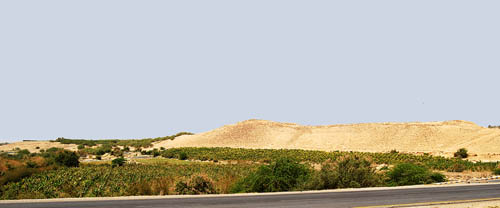
Tall el-Hammam in the Plains of Moab. View toward east. Photo by Ferrell Jenkins 2008.

Tall el-Hammam in Plains of Moab. View toward west. Photo by Ferrell Jenkins 2008.

Other scholars have suggest that Tall el-Hammam is the site of Abel-shittim (Numbers 33:49; Shittim, Numbers 25:1), in the plains of Moab. See Rainey and Notley, The Sacred Bridge, 125. The Israelite spies went out from here to view the land, especially Jericho (Joshua 2:1).

It is now common in Jordan for the old word Tell to be spelled Tall. You know that in Israel the word is Tel. Nothing like consistency.

HT: Dr. David E. Graves at Deus Artefacta.

Prof. Israel Finkelstein visits Khirbet Qeiyafa

Luke Chandler reports here, with photos, that Prof. Israel Finkelstein, Tel Aviv University, paid a visit to Khirbet Qeiyafa (the ElahFortress) on the last day of the dig. He has posted a couple of photos of Finkelstein with Prof. Yossi Garfinkel, director of the Khirbet Qeiyafa excavation.

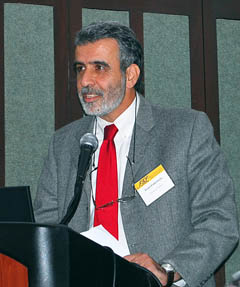
Prof. Finkelstein at the SBL Annual Meeting 2008. Photo by Ferrell Jenkins.

Prof. Finkelstein at the SBL Annual Meeting 2008. Photo by Ferrell Jenkins.

Luke describes Finkelstein as “a leading face of Biblical Minimalism.” He also comments on the evidence from Khirbet Qeiyafa:

The evidence there so far points to an organized, strong, Jerusalem-centered kingdom in the 10th century B.C. – the early Iron Age of David.

It is quite common for archaeologists to visit the excavations throughout the season. In this way they hear first hand from the director of the dig about what has been uncovered.