Author Archives: Ferrell Jenkins

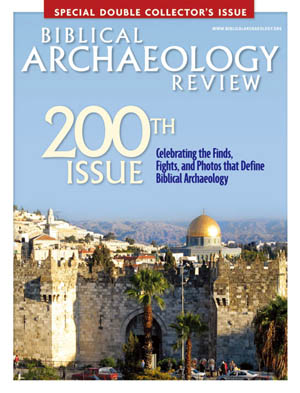
200th issue for Biblical Archaeology Review

bar_200_35040c100l-tYesterday I received the 200th issue of Biblical Archaeology Review. I have all issues of the magazine since that first small single color issue in March, 1975. When I bought the earlier issues in Libronix format for the computer I gave my paper copies to a young teacher.

Not everyone likes BAR. It has been a controversial magazine. No wonder. Editor Herschel Shanks has been controversial. But, I have enjoyed it all the way. I first met Herschel and his right hand gal, Suzanne Singer, at the ASOR meeting in New Orleans in 1979. I ate at the same round table with them, Prof. David Ussishkin, and Prof. William Sanford LaSor. Still, every time I see Herschel. I have to go through the introduction process.

Before BAR, unless we attended the annual meeting of the American Schools of Oriental Research, we had to depend on the reports in Biblical Archaeologist for popular articles on archaeology. My recollection is that the magazine was often late and the photography poor. Agree or disagree about Shanks and the magazine, one thing is for sure. It has made biblical archaeology a popular topic.

More information about this issue, with an opportunity to buy and subscribe, may be found at the magazine web site: Biblical Archaeology Review.

This special issue of BAR contains the following features:

  • A first personal article by Gabriel Barkay on “The Riches of Ketef Hinnom.” It was during this excavation that Iron Age tombs were found, one of which contained the tiny silver plaque with the oldest known text of a Bible reference.
  • Photos by the late photographer David Harris.
  • Ten top discoveries.
  • BAR’s Crusades, like the one to get the Dead Sea Scrolls published.
  • Letters we loved.
  • Much more.

In typical Shanks fashion, we are told that “The best is yet to come!”

Luke Chandler’s interview on The Book & the Spade

Over the past month we have called attention to Luke Chandler’s Blog while he was working as a volunteer at the Khirbet Qeiyafa excavation in Israel. Others have taken notice of his blog. Now Gordon Govier of The Book & the Spade radio program has interviewed Luke. There are two parts to the interview. Part one is already available on The Book & the Spade web site here. Part 2 will be available next week.

Luke’s report about the interview is here. Luke describes the interview:

The Book and Spade program is in its 26th year and has featured many well-known archaeologists and scholars, including Yossi Garfinkel (chief excavator of Khirbet Qeiyafa) who was interviewed on the program from Harvard last Fall. To put it in archaeological terms, I am not in the same stratum with these eminent scholars. I was invited to share my perspective as a volunteer excavator who participated in one of the hottest current digs.

The interview discussed a range of topics, from the experiences of a first-time excavator to the relevance of the site. It will be broadcast in two parts. Part 1 is freely available now, and for the duration of this week (August 11th and following). Part 2 of the interview will be broadcast next week.

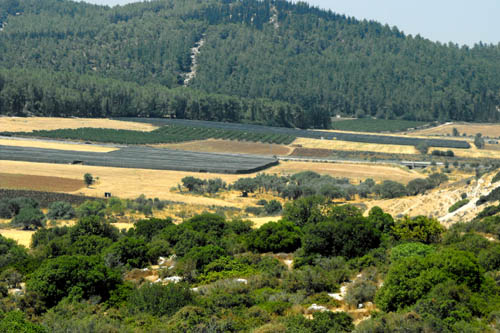
Luke has been kind enough to supply me with several photos during his time at Khirbet Qeifaya. The photo below was made from Khirbet Qeiyafa (the Elah Fortress). Notice the bridge in the extreme right of the photo. That bridge is build over the bed of the Brook of Elah. The brook is dry except during the rainy season.

Elah Valley from Khirbet Qeiyafa. Photo by Luke Chandler.

Elah Valley from Khirbet Qeiyafa. Photo by Luke Chandler.

For the background of this whole story read 1 Samuel 17.

Plea for help comes too late

The Times Online recently carried an article by Hannah Devli about a dig in southeastern Turkey under this headline: “Desperate plea for help came too late for ancient Assyrian leader.”

A letter scratched into a clay tablet reveals a desperate plea for reinforcements that came just too late. Alone, petrified and facing almost certain death, the ancient Assyrian leader Mannu-ki-Libbali scrawled a call for help to his commander, but his cry for extra troops came too late.

Soon after it was sent, the ancient city of Tushan was overrun by Babylonian invaders, its temples and palaces pillaged, then torn down or set aflame.

The letter, scratched into a clay tablet in 630BC, may never have reached its intended recipient. But more than 2,500 years later it has been unearthed almost intact by archaeologists, offering an unprecedented glimpse into the downfall of the one of the most powerful empires of the ancient world.
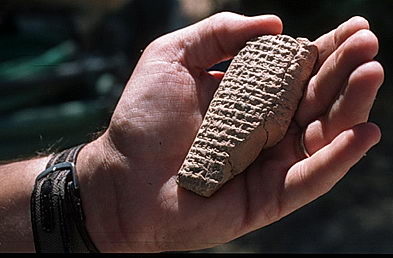
Assyrian tablet with plea of Mannu-ki-Libabli. Photo: Times Online.

Assyrian tablet with plea of Mannu-ki-Libabli. Photo: Times Online.

The archaeologists working at the site say that the author of the letter was a city treasurer who was responsible for building an army to defend the city of Tushan. The article continues…

John MacGinnis, an archaeologist from the University of Cambridge who led the excavation, said: “The letter is written during the process of downfall. The chances of finding something like this are unbelievably small.” Mannu-ki-Libbali laments that he has neither the equipment nor the troops needed for the onerous task ahead. He lists cohort commanders, craftsmen, coppersmiths, blacksmiths, bow makers and arrow makers as essential to building a resistance.

It is apparent that all of the above have already fled the city and that he has been left with a near-impossible task. “Nobody mentioned in this letter, not one of them is there!” he writes. “How can I command?”

He also lacked horses, containers, bandage boxes and chariots.

Expecting the imminent arrival of the Babylonians, armed with arrows, spears, boulders and battle rams, the letter ends with the despairing declaration: “Death will come out of it! No one will escape. I am done!”

Irving Finkel, a British Museum specialist in Assyrian history, said that the tablet captured an epic event. “It has almost a Hollywood quality, this sense of the enemy are coming. I can hear their hooves,” he said.

The Times Online article only mentions Cambridge archaeologist Dr. John MacGinnis as being involved in the dig. Checking on the web I discovered that this project has been carried out by teams from Akron University, Cambridge, Johannes Gutenberg University in Mainz, Marmara University in Istanbul, University of Helsinki, University of Copenhagen, University of Munich, and Sweet Briar College.

The site is known today as Ziyaret Tepe.

Here are some important links:

  • Johannes Gutenberg University (2008 report with photos). It appears that this university is no longer a participant.
  • Ziyaret Tepe website at the University of Akron. There we are told that Dr. Timothy Matney of Akron is the Project Director. This is a nice web site.
  • The Times Online full article is available here.

The cuneiform tablet is now in the Diyarbakir Museum. I had the opportunity to visit this small Museum in 2007.

This photo from the Johannes Gutenberg University shows the “discovery of a rare treasure trove of more than 20 bronze vessels under the paving stones in the courtyard.” Photo courtesy of the Ziyaret Tepe Archaeological Project. This discovery seems to have been in 2008.
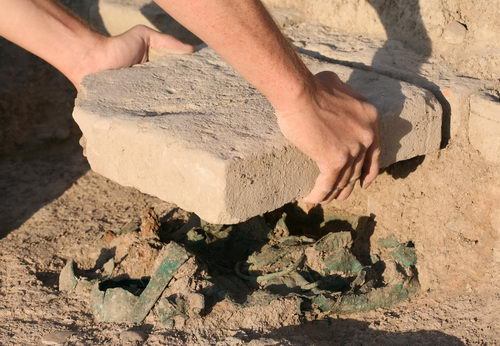
Bronze vessels under paving stones at Ziyaret Tepe in SE Turkey.

Bronze vessels under paving stones at Ziyaret Tepe in SE Turkey.

Why is this of interest to our readers? The Assyrians dominated the politics of the Middle East, including Israel and Judah, between 853 B.C. and 605 B.C. Numerous of the biblical kings had contact with the Assyrians. The Judean king at 630 B.C., the time of the cuneiform plea for help, was Josiah (2 Kings 22-23). Josiah was killed at Megiddo by Pharaoh Neco who was on his way to assist the Assyrians at Carchemish in 609 B.C. (2 Kings 23:28-30).

———–

HT: J. P. van de Giessen, Aantekeningen bij de Bijbel.

Video about Sodom

Dr. Steven Collins, Dean, College of Archaeology, Trinity Southwest University, has posted a short video on The Search for Sodom and Gomorrah at YouTube here. Collins is excavating Tall el-Hammam in the Jordan Valley (Transjordan) east of Jericho.

Numerous articles by Dr. Collins about the excavation at Tall el-Hammam have been posted at the Biblical Research Bulletin page.

Gary Byers of ABR has a good summary report on the excavation prior to the 2009 season here.

The Summer 2007 issue of Bible and Spade has an exchange between Dr. Collins and Dr. Bryant G. Wood. Wood holds that the location of Sodom should be on the southern end of the Dead Sea. Both articles are lavishly illustrated.

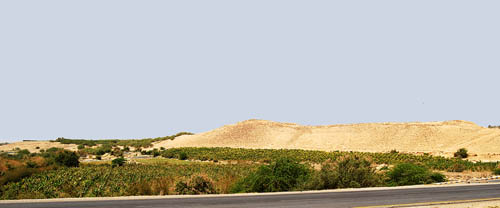
Tall el-Hammam in the Plains of Moab. View toward east. Photo by Ferrell Jenkins 2008.

Tall el-Hammam in Plains of Moab. View toward west. Photo by Ferrell Jenkins 2008.

Other scholars have suggest that Tall el-Hammam is the site of Abel-shittim (Numbers 33:49; Shittim, Numbers 25:1), in the plains of Moab. See Rainey and Notley, The Sacred Bridge, 125. The Israelite spies went out from here to view the land, especially Jericho (Joshua 2:1).

It is now common in Jordan for the old word Tell to be spelled Tall. You know that in Israel the word is Tel. Nothing like consistency.

HT: Dr. David E. Graves at Deus Artefacta.

Prof. Israel Finkelstein visits Khirbet Qeiyafa

Luke Chandler reports here, with photos, that Prof. Israel Finkelstein, Tel Aviv University, paid a visit to Khirbet Qeiyafa (the ElahFortress) on the last day of the dig. He has posted a couple of photos of Finkelstein with Prof. Yossi Garfinkel, director of the Khirbet Qeiyafa excavation.

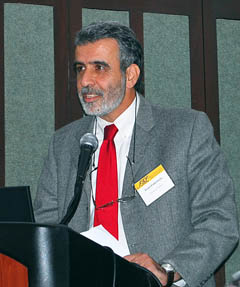
Prof. Finkelstein at the SBL Annual Meeting 2008. Photo by Ferrell Jenkins.

Prof. Finkelstein at the SBL Annual Meeting 2008. Photo by Ferrell Jenkins.

Luke describes Finkelstein as “a leading face of Biblical Minimalism.” He also comments on the evidence from Khirbet Qeiyafa:

The evidence there so far points to an organized, strong, Jerusalem-centered kingdom in the 10th century B.C. – the early Iron Age of David.

It is quite common for archaeologists to visit the excavations throughout the season. In this way they hear first hand from the director of the dig about what has been uncovered.

The last day at Khirbet Qeiyafa

Luke Chandler reports on the last full day of excavation at Khirbet Qeiyafa (the Elah Fortress) here. Several good photos are included with the post. Thanks to Luke for the reports and photos.

I call attention to these reports to give our readers who may not be aware an idea of the difficulty and slowness of an archaeological dig. Information is accumulated over many years. The archaeologists may have some conclusions at the end of the season, but they may change next year as new information comes to light.

Now we must await a full report by the director of the dig. There may be a press relase within the next month or two, but the next step is the presentation at the annual meetings of the American Schools of Oriental Research and the Society of Biblical Literature in November. Maybe a popular article or two will follow. In the background there may be lab studies, calling in of experts in various fields to look at artifacts, etc.

There will likely be more questions than answers. In the years to come other scholars will interact with the conclusion drawn by the excavator. Hopefully this will provide background for a better understanding of the story of David and Goliath (the Israelites and the Philistines).

World’s largest temple model

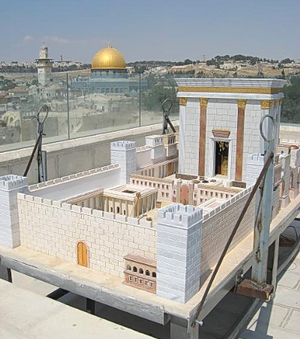
Arutz Sheva, Israel National News.com, reported the inauguration of the world’s largest model of the Second Temple (they mean Herod’s temple; not the one built by Zerubbabel in the days of the prophet Haggai).

The model, built at a scale of 1:60, was built by Michael Osanis for the Aish HaTorah Yeshiva in Jerusalem’s old city, and is displayed on the roof of its new museum, which at seven stories above the Western Wall plaza has a breathtaking view of the Temple Mount.

The photo of the model in place on the roof of Aish HaTorah’s new Exploration museum is impressive.

Largest temple model ignaurated August 5, 2009. Photo: Arutz Sheva.

Largest temple model inaugurated August 5, 2009. Photo: Arutz Sheva.

Read the full story here. There is a video showing the model being put into place.

Arutz Sheva reported July 30th on the building of the altar of the temple at Mitzpe Yericho. See article and photos here.

The Temple Institute has already built several of the Temple vessels such as the Ark and the menorah, and has now embarked on an ambitious project to build the altar, which will ultimately measure 3 meters wide by 3 meters long and 2 meters tall.

During Thursday’s ceremony, which took place in Mitzpe Yericho just east of Jerusalem, the Temple Institute laid the cornerstone for the altar and demonstrated how tar will be used to cement the stones together. The Institute plans on bringing the altar to its proper place on the Temple Mount when the Temple is rebuilt.

Mitzpe Yericho is in the wilderness of Judea near the Monastery of St. George.

There is some discussion between the Jews and Jesus about the building of Herod’s temple in the Gospel of John.

The Jews then said to Him, “What sign do You show us as your authority for doing these things?” Jesus answered them, “Destroy this temple, and in three days I will raise it up.” The Jews then said, “It took forty-six years to build this temple, and will You raise it up in three days?” But He was speaking of the temple of His body. So when He was raised from the dead, His disciples remembered that He said this; and they believed the Scripture and the word which Jesus had spoken. (John 2:18-22 NAU)

HT: Joseph I. Lauer.

Jerusalem excavation at BiblePlace Blog

Todd Bolen has posted three photos showing some current excavations in Jerusalem here. The one of the excavations in the Western Wall plaza is especially helpful.

A unique panorama from Tell es-Safi/Gath

Prof. Aren Maeir has posted a unique panoramic photo by Gal Avraham of Area A at Tell es-Safi/Gath. It appears to be made from at least 7 different photographs. See them here.

Reaching 200,000 hits

Overnight we registered our 200,000th hit on this blog. Our first post was May 2, 2007. Since that time we have covered two trips to Israel, two trips to Turkey, a trip to Greece and the Greek islands, a trip to Egypt, and a trip to Scotland. In addition we have reported on numerous archaeological developments and posted info on many biblical places and customs.

Actually we passed the 200,000 mark more than a week ago. Back in May we reported here on losing 3380 hits on our counter overnight.

Thanks should be extended to several people.

  • Thanks to WordPress for making this wonderful opportunity available at no cost. I would like to encourage everyone who thinks they have something worthwhile to say to get a blog and begin writing.
  • Thanks to our readers. The number has grown consistently in the past two years. We are delighted that you continue to check our blog. It has been fun to watch the increase of the traffic ranking at Alexa.
  • Thanks to everyone who has sent tips about items of interest that you think we should cover. Most of these come from acquaintances by email rather than as comments to the blog.
  • Thanks to Todd Bolen at blog.bibleplaces.com and BiblePlaces.com for his link to our page. Todd has called attention to this page several times and it has helped to increase the number of our readers.
  • Thanks to my wife for proofing many of the posts. I always appreciate her help.
  • Technological thanks to Nikon, Canon, and Adobe PhotoShop.

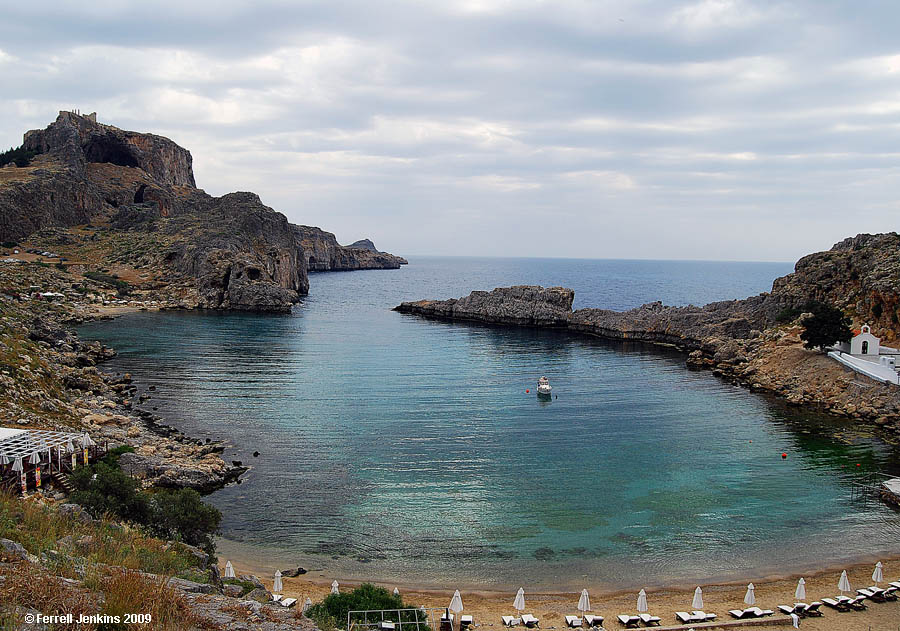
I would like to share a photo that is large enough to be of use to those who use visuals in teaching. This is a picture of St. Paul’s Bay on the island of Rhodes. Click on the photo for a larger image. For information about the place check our post for May 17, 2008.

St. Paul's Bay at Lindos, Rhodes. Photo by Ferrell Jenkins.

St. Paul's Bay at Lindos, Rhodes. Photo by Ferrell Jenkins.