Author Archives: Ferrell Jenkins

Sunday in Rome

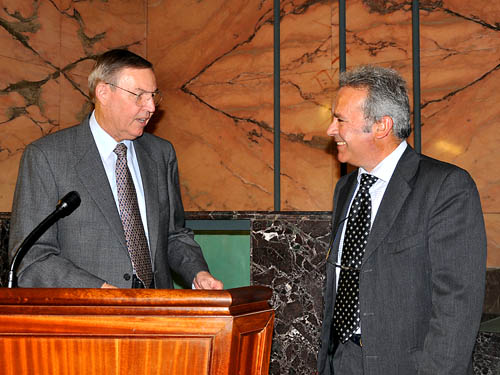
Sunday we worshipped with La Chiesa di Christo in Rome. This church was begun through the efforts of Sandro Corazza several decades ago. His son, Stefano, now serves the church as evangelist. Brother Sandro continues to spend his time in translating good biblical literature into Italian. At the invitation of the church I spoke yesterday and plan to speak again next Sunday. Stefano, one of my students about 30 years ago, translated for me. These men are doing a good work in a challenging area.

Ferrell Jenkins and Stefano Corazza visiting after the Sunday Sermon. Photo by C. West.

Ferrell Jenkins and Stefano Corazza visiting after the Sunday Sermon. Photo by C. West.

Our visit of the Colosseum and the Forum was marred by rain. It is difficult to complain about rain; it is such a blessing from the Lord. If you have ever tried to make photos in or after a rain I think you know what I mean. The Colosseum was built in A.D. 80 by the Emperor Titus. He used 10,000 of the slaves from Judea in this work. Titus was in charge of the Roman army when Jerusalem was burned in A.D. 70.

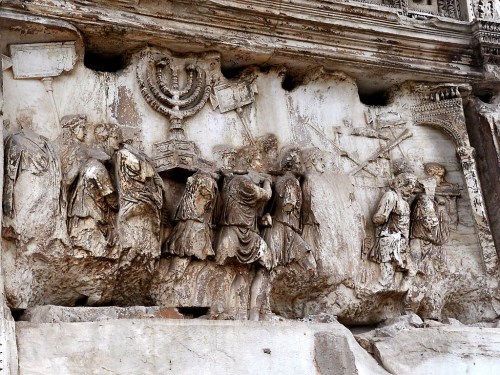
In the Forum there is an arch dedicated to Titus. The inside of the arch has two important reliefs. On one side we see the Roman soldiers taking away the seven-branched menorah, a table, and trumpets from the temple in Jerusalem. The other side shows a triumph scene. The Emperor rides in his chariot through the streets of Rome. Paul draws an analogy to this common scene in 2 Corinthians 2:14 and Colossians 2:15.

Rojman soldiers remove furniture from the temple. Arch of Titus. Photo by F. Jenkins.

Roman soldiers remove furniture from the temple. Arch of Titus. Photo by F. Jenkins.

Ready to go home

We had a good day in Rome, worshiping with brethren and friends at La Chiesa di Christo. In the afternoon we visited the Colosseum and the Roman Forum in the rain.

In the morning everyone leaves for the airport. Most of the group is returning to the USA. Elizabeth and I will be remaining in Italy, Malta, and Sicily for a week.

Hopefully we will post some more photos later, but now my 24 hour Internet fee is about to run out.

Vatican City and the Vatican Museum

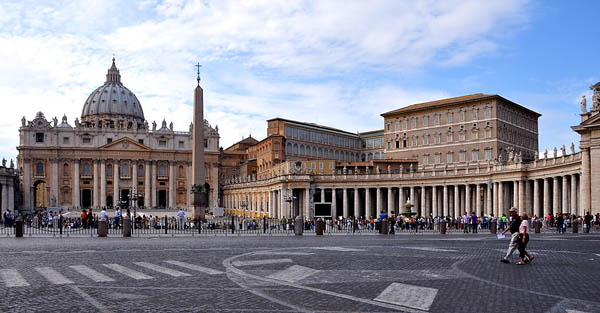
We had a busy day Saturday in Rome. In the morning we visited St. Peter’s Basilica in Vatican City. Vatican is an independent state within Italy. This is the largest church building in the world. Thousands of people visit it each day. There probably isn’t anyone who reads this blog who had not been here or seen photos or video of the building and its art treasures.

St. Peter's basilica in Vatican City. Photo by Ferrell Jenkins.

St. Peter's basilica in Vatican City. Photo by Ferrell Jenkins.

St. Peter’s is located on the site of Nero’s Circus. Nero’s persecution of Christians was in his circus, A.D. 64.  (Tacitus, Annales, XV, 44).

St. Peter’s was financed through the sale of indulgences in the 16th century. The reaction to this practice was an important factor in the Reformation Movement. Dr. Dan Petty explains a little about Martin Luther’s role.

Doctrinal Issues and Religious Authority. The immediate issue that prompted Martin Luther to post his 95 propositions for debate in 1517 was the abuse of the Roman Catholic system of indulgences. The doctrine of indulgences, first formulated in the thirteenth century, was associated with the sacrament of penance and the doctrine of purgatory. While the sacrament was believed to provide forgiveness of sin and eternal punishment, it was thought that there was a temporal satisfaction that the repentant sinner must fulfill in this life or in purgatory. The indulgence was a document that one could purchase for a sum of money that would free him from the temporal penalty of sin. The excess merits of Christ and the saints were believed to be stored up in a heavenly “treasury of merit” which the pope could draw from on behalf of the living.  In 1517 the Dominican Johann Tetzel was selling a special plenary indulgence (promising complete forgiveness of all sin) to raise money for the church. Half of the money was to be given to Archbishop Albert, to whom the pope had given a special dispensation to hold two offices. The rest would help finance the completion of Saint Peter’s cathedral in Rome. Luther’s protest initially was against what he saw as the abuse of the system of indulgence. It was also a challenge to the papal authority that made such abuses possible.

After the visit to St. Peter’s we went to the Vatican Museum. I broke away from the group to make some photos in the Roman section of the museum. Tremendous crowds visit this museum. I have been here several times since my first visit in 1967, and I have never seen the crowds worse than today.

In the afternoon the group went to the catacombs, I took leave to return to the hotel and continue work on my lesson for the Sunday service at La Chiesa di Christo, via Sannio 69 (Roma).

Learning the Bible in the Middle Ages

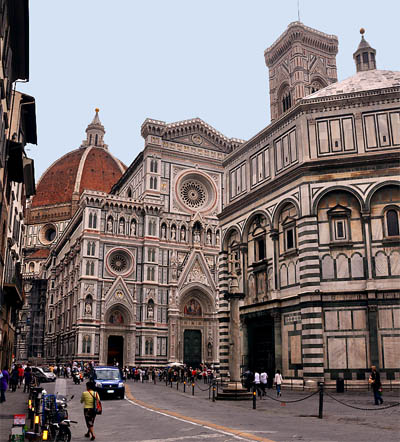
Duomo, Baptistery, and Campanile. Photo by Ferrell Jenkins.

The Cathedral (or Duomo) of Florence is of the Gothic style and dates to the 12th century A.D. The church, along with the baptistery, and the campanile (bell tower) have been designated a UNESCO World Heritage Site. The bronze baptistery doors, often designated as the Gates of Paradise, was designed by Lorenzo Ghiberti in the early 1400s. The gates we see today are reproductions.

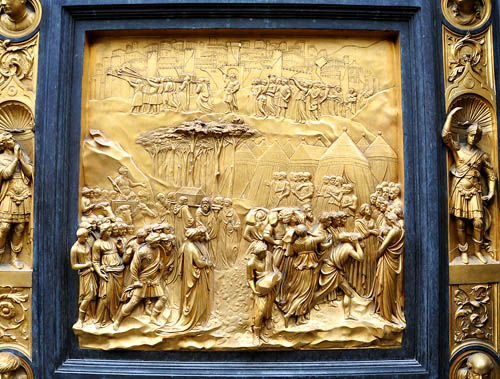
In the Middle Ages Bibles were not available to the common people. One of the ways the Bible was taught was through the stained glass windows, wood carvings, and cast works such as the doors of the baptistery. The panel in the photo below shows the Israelites crossing the Jordan, and the capture of Jericho (Joshua 3-6). Remember that for the Western World those were the Dark Ages.

Baptistery panel showing capture of Jeriocho. Photo by Ferrell Jenkins.

There is more that should be said about Florence, but we arrived in Rome last evening. Today and tomorrow will be filled with activity in Rome.

Be careful where you start a fire

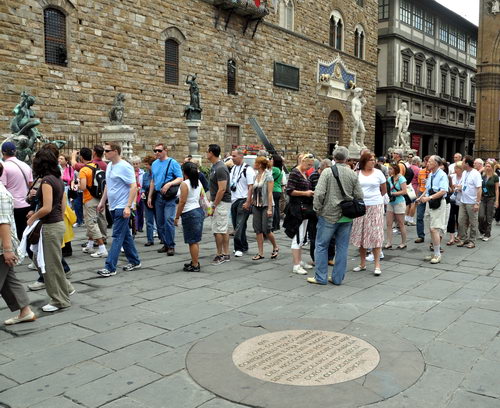
Piazza della Signoria in Florence with Savonarola marker showing. Photo by Ferrell Jenkins.

Piazza della Signoria in Florence with Savonarola marker showing. Photo by Ferrell Jenkins.

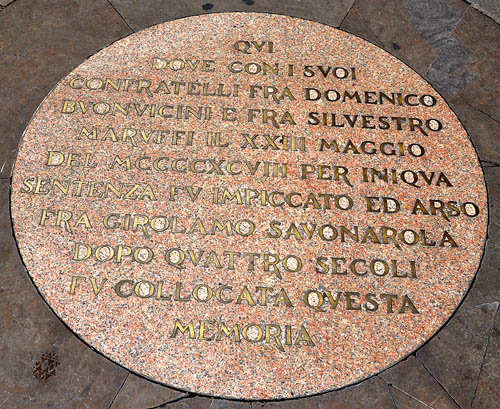
Yesterday morning I visited the Piazza della Signoria in Florence, Italy. I think many people walk through this Piazza to get to the Uffizi Gallery and never notice the plaque about Savonarola. Sometimes groups of people were standing on the plaque. When it was clear, one man walked up and said to his companions “Who’s that?” The group walked on without an answer.

Daniel M. Madden says,

In the lovely Piazza della Signoria, the political forum of Florence in all ages, Savonarola arranged a huge bonfire in 1497 so that penitents won over by his words could do away with their wigs, perfumes, lotions, powers and other accouterments of an easy way of life. He himself was burned to death in the same piazza a year later as a heretic. The spot where he died is marked with a plaque. It is not far from the copy of Michelangelo’s statue of “David.” (A Religious Guide to Europe)

One may say anything he wishes as long as he does not step on the toes of those in authority. Jesus faced this problem when He dealt with the Jewish leaders in Jerusalem.

“If we let him go on like this, everyone will believe in him, and the Romans will come and take away both our place and our nation.” (John 11:48 ESV)

Here is a closeup of the plaque marking the spot where Savonarola died.

Plaque marking spot where Savonarola died. Photo by Ferrell Jenkins.

Plaque marking spot where Savonarola died. Photo by Ferrell Jenkins.

The background of the Protestant Reformation

Dr. Dan Petty, chair of Biblical Studies at Florida College, gave me permission to post some of his information about the Reformation Movement on the blog. Dan has some other material on church history at Lessons on Line. The following section, without indentation, is by Dr. Petty.

-o-o-o-o-

The Protestant Reformation began in 1517, when Martin Luther posted his Ninety-five Theses in Wittenberg, Germany. The background of the movement is complex. The movement was conditioned by political, social, economic, moral and intellectual factors. But it was above all a religious movement led by men interested in a genuine reform of Christianity.

The Decline of Papal Power
The rise of national monarchies in the thirteenth through the fifteenth centuries came at the expense of the power of the papacy. This fact is illustrated by Pope Boniface VIII’s struggle with the king of France, which resulted in the pope’s humiliation and untimely death in 1303. The papacy was subsequently located in Avignon, France for an approximately seventy-year period known in history as the Avignon Papacy or the Babylonian Captivity of the Papacy (1303-77). During that time the papacy was dominated by the French monarchy. Efforts to restore the papacy to Rome at first only resulted in a division, known as the Great Schism. Rival popes claimed legitimacy until the situation was finally resolved in 1417.

Such scandalous affairs in the highest leadership of the Roman Catholic Church led to increasing corruption and a loss of confidence in the church. Many questioned the absolute authority claimed for the pope. Others increasingly called for a reform of the church in “head and members.”

Moral Corruption in the Leadership of the Church
The years leading up to the Protestant Reformation were also plagued by moral corruption and abuse of position in the Roman Catholic Church. The priesthood was guilty of several abuses of privilege and responsibility, including simony (using one’s wealth or influence to purchase an ecclesiastical office), pluralism (holding multiple offices simultaneously) and absenteeism (the failure to reside in the parish where they were supposed to minister). The practice of celibacy which was imposed by the church on  the priesthood was often abused or ignored, leading to immoral conduct on the part of the clergy. Secular-minded, ignorant priests corrupted their position by neglect or abuse of power.

During the fifteenth century the worldliness and corruption in the church reached its worst. The problem of corruption reached all the way to the papacy.

Among those who spoke out for a reform of the church was the Dominican Giralamo Savonarola (1452-1498) of Florence, Italy. This fiery preacher spoke out against the corrupt morals of the city’s leaders and the abuses of the papacy. The people were won over to Savonarola’s cause in Florence, but because of religious rivalries and political circumstances, the movement was short-lived. Savonarola was hanged and burned for heresy in 1498.

-o-o-o-o-

Here is a photo of the Piazza della Signoria in Florence, Italy. This is where Savonarola preached and died. In the next post we will show a photo of the plaque marking the place where Savonarola was martyred in 1498.
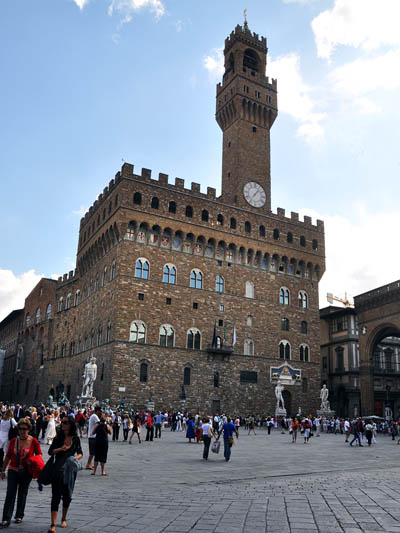
Piazza della Signoria in Florence, Italy. Photo by Ferrell Jenkins.

Piazza della Signoria in Florence, Italy. Photo by Ferrell Jenkins.
Our travel group in Florence, Italy

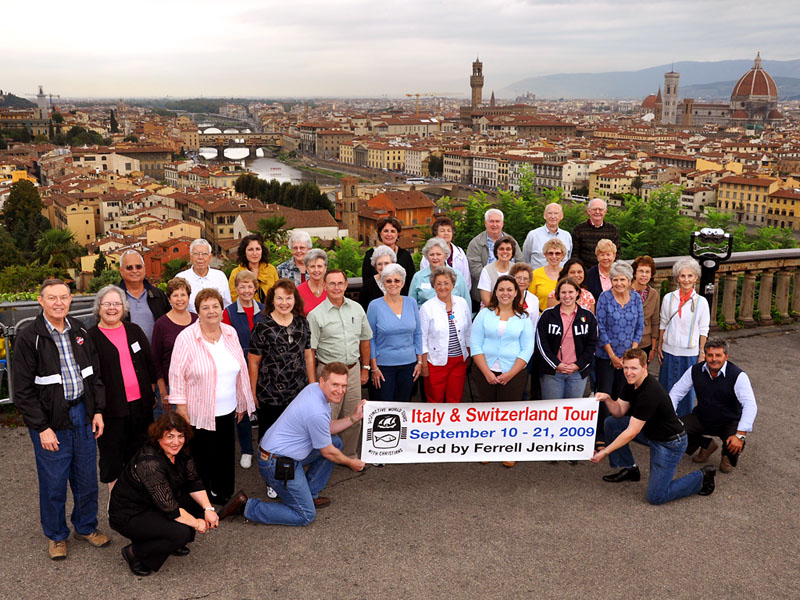
The rain cleared just as we arrived in Florence. Just in time to get a photo of the group from Piazza Michelangelo. This piazza is located on a hill on the south bank of the Arno River and provides a wonderful view of the center of Florence. From here one can see (from right to left) the Santa Croce Church, the Duomo, the tower at the Piazza della Signoria, and the Ponte Vecchio.

From the Middle Ages onward, Florence has been the center of Italian intellectual and artistic life. It was in Florence that Dante, Boccaccio and Petrarch wrote, and Michelangelo, da Vinci and many others worked. In addition to the art treasures, both in and out of the museums, Florence lends itself to leisurely strolling and relaxation.

group-florence-2009

If you know some of these nice folks, you may want to click on the photo for a larger image. All of the fun stuff, and lots of photos, is at Journeys With Jane.

Todd Bolen announces the Jerusalem CD

Todd Bolen has announced the publication of Jerusalem: Volume 2 of The American Colony and Eric Matson Collection. We mentioned this marvelous set of photographs earlier here. For more information on the current CD on Jerusalem click here

Venice and Mark

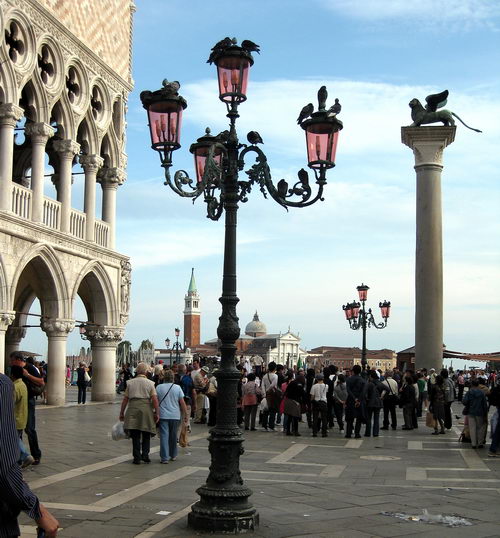
This view shows one corner of the Doge’s palace and the columns with the lion representing Mark the Evangelist. (Some of us would simply say Mark, the writer of the gospel that bears his name.) The buildings visible in the distance are across the Grand Canal.

Note the pigeons resting on the lamp post. There are now fewer pigeons in the Square than in the past because the city has quit feeding then.

Doges Palace and view from St. Mark's Square. Photo by Ferrell Jenkins.

Doges Palace and view from St. Mark's Square. Photo by Ferrell Jenkins.

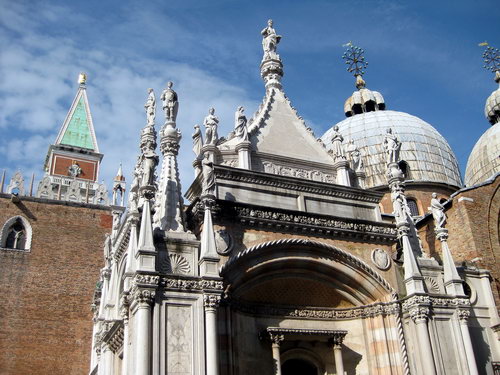
St. Mark’s Cathedral and Square is one of the best known tourist attractions in the world. The building is of the Byzantine style, but the liturgy is Roman Catholic. Madden explains how a Byzantine building happens to be in Italy.

The Byzantine style of St. Mark’s Cathedral bespeaks the maritime past of the Venetian republic, and its long range interests in the eastern Mediterranean, the Mare Nostrum of the Romans (A Religious Guide to Europe, 298).

Clock Tower and the Domes of St. Mark's. Photo by Ferrell Jenkins.

Clock Tower and the Domes of St. Mark's. Photo by Ferrell Jenkins.

It is alleged by some that the body (or relics) of St. Mark the Evangelist were brought to Venice in the 9th century B.C. by Venetian merchants.

Today we traveled from Venice to Florence. It rained most of that time. By the time we reached Florence we had some clearing. At the moment it is bright outside.

Everyone in the group is doing well.

Avoiding the Merchants of Venice

We had a full day in Venice. Our hotel is located on the mainland at Mestre, but we were in Venice about 12 hours. I hope to have a few photos to share later, but doubt I will get them uploaded tonight.

Everyone in the group spent the full day stepping from one island to another. I expect that everyone will sleep well tonight.

Just a few words from William Shakespeare:

The devil can cite Scripture for his purpose. (The Merchant of Venice, 1. 3)

The quality of mercy is not strained,
It droppeth as the gentle rain from heaven
Upon the place beneath. It is twice blest:
It blesseth him that gives and him that takes.
‘Tis mightiest in the mightiest: it becomes
The throned monarch better than his crown;
His sceptre shows the force of temporal power,
The attribute to awe and majesty,
Wherein doth sit the dread and fear of kings;
But mercy is above this sceptred sway,
It is enthroned in the hearts of kings,
It is an attribute to God himself;
And earthly power doth then show likest God’s,
When mercy seasons justice. Therefore, Jew,
Though justice be thy plea, consider this,
That in the course of justice none of us
Should see salvation: we do pray for mercy;
And that same prayer doth teach us all to render
The deeds of mercy. (The Merchant of Venice, 4. 1)