Author Archives: Ferrell Jenkins

Peter: “God raised him on the third day”

In the first gospel sermon preached to Gentiles at the house of Cornelius, Peter said,

39 And we are witnesses of all that he did both in the country of the Jews and in Jerusalem. They put him to death by hanging him on a tree,
40 but God raised him on the third day and made him to appear,
41 not to all the people but to us who had been chosen by God as witnesses, who ate and drank with him after he rose from the dead.
42 And he commanded us to preach to the people and to testify that he is the one appointed by God to be judge of the living and the dead.
43 To him all the prophets bear witness that everyone who believes in him receives forgiveness of sins through his name.” (Acts 10:39-43 ESV)

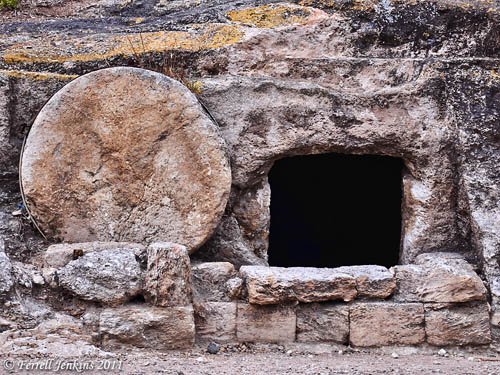
Last year we wrote about The Empty Tomb here, and used a photo of a tomb with a rolling stone. Our photo today is of the same tomb, but it is a different photo which we thought might be useful to those teaching on the resurrection of Christ. This tomb was uncovered during road work at the foot of Mount Carmel near the Jezreel Valley.

Tomb with rolling stone near Jezreel Valley in Israel. Photo by Ferrell Jenkins.

Roman period tomb with a rolling stone. Photo by Ferrell Jenkins.

A larger image, suitable for use in teaching presentations, is available by clicking on the photo above.

Pilate delivered Jesus to be crucified

About 1968 I was speaking in Lethbridge, Alberta (Canada), on Christian Evidences (or Apologetics). At the close of the lessons one of the attendees said, “I would believe, except for all of the contradictions in the Bible.” Already I had learned that “all of the contradictions” were too big for me to handle at one time. I said, “Name two.” He said, “There is no record of Pontius Pilate outside the New Testament.”

Pilate is mentioned no less than 56 times in the New Testament. Most of the references are in the Gospels (Matthew, Mark, Luke, and John). There are four references in Acts (3:13; 4:27; 13:28), and one in 1 Timothy 6:13.

I charge you in the presence of God, who gives life to all things, and of Christ Jesus, who testified the good confession before Pontius Pilate, (1 Timothy 6:13 NAU)

Except for Luke 3:1 and 13:1, the references in the Gospels are clustered in the final chapters of each book, the section dealing with the crucifixion of Jesus (Matthew 27; Mark 15; Luke 23; John 18-19).

I have no idea why one would think that having no external reference to a person named in the Bible would mean that the Bible was not true.

In fact, there are many literary references to Pilate outside the New Testament. A quick computer check shows at least 21 references to Pilate in Josephus (Antiquites and Jewish Wars).

Note this brief paragraph by Gary R. Habermas from The Historical Jesus: Ancient Evidence for the Life of Christ, page 221.

After suffering persecution (Gospel of Truth) and as a result of his teachings (Lucian), Jesus was put to death (Gospel of Thomas, Treatise on Resurrection). He died at the hands of Roman procurator Pontius Pilate (Tacitus), who crucified him (Josephus, Talmud, Lucian, Gospel of Truth, Acts of Pilate) during the reign of Emperor Tiberius (Tacitus, Phlegon).

And there is much more in Habermas’ book about Pilate, as well as in other secondary sources that point to the primary sources.

Pilate is well attested on Roman coins. Many coins were minted during the reign of Pontius Pilate as Prefect of Judea under the Roman Emperor Tiberius. Check Jean Philippi Fontanille’s Menorah Coin Project here. Scroll down to Pilate, click on one of the coin images and you will be able to spend as much time as you can afford in one day learning about the coins of Pilate. Fontanille is author of The Coins of Pontius Pilate (Marco Polo Monographs series)

I was able to say to the skeptic in Lethbridge that an inscription bearing the name of Pilate had been found at Caesarea Maritima in 1961. The photo below shows a replica of the inscription which was found in the excavation of the Roman theater. The original is in the Israel Museum. A large copy suitable for use in teaching presentations is available by clicking on the image.
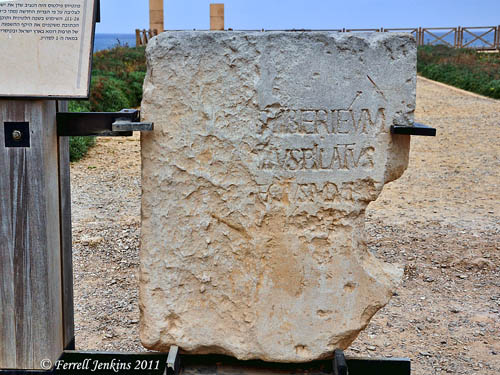
Pilate Inscription (Replica) at Caesarea Maritima. Photo by Ferrell Jenkins.

Pilate Inscription (Replica) at Caesarea Maritima. Photo by Ferrell Jenkins.

In an earlier post I mentioned that this inscription was found June 15, 1961. A reader who is doing research on Pilate asked about the specific date. As I began to look at various books dealing with archaeology, I noted that all I have looked at only mention the year 1961. In 1976 I self-published a book called The Book and the Land (now OP) primarily for use by persons joining my tours to the Bible Lands. Since that time I have thoroughly and continuously updated the material in connection with various tours. In those works, beginning in 1976, I cited The Israel Digest, a publication that I received for several years. I usually clipped the pages I was interested in and filed them. I spent several hours recently going through a multitude of folders without locating that particular page. However, I have had some success.
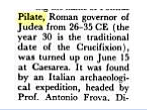
Israel Digest snippet mentioned Pilate Inscription.

Israel Digest, 1961.

A snippet view of a volume containing The Israel Digest for 1966 is available at Google Books here. Fortunately it contains a snippet showing the date that the Italian Expedition, headed by Prof. Antonio Frova, discovered the inscription. Click on the 1961 book and then search for Pilate. The digitized original is said to be from Indiana University.

Well, I know that most readers do not have this kind of curiosity, but I can’t avoid it. I like to know precisely where a writer or speaker got his info when he makes an unusual claim. We owe it to our readers and listeners.

Perhaps someday, if I live long enough, I will find the folder with the complete article.

Oh, and by the way, the guy in Lethbridge never mentioned the second “contradiction.”

The last week in the Gospel of John

If we consider the Gospel of John a sort of “Day Planner” for Jesus, we have nearly complete activity recorded for two weeks of the earthly ministry of Jesus. The first is in John 1:19—2:11 where activity for six of the seven days is recorded. I think the omitted day is the sabbath.

The next nearly complete week is the last week, leading up to the resurrection. John gives more attention to the last week than any other Gospel. Even here we have activities for only six of eight days. This section begins in John 12:1 and continues into John 20. Here is the way I have reconstructed it. Where John does not record the activity I have omitted the scripture reference.

  • Sunday — The King enters Jerusalem — 12:12-19
  • Monday — Cleansing the Temple —
  • Tuesday — Visit of the Greeks — 12:20-36
  • Tuesday — Jewish rejection — 12:37-50
  • Wednesday — No events recorded in the Gospels
  • Thursday Evening — Passover Meal, including Washing Disciples Feet (only in John) — 13:1-38
  • Thur. Eve — Farewell discourses — 14—16
  • Thur. Eve — Prayer — 17
  • Thur. Eve — Annas (only in John) — 18:12-14
  • Thur. Eve — Caiaphas — 18:24-28
  • Friday — Pilate — 18:28—19:16
  • Friday — Crucifixion — 19:16-42
  • Sabbath —
  • First Day — Resurrection — 20

It should be noted that the appearance before Annas and Caiaphas were the Jewish (Religious) trials. The appearance before Pilate [and Herod Antipas] were the Roman (Civil) trials.

John does not record the pronouncement of woes on the religious leaders, the institution of the Lord’s Supper, and the account of the agony in the Garden of Gethsemane.

With this sparse attention given to two weeks, no wonder John says,

Now there are also many other things that Jesus did. Were every one of them to be written, I suppose that the world itself could not contain the books that would be written. (John 21:25 ESV)

There is a medieval wood carving of the last week of Jesus in Notre Dame (Paris). In this photo you see the representation of the last supper, the washing of the disciples’ feet, and the agony in Gethsemane. (Sorry, this was made nearly a decade ago and I don’t have a hi-res photo.)

Wood carving of Last Week of Jesus in Notre Dame. Photo by Ferrell Jenkins.

Wood carving of Last Week of Jesus in Notre Dame. Photo by Ferrell Jenkins.

Jesus visited Bethany often

The crowds of pilgrims who had come to Jerusalem for Passover overloaded the system. Many of them likely slept in the open on the Mount of Olives and other places near the city. On Monday evening,

And he entered Jerusalem and went into the temple. And when he had looked around at everything, as it was already late, he went out to Bethany with the twelve. (Mark 11:11 ESV)

Luke tells us that it was His custom to do so.

And he came out and went, as was his custom, to the Mount of Olives, and the disciples followed him. (Luke 22:39 ESV)

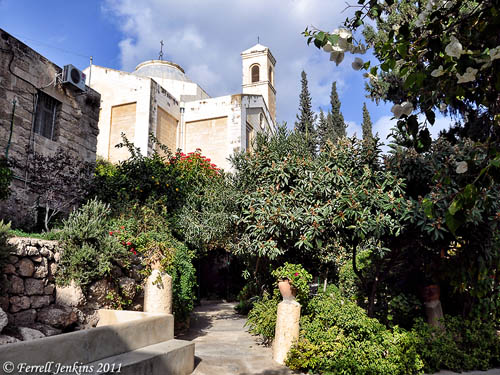
Bethany, the village of Mary, Martha and Lazarus (John 11:1), was located on the eastern slope of the Mount of Olives about two miles from Jerusalem (John 11:1, 18). The photo below shows the Church of St. Lazarus at Bethany. The walk from the main street goes through a pleasant garden. This was the Jerusalem-Jericho road before the building of the tunnel and the new highway.

Church at Bethany. Photo by Ferrell Jenkins.

Church at Bethany on eastern slope of Mount of Olives. Photo by Ferrell Jenkins.

Here on the eastern slope of Olivet we find the traditional tomb of Lazarus. In the time of Jesus the mountain was likely filled with olive trees.  Jerusalem may be seen only after one reaches the crest of the mountain.

Jesus also visited in the home of Simon the leper at Bethany, where a woman anointed his head with oil as He reclined at the table (Matthew 26:6-7).

Tradition places the ascension of Jesus on the top of the Mount of Olives, but Luke says it took place at Bethany (Luke 24:50-51).

Roman chariot races at Jerash

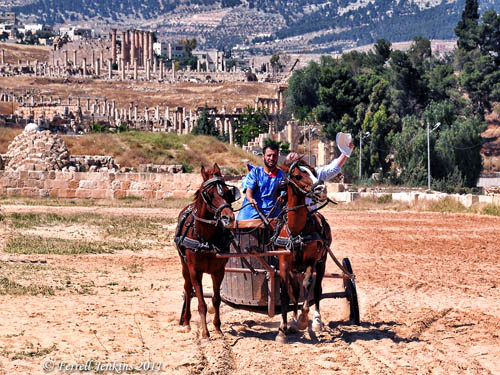
Several times in the past we have called attention to the RACE show at Jerash, Jordan. RACE stands for Roman Army Chariot Experience. The show is conducted in the Roman hippodrome at Jerash, one of the cities of the Decapolis in the time of Jesus.

Large crowds followed Him from Galilee, Decapolis, Jerusalem, Judea, and beyond the Jordan. (Matthew 4:25 CSB)

BBC News has posted a short video about the Roman chariot races and the Roman Army show. Click here to view.

Our photo shows one of the tourists being taken for a wild ride after the show. It appears he may have lost his hair during the ride. Note the background of the ruins of Roman Jerash and the mountains of biblical Gilead.

Chariot Race in the Roman Hippodrome at Jerash. Photo by Ferrell Jenkins.

Chariot Race in the Roman Hippodrome at Jerash. Photo by Ferrell Jenkins.

Click on the photo for a larger image.

HT: Bible Places Blog.

Early morning view across the Sea of Galilee

The photo below shows an early morning scene across the Sea of Galilee from Tiberias. Perhaps we should say across “the Sea of Tiberias” as John does.

After these things Jesus went away to the other side of the Sea of Galilee (or Tiberias). (John 6:1 NAU)

After these things Jesus manifested Himself again to the disciples at the Sea of Tiberias, and He manifested Himself in this way. (John 21:1 NAU)

The view is from the Caesar hotel in Tiberias across the roof tops of some of the older buildings of Tiberias to the north east. The northern shore is clearly visible, as well as the area of biblical Bashan and of the Geshurites to the east (Joshua 12:5; 13:11).

NE view across the Sea of Galilee from Tiberias. Photo by Ferrell Jenkins.

NE view across the Sea of Galilee from Tiberias. Photo by Ferrell Jenkins.

The photo was made January 30, 2011, a time when the heavy clouds might be expected. Notice the shallow water in the lower right corner of the photo.

The joy of hidden treasures

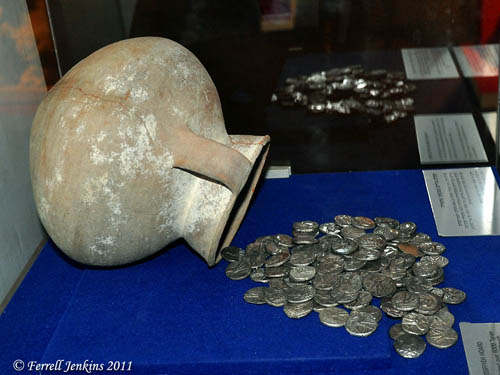
It doesn’t happen every day, but hoards of coins are sometimes found in archaeological excavations and other places by chance. The photo below shows a small portion of the Ussfiyeh Hoard of coins now displayed in the Erezt Israel Museum, Tel Aviv University, Israel. I think Ussfiyeh is a Druze town on Mount Carmel, but I have found nothing else about the site. If a reader knows more, please share.

Ussfiyeh Hoard of Tyrian Shekels & Other Coins. Eretz Israel Museum.

Ussfiyeh Hoard of Tyrian Shekels & Other Coins. Eretz Israel Museum.

The information sign with the display reads as follows:

The Ussfiyeh hoard originally contained 6000 Tyrian shekels, half-shekels and Augustaean denarii. Although Temple shekels bore pagan designs, they were accepted as Temple taxes in Jerusalem. The hoard probably represents a delivery of Temple tax intercepted and hidden away due to the events of the Jewish War which broke out in 66 C.E.

Jesus used an illustration related to a treasure found in a field.

The kingdom of heaven is like treasure hidden in a field, which a man found and covered up. Then in his joy he goes and sells all that he has and buys that field. (Matthew 13:44 ESV)

Click on the photo for a larger image suitable for use in teaching.

The mosaics of the Antakya Museum

Yesterday’s post about Antakya, Turkey (biblical Antioch of Syria, Acts 11), was highly popular. We had more than 1400 hits. Thanks for your interest. We hope you will find other entries of interest as well.

Take a look at the two good comments on the previous post. One from Balagebalogh calls attention to the mosaics from Antakya that are in the Baltimore Museum of Art and to his illustration of Antioch, and another from TBrinley calling attention to the mosaics in the Antakya Museum. I haven’t had the opportunity to visit the Baltimore museum, but I have been to the Antakya Museum a few times.

I thought I would share just one of the many mosaics displayed in the Antakya Museum. These mosaics typically date to the fourth or fifth century as I recall. (I am away from home and do not have access to my usual sources.)

Our photo shows a beautifully preserved mosaic displayed on a large wall. I am taking the liberty of copying info about it from Sacred Destinations, a site we have recommended before. Regarding this mosaic the site says,

Detail of mosaic from the floor of the 5th-century Bath of Apolausis, a small suburban bath uncovered in the Antioch excavations on the slopes of Mount Silpios, east of the city. The woman depicted in the middle is Soteria (Salvation) who formed a pair with Apolausis (Enjoyment). Soteria and Apolausis were minor deities who had the power to deliver people from danger and were popularly associated in late antiquity with baths, whose warm waters could give pleasure and soothe pain. Antakya Museum.

Antakya Museum mosaic displayed on wall. Photo by Ferrell Jenkins.

Antakya Museum mosaic displayed on wall. Photo by Ferrell Jenkins.

Beautiful, isn’t it? Turkey is filled with similar mosaics. I recall especially those from Zeugma displayed in the Gaziantep Museum.

Antioch of Syria, or is that Turkey?

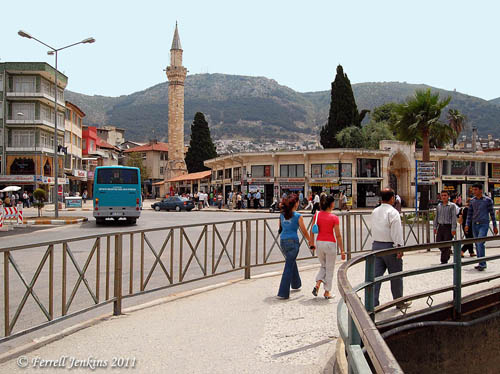
Antioch of Syria on the Orontes River was founded by Seleucus I Nicator in 300 B.C. Antioch became a Roman city in 64 B.C. and capital of the new province of Syria. It became the third largest city of the Roman Empire after Rome and Alexandria.

After Jerusalem, Antioch was the second great center of Christianity in New Testament times and where the disciples of Christ were first called Christians (Acts 11:19-30; 13:1-3; 14:26-28; 15:1-41; 18:22-23; Gal. 2).

Antioch is now called Antakya and is part of the HatayProvince of Turkey, but is near the border with Syria. The area became part of Turkey in 1939.

The photo below was made from the bridge crossing the Orontes River with a view east toward Mount Silipius. Click on the photo for an image suitable for use in presentations.

Antakya, Turkey. Antioch of Syria of the New Testament. Photo by Ferrell Jenkins.

View east toward Mount Silpius from the Orontes River. Photo by Ferrell Jenkins.

A church called the Cave Church of St. Peter honors Peter’s visit to the city (Gal. 2). This is a late Roman Catholic addition to the city, having become a Catholic church in 1946. Not the best choice, I think. Peter’s association with Antioch did not turn out too well. At first he ate with the new Gentile converts, but under pressure from James of Jerusalem played the hypocrite and withdrew from the Gentiles.

But when Cephas came to Antioch, I opposed him to his face, because he stood condemned. For before certain men came from James, he was eating with the Gentiles; but when they came he drew back and separated himself, fearing the circumcision party. And the rest of the Jews acted hypocritically along with him, so that even Barnabas was led astray by their hypocrisy. (Galatians 2:11-13 ESV)

I suggest you read Galatians 1 and 2, for a more complete account of this event.

From here the great journeys of Paul to take the Gospel to the Gentile world began (Acts 13:1-2).

Homemade in the Golan Heights

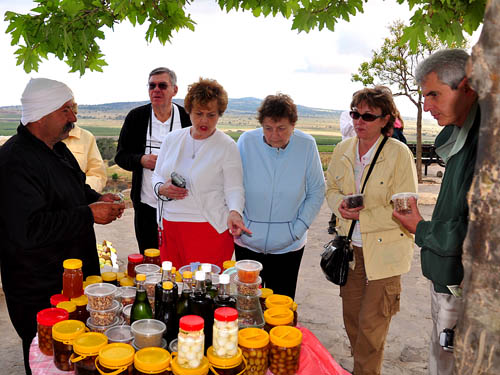
Today I am traveling, but I thought I would share a photo that illustrates one of the educational and sometimes fun things about travel in cultures other than our own. This Arab peddler has set up his table in the Golan Heights at the overlook from Israel into Kuneitra (Quneitra), Syria.

He seems to have a nice variety of the local goodies: olives, olive oil, nuts, and various fruits. Are those pickled eggs? He has already made two sales and it appears he is about to make a third. It can be really chilly in the Golan Heights, even in early May. Some of the potential customers would probably more quickly buy a sweat shirt.

Peddling homemade goodies in the Golan Heights. Photo by Ferrell Jenkins.

Peddling homemade goodies in the Golan Heights. Photo by Ferrell Jenkins.