
The dome of the Holy Sepulcher (Sepulchre) is easily recognizable to all visitors of the Old City of Jerusalem. It is the larger of two gray domes seen in the photo below. The smaller dome marks the traditional site of Calvary, the place where Jesus was crucified. The Church of the Holy Sepulcher was built by the Roman Emperor Constantine after his mother Helena visited Jerusalem. Murphy-O’Connor dates the dedication of the building to September 17, 335.
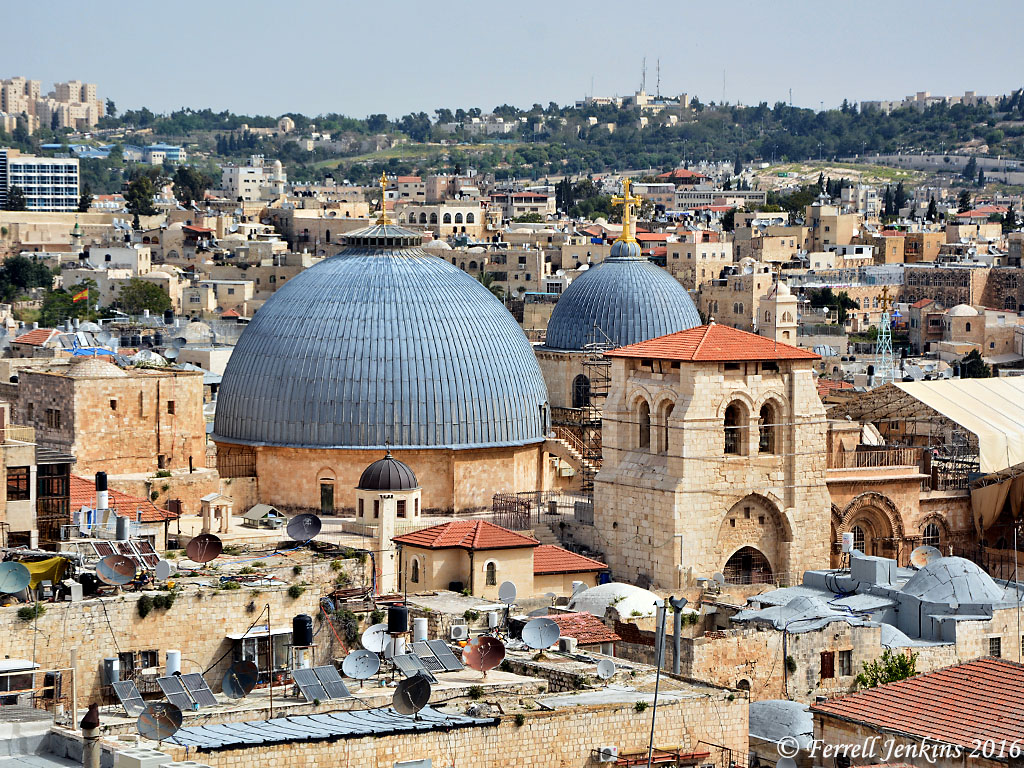
The gray domes of the Holy Sepulcher (left) and the site of Calvary (right) from the roof of the Citadel. Photo by Ferrell Jenkins.
An edicule or small building within the church is said to cover the tomb in which Jesus was laid after the crucifixion, that is, the tomb of Joseph of Arimathea (Matthew 27:57-60). The photo below shows some of the metal used to secure the structure in recent years.
For years it was known that the structure needed to be repaired. Finally, someone donated $1.3 million dollars to be sure the work could begin. Widespread reports indicate the work in now underway to remove the structure and then replace it.

The Edicule of the Holy Sepulcher. Photo by Ferrell Jenkins.
At this time the original tomb is covered by stone. The Franciscan Museum in the Old City of Jerusalem has a model to show what the original tomb looked like.

Cross section model of the tomb at the Holy Sepulchre in the Franciscan Museum, Jerusalem. Photo by Ferrell Jenkins.
Jerome Murphy-O’Connor asks the question, “Is this the place where Christ died and was buried?” He answers, “Yes, very probably.”
But Murphy-O’Connor also describes vividly the situation one finds today.
One expects the central shrine of Christendom to stand out in majestic isolation, but anonymous buildings cling to it like barnacles. One looks for numinous light, but it is dark and cramped. One hopes for peace, but the ear is assailed by a cacophony of warring chants. One desires holiness, only to encounter a jealous possessiveness: the six groups of occupants—Latin Catholics, Greek Orthodox, Armenian Orthodox, Syrians, Copts, Ethiopians—watch one another suspiciously for any infringement of rights. The frailty of humanity is nowhere more apparent than here; it epitomizes the human condition. The empty who come to be filled will leave desolate, those who permit the church to question them may begin to understand why hundreds of thousands thought it worthwhile to risk death or slavery in order to pray here. (The Holy Land, 5th Ed., p. 49).
Whether most of us will ever see the remains of the actual tomb is unknown. Our faith in the resurrected Christ does not depend on the actual tomb in which He was placed after being taken down from the cross. It depends rather on the testimony of those reliable witnesses who saw Him after the resurrection. Luke reports that eyewitness testimony (Luke 1:1-4). Here is what he says the women who went to the tomb on the first day of the week were told when they found the empty tomb.
He is not here, but has risen. Remember how he told you, while he was still in Galilee, that the Son of Man must be delivered into the hands of sinful men and be crucified and on the third day rise.” (Lukw 24:6-7 ESV)
When Todd Bolen reported (here) the plans to dismantle and rebuilt the shrine he said,
Maybe one of these days they’ll get around to moving the ladder.
This ladder is said by some to have been leaning against the facade above the entry to the church since the 18th century because the various religious groups can not agree who should remove it. The ladder has become a symbol of division. An interesting article about the Immovable Ladder may be found in Wikipedia here.

The immovable ladder above the entrance to the church of the Holy Sepulcher. Photo by Ferrell Jenkins.
 Ferrell's Travel Blog
You must be logged in to post a comment.