
Evil-merodach came to power in Babylon upon the death of his father Nebuchadnezzar in 562 B.C. There are only two references to him in the Bible, and these are parallel accounts. Evidence suggests that Jehoiachin (Jeconiah, Coniah), the king of Judah who was taken to Babylon in 597 B.C., was treated like a king in exile during most, or all, of his time in Babylon. The kindness of Evil-merodach receives special attention.
27 And in the thirty-seventh year of the exile of Jehoiachin king of Judah, in the twelfth month, on the twenty-seventh day of the month, Evil-merodach king of Babylon, in the year that he began to reign, graciously freed Jehoiachin king of Judah from prison. 28 And he spoke kindly to him and gave him a seat above the seats of the kings who were with him in Babylon. 29 So Jehoiachin put off his prison garments. And every day of his life he dined regularly at the king’s table, 30 and for his allowance, a regular allowance was given him by the king, according to his daily needs, as long as he lived. (2 Kings 25:27-30 ESV; cf. Jeremiah 52:31-34)
It is interesting that we have a biblical record mentioning Evil-merodach’s treatment of Jehoiachin (about 560 B.C.), and we have archaeological evidence of similar treatment at an earlier period. Four tablets mentioning Jehoiachin and his sons date to the period 595–570 B.C.
These tablets record rations that were given to the exiled king, his sons, and eight men of Judah. The one shown here is usually displayed in the Museum of the Ancient Near East (Vorderasiatische Museum), also called the Pergamon Museum, in Berlin (VAT 16378).
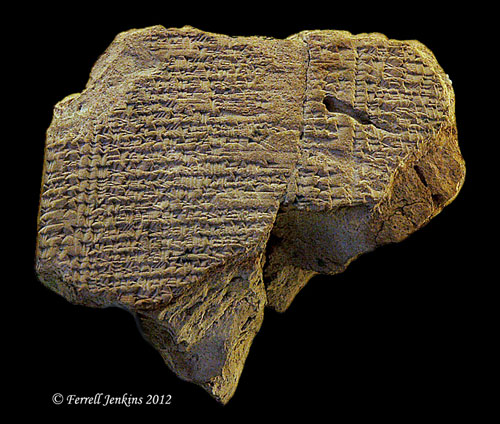
Babylonian ration tablet naming Jeconiah. Pergamum Museum. Photo by Ferrell Jenkins.
A trip to Berlin is worthwhile for many reasons, but one of the best is to visit the Museum of the Ancient East. Even though it could stand some revisions, you should find my Biblically Related Artifacts in the Museums of Berlin helpful. It is available in PDF here.
Here is what I wrote about this tablet:
“Jehoiachin (Jeconiah, Coniah) was the young king of Judah who was taken captive to Babylon by Nebuchadnezzar in 597 BC. (2 Kings 24:15). The date of the capture of Jerusalem (March 16, 597 BC) was learned in 1955 when Donald J. Wiseman, then of the British Museum, read a cuneiform tablet from Babylon. About 300 cuneiform tablets, dating between 595 and 570 BC, were found near the Ishtar Gate in Babylon. They contain lists of rations such as barley and oil paid to the captives and craftsmen. Persons from various countries are mentioned: Egypt, Philistia, Phoenicia, Asia Minor, Judah, etc. Some Biblical names are included: Gaddiel, Semachiah, and Shelemiah (a name mentioned prominently in Jeremiah 36-37). The most interesting name is Yaukin, king of the land of Yahud (Judah), along with five royal princes. The name, pronounced Yow-keen, is known to be an abbreviation for Jehoiachin. One document in which his name occurs is dated to 592 BC. These tablets show that the Babylonians continued to regard Jehoiachin as the legitimate king of Judah and gave him special treatment while he was in captivity (2 Kings 25:27-30; Jeremiah 52:31-34). The tablets were read by E. F. Weidner in the basement of the Kaiser Friedrich Museum, Berlin, after 1933.
[For those with access to this type of material:] Some Sources: Albright, BA 5 (1942), 49-55; ANET, 308 for translation; DOTT, 84-86; JFLAP, 225-227; IDB, II:811-13; Werner Keller, The Bible as History, 285-287; Wiseman, Illustrations from Biblical Archaeology, 73 for photo [showing both the reverse and the obverse of the photo above].”
More Recent Source: Fant, Clyde E. and Mitchell G. Reddish, Lost Treasures of the Bible, 217-220.
 Ferrell's Travel Blog
Pingback: Top Ten Discoveries Related to the Book of Jeremiah – Bible Archaeology Report
Dr. James Voelz in one of his hermeneutics classes stated that during a doctrinal review committee while reading an old testament survey book, it said: 2nd Kings does not end with the destruction of Jerusalem. The reader returns to Babylon, where Jehoiachin was being held captive. The narrative explains that Jehoiachin was released from prison and was allowed to life out his life in comfort. Clearly this ending demonstrates, that despite the horrors of Jerusalem’s fall, God’s presence remained with His people.
We question why Jehoiachin was treated fairly? Scripture states from Abraham, to Isaac, to Jacob, that in Genesis 46:4 “I myself will go down with you to Egypt, and I will also bring you up again, and Joseph’s hand shall close your eyes.” Romans 5:6 says all we need to hear, “Christ died for the ungodly.”
We fail to understand the levels in reading God’s Words are beyond our comprehension and understanding. Isaiah 55:8 is a good reminder. We deserve nothing, yet receive (given too as Dr. Nagel would say in his classes) everything Christ has inherited on our behalf. He cannot deny Himself, He is Almighty!
Pingback: King Jehoiachin: An Archaeological Biography – Bible Archaeology Report
Pingback: Three Babylonian Inscriptions About the Exile – Bible Archaeology Report
Pingback: Evil-merodach (562-560) graciously freed Jehoiachin | Daniel Man of Visions and Dreams
What I don’t understand is why if Evil-Merodach was assassinated at 2 years that the King Jehoiachin wasn’t also. The end of 2Kings seems to contradict his shortened life for some reason. After all Josephus says this Babylonian king reigned for 18 years and he had access to the records in Jerusalem the same as Luke and Matthew had. Oddly he was also a source for Berosus when all the sources were developed. Hmmm.
my two cents.
P C
I was curious as to why Jehoiachin received such favorable treatment…was it a cultural tradition of the Babylonians? It’s hard for me to understand that the Babylonians would intentionally carry Seraiah the high priest, Zephaniah the priest of the second rank, etc. all the way to Riblah in the land of Hamath to execute them, but treat Jehoiachin with kindness. Not doubting, just wondering what their rationale was for that behavior 🙂
Pingback: Isaiah 13: jackals & hyenas in the palaces of Babylon | Ferrell's Travel Blog
Pingback: Evil-merodach (562-560) graciously freed Jehoiachin | Daniel Herald of the Apocalypse
Pingback: Evil-merodach (562-560) graciously freed Jehoiachin | Jeremiah The Prophet Of God
Thank you for the interesting information. I’ve just read from my daily reading this passage from 2 Kings 25.
Pingback: The big three: Nabonidus, Belshazzar and Daniel | Ferrell's Travel Blog