
Monthly Archives: December 2011

Plan to sacrifice to Paul and Barnabas at Lystra

It is often been pointed out that the common designation of The Acts of the Apostles is a bit of an overstatement. Primarily the book of Acts is the story of some of the acts of the apostles Peter and Paul. Luke seems to be telling us that Paul is every bit as genuine an apostle as Peter. Peter can heal a man lame from his mother’s womb (Acts 3:2). So can Paul (Acts 14:8-10).

When the Lystrans saw the healing of the lame man they began to call Barnabas, Zeus, and Paul, Hermes. Luke’s account says that the priest of Zeus prepared to offer sacrifices with the crowds.

13 The priest of Zeus, whose temple was just outside the city, brought oxen and garlands to the gates, and wanted to offer sacrifice with the crowds. 14 But when the apostles Barnabas and Paul heard of it, they tore their robes and rushed out into the crowd, crying out (Acts 14:13-14 NAU)

The photo below provides a good illustration of what happened at Lystra. It is an architectural relief fragment showing preparation for a sacrifice. The large marble fragment belongs to the early part of the second century. It comes from Rome, but is now displayed in the Louvre.

The bull is being brought for sacrifice. It is thought that this represents only part of the original scene. A panel to the right should show the priest and the altar. Perhaps the laurel wreaths worn by the two characters on the left indicates the departure or return of the Roman emperor.

Roman architectural relief shows preparation for sacrifice. Louvre. Photo by Ferrell Jenkins.

Roman relief shows preparation for sacrifice. Louvre. Photo by Ferrell Jenkins.

The motif on this altar is common in the Greco-Roman world. The photo below shows a similar bull’s head on what appears to be part of an architectural frieze in the Augustan Imperial Sanctuary at Pisidian Antioch.
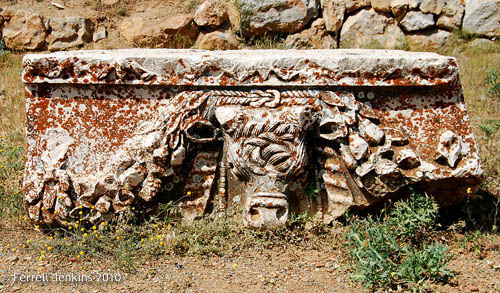
Frieze from the Augustan Imperial sanctuary at Pisidian Antioch. Photo by F. Jenkins.
Frieze from the Augustan Imperial sanctuary at Pisidian Antioch. Photo by F. Jenkins.

Lystra — Barnabas is Zeus and Paul is Hermes

G. Walter Hansen comments on the religious life of Galatia and the importance of Zeus and Hermes to the people who lived there.

Zeus was the most widely worshipped god in Galatia; temples to Zeus were ubiquitous. Zeus was often linked with other gods. In the territory of Lystra there are carvings and inscriptions which show Zeus accompanied by Hermes. An inscription found near Lake Sugla is a dedication to Zeus of a sundial and a statue of Hermes. The names of the dedicators are Lycaonian. A stone altar near Lystra is dedicated to “the Hearer of Prayer [presumably Zeus] and Hermes.” A relief near Lystra depicts Hermes with the eagle of Zeus. In Lystra a stone carving shows Hermes with two other gods, G and Zeus. (Gill and Gempf, The Book of Acts in its First Century Setting, Vol. 2: Graeco-Roman Setting, 393)

This evidence, says Hansen, provides the setting for the events of Paul and Barnabas at Lystra. Luke describes the reaction of the Lystrans when they saw Paul heal a lame man.

When the crowds saw what Paul had done, they raised their voice, saying in the Lycaonian language, “The gods have become like men and have come down to us.”  And they began calling Barnabas, Zeus, and Paul, Hermes, because he was the chief speaker.  The priest of Zeus, whose temple was just outside the city, brought oxen and garlands to the gates, and wanted to offer sacrifice with the crowds.  (Acts 14:11-13 NAU)

Bruce reminds us that “Zeus was the chief god in the Greek pantheon; Hermes, the son of Zeus by Maia, was the herald of the gods” (The Book of the Acts, NICNT, 292).

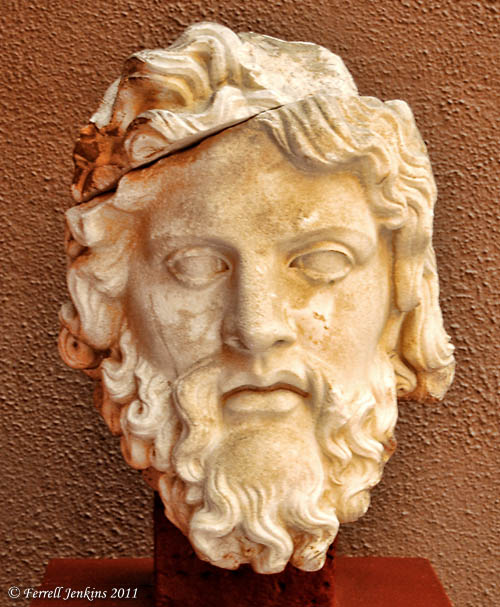
Our photo of Zeus is of a bust displayed in the archaeological museum at Ephesus.

Bust of Zeus in the Ephesus Museum. Photo by Ferrell Jenkins.

Bust of Zeus in the Ephesus Museum. Photo by Ferrell Jenkins.

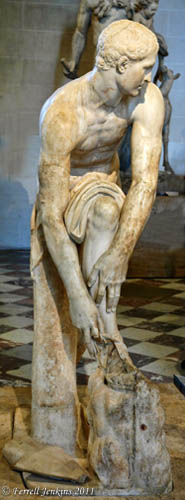
Paul was called Hermes because he was the chief speaker. Hermes was the messenger of the gods. How appropriate that our word hermeneutics, coming from the name Hermes, is used to describe the important work of interpreting the Scriptures. I have heard some speakers make fun of the word and then proceed to say that a certain phrase in the Scripture means … ! The photo below shows Hermes tying on his sandal in preparation for delivering a message. Some may recognize Hermes as the Latin Mercury, who is used as the symbol for the floral industry.

Hermes Putting on Sandal. Louvre. Photo by Ferrell Jenkins.

Hermes Putting on Sandal. Displayed in the Louvre. Photo by Ferrell Jenkins.

The King James Version used the Latin terms Jupiter and Mercurius in Acts 14:12. Bruce says this is “due to an old and foolish fashion of replacing Greek proper names by their Latin equivalents in English translations from the Greek.”