Monthly Archives: September 2011

Travel in the Plain of Acco and the Plain of Sharon

We saw most of what we had intended today, but due to a late start from Tiberias it was a long day. We got to Jerusalem a little late, went immediately to the dining room, and then made it to our room about 9:30 p.m.

We drove from Tiberias to Acco (Akko, Acre), a city of the biblical tribe of Asher, is mentioned in Judges 1:31. The city was known as Ptolemais in New Testament times. Paul stopped at Ptolemais and stayed with the brethren for a day on the return from his third journey (Acts 21:7).

We continued north along the Plain of Acco past Achziv (English versions use Achzib) (Joshus 19:29) to the Ladder of Tyre. More explanation latter. This natural formation has served as a natural boundary for centuries.

In the late afternoon we stopped in the Plain of Sharon, a few miles north of Caesarea, at the town of Beit Hananya to see a portion aqueduct that carried water to Caesarea. This portion of the aqueduct was constructed during the reign of the Roman Emperor Hadrian in the early second century A.D.

For a photo I want to share Tel Hannathon, the site of a town once belonging to the tribe of Zebulon.

The border circled around it on the north to Hannathon, and it ended at the valley of Iphtahel. (Joshua 19:14 NAU)
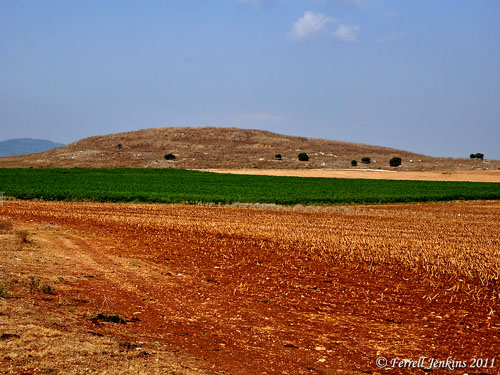
Tel Hannathon. Photo by Ferrell Jenkins.

Tel Hannathon. Photo by Ferrell Jenkins.

Hannathon is one of those places mentioned in the Bible that is simply passed over by most readers and teachers. The city was a real place in Bible times, occupied by real people who really did the things recorded in Scripture. Don’t let the details pass you by. Sometimes they can be highly significant.

We have an exciting day planned for tomorrow with a driver who will go with us to visit sites in the West Bank. Most of the rental car companies in Israel do not allow their cars to be driven in the West Bank.
Roman temples and hard to reach cities

Today was a busy day and one of the most productive of this trip. Several of the places we visited are difficult to reach today, but at the time of their glory they were on main routes of travel.

Our first stop was at Omrit in northern Israel, about 4 miles SW of Banias. Two temples have been found here. One of them dates to the late first century B.C. Some scholars suggest that this is the Temple of Augustus built by Herod the Great.

Omrit is not mentioned in the Bible, but may prove to be significant in accounts of the ministry of Jesus. It was located in the region known as Ituraea. Philip, the son of Herod the Great, was “tetrarch of the region of Ituraea and Trachonitis” (Luke 3:1).

Though not new to us, we stopped for a while to make some photos at Hazor.

Next stop was for lunch at McDonald’s.

We stopped at Khirbet (or Horbat) Amudim, site of an ancient synagogue. Our main interest was in seeing the area of travel between Cana and the towns around the Sea of Galilee.

A stop at Hannathon allowed us to get a photo of the tel. This site is mentioned as being in the territory of Zebulon in Joshua 19:14.

Yodfat (or Jotapata) is important because it is where Josephus led Jewish rebels against the invading Romans in 66 A.D.

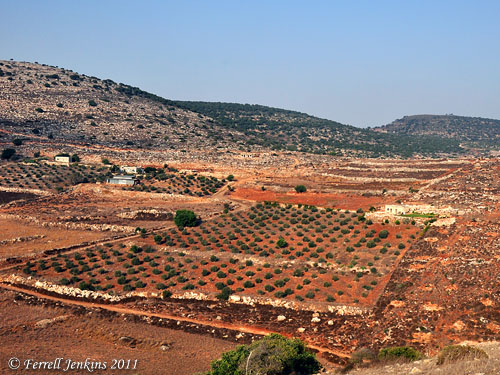
The photo below is of one of the beautiful valleys around Yodfat.

Fertile valley below Yodfat. Photo by Ferrell Jenkins.

Fertile valley below Yodfat. Photo by Ferrell Jenkins.

With the help of a local farmer we were led to an overlook where we could see Khirbet Kana (Cana), likely the site of the events of John 2. We had too little time left to make the full walk to the site. Always a reason for another visit.

We arrived back at the hotel in Tiberias about 7 p.m. In coming weeks we hope to share some of the new photos. with our readers.

A beautiful day in Galilee

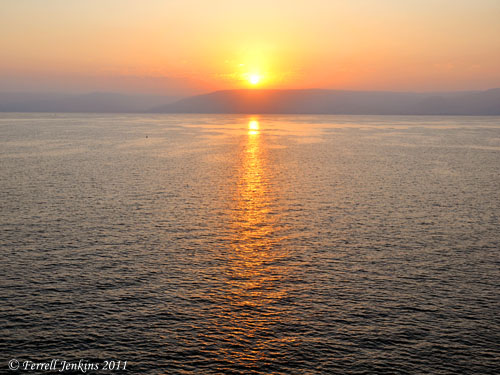
Sunrises on the Sea of Galilee can be extremely beautiful. I know that I have posted several photos of the sunrise, but I wanted to share another one from this morning.

Sunrise on the Sea of Galilee. Photo by Ferrell Jenkins - 09-04-11

Sunrise on the Sea of Galilee. Photo by Ferrell Jenkins - 09-04-11

Much of the ministry of Jesus was conducted on and around the Sea of Galilee. One of the important events recorded in Scripture is the calling of disciples.

Passing alongside the Sea of Galilee, he saw Simon and Andrew the brother of Simon casting a net into the sea, for they were fishermen. (Mark 1:16 ESV)

We went to Nazareth this morning to worship with the church there. Afterwards we spent a good bit of time in Mash’had, a small Arab town between Nazareth and the traditional site of Cana,  trying to locate the tell where the ancient city of Gath Hepher, the home of the prophet Jonah,  is thought to be located. Hopefully we will be able to tell you more about that experience later.

In May I wrote about locating and walking on a portion of the Roman Road near Golani Junction here. I wanted to share this experience with Leon, so we returned there.

There were some other things, but this will be enough for today.

It is hot at this time of the year, and especially when tramping around over hill and vale.

Somthing new, something old in Israel

No, we did not attend a wedding today. Leon and I are trying to see some places we have missed before. I have traveled here more than Leon, so I don’t like passing up a place he hasn’t visited.

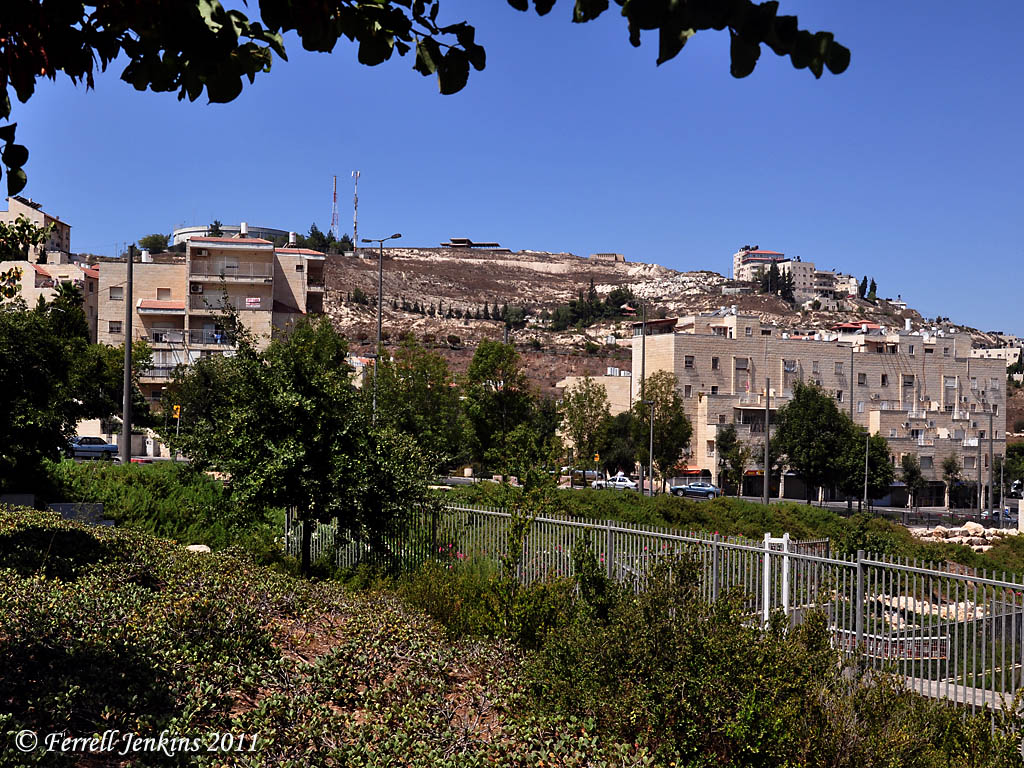
As we left Jerusalem this morning we missed a turn and ended up in one of the new Israeli suburbs called Pisgat Ze’ev Ma’arav (West). This suburb is on the east side of Tell el-Ful (Hill of Beans in Arabic), identified as biblical Gibeah. In an effort to find our way back to the main street to get on the highway to go to the Jordan Valley I saw a side of Tell el-Ful that I had not seen before. I had always seen the tell from the West, but now I was was looking at the East side.

How does one recognize Tell el-Ful? Beans no longer grow on the mound. Prior to the 1967 war, when the Old City of Jerusalem and the area under consideration was in Jordan, the late King Hussein of Jordan was beginning to build a palace on the top of the tell. The uncompleted structure still stands there as a silent monument to a failed plan.

The view from the east is impressive. The tell can be seen framed between the new buildings of Pisgat Ze’ev Ma’arav (West). I was beginning to fume a bit about missing the road I intended to take until I saw Tel el-Ful (Gibeah).

Gibeah of Saul (Tel el-Ful) from the east. Photo by Ferrell Jenkins.

Gibeah of Saul (Tel el-Ful) from the east. Photo by Ferrell Jenkins.

Several biblical references mention Gibeah as the home of Saul. In fact the city is even called Gibeah of Saul in 2 Samuel 21:6, and Gibeah of Benjamin in 1 Samuel 13:2. Saul was the first king of Israel from about 1050 to 1010 B.C.

William F. Albright excavated Tell el-Ful and found evidence of a fortress. Many think this would have been the palace of King Saul. An iron plowshare was also found in the excavation.

There is a nice photo by Eli Berckovitz of the skeleton structure of King Hussein on Wikipedia here.

We visited some new places, too. But it is late, and those will have to wait.

David escaped to the Cave of Adullam

One of the important places on our “bucket list” was the Cave of Adullam. The main reason we had never visited Adullam before is that it requires a long, difficult, walk or a four-wheel-drive vehicle. We made arrangements with Haelah Desert Tours, a company at Aderet, a moshav on the north side of Adullam, for a guide/driver who could take us there. Once we reached the forested mound we enjoyed a wonderful view to the north, east, and south. Our guide, Daphna, inquired first about our interest in the site. How did we even know about the site, she wondered. She is a Sabre, a native-born Israeli, who lives at Aderet.

The view below is to the east where you will see the border between Israel and the West Bank. The central mountain range is visible in the distance.

Daphna, our guide, and Leon look east from Tel Adullam. Photo by Ferrell Jenkins.

Daphna, our guide, and Leon look east from Tel Adullam. Photo by Ferrell Jenkins.

There is a large cave at Adullam. Is it the cave where David stayed while fleeing from Saul? Can’t say, but if it was not this one it had to be another one near by. The next photo was made from inside the cave.

View north from interior of the Cave of Adullam. Photo by Ferrell Jenkins.

View north from interior of the Cave of Adullam. Photo by Ferrell Jenkins.

Adullam is significant in several biblical accounts. Here are a few.

Judah stayed with an Adullamite man named Hirah. He married the daughter of a Canaanite man named Shua.

At that time Judah left his brothers and stayed with an Adullamite man named Hirah. There Judah saw the daughter of a Canaanite man named Shua. Judah acquired her as a wife and had marital relations with her. (Genesis 38:1-2 NET)

The episode of Onan and his failure to fulfill his responsibility to bring up children to his deceased brother (the Levirate marriage; Genesis 38:3-10).

Joshua defeated the king of Adullam during the Conquest (Joshua 12:15), and became one of the Shephelah (lowland) cities of the tribe of Judah (Joshua 15:35).

The cave of Adullam is associated with David. When he left Gath he went to Adullam before sending his parents to Moab for safety.

So David left there and escaped to the cave of Adullam. When his brothers and the rest of his father’s family learned about it, they went down there to him. (1 Samuel 22:1 NET)

In fact, David spent much time at Adullam. I suggest you read the entire account in 2 Samuel 23:13ff.

When the prophet Micah warned Judah about the coming Assyrian invasion he said,

…the leaders of Israel shall flee to Adullam (Micah 1:15 NET)

Just like David did about three centuries earlier.

One more point. Jesus was a descendant of David and Judah, both of whom had an association with Adullam (Revelation 5:5).

What a wonderful experience.

My thanks to Gordon Franz and Carl Rasmussen with whom I have corresponded about Adullam.

Update. In my orignal post I made a mistake in saying that Judah married the daughter of Hirah. I caught this mistake a few days ago and have now corrected it. Judah married the daughter of a Canaanite man named Shua.

Places less visited in Israel

Today we got a fairly early start and went through the Shephelah to Lachish. This takes about an hour or so from Jerusalem. We did not go to visit Lachish, but to continue east to a small kibbutz called Shekef. From here we would try to locate Tel Eiton (also Tel ‘Eton and Tel Aitun). I had been in the area before but did not locate the tel. The reason for going so far out of the way to get to the site is that it is situated on Israel’s border with the Palestinian West Bank. Just before reaching Shekef we began to  drive on the new highway 358 to Beersheba, parallel to the border. Soon we realized that we must be bypassing the place we want to go.

We backtracked and eventually after doing what men “never do”, ask for directions, we located Tel Eiton. Palestine is on the east side of the mound and a military firing range is on the west side. We decided it would be best to stick to the gravel road without straying too far to the left or the right — sort of like Joshua.

“Be very firm, then, to keep and do all that is written in the book of the law of Moses, so that you may not turn aside from it to the right hand or to the left,  so that you will not associate with these nations, these which remain among you, or mention the name of their gods, or make anyone swear by them, or serve them, or bow down to them.  (Joshus 23:6-7 NAU)

Tel Eiton currently is equated with biblical Eglon by many scholars. Recent excavations have been conducted under the direction of Prof. Avi Faust, now of Bar Ilan University.

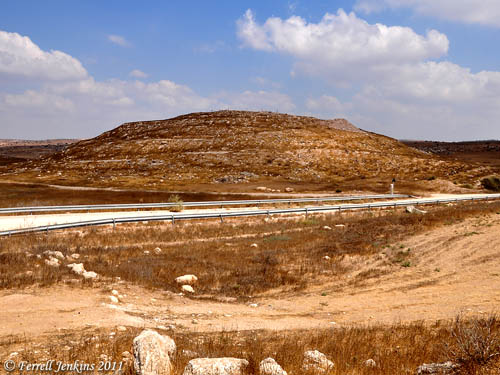
Here is a photo of the tel from the south and perhaps a little to the east.

Tel Eiton (Tel Aitun), possibly biblical Eglon.

Tel Eiton (Tel Aitun) from the south (and east). Photo by Ferrell Jenkins.

Eglon is mentioned at least eight times in the Bible, all in the book of Joshua (10:3, 5, 23, 34, 36, 37; 12:12). The Scripture emphasizes that Israel defeated the king of Eglon. Notice the relationship between Lachish, where we started our trek, and Eglon.

And Joshua and all Israel with him passed on from Lachish to Eglon, and they camped by it and fought against it.  They captured it on that day and struck it with the edge of the sword; and he utterly destroyed that day every person who was in it, according to all that he had done to Lachish.  Then Joshua and all Israel with him went up from Eglon to Hebron, and they fought against it.  (Joshua 10:34-36 NAU)

We also visited the following places.

Tel Bet Mirsim, a site identified as Debir by William F. Albright (Joshua 10:38, 39). Albright identified Tel Eiton as Libnah, but scholars today question this.

Tel Halif, north and slightly east of Beersheba, is thought by some to be biblical Ziklag, . Others place the biblical city at Tel Shera, northwest of Beersheba.

Finally we visit the Brook Besor and Tel el-Farah South. Israel calls the site Tel Sharuhen (1 Samuel 30). This tel is located in the Plain of Philistia, not far from the borders with Egypt and the Gaza Strip.

Hopefully we will be able to share more photos and information about this places with you at a later time. It is all very fascinating to the student of the Bible. Right now it is too late and I need to be sleeping.