Tag Archives: Ministry of Jesus

Previous posts relating to the birth of Jesus and Christmas

Thanks for the good response to our posts on frankincense and myrrh. Over the past 4+ years I have written several posts about Christmas, the birth of Jesus, and Bethlehem, in hope that they would be beneficial to Bible students and teachers.

Here are links to some of the more significant articles, usually with photos.

If you have more interest in learning about the origin of the celebration of the birth of Christ, take a look here. A more detailed study of the historical aspects of the celebration is available in PDF here.

For the next couple of days I plan to spent some (read, total) time with my grandson. I trust you will enjoy quality time with your family and friends.

I see that Leon Mauldin has a post about the manger at Leon’s Message Board here, and another about the traditional site of Jesus’ birth in Bethlehem here.

Todd Bolen has a list of his Christmas-Related Posts at Bible Places Blog here.

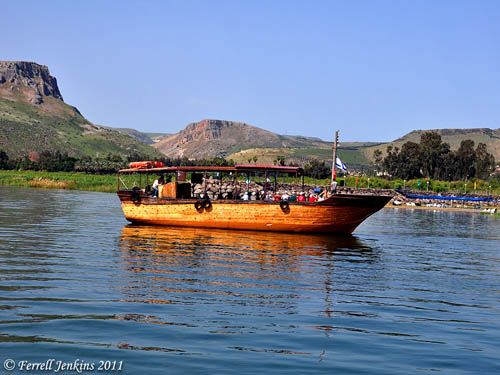
Approaching Gennesaret

The Sea of Galilee is called the “lake of Gennesaret” (Luke 5:1), and the “Sea of Tiberias” (John 6:1; 21:1). This indicates that both Tiberias, where Herod Antipas had built his capital in the mid-20s of the first century, and Gennesaret were significant places. When one traveled from Nazareth, Cana, or others places west of the Sea of Galilee, he would pass by Mount Arbel into the plain or land of Gennesaret.

This photo, taken on an unusually clear day, shows a small ship about to anchor at Nof Ginosaur (= Gennesaret). To the west we see Mount Arbel and the pass below allowing travel and commerce between lower Galilee and the towns around the Sea of Galilee.

Boat approaches the land of Genessaret. Photo by Ferrell Jenkins.

Boat approaching the land of Gennesaret. Photo by Ferrell Jenkins.

The photo nicely illustrates the text of Mark 6.

When they had crossed over they came to land at Gennesaret, and moored to the shore. When they got out of the boat, immediately the people recognized Him, and ran about that whole country and began to carry here and there on their pallets those who were sick, to the place they heard He was. Wherever He entered villages, or cities, or countryside, they were laying the sick in the market places, and imploring Him that they might just touch the fringe of His cloak; and as many as touched it were being cured. (Mark 6:53-56 NAU. cf. Matthew 14:34-36)

The first disciples of Jesus were called by the lake of Gennesaret (Luke 5:1).

Keep your lamps burning

Light is necessary for life and growth. We are introduced to light in the biblical account of creation.

And God said, “Let there be light,” and there was light.  And God saw that the light was good. And God separated the light from the darkness.  God called the light Day, and the darkness he called Night. And there was evening and there was morning, the first day.  (Genesis 1:3-5 ESV)

Of Jesus, the Gospel of John says, “In him was life, and the life was the light of men” (John 1:4 ESV).

David spoke of meditating on God during the watches of the night (Psalm 63:6). He watched his sheep by night, but most work was not done in the night prior to the introduction of electric power. We used one Aladdin lamp and a few kerosene lamps in our home in the rural South until I was about 8 or 10 years old. Then we began to use a single electric bulb in a room when we needed to be in the room.

Jesus said,

We must work the works of of him who sent me while it is day; night is coming, when no one can work.  As long as I am in the world, I am the light of the world” (John 9:4-5 ESV).

Herodian period lamp burning. Photo by Ferrell Jenkins.

Herodian period lamp from the time of Jesus. Photo by Ferrell Jenkins.

The photo above is one of the Herodian period lamps I have purchased in the Bible lands over the past 44 years. Two or three times I have used some olive oil (or Wesson oil, or a small piece of a candle) to show how much light the lamp gives.

In the parable of the watchful slaves Jesus said,

“Stay dressed for action and keep your lamps burning,  and be like men who are waiting for their master to come home from the wedding feast, so that they may open the door to him at once when he comes and knocks. (Luke 12:35-36 ESV)

The Apostle Paul commanded the saints at Philippi to shine as lights in the world.

Do all things without grumbling or questioning,  that you may be blameless and innocent, children of God without blemish in the midst of a crooked and twisted generation, among whom you shine as lights in the world, (Philippians 2:14-15 ESV)

Not much remains at Capernaum

Capernaum, on the northern shore of the Sea of Galilee, played a significant role in the ministry of Jesus. The town became the Galilean center for the ministry of Jesus.

And leaving Nazareth he went and lived in Capernaum by the sea, in the territory of Zebulun and Naphtali, (Matthew 4:13 ESV)

The aerial photo below was made on approach to Capernaum from the east. The site most visited by tourists may be seen left of the center of the photo. You may recognize the new church and the ruins of the synagogue. This property is owned by the Franciscans. To the right you will see the Greek Orthodox Church and the property they own. Evidence of some excavations may be seen.

There is not much remaining of ancient Capernaum. This is not surprising in light of the pronouncement of Jesus.

And you, Capernaum, will you be exalted to heaven? You will be brought down to Hades. For if the mighty works done in you had been done in Sodom, it would have remained until this day. (Matthew 11:23 ESV)

Aerial View of Capernaum. Photo by Ferrell Jenkins.

Aerial View of Capernaum. Photo by Ferrell Jenkins.

Contemplating the power of a single grain

Last Sunday evening I heard a good sermon based on John 12:24-26.

Truly, truly, I say to you, unless a grain of wheat falls into the earth and dies, it remains alone; but if it dies, it bears much fruit. (John 12:24 ESV)

This simple statement by Jesus is followed by a difficult lesson.

Whoever loves his life loses it, and whoever hates his life in this world will keep it for eternal life. If anyone serves me, he must follow me; and where I am, there will my servant be also. If anyone serves me, the Father will honor him. (John 12:25-26 ESV)

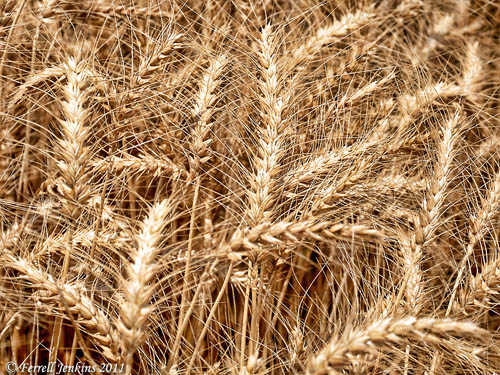
A grain of wheat must fall into the earth and die before it can produce fruit. Depending on the circumstances the grain can produce thirty-, sixty-, or a hundredfold (Matthew 13:8).

Wheat ready for harvest at En Dor. Photo by Ferrell Jenkins.

Wheat ready for harvest at En Dor. Photo by Ferrell Jenkins.

A single grain of wheat must die in order to produce much fruit. Jesus spoke of the necessity of His own death, and taught the tough lesson of giving up one’s life to serve Him.

Note the comment by William Hendriksen.

The illustration was very clear, especially at the moment when it was spoken, not more than a few days before the (religious and) harvest feast of Passover. The kernels or seeds had been entrusted to the soil. As seeds they had died. But by means of this very process of dissolution they had brought forth an abundant harvest. If a seed is not sown, it remains alone, producing no fruit. So also if Jesus does not die, he will remain alone, without spiritual fruit (souls saved for eternity). His death, however, will result in a rich, spiritual harvest. (New Testament Commentary : Exposition of the Gospel According to John).

We have included a larger image suitable for use in teaching. It is available by clicking on the image above.

The last week in the Gospel of John

If we consider the Gospel of John a sort of “Day Planner” for Jesus, we have nearly complete activity recorded for two weeks of the earthly ministry of Jesus. The first is in John 1:19—2:11 where activity for six of the seven days is recorded. I think the omitted day is the sabbath.

The next nearly complete week is the last week, leading up to the resurrection. John gives more attention to the last week than any other Gospel. Even here we have activities for only six of eight days. This section begins in John 12:1 and continues into John 20. Here is the way I have reconstructed it. Where John does not record the activity I have omitted the scripture reference.

  • Sunday — The King enters Jerusalem — 12:12-19
  • Monday — Cleansing the Temple —
  • Tuesday — Visit of the Greeks — 12:20-36
  • Tuesday — Jewish rejection — 12:37-50
  • Wednesday — No events recorded in the Gospels
  • Thursday Evening — Passover Meal, including Washing Disciples Feet (only in John) — 13:1-38
  • Thur. Eve — Farewell discourses — 14—16
  • Thur. Eve — Prayer — 17
  • Thur. Eve — Annas (only in John) — 18:12-14
  • Thur. Eve — Caiaphas — 18:24-28
  • Friday — Pilate — 18:28—19:16
  • Friday — Crucifixion — 19:16-42
  • Sabbath —
  • First Day — Resurrection — 20

It should be noted that the appearance before Annas and Caiaphas were the Jewish (Religious) trials. The appearance before Pilate [and Herod Antipas] were the Roman (Civil) trials.

John does not record the pronouncement of woes on the religious leaders, the institution of the Lord’s Supper, and the account of the agony in the Garden of Gethsemane.

With this sparse attention given to two weeks, no wonder John says,

Now there are also many other things that Jesus did. Were every one of them to be written, I suppose that the world itself could not contain the books that would be written. (John 21:25 ESV)

There is a medieval wood carving of the last week of Jesus in Notre Dame (Paris). In this photo you see the representation of the last supper, the washing of the disciples’ feet, and the agony in Gethsemane. (Sorry, this was made nearly a decade ago and I don’t have a hi-res photo.)

Wood carving of Last Week of Jesus in Notre Dame. Photo by Ferrell Jenkins.

Wood carving of Last Week of Jesus in Notre Dame. Photo by Ferrell Jenkins.

Banias — easternmost source of the River Jordan

The Nahr (River) Banias is the easternmost source of the River Jordan. The source of the Banias is located at a site we know as Caesarea Philippi in the New Testament. It is well known to those who study the ministry of Jesus (Matthew 16:13-19).

Banias is located on the eastern side of the Beka or Hula Valley.  The valley is called the Beka in Lebanon, and a little further south the Hula Valley. The elevation is about 1150 feet above sea level in the foothills of Mount Hermon.

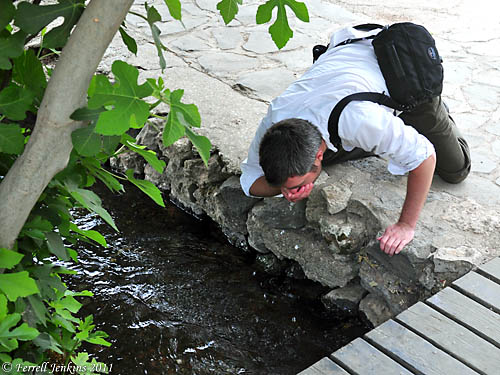
The photo below shows the place where the water emerges from the earth. Perhaps you are reminded of the text from the prophet Jeremiah:

for my people have committed two evils: they have forsaken me, the fountain of living waters, and hewed out cisterns for themselves, broken cisterns that can hold no water. (Jeremiah 2:13 ESV)

Getting a drink at the source. River Banias, Caesarea Philippi.

Getting a drink at the source. River Banias, Caesarea Philippi. Photo by Ferrell Jenkins.

Other posts about this site are listed below. Check them all.

Three other rivers we have recently mention, Flea River, the Senir, and the Dan, join with the Banias to form the River Jordan.

Another jumping off place — the pinnacle of the temple

A couple of days ago we wrote about the pinnacle of the temple (Mark 11:11; Luke 4:9). We followed the common suggestion that the reference was to the southeast corner of the temple mount precinct.

We mentioned that the late Benjamin Mazar, The Mountain of the Lord (page 149), shows a photo of the southeast corner of the wall with the comment that this “is known as the ‘pinnacle of the Temple’ (Mark 11:11; Luke 4:9).”

Leen Ritmeyer left us a comment to say that “Mazar actually had a different idea,” and called attention to his own post at ritmeyer.com.

Dr. Ritmeyer, author of The Quest: Revealing the Temple Mount in Jerusalem, provided some insight into the subject that is helpful and appreciated. He says,

Although this statement does appear in the book, I remember discussing this problem with him and he said that he actually saw the  southwest corner of the Temple Mount as a more likely candidate for the pinnacle of the Temple. One needs to determine what was the most important element in the temptation of Jesus to throw himself down from the pinnacle. Was it the height of the corner above what lay below or did the temptation lie in impressing as many people as possible with that jump?

As the southwest corner was a busy junction between the major north-south street running through Jerusalem and the Plaza in front of the Southern Wall of the Temple Mount, there would have been many more people to impress here than on the much quieter southeast corner.

It is in a setting such as this that we can visualise the dramatic scene that would have taken place had not Jesus challenged the temptation with the power of God’s Word.

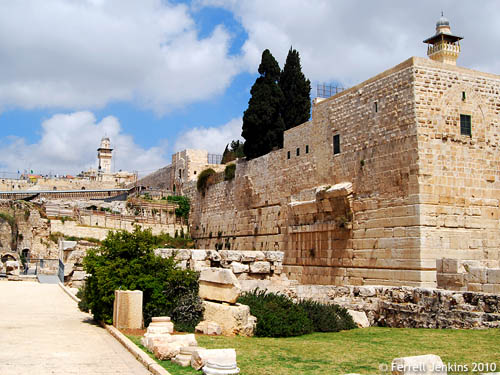
The Temple Mount Southwest Corner. Photo by Ferrell Jenkins.
The Southwest Corner of the Temple Mount. Photo by Ferrell Jenkins.

The western side of the Temple Mount enclosure ran along the Tyrophean Valley from north to south. A few years ago archaeologists found the first century street level at the southwest corner. The stones you see protruding from the wall are known as “Robinson’s Arch”, named for 19th century explorer Edward Robinson. When I first visited Jerusalem in 1967 it was commonly thought that the arch was the beginning of a bridge across the Tyrophean Valley, similar to Wilson’s Arch which is north of the Western Wall plaza. Now we know that the arch was the beginning of a winding staircase that allowed access to the Royal Stoa on the temple platform. (You will see a nice drawing of this staircase in Ritmeyer’s post.)

In my original post I said, “In a post to follow I will mention another view.” The other view I had in mind was the southwest corner.

Richard M. Mackowski, Jerusalem City of Jesus, says this corner “may be identified with the biblical Pinnacle of the Temple” (page 122). This is the comment I intended to use in today’s post. I am delighted that Dr. Ritmeyer calls attention to the discussion he had with Benjamin Mazar. We expect scholars to change their minds as they gain new information. It is also possible that an editor added the note in the book.

My bottom line is that we do not know for certain where the pinnacle of the temple is located. Either of these views suggest a good possibility.

Half a millionaire!

Compared with many websites and blogs, reaching the 500,000 hits level, as we did a few minutes ago, is not much. However, for a blog by an obscure writer dealing with the narrow topic of the Bible lands this might be impressive.

During our first month online (May, 2007) we averaged about 81 hits a day. The blog was intended to provide an opportunity for friends of those traveling with me on a tour of Anatolian Turkey and the area of Paul’s first journey to keep in touch. I think there was no thought of continuing the blog on a regular basis.

When we discovered that there was continuing interest in the photographs and bits of information we provided, we continued to write. The growth of readership was gradual. This month we are averaging about 885 hits a day. At the annual professional meetings of the NEAS, ETS, and SBL several people who saw my name badge mentioned reading the blog.

We always have in mind those who preach and teach the Bible as we prepare our material.

Thank you for your interest in this material and for your kind words of encouragement from time to time. I must confess that some days I give thought to discontinuing the blog. Except for the evidence that some of the readers are finding this material helpful I probably would.

I am grateful to others who have called attention to my blog through their links and honorable mentions. Every time Todd Bolen mentions my posts at Bible Places Blog I note an uptick in hits. I continue to be thankful for WordPress and the platform provided to anyone who wishes to post their thoughts/materials on the Internet.

Just had a thought. What if I had a dollar for each hit? It was just a thought.

For this special occasion I wanted to share a nice photo of the site of Paneas /Banias/Caesarea Philippi. This photo shows the site of the Pan shrine at the foot of the vast rock which is part of the the foothills of Mount Hermon. A spring flows from beneath the rock to form the Banias River which in turn joins other branches to form the Jordan River. Click on the photo to get an image suitable for use in sermon and class presentation.
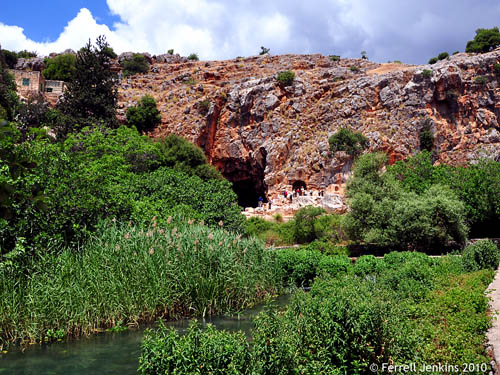
The site of Paneas was Caesarea Philippi in the time of Jesus. Photo by Ferrell Jenkins.

The site of Paneas was Caesarea Philippi in the time of Jesus. Photo by Ferrell Jenkins.

Here is the Bible text that goes with the photo.

13 Now when Jesus came into the district of Caesarea Philippi, He was asking His disciples, “Who do people say that the Son of Man is?”
14 And they said, “Some say John the Baptist; and others, Elijah; but still others, Jeremiah, or one of the prophets.”
15 He said to them, “But who do you say that I am?”
16 Simon Peter answered, “You are the Christ, the Son of the living God.”
17 And Jesus said to him, “Blessed are you, Simon Barjona, because flesh and blood did not reveal this to you, but My Father who is in heaven.
18 “I also say to you that you are Peter, and upon this rock I will build My church; and the gates of Hades will not overpower it.
19 “I will give you the keys of the kingdom of heaven; and whatever you bind on earth shall have been bound in heaven, and whatever you loose on earth shall have been loosed in heaven.” (Matthew 16:13-19 NAU)

Sea of Galilee now more than 701 feet below sea level

Arutz Sheva reports that the Sea of Galilee fell 20 centimeters last month.

Despite several periods of rain during the month, the Kinneret’s level fell 20 centimeters [7.87 inches] in October, the Hydrological Service of the Israel Water Authority said Tuesday. The lake’s level is now 213.88 [701.71 ft.] meters below sea level. According to the Service, the Kinneret lost 72 centimeters [28.35 in.] between July and September.

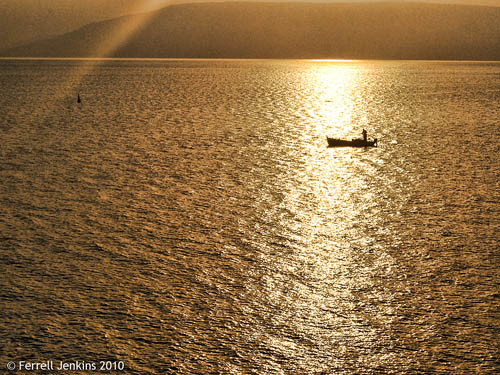
A lone fisherman on the Sea of Galilee at sunrise. View east. Photo by Ferrell Jenkins.

A lone fisherman on the Sea of Galilee at sunrise. View east. Photo by Ferrell Jenkins.

The Sea of Gailee/Kinneret played an important role in the ministry of Christ and His disciples.

When He heard that John had been arrested, He withdrew into Galilee. He left Nazareth behind and went to live in Capernaum by the sea, in the region of Zebulun and Naphtali. This was to fulfill what was spoken through the prophet Isaiah: Land of Zebulun and land of Naphtali, along the sea road, beyond the Jordan, Galilee of the Gentiles! The people who live in darkness have seen a great light, and for those living in the shadowland of death, light has dawned. From then on Jesus began to preach, “Repent, because the kingdom of heaven has come near!” (Matthew 4:12-17 CSB)

HT: Biblical Paths.