Tag Archives: Jerusalem

Could this be the quarry of Herod the Great?

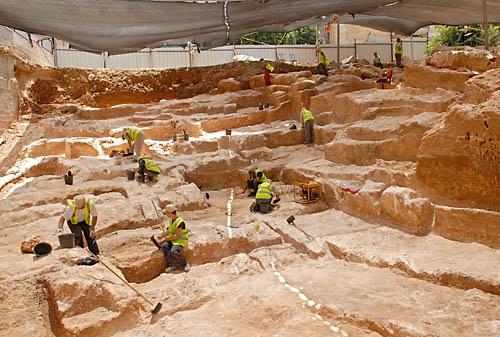
The Israel Antiquities Authority announced Monday the discovery of a large stone quarry dating to the first century B.C. It is suggested by the director of the excavation that this was one of the quarries used by Herod the Great in his building projects in Jerusalem.

First century B.C. quarry on Shmuel HaNavi Street. Photo: Assaf Peretz, courtesy IAA.

First century B.C. quarry on Shmuel HaNavi Street. Photo: Assaf Peretz, courtesy IAA.

Dr. Ofer Sion, the excavation director on behalf of the Israel Antiquities Authority, believes, “The immense size of the stones (maximum dimensions: length 3 m, width 2 m, height 2 m) indicates it was highly likely that the large stones that were quarried at the site were destined for use in the construction of Herod’s magnificent projects in Jerusalem, including the Temple walls. It seems that a vast number of workers labored in the quarry where various size stones were produced: first they quarried small stones and when the bedrock surface was made level they hewed the large stones. The stones were quarried by creating wide detachment channels that were marked by means of a chisel which weighed c. 2.5 kilograms. After the channels were formed the stones were severed from the bedrock using hammers and chisels”.

The full news release may be read here. Similar quarries have been discovered in Jerusalem in the decade. Todd Bolen, at Bible Places Blog, provides some links to the earlier quarries as well as some good photos. One photo shows the Ketef Hinnom quarry that has since been covered by the Menahem Begin Heritage Center. I’m glad Todd was there to capture that one.

HT: Todd Bolen; Joseph Lauer

The Way of the Cross – Via Dolorosa

Numerous events from the last day prior to the crucifixion of Jesus are recorded in the New Testament (Matthew 26-27; Mark 14-15; Luke 22-23; John 18-19). As early as Byzantine times Christians began to follow the final steps of Jesus on specified days. Over the centuries many changes were made in the route and the stops. The traditional Via Dolorosa, as known today, was fixed in the 18th century.

Jerome Murphy-O’Connor says,

The Via Dolorosa is defined by faith, not by history. (The Holy Land, 5th edition, 37)

He continues,

The present Way of the Cross has little chance of corresponding to hsitorical reality… (38)

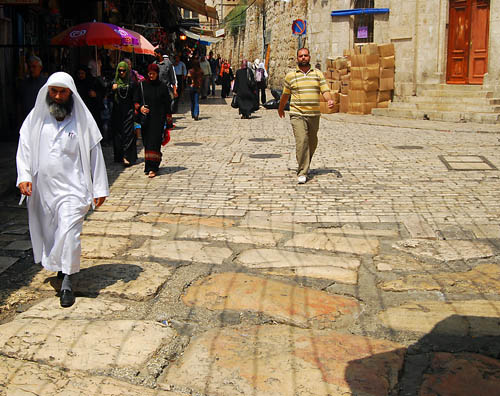
According to tradition, the third station of the cross is where Jesus falls the first time under His cross. It sounds reasonable, but the Gospels make no specific mention of this.

Roman period street near 3rd station of the cross. Photo by F. Jenkins.

Roman period street near 3rd station of the cross. Photo by F. Jenkins.

This photo shows the street in front of the third station. The plaque in Hebrew, Arabic and English provides the following information about the street.

Paving stones, apparently from the Second Temple Period (ca. 100 B.C.C. – 100 C.E.). The street was found in its entirety 3 meters below the existing level and was partially restored by the Municipality of Jerusalem … 1980-1981.

This means that the street Jesus might have walked is at least 10 feet below the present street level.

Antonia Fortress discussion

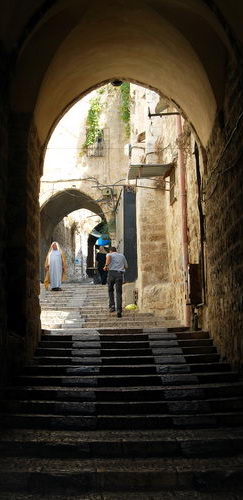
A street in the Moslem Quarter of Jerusalem. Photo by F. Jenkins.

A street in the Moslem Quarter of Jerusalem. Photo by F. Jenkins.

Todd Bolen calls attention to an article by Ehud Netzer in the curent Biblical Archaeology Review on the location of the Antonia Fortress. Read the post here.

Leen Ritmeyer posted a response to Netzer and included some of his great diagrams here.

With Todd’s photo and Leen’s diagrams you will have some great material to help you understand the location of the Antonia.

The Antonia may not be the place where Jesus appeared before Pontius Pilate, as we once thought, but it is the place where Paul stayed under the custody of the Romans before his transfer to Caesarea Maritima.

English versions refer to the building as the barracks (Acts 21:37). Paul’s speech on the stairs was from the steps leading from the temple precinct to the Antonia.

Our photo above was made in the Moslem Quarter of Jerusalem near the site of the Antonia.  I think the street is Bab Hutta. These little side streets are always so intriguing.

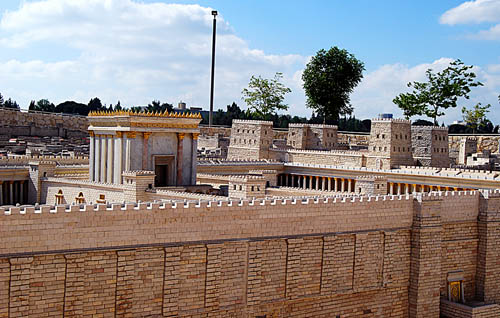
The photo below shows the Temple Mount in the Second Temple model at the Israel Museum. The Antonia is the large building on the right, the northwest corner of the Temple Mount.

The Temple Mount and the Antonia Fortress. Photo by F. Jenkins.

The Temple Mount and the Antonia Fortress. Photo by F. Jenkins.

BiblePlaces Newsletter

Todd Bolen’s BiblePlaces Newletter for December is now available. It includes a wonderful aerial photo of the Elah Valley. The main feature is a series of (Google) satellite photos of Jerusalem with the natural features (hills, valleys, springs, quarters of the city, etc.) identified. If you teach any lesson dealing with the city of Jerusalem you need these PowerPoint slides.

You should subscribe to the BiblePlaces Newsletter, but if you have not yet done so you may access the current issue here. The subscription link is at the bottom of the page.

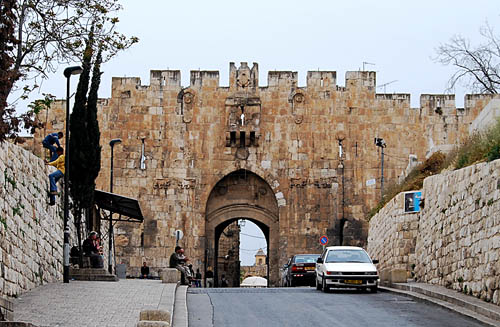
The photo below shows one of the modern gates of Jerusalem. It is labeled Stephen’s Gate on one of the slides mentioned above. Murphy-O’Connor says that Suliman called it the Bab el-Ghor (the Jordan Valley Gate). In Hebrew it is called the Lions’ Gate, but you may notice that the animals to the left of the gate are panthers. Murphy-O’Connor says this was “the heraldic emblem of the Mamluk sultan Baybar (1260-77). This is the only gate of the Old City on the east side that is currently open.

Lions Gate or St. Stephen Gate. Photo by Ferrell Jenkins.

Lions' Gate or St. Stephen's Gate. Photo by Ferrell Jenkins.

Learning more at the SBL meeting

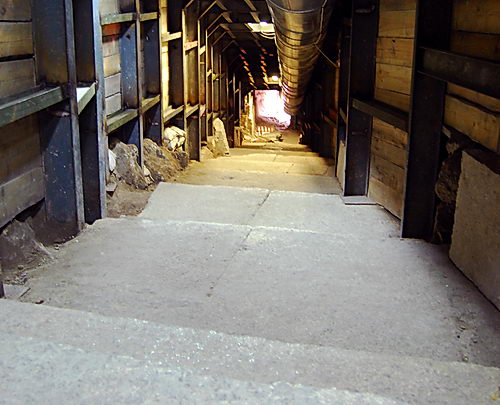
Sunday afternoon I attended two good sessions for a total of 10 papers or presentations. The first was on Biblical Lands and Peoples in Archaeology and Text. Ronny Reich of Haifa University spoke on the discovery of the road leading from the Pool of Siloam to the Temple Mount in Jerusalem. I saw a portion of this street and the tunnel underneath it earlier this year.

Street leading from Pool of Siloam up to the Temple Mount. Photo by Ferrell Jenkins.

Street leading from Pool of Siloam up to the Temple Mount. Photo by Ferrell Jenkins.

Doron Ben-Ami of the Israel Antiquities Authority spoke about the Givati Garage excavation south of Dung Gate. The structure found there is very large and is thought to have belonged to the family of Queen Helena of Adiabene. You can find more information and photos here.

One young scholar read a paper on Roman Jerusalem as a Setting of Earliest Christianity. He cited someone as saying that Acts might have been written in the middle of the second century. That theory is almost as old as the material he was dealing with. He thought that Luke’s account of the beginnings of Christianity was “magical.” Well, some presentations are well researched and profitable, and others are not.

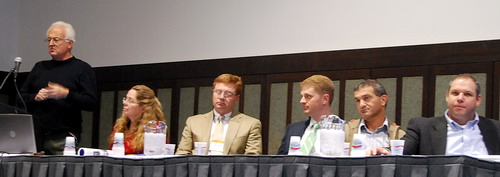
Bible Lands and Peoples in Archaeology and Text presenters. Reich is speaking. Photo by Ferrell Jenkins.

Bible Lands and Peoples in Archaeology and Text presenters.Photo by Ferrell Jenkins.

More later about the second section I attended.

Mazar now reads seal as Shlomit

We mentioned here that a seal found in the “City of David Excavation” in Jerusalem had been read by Prof. Eilat Mazar as Temech. In a comment on that page we noted that she had now changed her mind about the reading.

Today, the Jerusalem Post carried an article about this.

Mazar had originally read the name on the seal as “Temech,” and suggested that it belonged to the family of that name mentioned in the Book of Nehemiah.

But after the find was first reported in The Jerusalem Post, various epigraphers around the world said Mazar had erred by reading the inscription on the seal straight on (from right to left) rather than backwards (from left to right), as a result of the fact that a seal creates a mirror image when used to inscribe a piece of clay.

Several other scholars said the reading should be Shlomit.

Mazar said Monday that she accepted the reading of “Shlomit” on the ancient seal, and added that she appreciated the scholarly research on the issue.

“We are involved in research, not in proving our own opinions,” Mazar said.

Shlomit is the name of a woman mentioned in 1 Chronicles 3:19. Several English versions I checked use the spelling Shelomith. Whether the seal has anything to do with the persons named in the biblical text is unknown.

Does this seal bear the name of a Bible character?

We now have dozens of seals bearing the names of characters mentioned in the Bible, but every new one is interesting. The Jerusalem Post, January 16, 2008, reports the discovery of a seal that it says bears the name of a family of temple servants who were exiled to Babylon in 586 B.C., and then returned to Jerusalem after the exile. The discovery was made by Dr. Eilat Mazar at the City of David Excavation.

The Jerusalem Post:

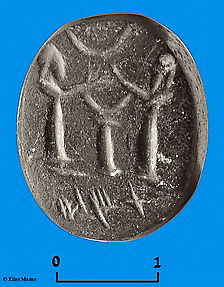
The seal, which was bought in Babylon and dates to 538-445 BCE, portrays a common and popular cultic scene, Mazar said.
The 2.1 x 1.8-cm. elliptical seal is engraved with two bearded priests standing on either side of an incense altar with their hands raised forward in a position of worship.
A crescent moon, the symbol of the chief Babylonian god Sin, appears on the top of the altar.
Under this scene are three Hebrew letters spelling Temech, Mazar said.
The Bible refers to the Temech family: “These are the children of the province, that went up out of the captivity, of those that had been carried away, whom Nebuchadnezzar the king of Babylon had carried away, and came again to Jerusalem and to Judah, every one unto his city.” [Nehemiah 7:6]… “The Nethinim [7:46]”… The children of Temech.” [7:55].
. . .
“The seal of the Temech family gives us a direct connection between archeology and the biblical sources and serves as actual evidence of a family mentioned in the Bible,” she said. “One cannot help being astonished by the credibility of the biblical source as seen by the archaeological find.”

The full article is here.

Seal Discovered by Dr. Eilat Mazar in City of David Excavation.

According to the article, Dr. Mazar reads the inscription as Temech. In many English versions this name is translated as Temah. The Nethinim are mentioned in Nehemiah 7:24 rather than 7:46. See also Ezra 2:53. Other scholars were quick to point out that Mazar had read the inscription left to right, but that seals are normally in the reverse order so that when they are impressed in clay the name reads right to left. Thus the suggestion has been made that the name should be Shelomith. Others have pointed out that there was a Shelomith among the returnees from Babylon (Ezra 8:10).

A warning is in order. There is no way to connect a name on a seal, without additional information such as a title, to a specific person in the Bible. The best one can say is that the name was common to the time of a given event or book. And we are never quite sure if the reporter with a deadline to meet got the comment correct, or placed it in the correct context. In other words, we must await additional, more detailed information. A context for the dating of the seal to a particular year, or span of years, must be provided.

Be patient and wait at least another week (month, year, decade) before using this in your sermon!

Many scholars are critical of Dr. Eilat Mazar and her work in the City of David Excavation. They paint her as a person with an agenda to prove the Bible true, and that she stretches the evidence to fit the theory. If this is true, it is not good. On the other hand, I suspect it is the lack of belief in the veracity of the Bible that prompts some to criticize her every shovel of dirt.

In 2005 Mazar announced the discovery of a clay bulla (the impression of a seal) bearing the inscription, “Yehukal son of Shelemyahu son of Shobi.” The suggestion has been made, and seems legitimate, that this is the name of the “Jehucal the son of Shelemiah” mentioned in Jeremiah 37:3. This bulla is added to several others, published much earlier, of persons named in the book of Jeremiah.

Archaeology has been a wonderful tool for the Bible expositor, but we must be careful not to expect too much from it.

The aerial photo below, which I commissioned a fews years back, shows the area of the Temple Mount to the north (top of photo) and the City of David to the south (bottom of photo).
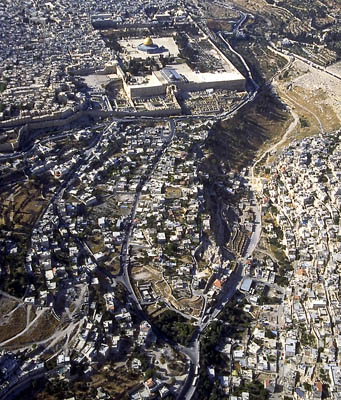
Aerial View of Jerusalem - Temple Mount and City of David. Photo belongs to Ferrell Jenkins.

HT: Paleojudaica; Todd Bolen; Chris Heard