Tag Archives: Apostle Peter

Pontus and Peter’s Epistles

Pontus is mentioned only three times in the New Testament.

  • Devout Jews were present in Jerusalem from Pontus on the day of Pentecost (Acts 2:9). Some of these individuals who accepted the message of Peter on Pentecost might later have been the recipients of his letters.
  • Aquila was a native of Pontus. He had moved to Rome, but being ordered to leave by the Emperor Claudius he came to Corinth where he, along with his wife Priscilla, met Paul (Acts 18:2).
  • Peter addressed his epistles to Christians residing in five different Roman provinces, including Pontus.

Peter, an apostle of Jesus Christ, To those who reside as aliens, scattered throughout Pontus, Galatia, Cappadocia, Asia, and Bithynia, who are chosen (1 Peter 1:1 NAU)

Scholars suggest that the order of the Roman provinces is indicative of the order in which Peter’s epistle was delivered by the messenger. Colin Hemer argues for Amasus (Amisos) as the starting point on the Black Sea coast for the messenger. Amisos is now identified with the Turkish city of Samsun, a prosperous town of over half a million inhabitants (“The Address of 1 Peter.” Expository Times, 89:239-243). Mark Wilson agrees (Bibical Turkey, 338).

The photo below was made from the harbor of Samsun. The hill in the distance marks the ancient acropolis of Amisos.
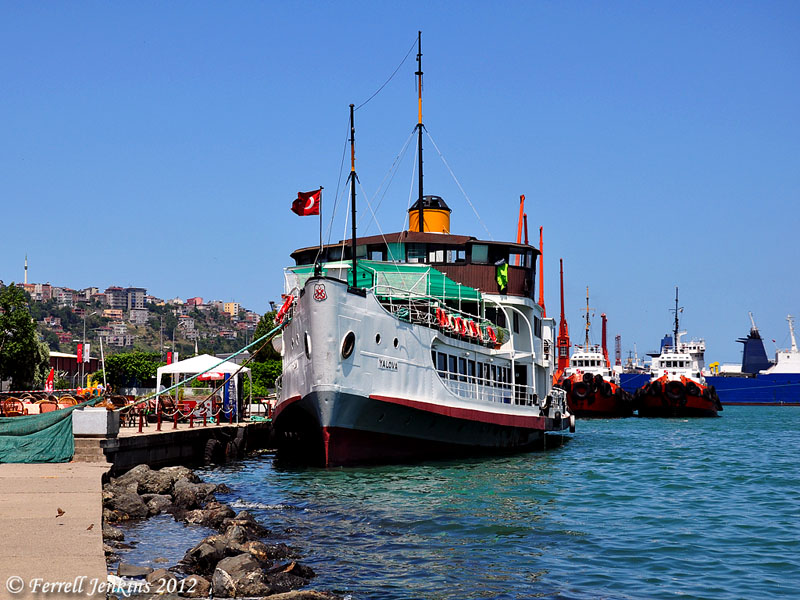
Harbor at Samsun with acropolis of ancient Amisos. Photo by Ferrell Jenkins.

Harbor at Samsun with acropolis of ancient Amiisos, Photo by Ferrell Jenkins.

Even the Romans brought their armies to this region of Asia Minor through the ancient port city of Amisos. This was much easier than traveling overland.

Amisos is mentioned under the same Sampsames in the Apocrypha book of 1 Maccabees 15:23 (RSV).

Tomorrow we hope to visit the Pontic city of Sinop (Sinope), about 100 miles west of Amisos.

Plan to sacrifice to Paul and Barnabas at Lystra

It is often been pointed out that the common designation of The Acts of the Apostles is a bit of an overstatement. Primarily the book of Acts is the story of some of the acts of the apostles Peter and Paul. Luke seems to be telling us that Paul is every bit as genuine an apostle as Peter. Peter can heal a man lame from his mother’s womb (Acts 3:2). So can Paul (Acts 14:8-10).

When the Lystrans saw the healing of the lame man they began to call Barnabas, Zeus, and Paul, Hermes. Luke’s account says that the priest of Zeus prepared to offer sacrifices with the crowds.

13 The priest of Zeus, whose temple was just outside the city, brought oxen and garlands to the gates, and wanted to offer sacrifice with the crowds. 14 But when the apostles Barnabas and Paul heard of it, they tore their robes and rushed out into the crowd, crying out (Acts 14:13-14 NAU)

The photo below provides a good illustration of what happened at Lystra. It is an architectural relief fragment showing preparation for a sacrifice. The large marble fragment belongs to the early part of the second century. It comes from Rome, but is now displayed in the Louvre.

The bull is being brought for sacrifice. It is thought that this represents only part of the original scene. A panel to the right should show the priest and the altar. Perhaps the laurel wreaths worn by the two characters on the left indicates the departure or return of the Roman emperor.

Roman architectural relief shows preparation for sacrifice. Louvre. Photo by Ferrell Jenkins.

Roman relief shows preparation for sacrifice. Louvre. Photo by Ferrell Jenkins.

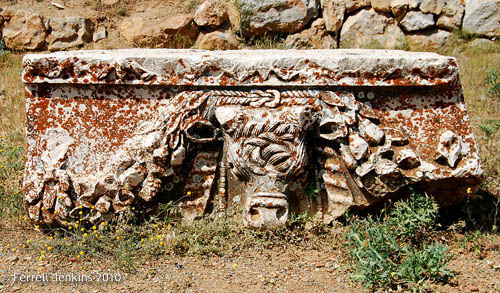
The motif on this altar is common in the Greco-Roman world. The photo below shows a similar bull’s head on what appears to be part of an architectural frieze in the Augustan Imperial Sanctuary at Pisidian Antioch.

Frieze from the Augustan Imperial sanctuary at Pisidian Antioch. Photo by F. Jenkins.

Frieze from the Augustan Imperial sanctuary at Pisidian Antioch. Photo by F. Jenkins.

Peter’s denial of Jesus

Thursday was another activity-filled day for Jesus, but we pick up on the activity late in the day. The Gospel of John fills in a lot of information not contained in the other accounts of His life. Here is what John records:

  • The passover meal (John 13:1-38). John includes no account of the institution of the Lord’s Supper which took place at the time of this meal (Matthew 26:26-29; Mark 14:22-25; Luke 22:17-20). Only John records the washing of the disciples’ feet.
  • His farewell discourses (John 14-16).
  • His priestly prayer for His disciples and those who believe on Him through their word (John 17).
  • His betrayal and arrest (John 18). Note that it would have been fairly late in the evening before He was arrested.
  • He is taken to the house of Annas (John 18:12-14), where he was delivered over to Caiaphas (John 18:24-28). I think the text indicates that Jesus remained there throughout the night.
  • The denial by Peter (John 18:15-18).

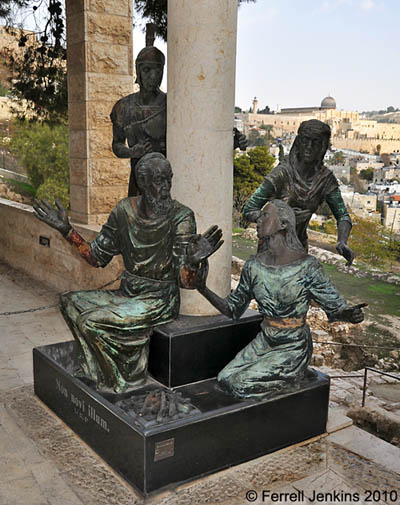
The traditional location for the house of Caiaphas is known as St. Peter in Gallicantu (St. Peter of the Cock Crowing). We have written about the site here, and I will not discuss the authenticity of the place now. The site has a nice statue of Peter saying, “mulier non novi illum.”

Peter denies knowing Jesus. Photo by Ferrell Jenkins at St. Peter in Galicantu.

Peter denies knowing Jesus. Photo by Ferrell Jenkins.

Having arrested Him, they led Him away and brought Him to the house of the high priest; but Peter was following at a distance. After they had kindled a fire in the middle of the courtyard and had sat down together, Peter was sitting among them. And a servant-girl, seeing him as he sat in the firelight and looking intently at him, said, “This man was with Him too.” But he denied it, saying, “Woman, I do not know Him.” (Luke 22:54-57 NAU)

This must have been one of the most hurtful things to Jesus. It is one thing to have acknowledged enemies mistreat you, but when it is done by a supposed friend it is doubly hurtful.

Nero’s revolving dining room found

Numerous news sources have reported the discovery of a revolving dining room from the time of the Emperor Nero in the Roman Forum.

The AP report, as found at CBS News, says,

Archaeologists say they have unveiled what they believe to be remains of the “dining room” of the Roman emperor Nero, part of his palatial residence built in the first century.

Lead archaeologist Francoise Villedieu says her team discovered part of a circular room, which experts believe rotated day and night to imitate the Earth’s movement and impress guests.

Villedieu told journalists Tuesday that the room on the ancient Palatine Hill was supported by a pillar with a diameter of 4 meters (more than 13 feet). She says only the foundation of the room was recovered during the four-month excavation.

The Golden Palace, also known by its Latin name Domus Aurea, rose over the ruins of a fire that destroyed much of Rome in 64 A.D. and was completed in 68 A.D.

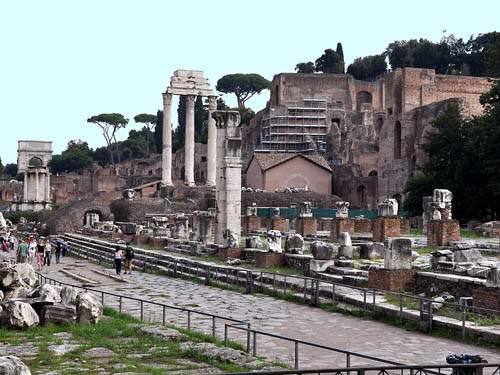
I was rather surprised to see several places in the Forum, and on the Palatine Hill, where excavations are in progress. I don’t know exactly where this new discovery was made, but I thought you might get some indication of the massive amount of work going on by noting the scaffolding in this photo.

Roman Forum and Palatine Hill. Note the scaffolding on the hill. Photo by Ferrell Jenkins.

Roman Forum and Palatine Hill. Note scaffolding on the hill. Photo by F. Jenkins.

The London Daily Mail online has a much longer article with good photos, diagrams, and a video here.

Biblical and historical information indicates that both Paul and Peter were put to death during the reign of Nero.

The empty tomb

The women who came to the tomb of Jesus on the first day of the week found the stone rolled away from the tomb. When they entered the tomb the body was not there (Luke 24:1-3).

The two men (Matthew says angel) said,

He is not here, but has risen. Remember how he told you, while he was still in Galilee, that the Son of Man must be delivered into the hands of sinful men and be crucified and on the third day rise.” (Luke 24:6-7 ESV)

Several tombs of the type in which Jesus was buried have survived the centuries. This one was discovered during road construction a few years ago near Mount Carmel.

A Roman Period tomb with a rolling stone. Photo by Ferrell Jenkins.

A Roman Period tomb with a rolling stone. Photo by Ferrell Jenkins.

The women told the apostles what happened when they went to the tomb.

1 Now on the first day of the week Mary Magdalene came to the tomb early, while it was still dark, and saw that the stone had been taken away from the tomb. 2 So she ran and went to Simon Peter and the other disciple, the one whom Jesus loved, and said to them, “They have taken the Lord out of the tomb, and we do not know where they have laid him.” (John 20:1-2 ESV)

The Gospel of John records the reaction of Peter and the other disciple [John]:

3 So Peter went out with the other disciple, and they were going toward the tomb. 4 Both of them were running together, but the other disciple outran Peter and reached the tomb first. 5 And stooping to look in, he saw the linen cloths lying there, but he did not go in. 6 Then Simon Peter came, following him, and went into the tomb. He saw the linen cloths lying there, 7 and the face cloth, which had been on Jesus’ head, not lying with the linen cloths but folded up in a place by itself. 8 Then the other disciple, who had reached the tomb first, also went in, and he saw and believed; 9 for as yet they did not understand the Scripture, that he must rise from the dead. 10 Then the disciples went back to their homes. (John 20:1-10 ESV)

I asked Frank and Norm, two living disciples, to stoop and look into an empty tomb much the way Peter and John did on that first day of the week.

Two disciples look into an empty tomb. Photo by F. Jenkins.

Two disciples look into an empty tomb. Photo by F. Jenkins.