Category Archives: Turkey

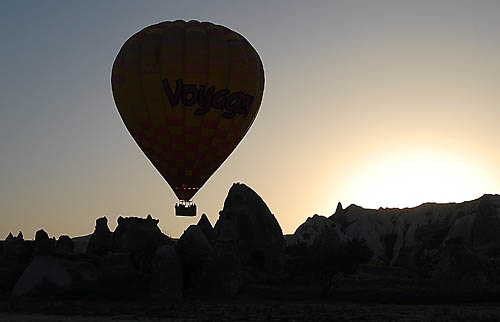
Cappadocian sunrise

He is a photograph I made at sunrise in the Cappadocian region of Turkey.

Cappadocian sunrise. Photo by Ferrell Jenkins.

Cappadocian sunrise. Photo by Ferrell Jenkins.

The Bible tells us that Jews of Cappadocia were present in Jerusalem on the day of Pentecost (Acts 2:9). Peter wrote his epistles to saints scattered throughout Cappadocia and other places in Roman Asia Minor (modern Turkey).

Peter, an apostle of Jesus Christ, To those who are elect exiles of the dispersion in Pontus, Galatia, Cappadocia, Asia, and Bithynia,  2 according to the foreknowledge of God the Father, in the sanctification of the Spirit, for obedience to Jesus Christ and for sprinkling with his blood: May grace and peace be multiplied to you. (1 Peter 1:1-2)

China Olympics opening is spectacular

I suspect that everyone reading this post saw either the opening ceremony of the Beijing 2008 Olympics or at least a few news clips about it. The Olympics originated with the Greeks centuries before Christ. The Isthmian games were conducted at Isthmia, a few miles from Corinth.

Paul used several illustrations relating to athletics in the epistles to the Corinthians.

Do you not know that those who run in a race all run, but only one receives the prize? Run in such a way that you may win. Everyone who competes in the games exercises self-control in all things. They then do it to receive a perishable wreath, but we an imperishable. Therefore I run in such a way, as not without aim; I box in such a way, as not beating the air;  but I discipline my body and make it my slave, so that, after I have preached to others, I myself will not be disqualified. (1 Corinthians 9:24-27 NASB)

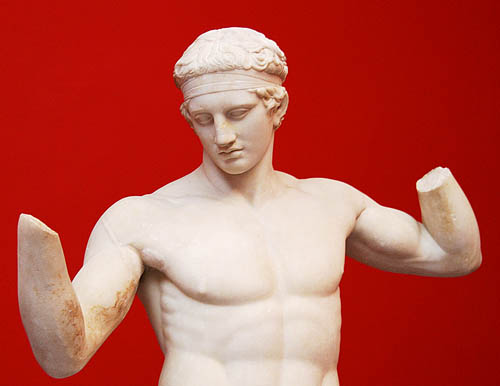
The Greeks had two words for crown. The diadema was the crown of the king. The stephanos was the crown of the victor in the races. This is the term used by Paul in the text above (the word wreath). Here is a photo of a nice sculpture displayed in the Athens National Archaeological Museum showing a young athlete wearing the stephanos. Incidentally, the stephanos was often made of olive branches, or other perishable items.

Young athlete wearing a crown (stephanos). Athens National Archaeological Museum. Photo by Ferrell Jenkins.

Young athlete wearing a crown (stephanos). Athens National Archaeological Museum. Photo by Ferrell Jenkins.

John also speaks of the stephanos. To the saints at Smyrna (modern Izmir in Turkey) he says,

Be faithful until death, and I will give you the crown of life. (Revelation 2:10).

Enjoy the Olympics, but think of the more important spiritual lessons.

A river in Pamphylia

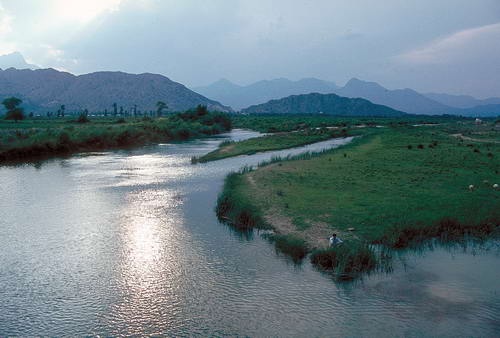
This week I am busy with a number of projects, but I wanted to share a beautiful photo that I made early one morning in the mid-80s. This is a river that flows from the Tarus Mountains into the Mediterranean at Antalya, Turkey. Antalya is know in the Bible as Attalia. Paul and Barnabas sailed from Attalia at the conclusion of the first preaching journey.

When they had spoken the word in Perga, they went down to Attalia. From there they sailed to Antioch, from which they had been commended to the grace of God for the work that they had accomplished. (Acts 14:25-26)

Attalia was in the Roman province of Pamphylia in the days of Paul.

A river in Pamphylia with the Tarus Mountains in the background.

The joy of traveling together

It is unfortunate that many younger couples are not able to travel to the lands of the Bible. This is especially true of young preachers who need the knowledge they could gain in their ministry. Some young folks could travel to these places if they wanted to. One fine lady who, along with her husband, had been on a tour to Israel and Greece, told me that she had rebuked (not her word) some of the young professionals she knew. She told them that they ought to give up a few ski trips and go to the Bible lands. A matter of priorities, isn’t it.

I find that many women want to travel, but their husbands refuse to do so. It often happens that the husband dies and the wife gets to travel. Too bad they could not have made these memories together. Elizabeth and I have enjoyed being blessed to travel to many parts of the world. We realize that most of those years are behind us and we have great memories to share. And we have made many wonderful friends in our travels.

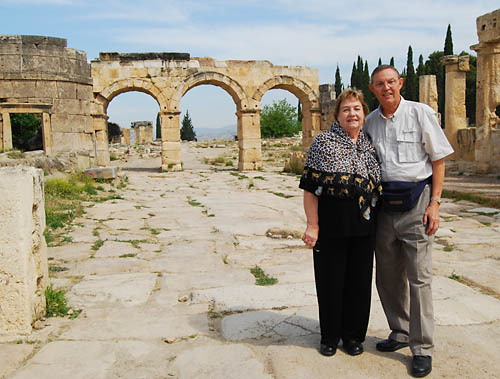
The photo below was made at Pamukkale, Turkey (ancient Hierapolis). We are standing on the colonnaded Roman road, and the monumental gateway behind us is the Arch of the Emperor Domitian (A.D. 81-96). It was constructed in A.D. 82-83.

Hierapolis was the home of Papias (c. A.D. 60 to c. A.D. 130). He was a disciples of the apostle John and a companion of Polycarp. There are some traditions associating Philip (apostle?, evangelist?) with the city.

The city of Hierapolis is one of the three cities of the Lycus River valley named in the New Testament.

For I testify for him that he has a deep concern for you and for those who are in Laodicea and Hierapolis. (Colossians 4:13).

Assos temple to be restored

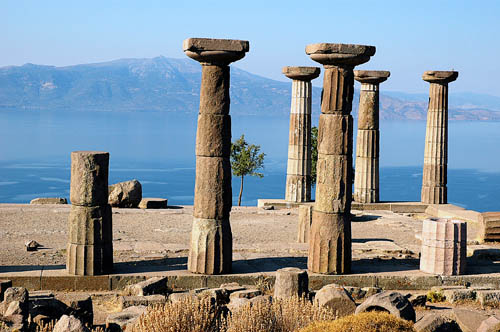
The current issue of Artifax reports that the temple of Athena at Assos in northwestern Turkey is to be restored. The temple was built originally about 540-530 BC. The project is expected to take about three years. Many pieces of the temple are scattered in museums (Istanbul Archaeological Museum, Louvre, Boston Museum of Fine Arts). The temple is built on a high cliff overlooking the sea. Here is the way the temple looks now.

The apostle Paul undoubtedly saw the temple of Apollo when he traveled the approximate 20 miles from Alexandria Troas to Assos by land. His companions had traveled by boat from Troas to Assos. The historical account reads this way:

But going ahead to the ship, we set sail for Assos, intending to take Paul aboard there, for so he had arranged, intending himself to go by land. And when he met us at Assos, we took him on board and went to Mitylene. (Acts 20:13-14 ESV)

The island across the strait is Lesbos. Further south is the town of Mitylene on Lesbos. Lesbos is now a Greek island in the Aegean.

Philadelphia, the church with an open door

Philadelphia is located about 30 miles southeast of Sardis in the valley of the Cogamis, a tributary of the Hermus. The city is built on the slope of Mount Tmolus overlooking a fertile valley. Philadelphia was in the province of Lydia in Western Asia Minor.

Philadelphia stood at the place where the borders of Mysia, Lydia, and Phrygia met. “It was characteristically a border town” (Barclay). This position made it the gateway to the East. Ramsay says,

“the Imperial Post-Road of the first century, coming from Rome by Troas, Pergamum and Sardis, passed through Philadelphia and went on to the East; and thus Philadelphia was a stage on the main line of Imperial communication” (The Letters to the Seven Churches 395).

The site of ancient Philadelphia is now covered by the Turkish agricultural town of Alashehir which has a population of about 20,000. Alashehir (Red City) is named for the volcanic earth in the area (Blaiklock 122). The plain is filled with vineyards. If Philadelphia were not a Biblical city very few tourists would put forth the effort to visit it.

According to Hemer, the location had one great disadvantage.

“It lies perilously close to the region known as the Catacecaumene (“the burnt land”) of Lydia, a hilly tract to the northeast which contained volcanic cones which had been active in recent geological time. And the whole area lies in the Anatolian fault system. Philadelphia was peculiarly liable to earthquake” (Hemer, “Unto the Angels of the Churches,” Buried History 11 (1975), 166).

Trench says, “No city of Asia Minor suffered more, or so much, from violent and often recurring earthquakes.” In A.D. 17 there was a destructive earthquake in the region which affected 12 cities. Sardis suffered worst, but Philadelphia is also mentioned. The cities were exempted from direct taxation and Tiberius provided personal funds for relief (Tacitus. Annals. 2.47).

Ramsay, who spent much time in Asia, reports that “the first great shock of earthquake is not so trying to the mind as the subsequent shocks, even though less severe, when these recur at intervals during the subsequent weeks and months….” Colin J. Hemer visited Philadelphia in 1969 just a few days after an earthquake (172-73). The people would leave the city and go out into the open fields and live in tents. When all danger was passed, and they did the necessary rebuilding, they would go back into the city. Strabo reports this in A.D. 20 (Ramsay), and Hemer provides a photograph of people living in tents outside their houses in 1969.

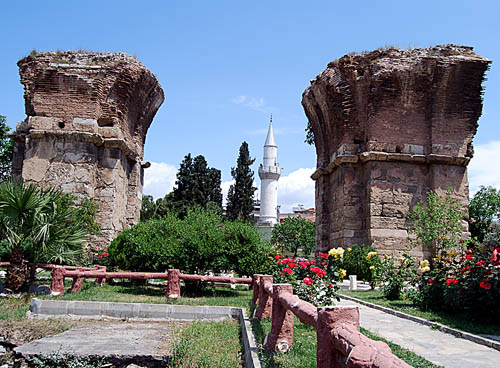
Our photo shows the ruins of the Byzantine church. Local tradition says this building served as a cathedral dedicated to St. John the Theologian. In Turkey the minaret is positioned to be in almost every tourist photo.
Toward the end of the first century the Lord sent a letter to the church at Philadelphia (Revelation 1:11; 3:7-13). The Lord commended the church with these words:

Behold, I have put before you an open door which no one can shut, because you have a little power, and have kept My word, and have not denied My name. Revelation 3:8

Another kind of Poppy

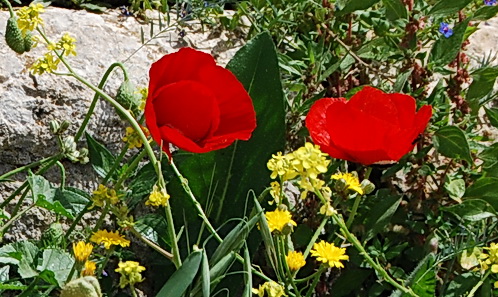
A few days ago I posted a photo of some poppies in Turkey and included the term anemone with it here. Reader J. P. Van de Griessen, of the Netherlands, informed us that he thinks that this is the “Papaver rhoeas or family of it.” I do not have much knowledge about plants, but I had noticed that the poppies in Turkey were a bit different from the ones I have seen in Israel and Jordan in the spring of the year. J. P. has a section of his blog dealing with flora. Even if you can not read the Dutch you might be able to make a suitable translation using the Google language tools.

In the past three trips to Israel, with good digital equipment, I have not seen many poppies growing. In past visits, earlier in the year, we have seen entire fields colored with them. Here is a photo of some poppies among the ruins at Jerash in Jordan.

I understand this to be the anemone. Dr. David Darom, in Beautiful Plants of the Bible, calls it the common poppy (Papaver sp.). One Wikipedia article indicates that there are more than 150 varieties of the poppy. Darom links this plant with the “lilies of the field” mentioned by Jesus.

And why are you worried about clothing? Observe how the lilies of the field grow; they do not toil nor do they spin, yet I say to you that not even Solomon in all his glory clothed himself like one of these. “But if God so clothes the grass of the field, which is alive today and tomorrow is thrown into the furnace, will He not much more clothe you? You of little faith! (Matthew 6:28-30)

The UBS Fauna and Flora of the Bible comments on the New Testament word krinon:

It is used by Jesus in the Sermon on the Mount, when he says: ‘Even Solomon in all his glory was not arrayed like one of these.’ Most commentators now think of the Anemone coronaria, the anemone with beautiful bright colours which is to be found on the hills of Galilee, where it would undoubtedly have been seen by the people listening to Jesus. (page 135)

Thanks, J.P. Any other help will be appreciated.

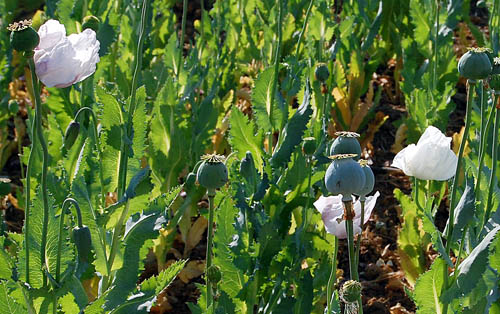
Speaking of poppies. In Turkey, another type of poppy is legally cultivated. On the outskirts of Yalvac (near Pisidian Antioch of Acts 14), I have seen cultivated fields of white poppies along the road. Under U. S. pressure, Turkey outlawed the growing of poppies in 1971. By 1974 they were allowing them to be grown under strict government control. Government factories convert the dried stems into poppy-straw concentrate (PSC) and then into morphine and codeine (See “The Poppy,” National Geographic, Feb., 1985, pp. 143-189). Here is a photo I made last year. I trust that I will not be charged with possession of a poppy photo!

From the mountains of Ararat to the island called Patmos

Or, from Genesis to Revelation. I did not make an intentional plan to do so, but within the past twelve months I have visited areas of the Bible world, from the mountains of Ararat to the island of Patmos. What a blessing to have the opportunity to spend about four weeks in Turkey, covering most of the sites mentioned in the Bible, about 10 days in Greece, more than a week in Israel, and a week in Jordan.

This means that I have been able to visit some of the most significant portions of the Bible world. Better than visiting the area alone, I have been able to share the area with other teachers (both men and women) who will be incorporating this information into their lessons for years to come.

When I first reflected on the past year and realized that I had been to Mount Ararat, in the mountains of Ararat, and on the Island of Patmos, I realized that this covers from Genesis 6 to the book of Revelation. Of course, this doesn’t mean that I have visited every place in between, but it does give a sense of comprehensive overview.

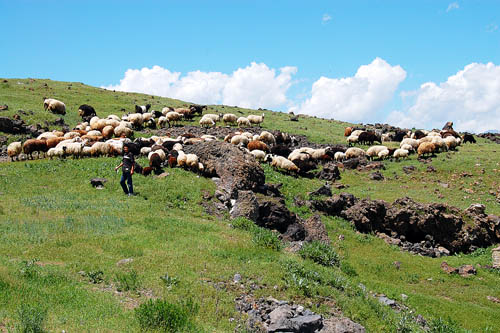
Here are a couple of photos I trust you will find helpful. The first is of a shepherd with his sheep in the mountains of Ararat. Remember that the book of Genesis records that Noah’s ark rested “upon the mountains of Ararat” (Genesis 8:4).

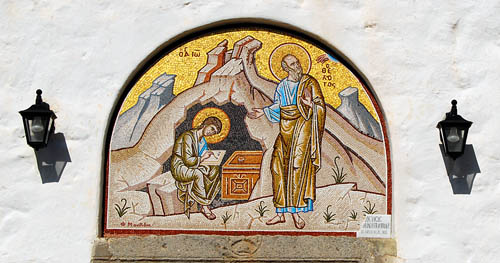
This photo was made at the entry to the cave of the Apocalypse on “the island called Patmos” (Revelation 1:9). John was exiled here during the reign of the Roman emperor Domitian. Whether the book of Revelation was written on Patmos, or after John’s release, we can not say with certainty. The mosaic over the entry to the cave shows John dictating the revelation given to him by the Lord.

It is my conviction that Bible land travel can enhance one’s Bible study and improve one’s understanding of the text. This, in turn, needs to be converted to action in obedience to the will of the Lord, and in service to Him.

A pretty picture

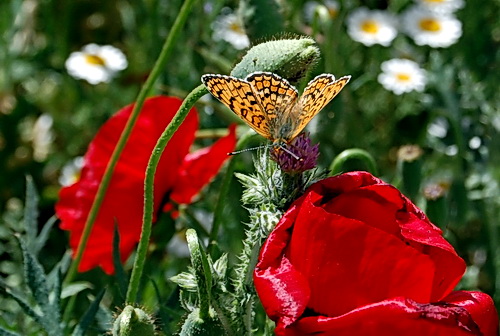
While looking for a photo for use in a lesson for Sunday I noticed this photo that I made near Konya, Turkey. This is the site of biblical Iconium (Acts 13:51-14:5). I was lucky to catch the butterfly on a poppy (anemone). Enjoy.

Ephesus and Miletus

This morning we visited the city of Ephesus, one of the most spectacular excavated sites to be seen anywhere. Austrian archaeologists have worked here for the past 115 years. The city has taken on what Blaiklock calls, an “edited look.” And the work continues.

Items of interest at Ephesus include the single standing column of the Temple of Diana (Artemis), the harbor which is now silted up, the great theater which seated nearly 25,000 (Acts 19:29), the Marble street, the Library of Celsus, the Agora, the Temple of Hadrian, the Temple of Domitian (or the Flavian Emperors), and much more.

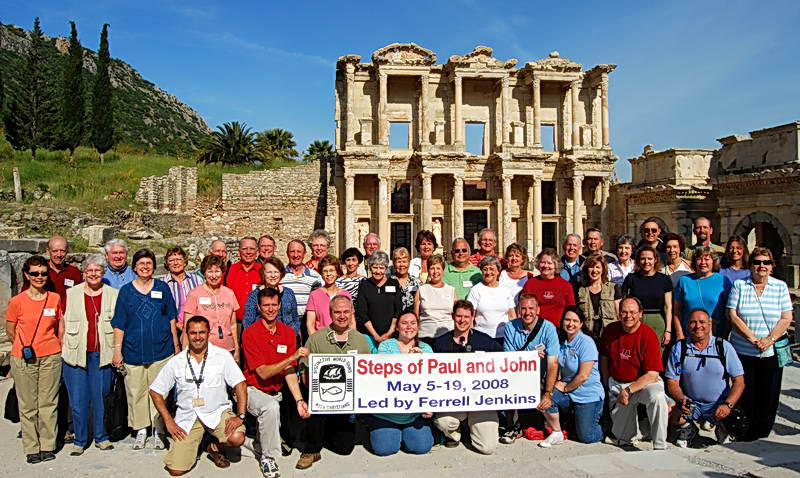
We had a group photo made in front of the Library of Celsus at Ephesus. Here is a small copy of the photo. If you know some of the folks on the tour and would like to see a larger photo, just click on the small one.

Group photo in front of the library of Celsus at Ephesus.

The first instance of believers baptized into Christ at Ephesus is recorded in Acts 19. Many changes took place in the church between the time when Paul spent nearly three years in the city, and the time when John lived there. There are two letters in the New Testament addressed to the church at Ephesus. The first is the letter of Paul to the Ephesians. The other is the letter included in the book of Revelation (Revelation 2:1-7).

The Archaeological Museum in Seljuk contains many items from Ephesus. There are two statues of Diana.

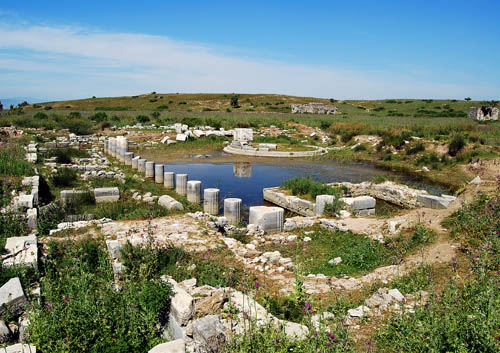
After lunch at a carpet shop we went to Miletus where Paul preached to the Ephesian elders (Acts 20). Construction of the theater began in the fourth century B.C. The Lion harbor was built in 63 B.C. Our photo shows the remnants of the Lion harbor. The entire harbor has silted up over the centuries, but a small amount of water stands in the inner harbor. I think this is likely where Paul docked, and the place from which he departed for Jerusalem.

The biblical account of Paul’s departure is touching. Luke records,

When he had said these things, he knelt down and prayed with them all. And they began to weep aloud and embraced Paul, and repeatedly kissed him, grieving especially over the word which he had spoken, that they would not see his face again. (Acts 20:36-38).

Note especially these final words about the event:

And they were accompanying him to the ship.

Try to envision this scene as you look at the photo.