Category Archives: Turkey

More illustrations of apocalyptic imagery

We mentioned in earlier posts on apocalyptic literature that composite images were common among the Assyrians, Babylonians, and Persians. This was also true of the Hittites who lived in the upper Euphrates area. The Anatolian Civilization Museum at Ankara contains many of the reliefs from Carchemish on the Euphrates. The one below shows two human-headed sphinx standing. There is also a winged horse standing between them. They appear to be dancing.
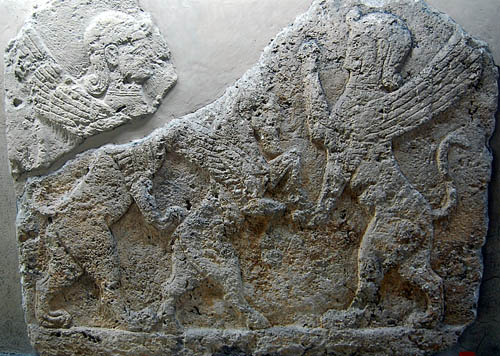
Human-headed sphinxs standing; winged horse standing. Photo by F. Jenkins.

Human-headed sphinx standing; winged horse standing. Photo by F. Jenkins.

This drawing from the Museum may show the image more clearly. Notice the bird head on the tail of the sphinx on the right.
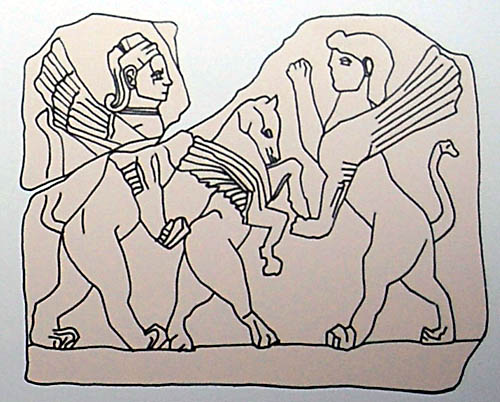
Drawing of the human-headed sphinx and standing horse.

Drawing of the human-headed sphinx and standing horse.

This one is of special interest. It shows a lion with wings and a human head.  The tail shows the head of a bird. There are four images in composite form. This basalt orthostat also comes from Carchemish.
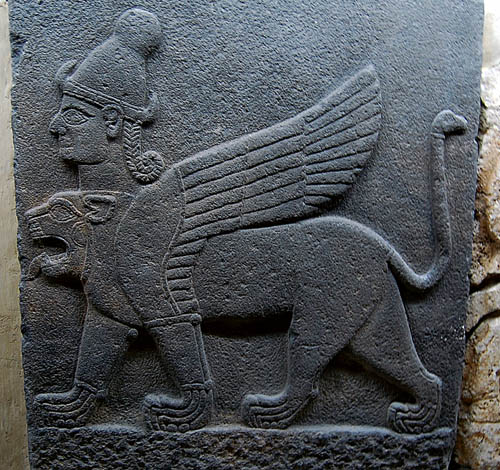
Three-headed sphinx.

Three-headed sphinx.

Judeans who were taken captive to Babylon traveled in this region on their way to their place on the Chebar (Kebar) River in southern Mesopotamia. We know that Nebuchadnezzar made his headquarters at Riblah in the land of Hamath. Because this region was part of the Fertile Crescent we can be sure that the Judeans traveled in the area on their long trip from Judea to Babylon. See 2 Kings 25:6-7.

We are not saying that Ezekiel borrowed his composite creatures from the culture around him. We are saying that such was common and that it would not have been unusual or strange to Ezekiel or his hearers/readers.

Notice, again, Ezekiel’s description of the creatures he saw:

These are the living beings that I saw beneath the God of Israel by the river Chebar;  so I knew that they were cherubim.  Each one had four faces and each one four wings, and beneath their wings was the form of human hands.  As for the likeness of their faces, they were the same faces whose appearance I had seen by the river Chebar. Each one went straight ahead. (Ezekiel 10:20-22 NASB)

For the images in the book of Daniel we could show numerous composite creatures from Babylon.
More about the Cherubim

To the illustration from Byblos included with W. F. Albright’s article I would like to add a few photographic illustrations that might be helpful in understanding the concept of the Cherub as well as the general concept of composite beasts in the Apocalyptic books of Ezekiel, Daniel,  Zechariah, and Revelation.

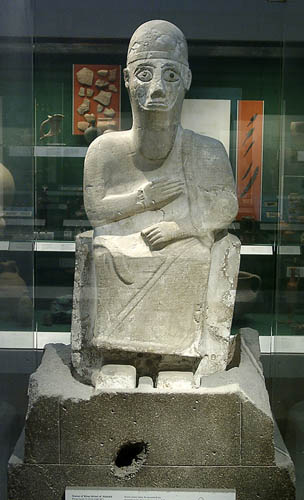
Throne of King Idrimi of Alalakh. Photo by Ferrell Jenkins.

Throne of King Idrimi of Alalakh. Photo by F. Jenkins.

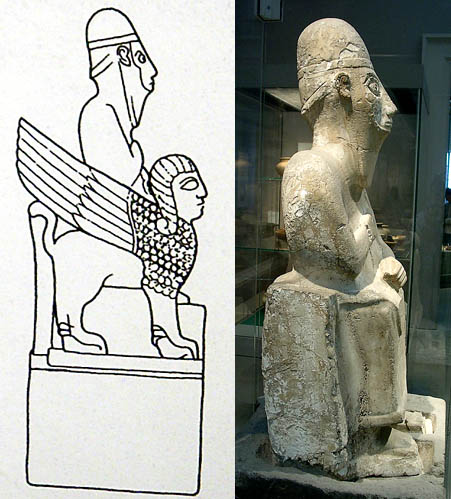
The photo above shows the front of the Statue of King Idrimi of Alalakh, now displayed in the British Museum. An associated cuneiform inscription tells that this king, following a popular revolt, was forced into exile. He went first to Emar on the Euphrates, then to Canaan, where he joined other refugees from Syria and lived with the Hapiru. Seven years later he recaptured the district of Mukish and was acclaimed king of Alalakh.

King Idrimi of Alalakh. Photo by F. Jenkins.

King Idrimi of Alalakh. Photo by F. Jenkins.

The drawing on the left (above) shows the suggested reconstruction of the throne of King Idrimi of Alalakh (1570-1500 BC) . Alalakh is located in North Syria, near the Orontes River. Due to political changes, Alalakh, Tell Atshana [Açana], is now in southern Turkey. See The New International Dictionary of Biblical Archaeology or The Biblical World for more information about the excavations at Alalakh.

This photo on the right (above) shows the right side of the statue as it is displayed in the British Museum.

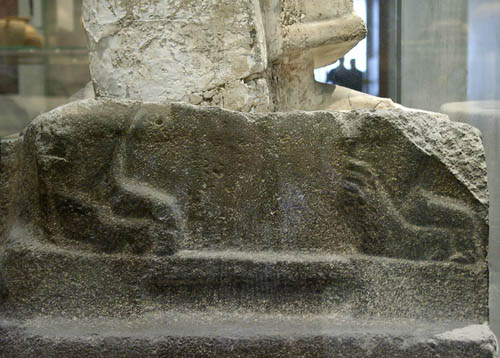
Right side base of throne of the King of Alalakh.

Right side base of throne of the King of Alalakh.

The photo above shows the base of the right side of the statue. The front and hind feet of the “creature” upon which the throne stands are clearly visible.

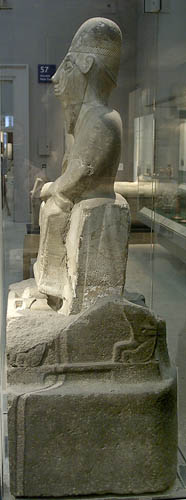
Left side of the throne.

Left side of the throne.

The photo to the right shows the left side of the throne. The front and hind legs of the animal can be seen.

Recall these references from the Bible describing the LORD as riding on a cherub.

And He rode on a cherub and flew; And He appeared on the wings of the wind. (2 Samuel 22:11)

He rode upon a cherub and flew; And He sped upon the wings of the wind. (Psalm 18:10)

These are the living beings that I saw beneath the God of Israel by the river Chebar; so I knew that they were cherubim. (Ezekiel 10:20; see entire chapter)

We are saying that images such as the one discussed here provide an idea of the imagery involved in the biblical description of the cherubim.

Perhaps later we will be able to include some photos of representations of the cherubim upon the ark of the covenant.

Celebrating 100,000 visitors; a gift for you

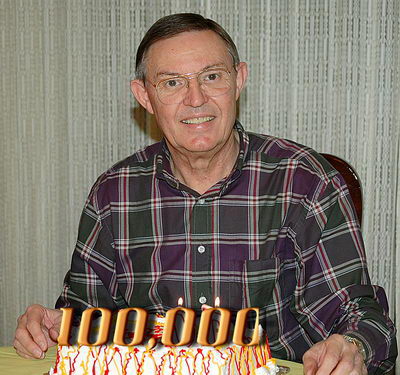
Thanks for visiting Ferrell’s Travel Blog. This afternoon our Blog Stats moved above 100,000. I think when we began the blog we only had in mind that families of some of our tour members could follow our route of travel. Then I began to write about other places I had visited. Well, here we are today.

As my wife and I looked at the stats I said, “Well, we have reached a millstone, if not a milestone.” She said, “Yes, it is a millstone.” I must admit it has become addictive. But when I realize that I am reaching a large number of people each day/week/month with something that may be beneficial in Bible study and teaching, I am delighted.

Ferrell Jenkins celebrating 100,000 visitors.

Ferrell Jenkins celebrating 100,000 visitors.

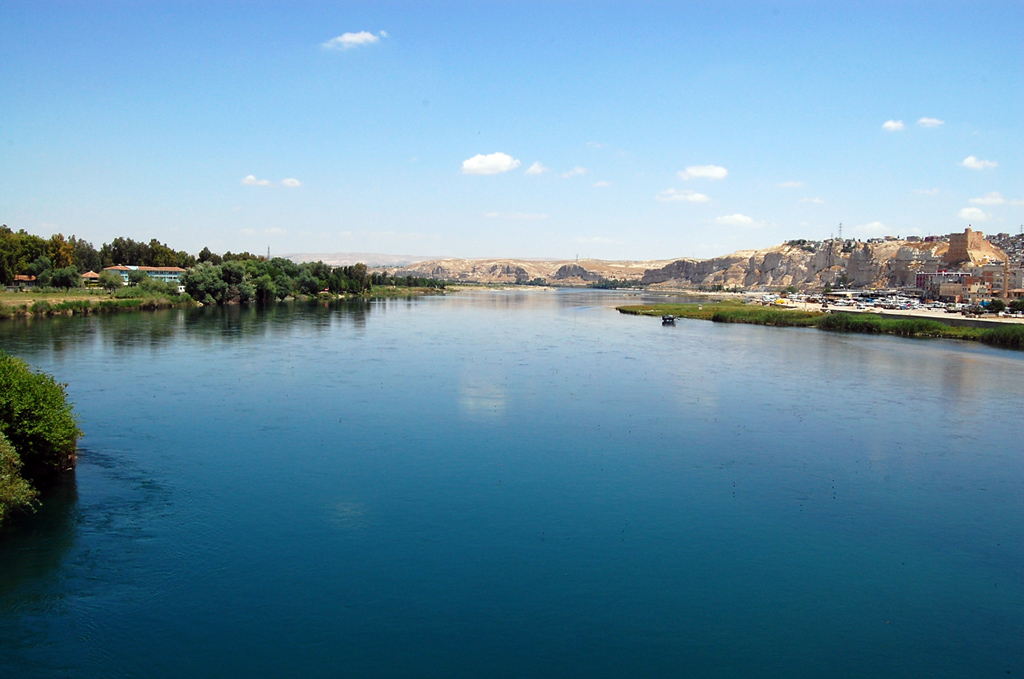
I want to share a gift that may be of benefit to those who use PowerPoint presentations in teaching. During the life of the blog, more people have visited our pages on the Euphrates River than any other. Here is a photo of the Euphrates at Birecik, Turkey. Click on the small photo below and it will take you to a high resolution photo that you may download and use. We request that you not publish the photo without permission. A digital copyright notice is embedded in the image.

The Euphrates River at Birecik, Turkey. Photo by Ferrell Jenkins.

The Euphrates River at Birecik, Turkey. Photo by Ferrell Jenkins.

The Euphrates is the largest, longest and most important river of Western Asia. It is nearly 1800 miles long and was the northeastern boundary of the land promised to Abraham (Gen. 15:18). The empires of Assyria and Babylon, the greatest enemies of Israel, were east of the Euphrates. The Old Testament prophets often put the Euphrates by metonomy for these countries to designate the place from which the punishment of God would come (Isa. 7:20; 8:7; Jer. 46:10). For more information on the Euphrates River read the article here.

Text and Canon in Providence, RI

For the past few days I have been in Providence, RI, attending meetings of the Evangelical Theological Society (ETS) and the Near East Archaeological Society (NEAS). The theme for the ETS annual meeting was Text and Canon. I attended the four plenary session papers. These were extremely worthwhile. Here are the topics and speakers:

  • Old Testament Text – Peter J. Gentry
  • Old Testament Canon – Stephen Dempster
  • New Testament Text – Daniel B. Wallace
  • New Testament Canon – Charles E. Hill

Current, scholarly, material on these topics are needed among God’s people today.

I also attend several sessions of the NEAS. I heard Bryant Wood present evidence suggesting that Mount Sinai possibly should be identified with Gebel Khashm et-Tarif, and calling for more research in the area. This site is located about 22 miles north-northwest of the Gulf of Aqaba/Eilat in the Wilderness of Paran on the current Egyptian side of the border. For more information check the Associates for Biblical Research website here.

In one session I heard Rex Geissler present some of the historical evidence for the area of ancient Urartu as the place associated with Noah’s Ark. Rex is president of Archaeological Imaging Research Consortium (ArcImaging). Over at the Biblical Studies Info Page I have several links to good photos by Rex in various parts of the world. You can get to his material at the ArcImaging page.

Bill Crouse presented material to bolster the case for an identification of the landing place of the ark with Mount Cudi in southereastern Turkey. I think Gordan Franz presented material in defense of this view also, but I was unable to be present.

There were two reports on the excavations this year at Tel Gezer in Israel.

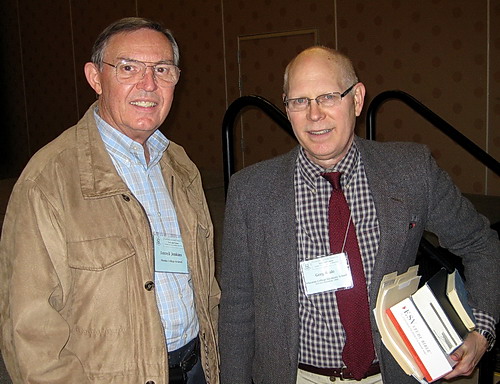
Crossway, publisher of the English Standard Version of the Bible, has been sponsoring a special lecture for the past few years. The lecture this year featured Gregory K. Beale of Wheaton College on The Authority of Scripture: A Biblical Theology According to John’s Apocalypse. This was a great paper. Beale is author of The Book of Revelation: A Commentary on the Greek Text (New International Greek Testament Commentary). I had heard Beale speak before, but it was a pleasure to hear him again and visit for a few moments. I am honored that my The Old Testament in the Book of Revelation is mentioned in a footnote of this commentary.

Ferrell Jenkins and Gregory K. Beale at ETS Annual Meeting. Photo by Leon Mauldin.

Ferrell Jenkins and Gregory K. Beale at ETS Annual Meeting. Photo by Leon Mauldin.

The book display at ETS has grown substantially over the years I have been attending the annual meetings(since 1975). The professors and others who attend get an opportunity to buy the recent publications in biblical studies at a sizable discount. I buy very few these days, but I have taken advantage of this opportunity over the years.

Well, its on to Boston for more meetings.

For a Florida guy, I must say that it is cold up here.

Iron Age stele speaks of soul apart from body

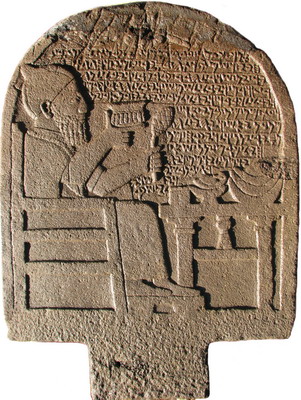
The New York Times reports here on the discovery of an interesting stele at Sam’al/ Zincirli (ZIN-jeer-lee), an ancient site in southeastern Turkey.

In a mountainous kingdom in what is now southeastern Turkey, there lived in the eighth century B.C. a royal official, Kuttamuwa, who oversaw the completion of an inscribed stone monument, or stele, to be erected upon his death. The words instructed mourners to commemorate his life and afterlife with feasts “for my soul that is in this stele.”
…..
“Normally, in the Semitic cultures, the soul of a person, their vital essence, adheres to the bones of the deceased,” said David Schloen, an archaeologist at the university’s Oriental Institute and director of the excavations. “But here we have a culture that believed the soul is not in the corpse but has been transferred to the mortuary stone.”

A translation of the inscription by Dennis Pardee, a professor of Near Eastern languages and civilization at Chicago, reads in part: “I, Kuttamuwa, servant of [the king] Panamuwa, am the one who oversaw the production of this stele for myself while still living. I placed it in an eternal chamber [?] and established a feast at this chamber: a bull for [the god] Hadad, a ram for [the god] Shamash and a ram for my soul that is in this stele.”

Here is a photograph of the stele provided by the University of Chicago.

University of Chicago.

Stele from Zincirli in which the king says that his soul is in this stone. Photo: University of Chicago.

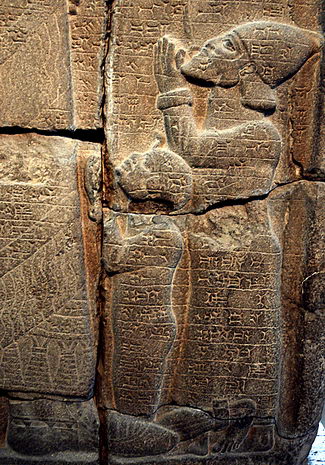
A well known monuments discovered at Zincirli in 1888 depicts the Assyrian king Esarhaddon holding ropes leading to Tirhakah, king of Egypt and Ethiopia [Cush], and Ba’alu of Tyre. Tirhakah is the kneeling figure with negroid features befriended King Hezekiah of Judah against the Assyrians (2 Kings 19:9). The photo below shows the two captives on the lower portion of the stele. It is now displayed in the Pergamum Museum in Berlin.

Esarhaddon stele showing Tirhakah and the king of Tyre. Photo by Ferrell Jenkins.

Esarhaddon stele showing Tirhakah and the king of Tyre. Photo by Ferrell Jenkins.

Alexandria Troas # 3

For # 1 scroll down to November 7, or click here. For # 2 scroll down to November 10, or click here.

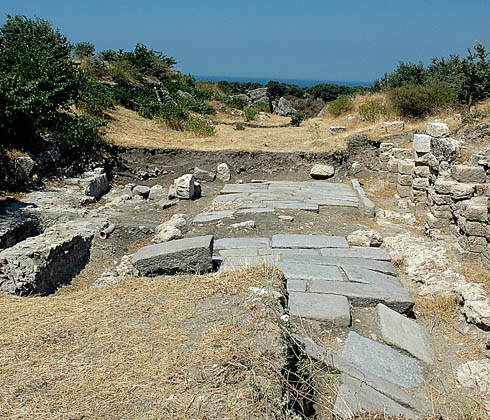
Recent excavations by the University of Münster have uncovered a portion of the Roman road at Troas. A member of the staff said, “We like to think that this is the road traveled by the apostle Paul when he entered the city.” Perhaps this photo helps illustrate the statement in Acts 16:8 which says “they came down to Troas.” The Aegean Sea is visible in the distance.

Recently excavated Roman road at Troas. Photo by Ferrell Jenkins 2006.

Recently excavated Roman road at Troas. Photo by Ferrell Jenkins 2006.

Alexandria Troas # 2

For # 1 scroll down to November 7, or click here.

Paul visited Troas on the return from his third journey. His companions, including the men who were taking the contribution to the poor among the saints at Jerusalem arranged time to be with the disciples on the first day of the week. When they met to break bread Paul spoke for a long time and raised Eutychus (Acts 20:4‑12). After the raising of Eutychus, Paul’s companions set sail for Assos, but Paul decided to travel about 20 miles south by land from Troas to Assos and meet the ship there (Acts 20:13‑14).

On another occasion, while awaiting the return of Titus from Corinth, Paul was very discouraged during his stay at Troas (2 Cor. 2:12ff.). He did not write a letter to the church at Troas, but in his last letter he requested Timothy to bring the cloak, the books, especially the parchments, which he had left at Troas with Carpus (2 Tim. 4:13).

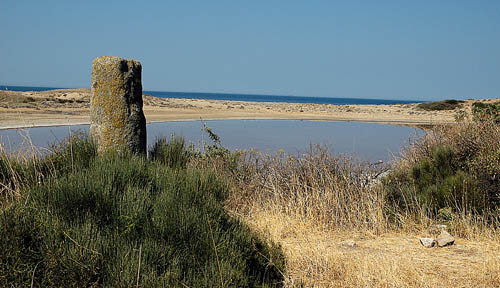
The inner harbor at Troas. Photo by Ferrell Jenkins.

The inner harbor at Troas. Photo by Ferrell Jenkins.

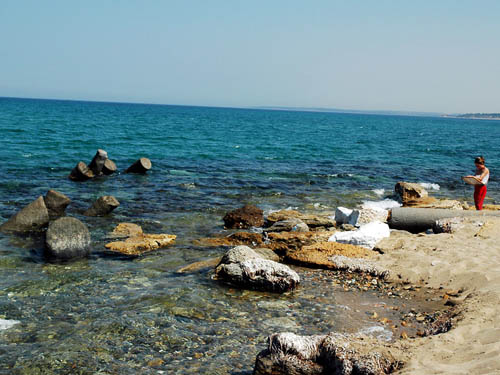
Earlier visits to Troas have allowed us to see only a few exposed ruins and a pathetic looking artificial harbor. The entry to the harbor is now clogged up; water flows into the harbor from the Aegean Sea, but none flows out. Over the past ten years archaeologists from the University of Münster and other institutions have been excavating in Troas. We will show some of the new discoveries in the next post.

The outter harbor at Troas. Photo by Ferrell Jenkins.

The outter harbor at Troas. Photo by Ferrell Jenkins.

New photo header

The new header shows one of the streets in the temple area at the ancient Hittite capital of Hattusas (now Bogazkale in Turkey). The Hittites are mentioned more than 40 times in the Old Testament.

Alexandria Troas

The terms Troy, Troas, and Troad were derived from the name of the ancient people known as the Troes. The Troes lived in the Troad. This region became part of the Roman province of Asia, and was a substantial portion of the area known as Mysia which included the cities of Troas, Assos and Pergamum.

The term Troas or Troad was used to describe the region where Alexander first defeated the Persians in the Battle of Granicus. The city of Alexandria Troas, located about 10 miles from ancient Troy was first called Antigonia. Lysimachus changed the name to Alexandria in about 300 B.C., but there were many cities named for Alexander, so this one came to be called Alexandria Troas.

Colin Hemer points out that “Troas was a nodal point on what became a sophisticated system of international routes, organized functionally with regard to complex variables of speed and safety, of season and weather and conditions by land and sea.” Troas was, therefore, an ideal place from which the Gospel would spread into Europe.

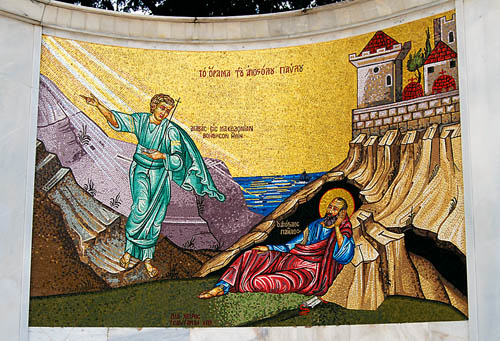
Troas was made a Roman colony by Augustus, and became one of the important cities of northwest Asia. A man of Macedonia appeared in a night vision to Paul at Troas and immediately his traveling party sailed for Macedonia (Acts 16:8‑11). Timothy, Silas, Luke, and perhaps others, were with Paul at Troas.

This photo from Berea illustrates the vision of the man of Macedonia calling on Paul to come over into Macedonia.

A man of Macedonia appears to Paul at Troas. Photo by Ferrell Jenkins.

A man of Macedonia appears to Paul at Troas. Photo by Ferrell Jenkins.

Ask in the next village

Once while visiting the site of Lystra our group enjoyed some time with local farmers who were working the fields below the tell (huyuk, in Turkey). I asked our guide to ask the men if they had heard of the apostle Paul. When he asked them, a puzzled look came over the face of the farmer who was doing most of the talking. He said, “No, but you might ask in the next village.”

The farmer said, "Ask in the next village." Photo by Ferrell Jenkins.

The farmer said, "Ask in the next village." Photo by Ferrell Jenkins.

Paul visited Lystra on his first journey (Acts 14). On the second journey he came through Lystra where Timothy lived. From that point on Timothy remained a faithful companion and co-worker with Paul in the spread of the gospel throughout the Roman Empire.

Paul came also to Derbe and to Lystra. And a disciple was there, named Timothy, the son of a Jewish woman who was a believer, but his father was a Greek,  2 and he was well spoken of by the brethren who were in Lystra and Iconium.  3 Paul wanted this man to go with him; and he took him and circumcised him because of the Jews who were in those parts, for they all knew that his father was a Greek.  (Acts 16:1-3 NASB)

Is the Apostle Paul known in your village? I mean, is the teaching of Christ and Him crucified known there? (1 Corinthians 2:2).