Category Archives: Travel

Titus was left in Crete

Paul left Titus in Crete to set in order what was lacking in the churches, and appoint elders in every city (Titus 1:5). This indicates that Paul visited Crete with Titus and left Titus there. It is difficult to fit this into the information we know about Paul’s life, but likely came after the first Roman imprisonment. Tradition has it that Titus was the first bishop of Gortyn. There we saw the ruins of the Basilica of St. Titus (4th to 8th centuries). Here is one of the photos from this site was was on the main road from Heraklion to Fair Havens.

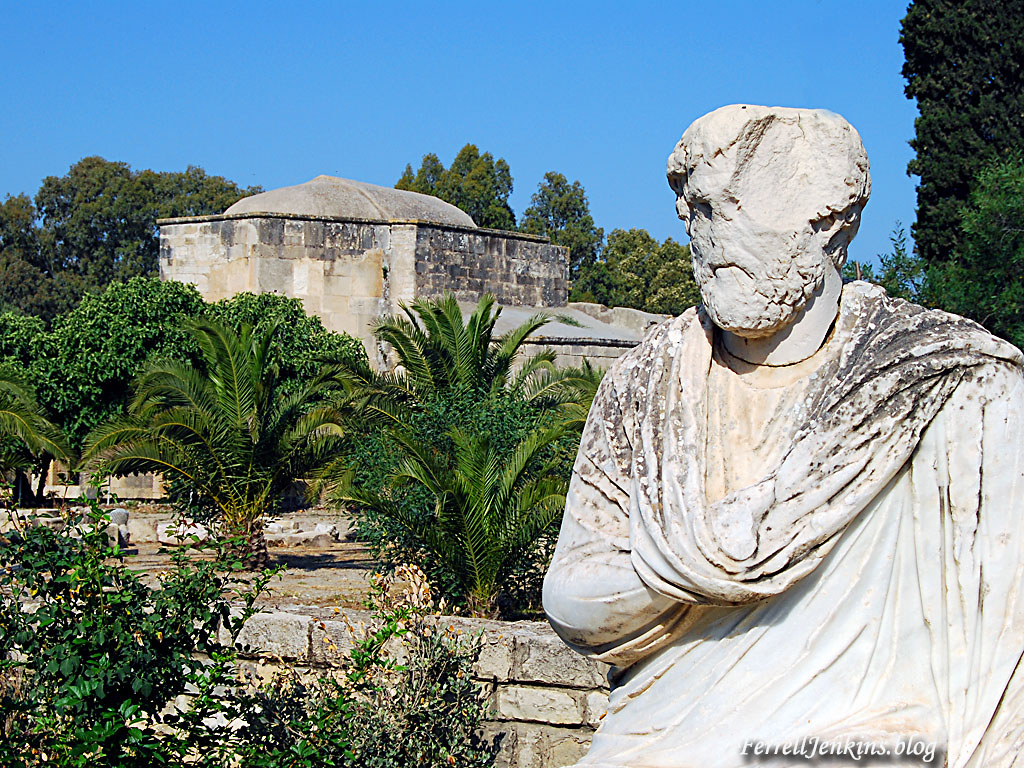
The back of the basilica of Titus at Gortyna, Crete. Roman statue in foreground. Photo by Ferrell Jenkins.

The back of the basilica of Titus at Gortyna, Crete. Roman statue in foreground. Photo by Ferrell Jenkins.

This photo shows the back of the basilica because the front was in the shadows. One of our tour members was looking at the photo. I said, “We could say that this Roman statue is of Titus.” She said, “It looks as if he has a splitting headache.”

The City of Rhodes

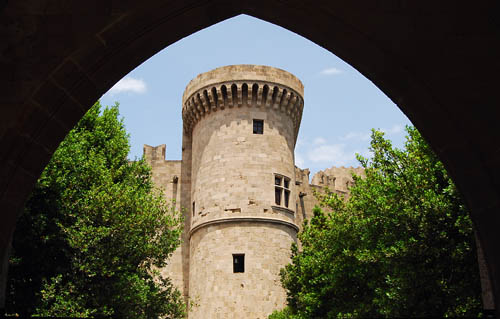
The Knights of St. John controlled the city of Rhodes from the 14th century to the early 16th century. The town provides some spectacular views of various kinds of architecture.

The island called Patmos

This afternoon we made a visit to Patmos. I am using an Internet Cafe in Patmos to connect. The cost of Internet on the ship is $1.60 per minute!!!!

I decided to share with you an article I wrote some time back for Biblical Insights. The photos were made on a previous tour. Later I will try to post some of the photos I made today. I think they will be better.

John, the writer of the book of Revelation, was “on the island called Patmos, because of the word of God and the testimony of Jesus” (Rev 1:9). I am convinced that this was the apostle John. He was there because of (Greek dia, on account of) the word of God. Filson says this could mean either banishment, or banishment to hard labor. He points out that the word of God and witness or testimony are used in Revelation 6:9 and 20:4 “in reference to a persecution situation” (Interpreter’s Dictionary Bible III:677).

The Romans used the island as a penal settlement to which they sent political agitators and others who threatened the peace of the empire (Tacitus Annals 3.68; 4.30; 15.71). According to Eusebius, John was banished to Patmos by the Emperor Domitian, A. D. 95, and released 18 months later under Nerva (HE III.18.1; 20.8-9).
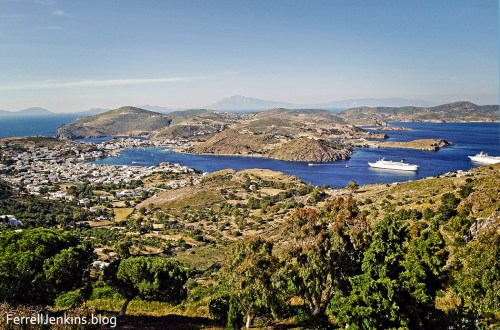
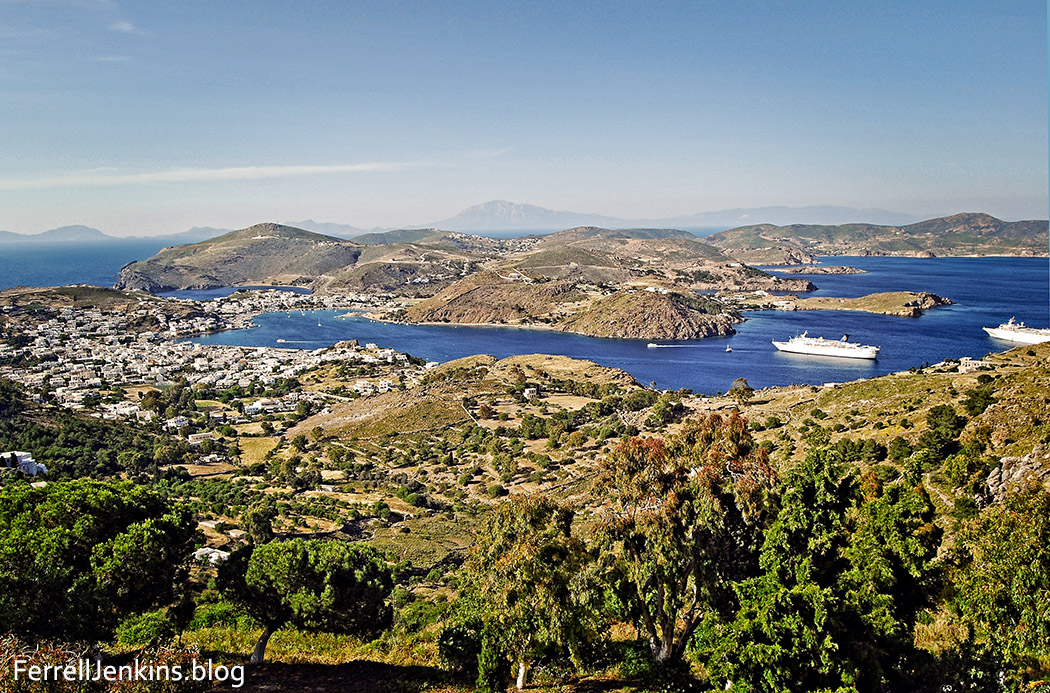
A view of the harbor on the island of Patmos, the place where the apostle John received, and possibly wrote the Book of Revelation. Photo by Ferrell Jenkins.

A view of the harbor on the island of Patmos, the place where the apostle John received, and possibly wrote the Book of Revelation. This photo was made from Chora, looking down to the port of Skala. Photo by Ferrell Jenkins, 2008.

Patmos is a rocky island off the west coast of Asia Minor in the Aegean Sea, about 37 miles southwest of Miletus. The island is one of the Dodecanese (twelve) or of the Southern Sporades. It is about 10 miles long (N–S) and 6 miles wide at the north end, and consists of about 22 square miles of land area. The island is mountainous and of irregular outline. Some visitors to the island have suggested that the natural scenery “determined some features of the imagery of the Apocalypse” (HDB III:693-94).

Patmos has been a part of Greece since 1947, and may be reached by boat from Piraeus, Samos, Kos, or Rhodes. The ferry from Samos takes about 2 1/2 hours, arriving at the port of Skala. Our cruise ship sailed from Kusadasi, Turkey, to Patmos.

On the way from Skala to Chora, the only other town on the island, one passes the Monastery and Cave of the Apocalypse. This site is marked as the traditional place where John received the Revelation.

At Chora, the monastery of St. John the Theologian dominates the island. It was built by a monk called Christodulos (slave of Christ) in A. D. 1088. The monastery library is noted for its manuscripts, but especially for its collection of more than 200 icons. The oldest book in the library is part of a 6th century codex of Mark (Codex Purpureus). The second oldest manuscript is an 8th century A. D. copy of Job.

We begin a cruise on the Aegean

After breakfast this morning we will be boarding M/V Aquamarine, a ship of the Louis Cruise Lines, for a four day/three night cruise of the Greek Islands. Our first stop this afternoon will be Patmos, a small island in the Dodecanes group (12 islands), where John was exiled prior to writing the book of Revelation.

I, John, your brother and fellow partaker in the tribulation and kingdom and perseverance which are in Jesus, was on the island called Patmos because of the word of God and the testimony of Jesus. (Revelation 1:9).

During the cruise portion of our tour my posts may be limited and/or brief. I understand that the ship has Internet service, but I am not sure of the arrangements.

Several others members of our tour group are blogging. If you would like to read a good blog of much more human interest, please take a look at journeyswithjane.

Norm teaches Bible at Athens Bible School. He is writing for this students, and is including some good photos of the places we are visiting. N.O.R.M. is the name of his blog. He says its means Not Out Roaming Mindlessly. I like that! Click here to visit his blog.

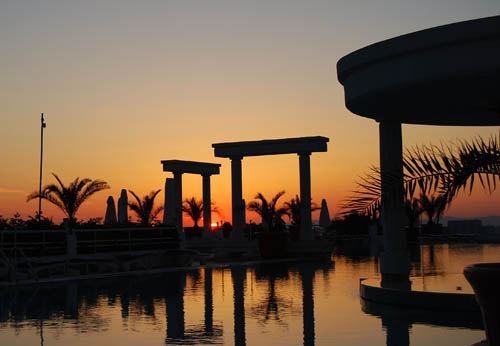
Our hotel at Kusadasi (near Ephesus), Turkey, is built on a cliff overlooking the Aegean Sea. Here is a sunset view if caught last evening from the hotel pool deck.

Sunset on the Aegean. Made a Kusadasi, Turkey, by Ferrell Jenkins.

Ephesus and Miletus

This morning we visited the city of Ephesus, one of the most spectacular excavated sites to be seen anywhere. Austrian archaeologists have worked here for the past 115 years. The city has taken on what Blaiklock calls, an “edited look.” And the work continues.

Items of interest at Ephesus include the single standing column of the Temple of Diana (Artemis), the harbor which is now silted up, the great theater which seated nearly 25,000 (Acts 19:29), the Marble street, the Library of Celsus, the Agora, the Temple of Hadrian, the Temple of Domitian (or the Flavian Emperors), and much more.

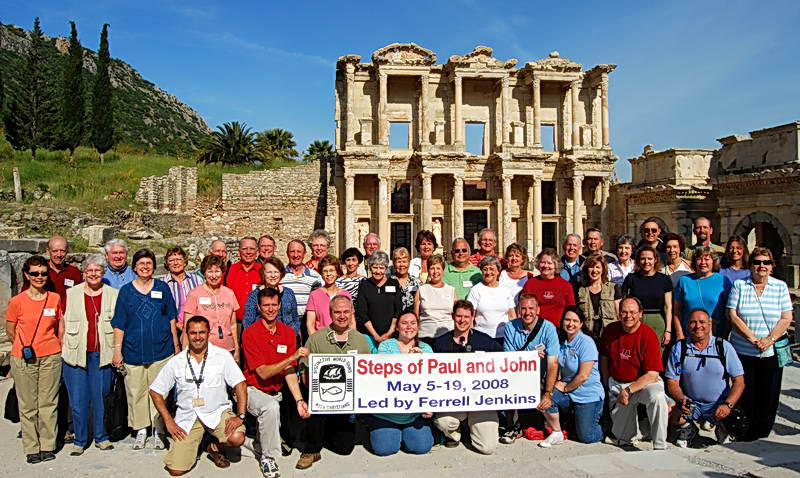
We had a group photo made in front of the Library of Celsus at Ephesus. Here is a small copy of the photo. If you know some of the folks on the tour and would like to see a larger photo, just click on the small one.

Group photo in front of the library of Celsus at Ephesus.

The first instance of believers baptized into Christ at Ephesus is recorded in Acts 19. Many changes took place in the church between the time when Paul spent nearly three years in the city, and the time when John lived there. There are two letters in the New Testament addressed to the church at Ephesus. The first is the letter of Paul to the Ephesians. The other is the letter included in the book of Revelation (Revelation 2:1-7).

The Archaeological Museum in Seljuk contains many items from Ephesus. There are two statues of Diana.

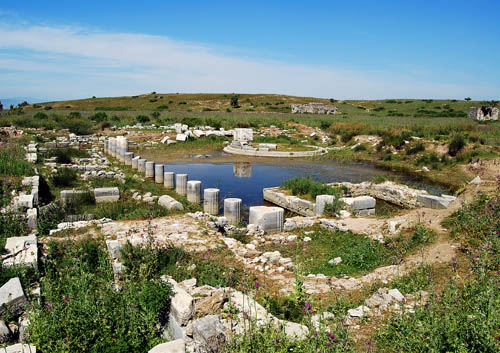
After lunch at a carpet shop we went to Miletus where Paul preached to the Ephesian elders (Acts 20). Construction of the theater began in the fourth century B.C. The Lion harbor was built in 63 B.C. Our photo shows the remnants of the Lion harbor. The entire harbor has silted up over the centuries, but a small amount of water stands in the inner harbor. I think this is likely where Paul docked, and the place from which he departed for Jerusalem.

The biblical account of Paul’s departure is touching. Luke records,

When he had said these things, he knelt down and prayed with them all. And they began to weep aloud and embraced Paul, and repeatedly kissed him, grieving especially over the word which he had spoken, that they would not see his face again. (Acts 20:36-38).

Note especially these final words about the event:

And they were accompanying him to the ship.

Try to envision this scene as you look at the photo.

Hierapolis and Aphrodisias

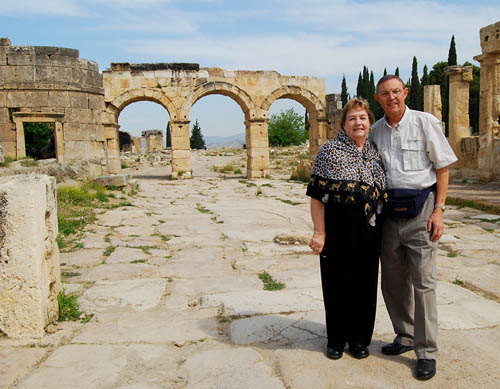
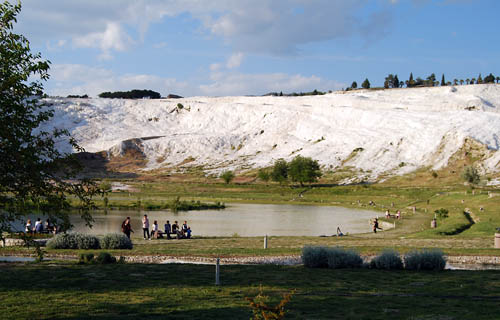
This morning we visited Hierapolis, a city famous for its hot mineral springs and terraced travertine formations. Tradition associates this city with Philip. It is not clear whether Philip the apostle, or Philip the evangelist is intended. A colonnaded street and the Arch of Domitian (emperor A.D. 81-96) was erected by Julius Frontinus, proconsul of Asia about A.D. 82-83. The book of Revelation was written about the time of Domitian’s death.

Elizabeth and I have been traveling some of these roads together since 1967.

Papias (about A.D. 60 to A.D. 130) was a disciple of the apostle John and a companion of Polycarp. Fragments of his writings about the apostles survive in Irenaeus and Eusebius. He is said to have been Bishop of Hierapolis. Eusebius (active about A.D. 185), tells us that Papias wrote as follows:

Matthew also issued a written Gospel among the Hebrews in their own dialect, while Peter and Paul were preaching at Rome, and laying the foundations of the Church. After their departure, Mark, the disciple and interpreter of Peter, did also hand down to us in writing what had been preached by Peter. Luke also, the companion of Paul, recorded in a book the Gospel preached by him.

Afterwards, John, the disciple of the Lord, who also had leaned upon His breast, did himself publish a Gospel during his residence at Ephesus in Asia. (Euseius, Against Heresies III.1.1)

Paul commended Epaphras for his labor on behalf of all of the churches of the Lycus River valley.

For I testify for him that he has a deep concern for you and for those who are in Laodicea and Hierapolis. (Colossians 4:13).

On the way to the Aegean coast we visited the fabulous new excavations at Aphrodisias. The National Geographic Society sponsored the excavations here for about 30 years. Many of the items from the Roman time are well preserved. These include the Roman stadium, the temple of Aphrodite, the odeon, the baths, and some marvelous sculp­tures in the Museum.

Tonight we are at Kusadasi, the Turkish resort town on the Aegean. Our hotel is about 12 miles from the ancient site of Ephesus which we hope to see tomorrow.

Sardis, Philadelphia, and Laodicea

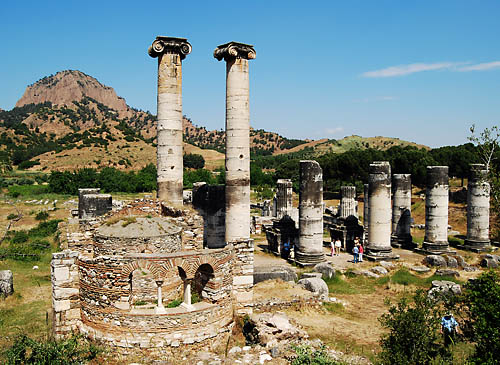
Our first stop today was Sardis, capital of ancient Lydia, where surrounding hills have been carved into curious shapes by wind and rain. We could see the significant ruins of the Acropolis from the plain below. We visited the temple of Cybele (the mother goddess of Anatolia) and Diana (Artemis). In later centuries a church was built at the same site.

The river Pactolus flows past Sardis. In ancient time gold was panned from the river. The first coins were minted by the Lydians. We visited the reconstructed synagogue and the gymnasium.

The letter to this church is in Revelation. 3:1-6.

We traveled southeasterly through beautiful table lands to the site of Philadelphia (Alashehir). The city is built on the slope of Mount Tmolus overlooking a fertile valley near where the ancient borders of Mysia, Lydia and Phrygia meet. The letter to this church is found in Revelation 3:7-13.

When we reached the Lycus valley we made a stop at Colossae. Colossae is nothing but a tell (mound) at this time. It sits at the foot of Mount Cadmus, near the city of Honaz. Paul wrote a letter to the saints at Colossae about A.D. 62. This was the home of Philemon, an individual who received a letter from Paul about his runaway slave, Onesimus.

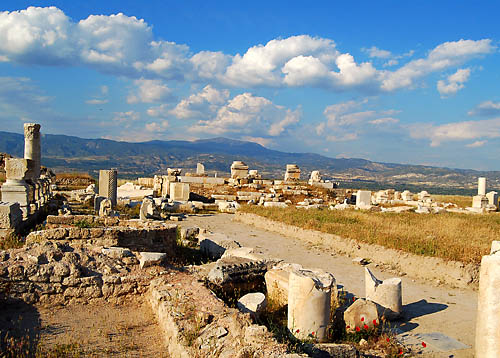
At Laodicea we saw the ruins of the theater, the stadium, the aqueduct, and the water distribution system. This was a vivid reminder of the letter of the Lord to the church (Revelation 3:14-22). New excavations at Laodicea are bringing to light exciting Roman period ruins. Here is a view of the Emperor worship square. This is the danger addressed in the book of Revelation.

We are staying overnight at Pamukkale (biblical Hierapolis; Colossians 4:13). Hierapolis is famous for hot mineral springs and terraced travertine formations. It is now a World Heritage site.

Pergamum and Thyatira

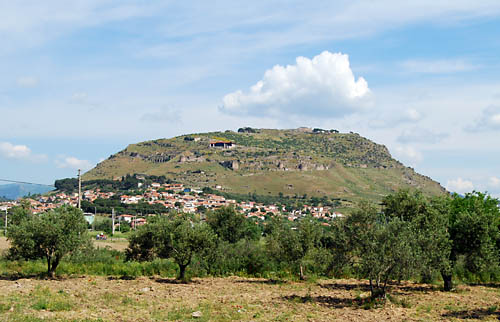
Today we drove north of Izmir to visit the Pergamum (modern Bergama), another of the cities of the seven churches of the book of Revelation. This visit included the acropolis temple of Athena, the famous library, the royal palace, the temple of Trajan, the steepest theater of the world, and site of the altar of Zeus. The weather was perfect for photography most of the day. This photo shows the acropolis of Pergamum.

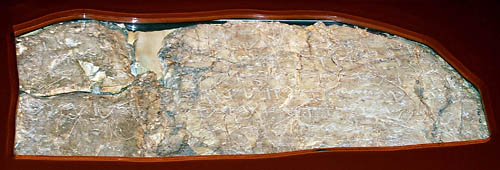
We made a short visit at the Archaeological Museum to see the inscription that states that Pergamum had twice been named NEOKOROS. This term means that two temples dedicated to the Roman emperors had been erected in the city. In fact, later there was a third temple. Emperor worship presented a serious problem for the Christians of Asia Minor in the last part of the first century, and the following centuries.

We visited the ruins of the Asclepieum, the medical center of the ancient world.

After lunch we drove to Thyatira (modern Akhisar) to see the few archaeological remains of the city. Lydia, the seller of purple who was converted to Christ at Philippi, was from Thyatira (Acts 16:14).

For the letter to the church at Pergamum read Revelation 2:12-17. For the letter to Thyatire read Revelation 2:18-29.

Significant biblical artfacts in the Istanbul Museum

My favorite place in Istanbul is the Archaeological Museum. There are several buildings. One contains items from the Ancient Orient, that is, from Mesopotamia, Assyria, Babylon, and a collection of Hittite items. Another has numerous items from the Greco-Roman world. On the third floor artifacts from Syria, Palestine, Lebanon, and Cyprus, are displayed.

The Ottoman Empire controlled Palestine in from the 16th to the 20th centuries. The earliest archaeology in Palestine was done at Megiddo, Tanaach, and Gezer. Since the Turks were in charge, many of the artifacts were brought to Istanbul. These items have not always been easy to see. Once or twice, in past years, I had to made a “donation” to the museum in order to get in room where these items are exhibited. Even now, it is difficult (for older visitors) because there are no elevators going to the third floor.

There is not time now to mention all of these items. However, I am pleased to share with you what I consider an unusually good photo made without a tripod and special lighting. It is the famous Siloam Inscription. We sometimes call its the Hezekiah;s tunnel inscription.

This inscription was cut from Hezekiah’s tunnel in Jerusalem shortly after it was discovered in 1880. The tunnel was built to connect Gihon Spring with the Pool of Siloam (ca. 710 B.C.; 2 Kings 20:20; 2 Chronicles 32:30; cf. John 9:7). Palestine was part of the Turkish empire at the time of the discovery and this is how the inscription came to be in Istanbul. The inscription, written in the ancient Hebrew script, describes the completion of the tunnel when the workers met near the middle on the last day of work. It reads, in part:

while there were still three cubits to be cut through, (there was heard) the voice of a man calling to his fellow, for there was an overlap in the rock on the right (and on the left). And when the tunnel was driven through, the quarrymen hewed (the rock), each man toward his fellow, axe against axe; and the water flowed from the spring toward the reservoir for 1,200 cubits, and the height of the rock above the head(s) of the quarrymen was 100 cubits. (Ancient Near Eastern Texts 321)

I have walked through Hezekiah’s tunnel several times and have seen the place from which the inscription was taken.

Aslan

We had a nice day in Istanbul. Sightseeing included the Blue Mosque, the Hagai Sophia, Topkapi Palace, and the Archaeological Museum. We toped off the day with a cruise on the Bosphorus. This is the strategic waterway that connects Russia (and the countries that were formerly part of the USSR) and the Mediterranean and the rest western world.

After I review my photos I will try to upload an additional one or two for your enjoyment. Below is something I wrote a few days ago about Aslan. Read and enjoy.

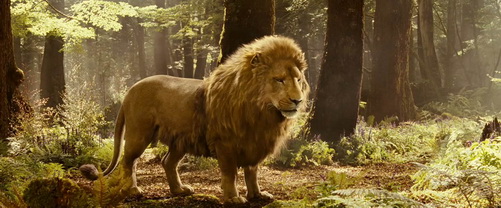
Everyone familiar with the Chronicles of Narnia remember that Aslan is the name of the lion. Note this paragraph about Aslan from Wikipedia.

Aslan is a word meaning lion. Lewis came up with the name during a trip to the Ottoman Empire, where he was impressed with the Sultan’s elite guards also called Aslan because of their bravery and loyalty.

I noticed a restaurant in Istanbul with the name Aslan. You may also recall that Edmund was tempted by Turkish delight. It is good stuff.

The Disney movie, Prince Caspian, opens May 15. The official website is here.

Check our page about C. S. Lewis here.