Category Archives: Travel

Learning the Bible in the Middle Ages

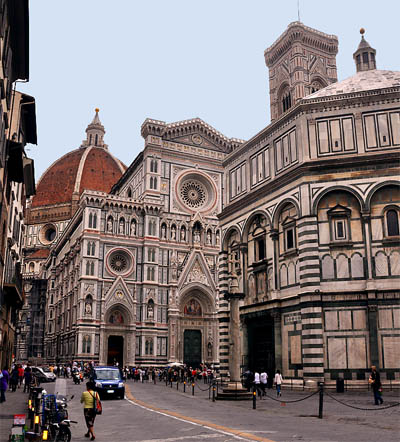
Duomo, Baptistery, and Campanile. Photo by Ferrell Jenkins.

The Cathedral (or Duomo) of Florence is of the Gothic style and dates to the 12th century A.D. The church, along with the baptistery, and the campanile (bell tower) have been designated a UNESCO World Heritage Site. The bronze baptistery doors, often designated as the Gates of Paradise, was designed by Lorenzo Ghiberti in the early 1400s. The gates we see today are reproductions.

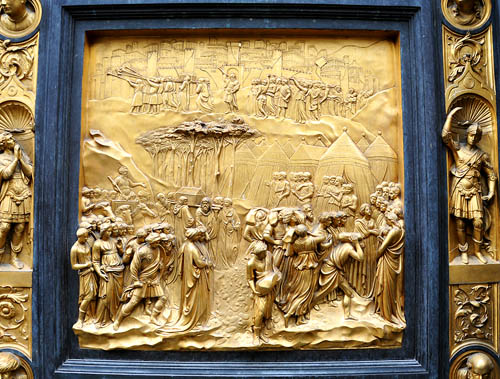
In the Middle Ages Bibles were not available to the common people. One of the ways the Bible was taught was through the stained glass windows, wood carvings, and cast works such as the doors of the baptistery. The panel in the photo below shows the Israelites crossing the Jordan, and the capture of Jericho (Joshua 3-6). Remember that for the Western World those were the Dark Ages.

Baptistery panel showing capture of Jeriocho. Photo by Ferrell Jenkins.

There is more that should be said about Florence, but we arrived in Rome last evening. Today and tomorrow will be filled with activity in Rome.

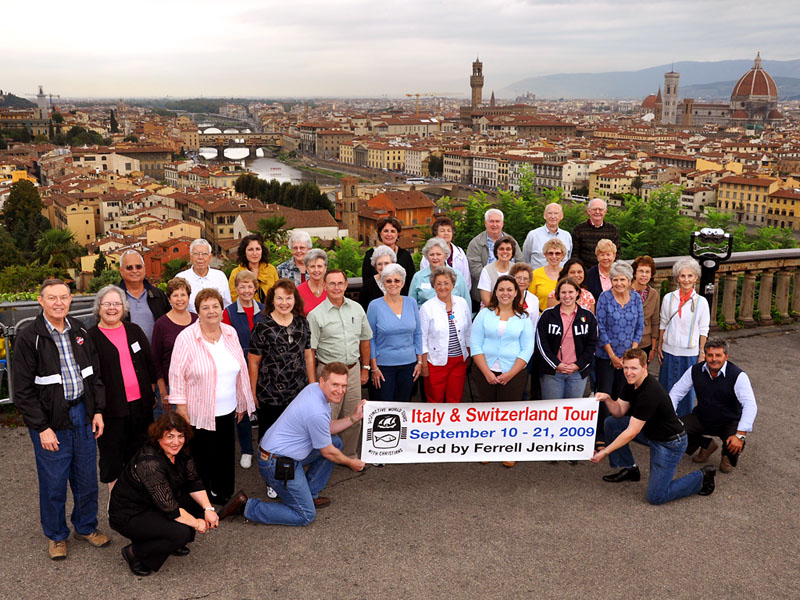
Our travel group in Florence, Italy

The rain cleared just as we arrived in Florence. Just in time to get a photo of the group from Piazza Michelangelo. This piazza is located on a hill on the south bank of the Arno River and provides a wonderful view of the center of Florence. From here one can see (from right to left) the Santa Croce Church, the Duomo, the tower at the Piazza della Signoria, and the Ponte Vecchio.

From the Middle Ages onward, Florence has been the center of Italian intellectual and artistic life. It was in Florence that Dante, Boccaccio and Petrarch wrote, and Michelangelo, da Vinci and many others worked. In addition to the art treasures, both in and out of the museums, Florence lends itself to leisurely strolling and relaxation.

group-florence-2009

If you know some of these nice folks, you may want to click on the photo for a larger image. All of the fun stuff, and lots of photos, is at Journeys With Jane.

Venice and Mark

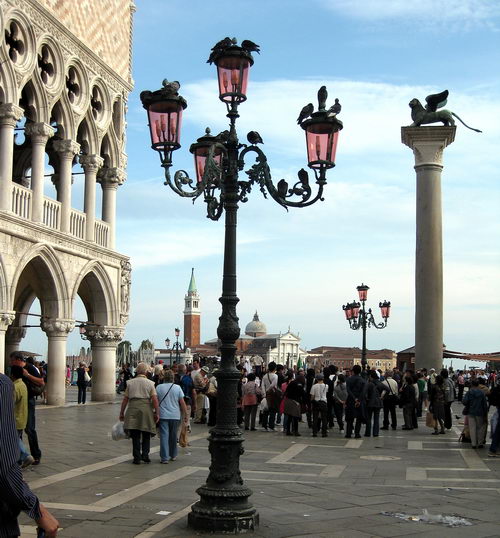
This view shows one corner of the Doge’s palace and the columns with the lion representing Mark the Evangelist. (Some of us would simply say Mark, the writer of the gospel that bears his name.) The buildings visible in the distance are across the Grand Canal.

Note the pigeons resting on the lamp post. There are now fewer pigeons in the Square than in the past because the city has quit feeding then.

Doges Palace and view from St. Mark's Square. Photo by Ferrell Jenkins.

Doges Palace and view from St. Mark's Square. Photo by Ferrell Jenkins.

St. Mark’s Cathedral and Square is one of the best known tourist attractions in the world. The building is of the Byzantine style, but the liturgy is Roman Catholic. Madden explains how a Byzantine building happens to be in Italy.

The Byzantine style of St. Mark’s Cathedral bespeaks the maritime past of the Venetian republic, and its long range interests in the eastern Mediterranean, the Mare Nostrum of the Romans (A Religious Guide to Europe, 298).

Clock Tower and the Domes of St. Mark's. Photo by Ferrell Jenkins.

Clock Tower and the Domes of St. Mark's. Photo by Ferrell Jenkins.

It is alleged by some that the body (or relics) of St. Mark the Evangelist were brought to Venice in the 9th century B.C. by Venetian merchants.

Today we traveled from Venice to Florence. It rained most of that time. By the time we reached Florence we had some clearing. At the moment it is bright outside.

Everyone in the group is doing well.

Avoiding the Merchants of Venice

We had a full day in Venice. Our hotel is located on the mainland at Mestre, but we were in Venice about 12 hours. I hope to have a few photos to share later, but doubt I will get them uploaded tonight.

Everyone in the group spent the full day stepping from one island to another. I expect that everyone will sleep well tonight.

Just a few words from William Shakespeare:

The devil can cite Scripture for his purpose. (The Merchant of Venice, 1. 3)

The quality of mercy is not strained,
It droppeth as the gentle rain from heaven
Upon the place beneath. It is twice blest:
It blesseth him that gives and him that takes.
‘Tis mightiest in the mightiest: it becomes
The throned monarch better than his crown;
His sceptre shows the force of temporal power,
The attribute to awe and majesty,
Wherein doth sit the dread and fear of kings;
But mercy is above this sceptred sway,
It is enthroned in the hearts of kings,
It is an attribute to God himself;
And earthly power doth then show likest God’s,
When mercy seasons justice. Therefore, Jew,
Though justice be thy plea, consider this,
That in the course of justice none of us
Should see salvation: we do pray for mercy;
And that same prayer doth teach us all to render
The deeds of mercy. (The Merchant of Venice, 4. 1)

Innsbruck to Venice via Verona

Today we traveled from Innsbruck to Venice. This involved driving over the Brenner Pass and through the Dolomite region of the Italian Alps. It rain off and on most of the day, but that did not seem to deter the enjoyment of the experience for the tour members.

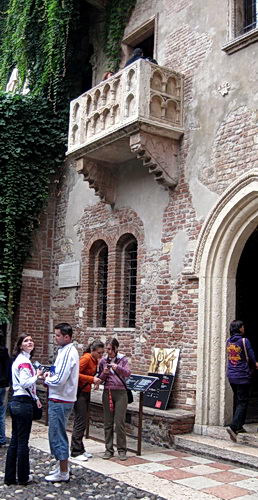
We had some time in Verona, Italy, for a visit of the city. Everyone wants to see the balcony associated with Shakespeare’s Romeo and Juliet. It was impossible to get a good photo because of the large number of tour groups composed of college age young people. Here is a little peak.

Romeo & Juliet Window in Verona. Photo by Ferrell Jenkins.

Romeo & Juliet Window in Verona. Photo by Ferrell Jenkins.

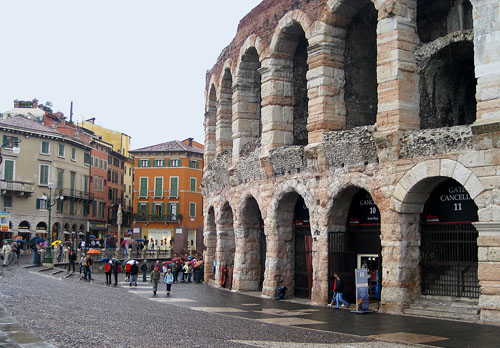
I was more fascinated by the strong Roman fortifications that are still visible around the city. The Colosseum, which was built in the first century B.C. or the first century A.D., is the third largest in the world and is among the best preserved from the ancient world.

The Colosseum is located in the center of the town and is still used for various musical performances.

Roman Colosseum in Verona, Italy. Photo by Ferrell Jenkins.

Roman Colosseum in Verona, Italy. Photo by Ferrell Jenkins.

We look forward to visiting Venice tomorrow. The city is situated more than two miles from the mainland on 118 islands connected by many stone bridges and interlaced by more than 150 canals.

So far as I can detect all of the members of our group are in good health and good spirit.

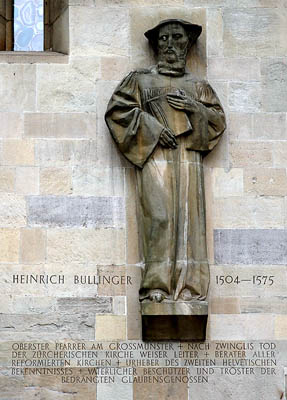
Heinrich Bullinger, successor to Zwingli

Upon the untimely death of Zwingli, Heinrich Bullinger (A.D. 1504- 1575)  became pastor of the Gossmunster in Zurich. He is not as well known as other leaders of the early Reformation, but was a significant thinker and writer.  This statue of Bullinger is attached on the wall of the Grossmunster to the right of the entry.

Heinrich Bullinger. Photo by Ferrell Jenkins.Statue of Bullinger. Photo by Ferrell Jenkins.

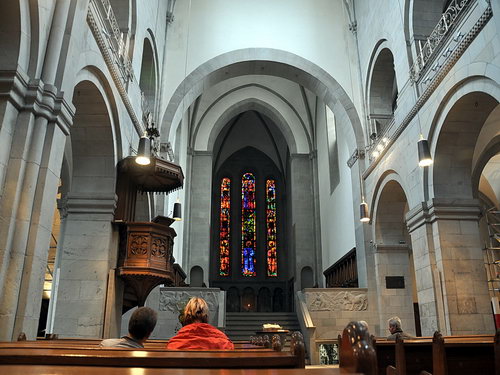
In the days of Zwingli the altars and images were removed from the Grossmunster in Zurich. The interior of the building has been restored to its orignal Romanesque appearance.

Interior of the Grossmunster in Zurich. Photo by Ferrell Jenkins.

Interior of the Grossmunster in Zurich. Photo by Ferrell Jenkins.

Take a look at Sacred Destinations if you would like to see some more information about the Grossmunster and good photos of sites in Zurich.

A beautiful but hazy day in the Bernese Oberland

Today we visited the Bernese Oberland in Switzerland. It was a beautiful sunny day by about 10 a.m., but the distant mountains remained hazy almost all day. We went to Trummelbach Falls. Using an elevator and steps one is able to go inside the mountain to see the falls.  I think everyone in our group saw at least part of the falls, and several went all the way to the top.

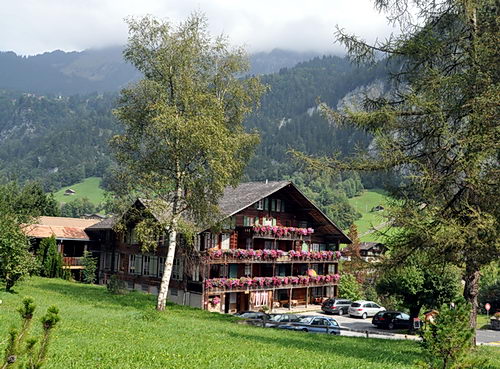
Here is a photo I made of one of the colorful buildings. It is typical here for houses and other buildings to display beautiful flowers under their window”I am my beloved’s and my beloved is mine, He who pastures his flock among the lilies.”s. This provide color for those passing buy as well as for those in the house. This reminds me of the Shunamite (Shulamite) girl’s description of her beloved.

“I am my beloved’s and my beloved is mine, He who pastures his flock among the lilies.” (Song of Solomon 6:3)

A little color adds a lot to life even when one has to deal with difficult earthly problems.

A beautiful house at Lauterbrunen. Photo by Ferrell Jenkins.

A beautiful hotel at Lauterbrunnen. Photo by Ferrell Jenkins.

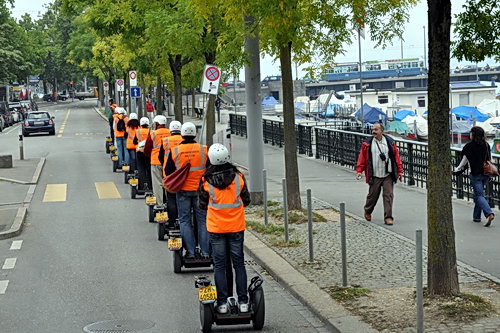
Both in Lucerne and in Interlaken we saw some small tour groups traveling on Segways. This service is offered in the City of David in Jerusalem (click here), but it is the first time I have seen it in action. I think each participtant can hear the leader speaking through the earphones in the helmet.

Segway tour in Lucerne, Switzerland. Photo by Ferrell Jenkins.

Segway tour in Lucerne, Switzerland. Photo by Ferrell Jenkins.

If you know some of the people in our group and wish to read more about the individuals, take a look at Journey’s With Jane.

Third Man of the Reformation

Ulrich (or Huldrich) Zwingli was born January 1, 1484, about 50 days after the birth of Martin Luther. Zwingli is sometimes called the “third man of the Reformation” after Luther and Calvin (Jean Rilliet, Zwingli: Third Man of the Reformation).
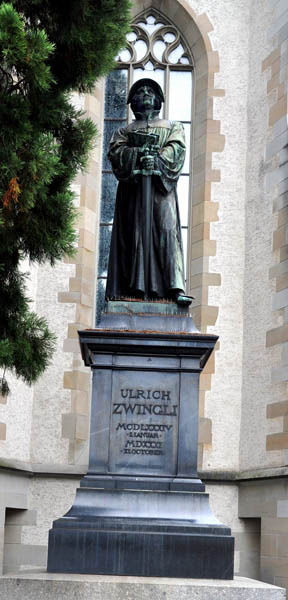
Zwingli Statue in Zurich. Photo by Ferrell Jenkins.

Zwingli Statue in Zurich. Photo by Ferrell Jenkins.

Zwingli was born in a small town in eastern Switzerland. His family was able to provide a good education for him. He first attended the University of Vienna and then the University of Basel. Dr. Dan Petty describes one of the influences that led him away from Catholicism.

“His education brought him into contact with humanistic studies and he became an ardent admirer of Erasmus of Rotterdam. This emphasis tended to lead Zwingli away from the Scholastic theology of medieval Catholicism, and toward the study of the Bible.”

Church historians have described the difference between Zwingli and Luther in their respective attitude about the silence of the Scriptures.

“While Luther was disposed to leave untouched what the Bible did not prohibit, Zwingli was more inclined to reject what the Bible did not enjoin” (George P. Fisher, The Reformation, 145).

“Luther said we may do what the Bible does not forbid. Zwingli said what the Bible does not command we may not do, and on that account he gave up all images and crosses in the churches.  In this respect he was like the Iconoclasts.  Organs in church also were given up. The Lutherans loved to sing around the organ. The Zwinglians, if they sang at all, did so without any instrument” (Roland H. Bainton, The Church of Our Fathers, 143-144).

The Zurich city council called Zwingli to serve at the cathedral there. Darrell Turner, in a Religious News Service article commemorating Zwingli’s 500th birthday in 1984, said:

“His first Sunday in the pulpit of Zurich’s Grossmuenster Cathedral was also Zwingli’s 35th brithday. He shocked his listeners by announcing that instead of following the prescribed liturgy, he would preach through the Gospel of Matthew on a weekly basis.”

That was a simple. unique, and powerful things for Zwingli to do. Folks don’t like you messing with the order of service, as many a young minister has learned. But there was much more involved here. Zwingli was making a break from what Rome prescribed to be done. Going back to the Bible is always a noble thing.

Perhaps we can post more later about Heinrich Bullinger, the successor to Zwingli, in Zurich.

Group arrives safely in Switzerland

We arrived on time this morning after an all night flight from Atlanta to Zurich. As soon as we got out luggage, with three or four bags missing, we went to downtown Zurich to visit the statue of Ulrich Zwingli at the Wasserkirche (Water Church), the Grossmünster (the great cathedral where Zwingli preached in the early 15th century), and a few other sites in the downtown area of the city.

After our guide presented some of the history of the political and religious conditions in Switzerland in the early 15th century, I took the opportunity to talk about the work and beliefs of Zwingli as an early leader of the Reformation Movement. More in a later post.

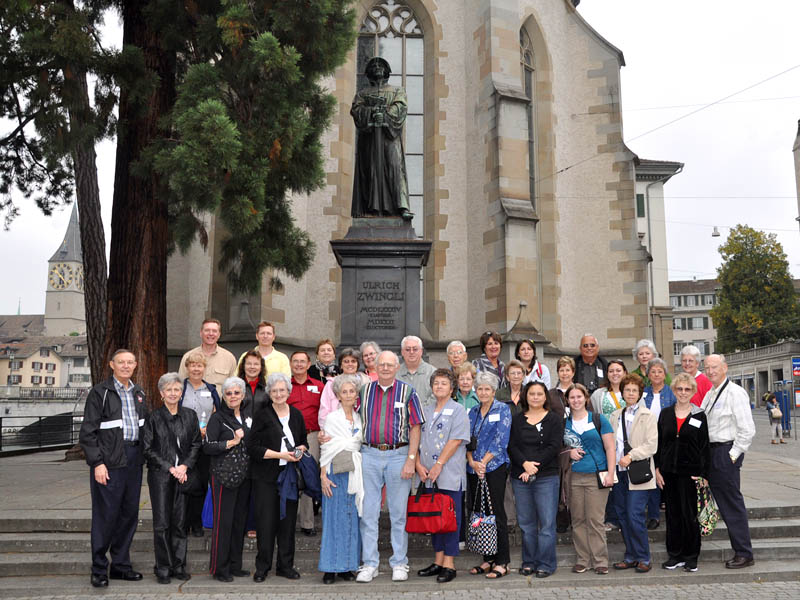
Ferrell Jenkins Tour Group at the Zwingli Statue in Zurich.

Ferrell Jenkins Tour Group at the Zwingli Statue in Zurich.

The steps there seemed like a good place to line up the group for a photo. If you think you know someone in the group you may click on the photo for a larger image. This wasn’t our “official” tour photo with banner, etc., and some of the ladies didn’t much like the idea of the photo being posted. I think they look nice after being up all night. How about you?

On the road in Switzerland, Austria and Italy

This afternoon we are ticketed to leave Atlanta for an overnight flight to Zurich, Switzerland. After some brief sightseeing in Zurich we will head for Lucerne for overnight.

Most of our tours are in the Bible Lands (Israel, Jordan, Egypt, Turkey, Greece, et al.), but we have directed other tours since 1967. On this current tour in Switzerland, Austria, and Italy, in addition to the general learning that travel affords, we will give some emphasis to church history, and Paul’s time in Rome.

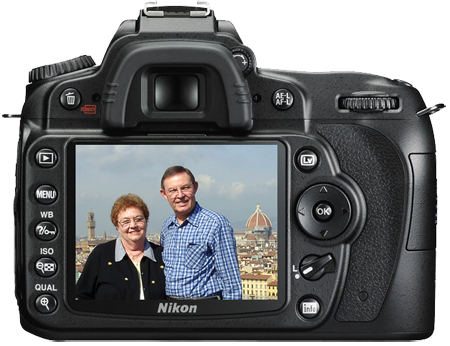
Ferrell and Elizabeth in Florence, Italy, 2001.

Ferrell and Elizabeth in Florence, Italy, 2001.

This time I am using a Nikon D90. It is amazing how much younger the camera makes us look. This will be a great selling point for many.