Category Archives: Old Testament

For seasons, days, and years

2010. We say it is a New Year. All of this depends on the goodness and lovingkindness of the Lord. Today I will post a few scriptures to remind us of the source of all material blessings.

God created the earth, and the entire universe, as a place for man to dwell. He arranged the sun, moon and stars so we might have seasons, days, and years.

Then God said, “Let there be lights in the expanse of the heavens to separate the day from the night, and let them be for signs and for seasons and for days and years; and let them be for lights in the expanse of the heavens to give light on the earth”; and it was so. (Genesis 1:14-15 NAU)

The New Testament teaches that Jesus, the Word, was active in creation, and that He keeps everything going as it should.

For by Him all things were created, both in the heavens and on earth, visible and invisible, whether thrones or dominions or rulers or authorities– all things have been created through Him and for Him. He is before all things, and in Him all things hold together. (Colossians 1:16-17 NAU)

The words of Psalm 106 express an appropriate thanks to the Lord for His provisions.

Praise the LORD! Oh give thanks to the LORD, for He is good; For His lovingkindness is everlasting. (Psalm 106:1 NAU)

Happy New Year!

A lone fisherman on the Sea of Galilee at sunrise. Photo by Ferrell Jenkins.

A lone fisherman on the Sea of Galilee at sunrise. Photo by Ferrell Jenkins.

2010 Five Day Bible Reading Program

Mark Roberts, BibleClassMaterial.com, has a good five day [a week] Bible reading schedule available for 2010 here. A single copy for personal use is free. Churches and study groups may buy a license to print multiple copies. Check the catalog for other good materials currently available.

On USA soil

If being in the Atlanta airport qualifies, I am on USA soil. The flight from Israel was scheduled for 13 1/2 hours (longer than I mentioned in the previous blog), but we had a good wind and made it in 13 hours. From touchdown it took a full hour and a half to make it through passport control, customs, luggage collection, Atlanta security to enter the airport, etc. In Israel we arrived at the airport and started through the security process about three hours ahead of departure. That makes a total of 17 1/2 hours, and I still have a flight home (about 2 hours counting collecting luggage). Add in the wait here and that makes another 2 1/2 hours. Total time is now at 20 hours. Don’t forget getting to/from the airport. Travel is fun! But I have time to blog.

Israeli security has a deserved reputation as being the best in the world, but I did not have to remove my shoes.

We flew Delta for this trip. I think every seat was full on the return. Flights were departing Tel Aviv for Philadelphia and New York about the same time last night. This is not the most popular time for travel to Israel. We saw a few American groups, but there were several Asian and Indian groups.

The comments left on the blog, and Emails from friends are appreciated. I did note, however, that almost every friend who wrote also made a request. Sorry I did not have time to answer. Don’t expect one tomorrow, either! I will do my best. Several Emails came from folks who were unaware that I was in Israel. That is a sure giveaway that they do not follow the blog. Shame! Shame!

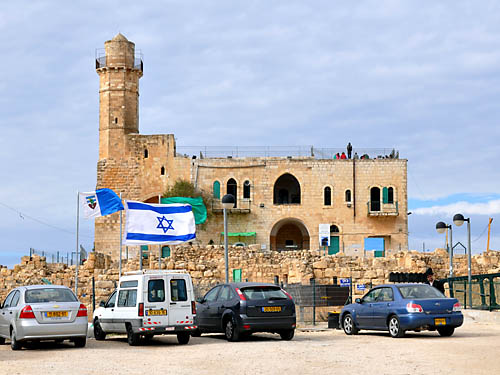
Yesterday we went to Nabi Samwil (or Nebi Samwil), the traditional burial place of Samuel the prophet. According to the Bible Samuel was buried at Ramah, a short distance from Nebi Samwil.

Now Samuel had died, and all Israel had mourned for him and buried him in Ramah, his own city. And Saul had put the mediums and the necromancers out of the land. (1 Samuel 28:3 ESV)

We know from the Old Testament that Samuel anointed both Saul and David as kings of Israel. Both Old and New Testaments acknowledge the importance of Samuel as a prophet.

And all Israel from Dan to Beersheba knew that Samuel was established as a prophet of the LORD. And the LORD appeared again at Shiloh, for the LORD revealed himself to Samuel at Shiloh by the word of the LORD. (1 Samuel 3:20-21 ESV)

And all the prophets who have spoken, from Samuel and those who came after him, also proclaimed these days. (Acts 3:24 ESV)

Traditional Burial Place of Samuel at Nabi Samwil. Photo by Ferrell Jenkins 2009.

Traditional Burial Place of the prophet Samuel at Nabi Samwil. Photo by Ferrell Jenkins 2009.

The Herodian Family Tomb

In the morning we visited Nabi Samwil, the traditional tomb of the prophet Samuel. Some scholars think this may be the biblical Mizpah. Others believe that Mizpah should be identified by Tell en-Nahbeh.

Now Samuel called the people together to the LORD at Mizpah. (1 Samuel 10:17 ESV)

The site at Nabi Samwil provides a great view of the biblical territory of Benjamin.

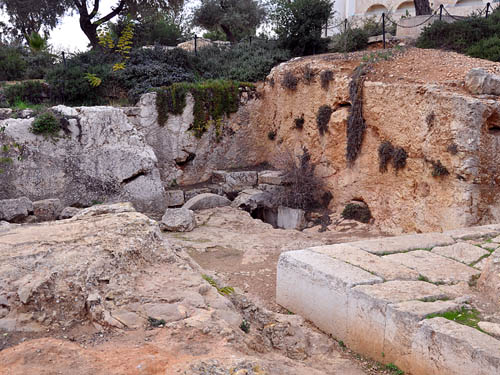
Later we went to the traditional family tomb of Herod the Great (37 – 4 B.C.) which is located on the west side of the Old City, and behind the famous King David Hotel. We know from Josephus that Herod buried certain family members in Jerusalem (Wars 1:581). Herod was buried at the Herodium near Bethlehem.

This first photo shows the general area of the tomb which is cut from solid rock.

Herodian Family Tomb in Jerusalem. Photo by Ferrell Jenkins 2009.

Herodian Family Tomb in Jerusalem. Photo by Ferrell Jenkins 2009.

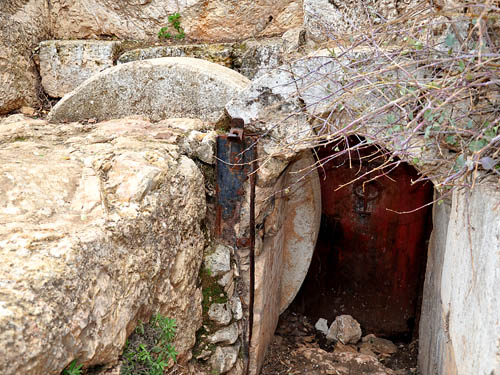
The photo below shows the rolling stone. In more recent time a door has been places at the opening of the tomb. Murphy-O’Connor says the tomb was found empty because robbers got there before the archaeologists (The Holy Land).

Herodian Family Tomb in Jerusalem. Photo by Ferrell Jenkins 2009.

Herodian Family Tomb Rolling Stone. Photo by Ferrell Jenkins 2009.

We also visited the Skirball Museum at the Hebrew Union College. Some artifacts from Gezer and Dan have been displayed at this small museum. Today we learned that the museum is closed. The lady at the reception desk said she did not know when or if it would be opened. She allowed us to look at a few items displayed in cases along a corridor among the offices. This was a disappointment. One item of interest that is in the poorly lit cases is a replica of the inscription from Dan that mentions the “god” who is in Dan.

The site of Kiriath-jearim is now Abu Ghosh

Conditions for photography today were about the best I have seen. We had a busy day but have run out of time to write very much. We have one more day before this wonderful study and research opportunity comes to an end.

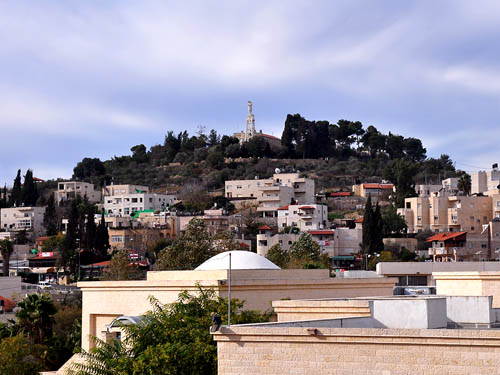
This morning we stopped in the Judean Hills, about nine miles west of Jerusalem, at the Arab town of Abu Ghosh. This is the biblical site of Kiriath-jearim (or Kiriath Jearim).

Kiriath-jearim’s highest honor is in the association with the ark of the covenant. The Israelites took the ark from the tabernacle at Shiloh to the battle field at Ebenezer when they were fighting with the Philistines (1 Samuel 4). The ark was captured by the Philistines and taken to Ashdod, then to Gath, and finally to Ekron before they decided to get rid of it. The ark was returned to Beth-shemesh (1 Samuel 4-6).

The men of Beth-shemesh sent messengers to the residents of Kiriath-jearim asking them to come and take the ark to their town. The ark was brought into the house of Abinadad on the hill. His son, Eleazar, was consecrated by the men of the city to keep the ark of the LORD. The ark remained there for many years until David had it brought to Jerusalem (1 Samuel 6:21-7:2; 2 Samuel 6).

The town of Abu Ghosh, site of biblical Kiriath-jearim. Photo by Ferrell Jenkins.

The town of Abu Ghosh, site of biblical Kiriath-jearim. Photo by Ferrell Jenkins.

Our photograph shows the hill of Kiriath-jearim. Our Lady of the Ark of the Covenant Church was built in 1911 on the ruins of a fifth century Byzantine church.

The waterfall at En Gedi

Yesterday Leon Mauldin made a short video of one of the waterfalls at En Gedi. He agreed for me to share this with you.

When David was fleeing from King Saul he visited En Gedi (or Engedi). There are a series of beautiful waterfalls at En Gedi. Everyone has to have water, and it would be difficult to think that David did not visit these waterfalls.

Then David went up from there and stayed in the strongholds of En Gedi. (1 Samuel 23:29)

Thursday we visited some interesting places in the Galilee. Hopefully I will be able to post a few photos later.

Traveling in the Great Rift

Today we traveled from the southern end of the Dead Sea to Tiberias on the shore of the Sea of Galilee. This area is a geological phenomon of great significance. The Dead Sea is now about 1340 feet below sea level. The Sea of Galilee is currently more than 700 feet below sea level. I don’t think we have been above sea level all day.

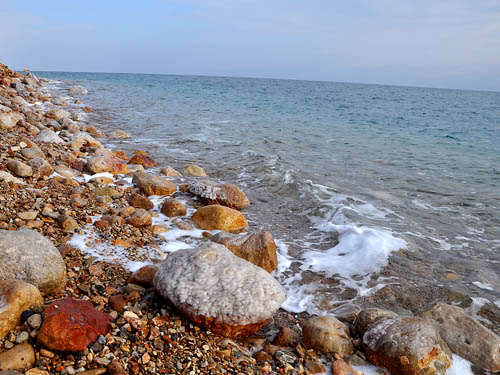
We made a stop at the Dead Sea to get some photos showing the salt accumulation on the rocks along the shore. There are few places where the sea shore is easily accessible. I have seen more salt other times. The area shown in our photo is near En Gedi and is a used often by swimmers.

The Dead Sea is called the Salt Sea in Genesis 14:3 and other places in the Bible.

Along the shore of the Dead Sea. Photo by Ferrell Jenkins 2009.

Along the shore of the Dead Sea. Photo by Ferrell Jenkins 2009.

We stopped at En Gedi, a place associated with Davi.

Then David went up from there and stayed in the strongholds of En Gedi. (1 Samuel 23:29 NET).

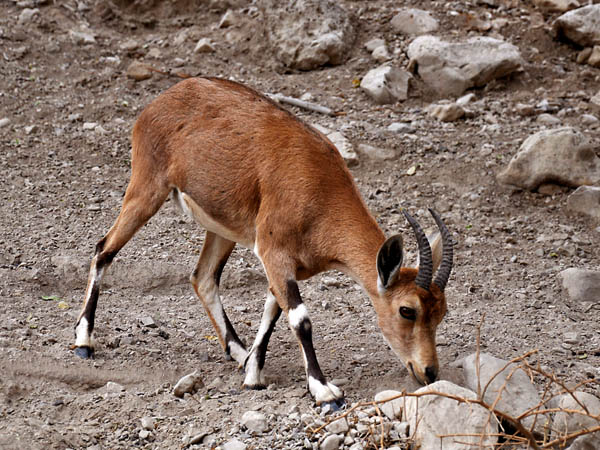
En Gedi means ‘spring of the wild goat” or “spring of the kid.” Some associate the Ibex which can be seen in the area with the wild goats.

An Ibex at En Gedi. Photo by Ferrell Jenkins 2009.

An Ibex at En Gedi. Photo by Ferrell Jenkins 2009.

We hiked all the way to the highest and longest water fall. This was about a two hour stop. It was tiring but enjoyable.

We stopped at Qumran so Leon could get a few photos and we could pick up some Ahava products.

We continued north in the Jordan Valley. At about the mid-point between the Dead Sea and the Sea of Galilee the air cleared and we could easily see the area on the east side of the Jordan known as Perea in Roman times. We tried to make a few photos but twice Israeli soldiers told us not to make photos in the area.

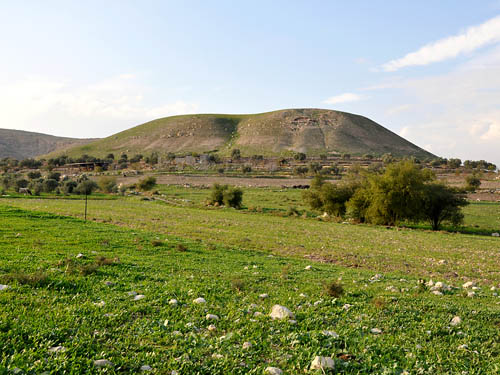
About 10 miles south of Bethshan (Beit Shean) we stopped to make a few photos of the possible site of Abel-Meholah, the home of the prophet Elisha.

The prophet Elijah was told,

You must anoint Jehu son of Nimshi king over Israel, and Elisha son of Shaphat from Abel Meholah to take your place as prophet. (1 Kings 19:16 NET)

The village at that site today is called Meholah. No significant archaeological work has been done here.

A suggested site for Abel-Meholah, home of Elisha. Photo by Ferrell Jenkins 2009.

A suggested site for Abel-Meholah, home of Elisha. Photo by Ferrell Jenkins 2009.

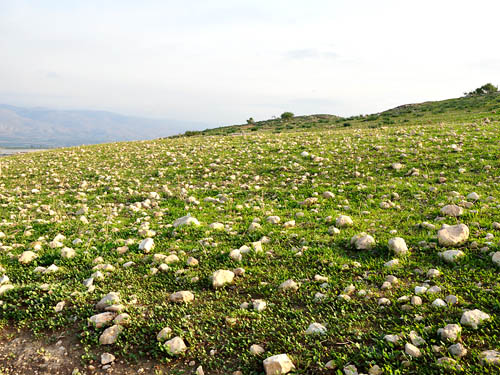
We noticed that the people at Meholah were growing rocks. The hills visible in the distance are in Jordan.

Rocks in the Jordan Valley at Meholah. Photo by Ferrell Jenkins.

Rocks in the Jordan Valley at Meholah. Photo by Ferrell Jenkins.

We tried to get to Tiberias before sunset to make photos, but the clouds were dark and thick in the later afternoon. Our hotel is literally on the shore of the Sea of Galilee. Maybe tomorrow will be a good day for photos.

A day in the Negev

Today we spent most of the time in the area of Israel known as the Negev (Negeb, or South). This area was home to Abraham (Genesis 12:9; 13:1) and Isaac (Genesis 24:62). Our first stop as we left the Dead Sea area was Arad (Numbers 21). We continued to Beersheba. This was the home of Abraham (Genesis 21-22). He dug a well and planted a Tamarisk tree here.

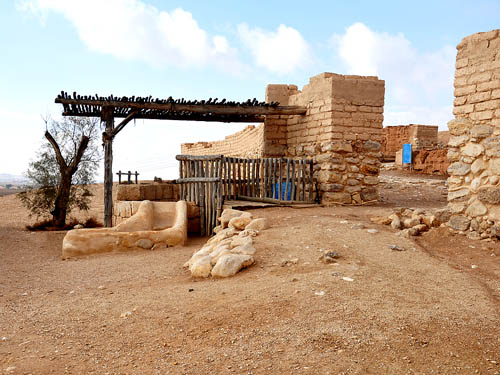
The excavation at Beersheba has been skillfully reconstructed to reveal the layout of the city. The photo shows the outer gate, the well, and a tamarisk tree.

The outer gate at Beersheba. Photo by Ferrell Jenkins 2009.

Tamarisk Tree and Well at the Outer Gate of Beersheba. Photo by Ferrell Jenkins.

We devoted about 3 hours trying to locating Ziklag. The city is mentioned no less than 15 times in the Old Testament. One of the most significant references is in1 Samuel 27. Achish, king of Gath, gave Ziklag to David.

Then David said to Achish, “If I have found favor in your eyes, let a place be given me in one of the country towns, that I may dwell there. For why should your servant dwell in the royal city with you?” So that day Achish gave him Ziklag. Therefore Ziklag has belonged to the kings of Judah to this day. And the number of the days that David lived in the country of the Philistines was a year and four months. (1 Samuel 27:5-7 ESV)

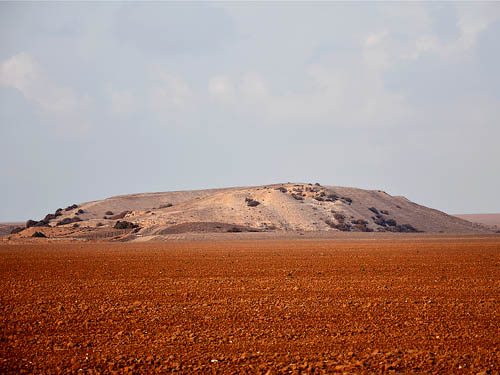
Scholars are not certain about the identification of Ziklag. The site pictured here is known as Tel esh-Sharieh (Tel Sera in Hebrew) which is a possible candidate for Ziklag. This photo shows that Tel Sera is located in an agricultural area of the Negev. The Wadi Gerar lies on the south side of the tel, but the wadi is not visible in this photo because it is now below the present ground level of the field.

Tel Shera, possible site of Ziklag. Photo by Ferrell Jenkins 2009.

Tel Sera, possible site of Ziklag. Photo by Ferrell Jenkins 2009.

Instead of the typical dry water bed, Wadi Gerar is filled with reeds. At least this is true in the area around Ziklag.

Wadi Gerar near Ziklag. Photo by Ferrell Jenkins 2009.

Wadi Gerar near Ziklag. Photo by Ferrell Jenkins 2009.

A model of a day

After worship this morning we went to Ein Kerem, the traditional home of Zechariah and Elizabeth, the parents of John the Baptist. The surrounding area in the hill country of Judea is beautiful.

In those days Mary arose and went with haste into the hill country, to a town in Judah (Luke 1:39 ESV)

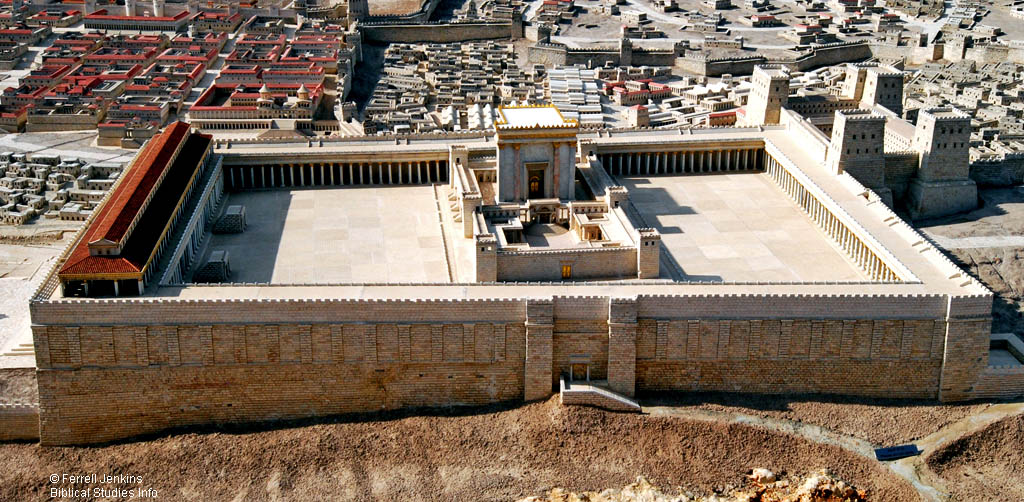
Next we went to the Israel Museum. The Museum is closed for renovation, but the Shrine of the Book and the Second Temple Model are open for visits. I am including a photo of the Herodian Temple and the Antonia. This photo is large enough for presentation. Just click on it.

The Second Temple Model. Photo by Ferrell Jenkins 2009.

The Temple Model from the time of Jesus. Photo by Ferrell Jenkins 2009.

We drove from the Bethlehem area along the route most likely used by David when he went to visit his brethren in the Valley of Elah.

Now the Philistines gathered their armies for battle. And they were gathered at Socoh, which belongs to Judah, and encamped between Socoh and Azekah, in Ephes-dammim. (1 Samuel 17:1 ESV)

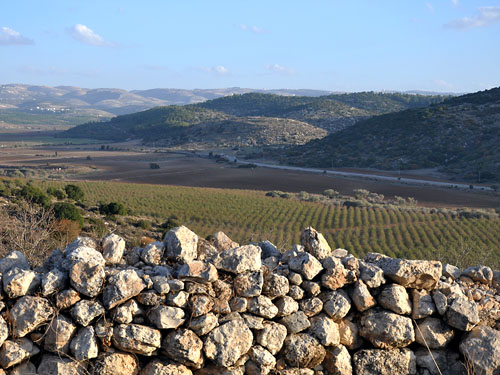
We made some photos of Socoh, and then went to the new excavation of Khirbet Qeiyafa (the Elah Fortress) which overlooks the Valley of Elah. The site has a view of Azekah and Socoh. It was a clear day and the light was such a way that we were able to get this photo from the Khirbet Qeiyafa across the Valley of Elah toward Socoh.

A view from Khirbet Qeifaya across the Valley of Elah to Socoh. Photo by Ferrell Jenkins.

A view from Khirbet Qeiyafa across the Valley of Elah to Socoh. Photo by Ferrell Jenkins.

Thanks for sharing this journey with us. A trip like this is not a vacation, but a study and research oppotunity to learn more about the land of the Bible. And the purpose of that is to be able to better teach the Word.

A visit to Nablus and Samaria

If you have traveled to Israel in the past decade you likely were not able to visit the region of biblical region of Samaria. Since the beginning of the Second Intifada that area, known as the West Bank, has been tightly controlled by Israel. Several of the folks we have talked with here spoke about how condition have eased in the past few months.

We have a rental car, but it is not to be taken into the West Bank. We had arranged through a reliable travel operator here for a driver and car to take us to several places in the West Bank. We left our hotel in Jerusalem about 8:30 a.m. this morning and got back a little after 4:30 p.m. as the sun was dropping beyond the horizon.

Our first stop was at Jacob’s well in Nablus. There is a piece of land here once owned by Jacob (Genesis 33:19). The territory was apportioned to the descendants of Joseph, and Joseph was buried there at Shechem (Joshua 24:32). It was a place of great historic importance. Jesus came to Sychar, a city of Samaria, near the piece of land Jacob had owned (John 4:5).

The traditional Jacob’s Well is located at Shechem in the valley between Mount Gerizim and Mount Ebal. The modern town of Nablus now fills this valley.

André Parrot says,

“Of all the ‘holy places’ of Palestine, none has more reason to be considered authentic than Jacob’s well. Indeed, there is no reason why its authenticity should be questioned” (Land of Christ 65).

Parrot describes the water as “cool and pleasant-tasting…drawn from a depth of 128 feet.” I have drunk the water several times, but in the few decades my guides have advised against it due to pollution in the area.

A church was erected over the well about A.D. 380. The Crusaders built another church on the site in the 12th century. The property came under the control of the Greek Orthodox church in 1860. By the end of the 19th century the Greeks began a new church, but construction was halted during World War I. The last time I was at Jacob’s well (2000) construction had resumed and the building was completed in 2007. Here is a photo of the interior. The building is unlike most of the Greek Orthodox churches in this part of the world. Instead of being dark and dismal, this one is bright and cheery.
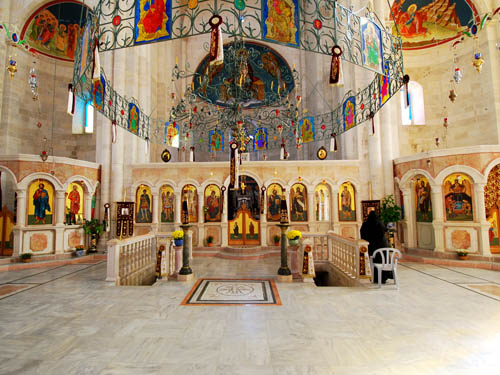
The interior of the Greek Orthodox church covering Jacob's Well. Photo by Ferrell Jenkins 2009.

The interior of the Greek Orthodox church covering Jacob's Well. Photo by Ferrell Jenkins 2009.

Those of you who have visited Jacob’s well in the past will recognize the entry to the steps going down to the well.

After Jacob’s Well we visited the nearby site of Shechem and made photos of the ruins and of Mount Ebal and Mount Gerizim. These mountains are where the blessings and curses of the Law were read by the Israelites after they entered the land (Deuteronomy 11:29). It was here in this valley that the land promise was made to Abraham (Genesis 12:6-7).

We continued to the modern village of Sebastiye and the site of biblical Samaria. The hill Samaria was bought by Omri, king of Israel, to serve as the capital of the Northern Kingdom of Israel (1 Kings 16:23-24). We visited the ruins and then had a good lunch at the Samaria Restaurant. I had eaten at this restaurant several times in the past. The food and service were good. Sari and his uncle were gracious to us and told us how they wished for more tourists to come to the site. We told them that we would certainly like to see that, too. Several good things are going on at Sebastiye which we may be able to comment on later.

Samaria was destroyed by the Assyrians in 721 B.C. By New Testament times Samaria had been rebuilt by Herod the Great, and was visited by Peter and John (Acts 8).

I wanted to share a photo of the hill of Samaria. The tell is on the top of the hill. The village of Sebastiye can be seen to the right. There are ancient ruins under the village.
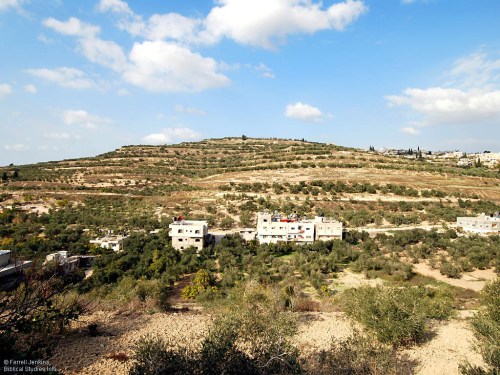
The Hill of Samaria. Photo by Ferrell Jenkins.

The Hill of Samaria. Photo by Ferrell Jenkins.

I am rather sure that Bible teachers and preachers among our readers would like a copy of this photo to use in presentations. All you need to do is click on the photo for a larger image suitable for use in PowerPoint. I rented an expensive wide-angle lens, to go along with my not-quite-as-expensive camera, to be able to get high quality photos like the one above.

On the return to Jerusalem we drove up to the Samaritan village on Mount Gerizim. We had intended to visit the museum, but just about everything was closed because the Sabbath was being observed.

The weather was great today and we had plenty of sunshine for all of the photography. Thanks for reading. Leave us a comment if you find this material helpful.