Category Archives: New Testament

Perfume of pure nard

Shortly before His death, Jesus went to Bethany. The event we are considering today took place at the home of Simon the Leper, but Mary, Martha, and Lazarus, His friends, were present.  On this occasion Mary anointed the feet of Jesus with perfume of pure nard.

Mary therefore took a pound of expensive ointment made from pure nard, and anointed the feet of Jesus and wiped his feet with her hair. The house was filled with the fragrance of the perfume. (John 12:3 ESV)

The Greek word for perfume is muron, and the word for nard is nardos. Our word myrrh comes from muron. While it might be used of a specific type of fragrance, in this place it is probably used in the general sense of perfume. Nard (or spikenard) is “a fragant oil derived from the root and spike (hair stem) of the nard plant which grows in the mountains of northern India” (Brown, Anchor Bible, I:448). Mary anointed His feet. The parallel accounts are Matthew 26:6-13 and Mark 14:3-9. This act is to be told wherever the gospel is preached. This took place in the house of Simon the leper. The account in Luke 7:36-50 took place in Galilee and is different.

The Eretz Israel Museum at Tel Aviv University has one entire building devoted to glassware. I was especially interested in a large collection of perfume bottles from the first century A.D.

Perfume Bottles at Eretz Israel Museum at Tel Aviv University

First Century A.D. Perfume Bottles at Eretz Israel Museum. Photo by Ferrell Jenkins.

The museum sign associated with this collection identifies these bottles as “Free-blown vessels of colored opaque and translucent glass, probably produced in the same centers.”
“He is not here, for He has risen”

The women who came to the tomb of Jesus on the first day of the week found the stone rolled away from the tomb. When they entered the tomb the body was not there (Luke 24:1-3).

The angel said to the women,

He is not here, for he has risen, as he said.  (Matthew 28:6a ESV)

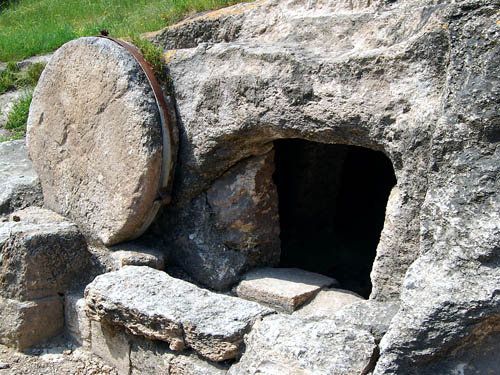
Several tombs of the type in which Jesus was buried have survived the centuries. This one was discovered during road construction a few years ago near Mount Carmel.

A Roman Period tomb with a rolling stone. Photo by Ferrell Jenkins.

A Roman Period tomb with a rolling stone. Photo by Ferrell Jenkins.

Paul says that Jesus was “delivered up for our trespasses and raised for our justification.” (Romans 4:25 ESV).

Last year I wrote about “The empty tomb” here, and “The Tomb of Jesus” here. Use the search box to locate other posts about tomb.

The observance of Easter

Have you ever thought about it? Was Easter celebrated in the churches of New Testament times? For a brief discussion of the historical information, read an article that I have posted here at the Biblical Studies Info Page.

The Via Dolorosa – the Way of the Cross

An incredible day in history. Early in the morning Jesus was transferred from Caiaphas, the Jewish High Priest, to Pontius Pilate, the Roman military governor. When Pilate learned that Jesus was from Galilee, he sent Him to Herod Antipas. Herod quickly sent Him back to Pilate. Under pressure from the religious leaders, Pilate delivered Jesus to be crucified. The numerous events from the last day prior to the crucifixion of Jesus are recorded in the New Testament (Matthew 26-27; Mark 14-15; Luke 22-23; John 18-19).

As early as Byzantine times Christians began to follow the final steps of Jesus on specified days. Over the centuries many changes were made in the route and the stops. The traditional Via Dolorosa, as known today, was fixed in the 18th century.

Jerome Murphy-O’Connor says,

The Via Dolorosa is defined by faith, not by history. (The Holy Land, 5th edition, 37)

He continues,

The present Way of the Cross has little chance of corresponding to historical reality… (38)

According to tradition, the third station of the cross is where Jesus falls the first time under His cross. It sounds reasonable, but the Gospels make no specific mention of this.

Roman period street near 3rd station of the cross. Photo by F. Jenkins.

Roman period street near 3rd station of the cross. Photo by F.  Jenkins.

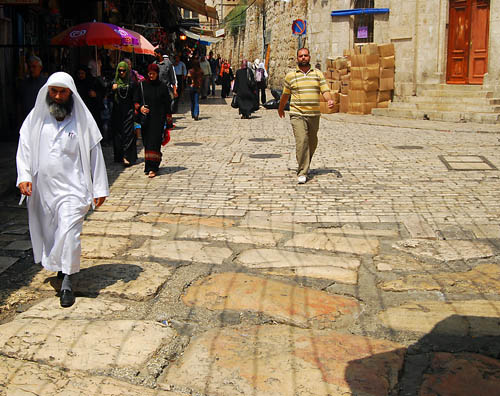
This photo shows the street in front of the third station. The plaque in Hebrew, Arabic and English provides the following information about the street.

Paving stones, apparently from the Second Temple Period (ca. 100 B.C.E. – 100 C.E.). The street was found in its entirety 3 meters below the existing level and was partially restored by the Municipality of Jerusalem … 1980-1981.

This means that the street Jesus might have walked is at least 10 feet below the present street level.

[A portion of this post is repeated from April 8, 2009.]

Peter’s denial of Jesus

Thursday was another activity-filled day for Jesus, but we pick up on the activity late in the day. The Gospel of John fills in a lot of information not contained in the other accounts of His life. Here is what John records:

  • The passover meal (John 13:1-38). John includes no account of the institution of the Lord’s Supper which took place at the time of this meal (Matthew 26:26-29; Mark 14:22-25; Luke 22:17-20). Only John records the washing of the disciples’ feet.
  • His farewell discourses (John 14-16).
  • His priestly prayer for His disciples and those who believe on Him through their word (John 17).
  • His betrayal and arrest (John 18). Note that it would have been fairly late in the evening before He was arrested.
  • He is taken to the house of Annas (John 18:12-14), where he was delivered over to Caiaphas (John 18:24-28). I think the text indicates that Jesus remained there throughout the night.
  • The denial by Peter (John 18:15-18).

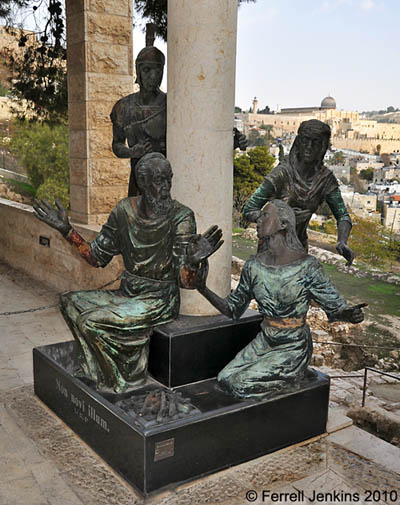
The traditional location for the house of Caiaphas is known as St. Peter in Gallicantu (St. Peter of the Cock Crowing). We have written about the site here, and I will not discuss the authenticity of the place now. The site has a nice statue of Peter saying, “mulier non novi illum.”

Peter denies knowing Jesus. Photo by Ferrell Jenkins at St. Peter in Galicantu.

Peter denies knowing Jesus. Photo by Ferrell Jenkins.

Having arrested Him, they led Him away and brought Him to the house of the high priest; but Peter was following at a distance. After they had kindled a fire in the middle of the courtyard and had sat down together, Peter was sitting among them. And a servant-girl, seeing him as he sat in the firelight and looking intently at him, said, “This man was with Him too.” But he denied it, saying, “Woman, I do not know Him.” (Luke 22:54-57 NAU)

This must have been one of the most hurtful things to Jesus. It is one thing to have acknowledged enemies mistreat you, but when it is done by a supposed friend it is doubly hurtful.

A quiet day for Jesus

The Gospel accounts indicate no activity  for Jesus on Wednesday of the final week. After all of the conflict on Tuesday, one can imagine He needed a time for seclusion. We should consider another possibility. Had He continued the intense conflict with the religious leaders it might have affected the time of His death.

Jesus carefully orchestrated His death. From the beginning He spoke of His hour. After the raising of Lazarus he withdrew to a place northwest of Jerusalem on the edge of the wilderness at Ephraim.

Jesus therefore no longer walked openly among the Jews, but went from there to the region near the wilderness, to a town called Ephraim, and there he stayed with the disciples. (John 11:54 ESV)

Jesus would offer Himself as the sacrificial lamb at the time of the Passover meal. This took intricate planning.

The crowds of pilgrims who had come to Jerusalem for Passover overloaded the system. Many of them likely slept in the open on the Mount of Olives and other places near the city. On Monday evening,

And he entered Jerusalem and went into the temple. And when he had looked around at everything, as it was already late, he went out to Bethany with the twelve. (Mark 11:11 ESV)

Luke tells us that it was His custom to do so.

And he came out and went, as was his custom, to the Mount of Olives, and the disciples followed him. (Luke 22:39 ESV)

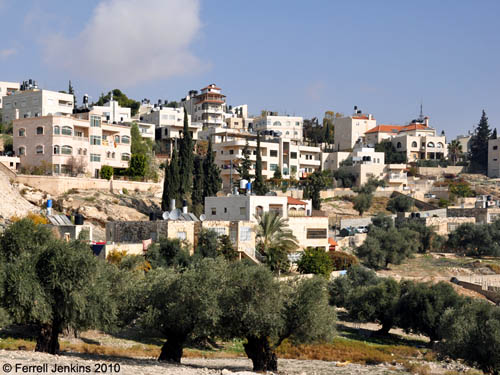
Bethany, the village of Mary, Martha and Lazarus (John 11:1), was located on the eastern slope of the Mount of Olives about two miles from Jerusalem (John 11:1, 18). The photo below of the eastern slope of Olivet was made from near the traditional tomb of Lazarus at Bethany. In the time of Jesus the mountain was likely filled with olive trees. Today we see modern housing. Jerusalem may be seen only after one reaches the crest of the mountain.

Eastern slope of Mount of Olives near Bethany. Photo by Ferrell Jenkins.

Eastern slope of Mount of Olives near Bethany. Photo by Ferrell Jenkins.

A day of conflict for Jesus

Tuesday of the week of Jesus’ death was a day of great conflict. The tensions between Jesus and the Jewish leaders had been growing for a long time and was about to reach its peak. The Gospel of John records this climax in His ministry.

37 Although Jesus had performed so many miraculous signs before them, they still refused to believe in him, 38 so that the word of Isaiah the prophet would be fulfilled. He said, “Lord, who has believed our message, and to whom has the arm of the Lord been revealed?” 39 For this reason they could not believe, because again Isaiah said, 40 “He has blinded their eyes and hardened their heart, so that they would not see with their eyes and understand with their heart, and turn to me, and I would heal them.” 41 Isaiah said these things because he saw Christ’s glory, and spoke about him. (John 12:37-41 NET)

Not everyone rejected Jesus. John says that many among the rulers believed on Him. Their faith was not strong enough to overcome their fear of being cast out of the synagogue and elicit a confession of Him (John 12:42).

According to the Gospel of Matthew, the chief priests and elders questioned His authority to do the things He was doing. It seems they were especially perturbed that He would dare do these things in the temple courts. That was where they were in control! (Matthew 21:23ff.). The intellectual sparring was followed by His scathing rebuke of them recorded in Matthew 23.

When Jesus and His disciples left the Temple that day to go out to the Mount of Olives, His disciples pointed out the magnificent buildings of the temple that had been constructed by Herod the Great. And the work continued long past the death of Herod in 4 B.C. (John 2:20).

1 Now as Jesus was going out of the temple courts and walking away, his disciples came to show him the temple buildings. 2 And he said to them, “Do you see all these things? I tell you the truth, not one stone will be left on another. All will be torn down!” (Matthew 24:1-2 NET)

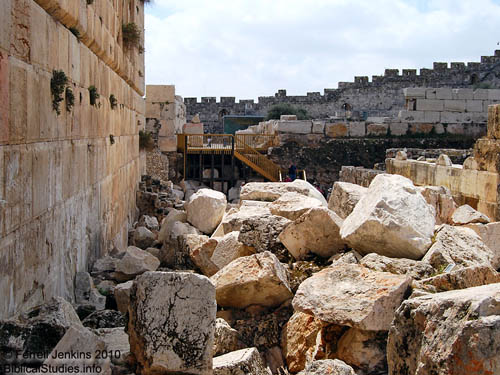
In the Olivet Discourse of Matthew 24 (= Mark 13; Luke 21), Jesus foretold the destruction of Jerusalem by the Roman armies in A.D. 70. The destruction was so complete that only the retaining walls around the Temple precinct were left standing. Archaeological excavations following 1967 have brought to light some of the rubble that was pushed from the platform into the Tyropoeon Valley on the western side. The stones are still impressive.

Broken stones once part of the temple precinct. Photo by Ferrell Jenkins.

Broken stones that once were part of the temple precinct. Photo by Ferrell Jenkins.

Jesus cleanses the Temple

On two separate occasions, perhaps separated by at least three years, Jesus cast out the money changers and merchants from the temple precinct. The first account, early in His ministry, is recorded in John 2:13-17. The second cleansing took place during the final week of His earthly ministry on Monday (Matthew 21:12-16; Mark 11:15-18; Luke 19:45-47).

Then Jesus entered the temple area and drove out all those who were selling and buying in the temple courts, and turned over the tables of the money changers and the chairs of those selling doves. And he said to them, “It is written, ‘My house will be called a house of prayer,’ but you are turning it into a den of robbers!” (Matthew 21:12-13 NET)

The photo below shows the Temple as it is envisioned from the time of Jesus. This wonderful model was displayed for many years on the grounds of the Holyland Hotel, but is now displayed at the Israel Museum in Jerusalem. Money changing and selling of sacrificial animals was an appropriate function. Then why did Jesus react as He did? The merchants were in the wrong place. They were in the temple precinct (hieros), the large area surrounding the temple proper (the sanctuary where the priests were allowed; naos).

Second Temple Model at the Israel Museum. Photo by Ferrell Jenkins.

Second Temple Model at the Israel Museum. Photo by Ferrell Jenkins.

Jesus enters Jerusalem (The Lexham English Bible)

Last evening I downloaded The Lexham English Bible, which Logos is giving away to Logos Libronix users. Information here. The Lexham Bible is available free in several popular formats here. I decided to share this text about Jesus’ entry into Jerusalem in preparation for His death. Notes have been removed. The note are an important part of The Lexham Bible, but you may read those when you download your own copy.

And when they drew near to Jerusalem and came to Bethphage at the Mount of Olives, then Jesus sent two disciples, 2 saying to them, “Go into the village before you, and right away you will find a donkey tied and a colt with her. Untie them“bring them to me. 3 And if anyone says anything to you, you will say, ‘The Lord needs them,’ and he will send them at once.” 4 Now this took place so that what was spoken through the prophet would be fulfilled, saying,
5 “Say to the daughter of Zion,
‘Behold, your king is coming to you,
humble and mounted on a donkey,
and on a colt, the foal of a pack animal.’”
6 So the disciples went and did just as Jesus directed them, 7 and brought the donkey and the colt and put their cloaks on them, and he sat on them. 8 And a very large crowd spread their cloaks on the road, and others were cutting branches from the trees and spreading on the road. 9 And the crowds who went ahead of him and the ones who followed were shouting, saying,
“Hosanna to the Son of David!
Blessed is the one who comes in the name of the Lord!
Hosanna in the highest heaven!”
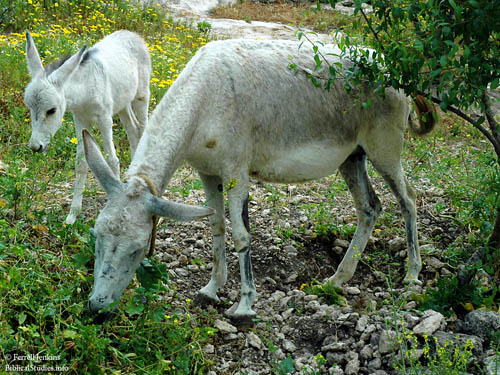
Donkey and Colt at Nazareth Village. Photo by Ferrell Jenkins.

Donkey and Colt at Nazareth Village. Photo by Ferrell Jenkins.

The late William Hendriksen makes these comments about this important event.

However, he also shows the crowds what kind of Messiah he is, namely, not the earthly Messiah of Israel’s dreams, the One who wages war against an earthly oppressor, but the One who came to promote and establish “the things that make for peace” (Luke 19:42), lasting peace: reconciliation between God and man, and between a man and his fellow man. Accordingly, Jesus enters Jerusalem mounted on a colt, the foal of an ass, an animal associated not with the rigors of war but with the pursuits of peace, for he is the Prince of Peace (Isa. 9:6).

But the people in general, their minds filled with earthly ideas concerning the Coming One, did not understand or appreciate this. In hailing him as the Messiah, the people were right; the Pharisees, chief priests, and scribes (Matt. 21:15, 16; Luke 19:39, 40) were wrong. But in expecting this Messiah to reveal himself as a political, earthly Messiah the Hosanna shouters were as wrong as were their leaders. Those who in every way rejected Jesus were committing a crime, but those who outwardly “accepted” and cheered him were also doing him a gross injustice, for they did not accept him for what he really was. Their tragic mistake was committed with dire results for themselves. (William Hendriksen, New Testament Commentary : Exposition of the Gospel According to Matthew, 760)

Scholarship or theft?

Someone unknown to me has copied numerous of my posts and posted them at their own site here.

I am delighted for others to use my material with a credit line, but this source includes no indication of the source of the material. It cost me many thousands of dollars to obtain the photos that I use on this page. Gaining permission to use material is not that difficult, and a credit line is certainly required.

You shall not steal. (Exodus 20:15 NAU)

He who steals must steal no longer; but rather he must labor, performing with his own hands what is good, so that he will have something to share with one who has need. (Ephesians 4:28 NAU)

Update Regarding Ethical and Legal Violations (March 27, 2010)

I knew that the person back of the actions mentioned above had done something unethical (sinful, according to the Hebrew Bible and the New Testament). I knew they were in violation of copyright law. After doing a little check, I learned that the practice is an infringement of the agreement made with WordPress, and a violation of the DMCA (Digital Millennium Copyright Act).

After checking the archives of the web site, I learned that this practice has been going on since December, 2009. The owner has used my photos with the same or similar captions, but has removed “Photo by Ferrell Jenkins” or other credits that I included. Outrageous, isn’t it?

Update (March 29, 2010): In response to my letter stating that my material had been plagiarized, WordPress has notified me that the offending web site “has been removed.” Thank you, WordPress. You are a great service.

Update # 2 (March 29, 2010): Soon after the single post that I reported to WordPress was taken down, others were moved to the top of the blog. Later, I reported 40 of my blogs that were copied. Late this afternoon I received this note: “The entire blog has now been removed, as per these multiple reports.”

ArchaeologyExcavations taken down from WordPress.