Category Archives: New Testament

A rooster can wake you up

Having been brought up in the country, I learned early about the annoyance of the rooster as well as his usefulness. His crowing awakened those who wanted to get up early and those who would have preferred sleeping. Without the rooster there would be no more chicks. Bantam roosters were especially known for their strutting. The writer of Proverbs mentioned this attribute:

Three things are stately in their stride, even four are stately in their walk: a lion, which is mightiest among beasts and doesn’t retreat before anything, a strutting rooster, a goat, and a king at the head of his army. If you have been foolish by exalting yourself or if you’ve been scheming, put your hand over your mouth. For the churning of milk produces butter, and twisting a nose draws blood, and stirring up anger produces strife. (Proverbs 30:29-33 CSB)

The rooster strutted as if he owned the yard. Our backyard was barren. Chicken scratch was scattered across the yard and the chickens scurried to get their share.

The photo below was made recently at the Jordan River Park north of the Sea of Galilee.
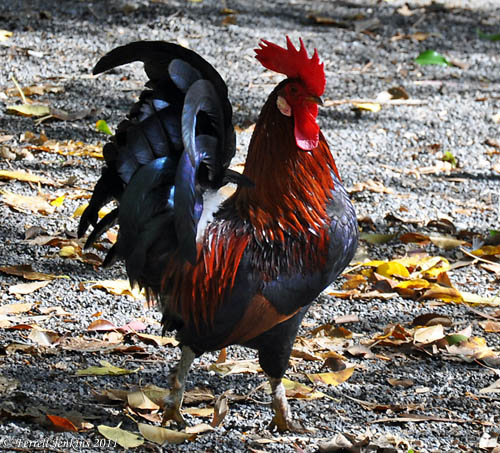
Rooster at Jordan River Park. Photo by Ferrell Jenkins.

Rooster at Jordan River Park. Photo by Ferrell Jenkins.

We especially remember the rooster in connection with Peter’s denial of the Lord. Note first the Lord’s prediction:

“I assure you,” Jesus said to him, “tonight, before the rooster crows, you will deny Me three times!” “Even if I have to die with You,” Peter told Him, “I will never deny You!” And all the disciples said the same thing. (Matthew 26:34-35 CSB)

Matthew records what happened after the denial:

Then he started to curse and to swear with an oath, “I do not know the man!” Immediately a rooster crowed, and Peter remembered the words Jesus had spoken, “Before the rooster crows, you will deny Me three times.” And he went outside and wept bitterly. (Matthew 26:74-75 CSB)

If you have visited St. Peter in Galicantu (St. Peter of the Cock Crowing) in Jerusalem recently, you have seen this sculpture showing Peter saying “I do not know Him.” Note the rooster on the top of the column.
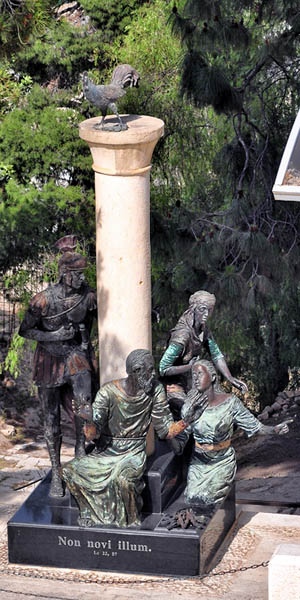
Sculpture at St. Peter in Galicantu. Photo by Ferrell Jenkins.

Sculpture at St. Peter in Galicantu. Photo by Ferrell Jenkins.

Then the Lord turned and looked at Peter. So Peter remembered the word of the Lord, how He had said to him, “Before the rooster crows today, you will deny Me three times.” And he went outside and wept bitterly. (Luke 22:61-62 CSB)
Grass on the roof

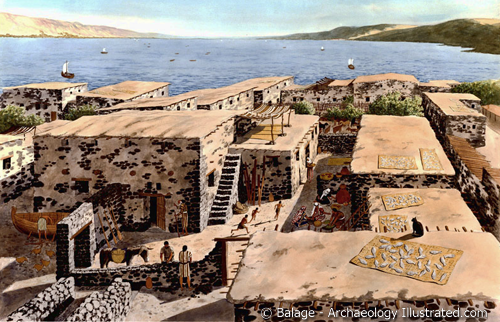
In the previous post we wrote about the account of some men putting a hole in the roof of the house where Jesus was teaching in Capernaum. Our photos illustrated the way roofs were constructed at the time. This art by Balage Balogh of Archaeology Illustrated shows clearly the roofs. You can see the flat dirt roof with the poles (we might say rafters) showing under the surface.

The houses of Capernaum in the time of Jesus.

The houses of Capernaum in the time of Jesus. Art by Balage Balogh, ArchaeologyIllustrated.com

Other biblical passages become clear when we understand the nature of house construction during Bible times.

Take a look at Proverbs27:15. Think of what the winter rains might do to one of the roofs of the day.

A continual dripping on a rainy day and a contentious wife are alike. (Proverbs 27:15 NET)

One of the Psalms of Ascent calls for the overthrow of  those who hate Zion.

May they be like the grass on the rooftops which withers before one can even pull it up, (Psalm 129:6 NET)

In another text we are told that King Hezekiah of Judah prayed to the Lord during the days of the Assyrian threat to Judah. The prophet Isaiah informs the Assyrian king Sennacherib that the Lord has overthrown His enemies in the past and will do so again. Notice the illustration:

Their residents are powerless, they are terrified and ashamed. They are as short-lived as plants in the field, or green vegetation. They are as short-lived as grass on the rooftops when it is scorched by the east wind. (2 Kings 19:26 NET = Isaiah 37:27).

They removed the roof above Jesus

The following paragraph by M. J. Selman in the New Bible Dictionary, 3rd ed., provides a good summary about houses in Bible times.

Many houses had two storeys, though, since no building in ancient Israel has yet been preserved with a complete roofed ground floor or ceiling, the original height of a building is not always certain. Upper rooms were reached by stairs or ladders. These rooms provided the main living and sleeping accommodation (cf. 2 Ki. 9:13, 17), and guests could also be looked after there (1 Ki. 17:19; 2 Ki. 4:10-11).

Roofs were constructed from beams covered with branches and a thick layer of mud plaster, though the rafters were sometimes supported by a row of pillars along the middle of the room. Cylindrical stone rollers about 60 cm. [23.6 inches] long were used to keep the roofs flat and waterproof, though roofs needed to be re-plastered annually prior to the rainy season to seal cracks which had developed during the summer heat.

The family would often sleep on the roof in summer or use it to dry raisins, figs, flax, etc., in the sun. A parapet was to be built as a safety precaution according to Dt. 22:8. Vaulted roofs were certainly in use in Palestine by the Persian period, while the tiled roof also appeared before NT times. The rooftop was also a place of worship, either for Baal and especially the host of heaven (Je. 19:13; Zp. 1:5), or for the true God (Acts 10:9).

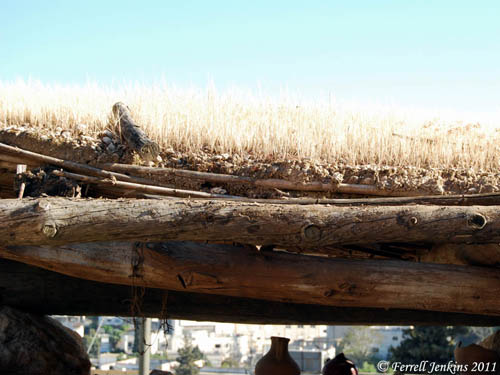
The first photo shows a portion of a roof made from wood and mud. You will also notice a roof roller on the roof. After the winter rains it was necessary to roll the roof.

Typical roof from NT times with roof roller. Nazareth Village. Photo by Ferrell Jenkins.

Typical roof from NT times with roof roller. Nazareth Village. Photo by Ferrell Jenkins.

The next photo shows the roof a little later in the year after grass has grown on the roof and died under the summer heat.

Typical of a roof from NT times with grass growing on it. Nazareth Village. Photo by Ferrell Jenkins.

Typical of a roof from NT times with grass growing on it. Nazareth Village. Photo by Ferrell Jenkins.

From the inside of the house the ceiling might look something like this.

Ceiling of roof made of timber and reeds. Nazareth Village. Photo by F. Jenkins.

Ceiling of roof made of timber and reeds. Nazareth Village. Photo by F. Jenkins.

Notice the New Testament texts implying such a roof.

When they were not able to bring him in because of the crowd, they removed the roof above Jesus. Then, after tearing it out, they lowered the stretcher the paralytic was lying on. (Mark 2:4 NET)

The account of Luke, a gentile physician, adds an interesting point that creates a small problem in interpretation.

But since they found no way to carry him in because of the crowd, they went up on the roof and let him down on the stretcher through the roof tiles right in front of Jesus. (Luke 5:19 NET)

Did you notice the reference to roof tiles? One of the Translator’s Notes in the NET Bible discusses this problem.

There is a translational problem at this point in the text. The term Luke uses is keramos. It can in certain contexts mean “clay,” but usually this is in reference to pottery (see BDAG 540 s.v. 1). The most natural definition in this instance is “roof tile” (used in the translation above). However, tiles were generally not found in Galilee. Recent archaeological research has suggested that this house, which would have probably been typical for the area, could not have supported “a second story, nor could the original roof have been masonry; no doubt it was made from beams and branches of trees covered with a mixture of earth and straw” (J. F. Strange and H. Shanks, “Has the House Where Jesus Stayed in Capernaum Been Found?” BAR 8, no. 6 [Nov/Dec 1982]: 34). Luke may simply have spoken of building materials that would be familiar to his readers.

There are other possible interpretations, but I hope this information with the photos will help you better understand the biblical text.

Walking on Roman roads

Gordan Franz, Life and Land Seminars, recently led the 2011 Talbot Bible Lands study tour of Turkey and Greece. He writes about the Roman roads used by Paul in his journeys. See here.

Photos are included of the following roads, portions of which still exist.

  • The Via Taurus, “a beautifully preserved road between Tarsus and the Cilician Gates” (Acts 15:36).
  • The Via Sebaste (“Emperor’s Road”) connecting Iconium and Pisidian Antioch (Acts 13:51; 14:21-23).
  • The Roman Road west of Assos (Acts 20:22-23).
  • The Roman Road inside the city of Alexandria Troas leading to the harbor (Acts 16:8-11).
  • The Via Egnatia which connected Neapolis and Philippi (Acts 16:11-12; 20:6).
  • The Appian Way (Acts 28:14-16).

The link to photos made by one of the tour members is given at the bottom of the article. At this moment you will need to copy the link and paste it into your browser. There is an extra http// in the embedded code.

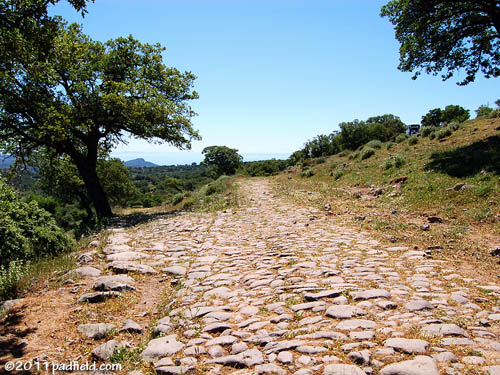
The photo below is one provided by friend David Padfield of the Roman road near Assos.

Roman Road near Assos. Photo by David Padfield.

Roman Road near Assos. Photo by David Padfield.

I have been on journeys many times, in dangers from rivers, in dangers from robbers, in dangers from my own countrymen, in dangers from Gentiles, in dangers in the city, in dangers in the wilderness, in dangers at sea, in dangers from false brothers… (2 Corinthians 11:26 NET)

New Testament artifacts in the Israel Museum

There are some highly significant artifacts relating to the study of the New Testament in the Israel Museum.

  • The Pilate inscription from Caesarea Maritima (Acts 13:28; 1 Timothy 6:13).
  • The ossuary of the high priest Caiaphas (Matthew 26:3). An inscription on the ossuary reads “Yehosef bar Qafa” (Joseph the son of Caiaphas). There are several ossuaries bearing common names of the New Testament period such as Mary and Jesus.
  • The fragment of one of the warning inscriptions once in the wall separating the Court of the Gentiles from the Court of the Women (Acts 21:29; cf. Ephesus 2:14). The only full inscription discovered in Jerusalem is now in the Istanbul Archaeological Museum.
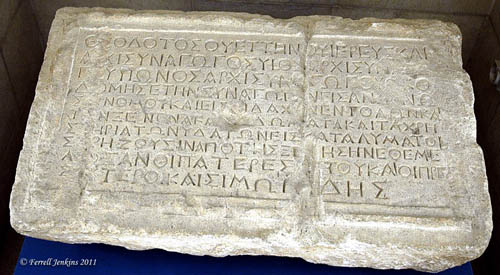
  • The Theodotus Inscription. This inscription came from a Synagogue of Freedmen (liberated slaves). Stephen contended with some men from this synagogue (Acts 6:9). This item was previously displayed in the Rockefeller Museum.
Theodotus Inscription now displayed in the Israel Museum.

Theodotus Inscription now displayed in the Israel Museum.

And more….

One item I failed to see (if it was on display) was the “Chair of Moses” from the Synagogue at Chorazin (Matthew 23:2). In some cases the replicas at the site of discovery are good — and they may be photographed. Examples are the chair of Moses and the Pilate inscription.

The Israel Museum should reevaluate the policy of not allowing photographs. There is nothing on display that has not already been published in numerous places. Teachers like to have their own photos to show their students.

Impressions about the “new” Israel Museum

Many groups visit the campus of the Israel Museum. There are now three areas of interest:

  • The Israel Museum
  • The Shrine of the Book where some Dead Sea Scrolls are displayed
  • The Second Temple Model

We wrote about the planned reopening of the Israel Museum here, and about the opening here. The Shrine of the Book remained open during the time the Museum was closed, and the Second Temple Model has been open since it was moved from the grounds of the Holyland Hotel in the middle of 2008. See here.

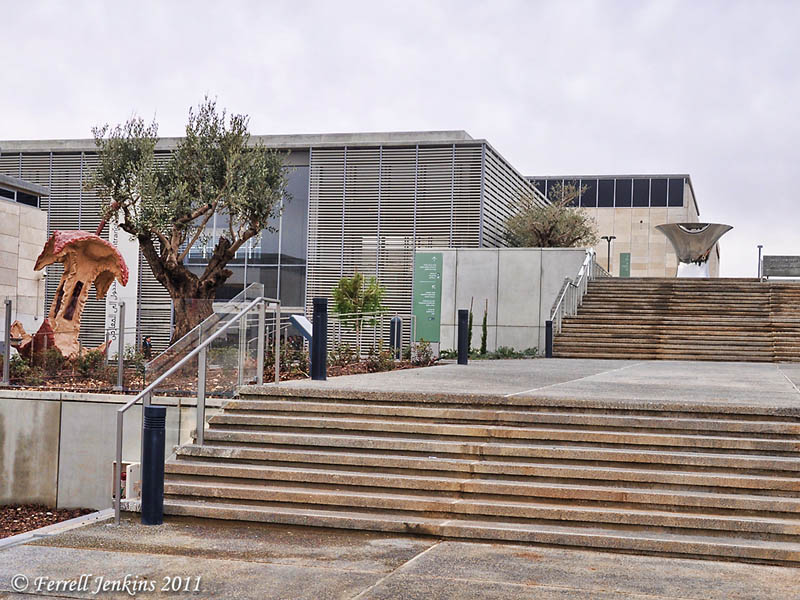
The  galleries devoted to archaeology remain in the same place as before, but there is a significant difference from before. The entrance to the galleries is not at the top of the steps, but about half way up by the apple core sculpture. There is a small cafe with snacks and drinks at the entrance. Tickets are purchased down below at the entrance to the entire complex.

Entrance to Israel Museum. Photo by Ferrell Jenkins.

Entrance to Israel Museum. Photo by Ferrell Jenkins.

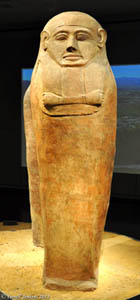
Once inside the galleries entrance, the archaeology section is on the left. One is greeted by a display of seven standing anthropoid clay coffins from Deir el-Balah, a site south of Gaza city excavated by Trude Dothan in 1972. These coffins which bear the evidence of Egyptian influence date to the 13th century B.C.

Clay coffin (sarcophagus) from Deir el-Balah.

Clay coffin from Deir el-Balah

In the March, 1976, issue of Biblical Archaeology Review, Hershel Shanks closed an article about the discovery of these sarcophagi this way:

We may close on a Biblical note. “Aron”, or coffin, is used only once in the Bible (Genesis 50:26)—in connection with Joseph’s burial. Joseph, a high-ranking minister in the Egyptian government was naturally buried in accordance with Egyptian rites, including mummification and a coffin. It is likely that his coffin resembled the anthropoid coffins unearthed at Deir el-Balach.

Many sections of the archaeology section remains much the same as before. I will list a few of the items that I think are extremely important to biblical study.

  • The Tel Dan “House of David” Inscription (Isaiah 22:22, et al.)
  • The cult shrine from Hazor.
  • A few pieces of ivory from Samaria (1 Kings 22:39; Amos 3:15; 6:4).
  • Ekron inscription found at Tel Miqne, naming the city and five of its rulers (1 Samuel 6:17).
  • Silver plaques inscribed with the priestly blessing (Numbers 6:23-26). Also known as the Ketef Hinnom discovery.
  • The “Holy of Holies” from the temple at Arad.
  • The Edomite Shrine from biblical Tamar (aka Ein Hazevah).
  • The basalt stele showing a stylized figure of a horned bull from Geshur (aka New Testament Bethsaida).
  • Sennacherib’s siege of Lachish. The original is in the British Museum, but the replica in the Israel Museum has been enhanced to better show the scene (2 Chronicles 32:9).
  • Lachish Ostracon. I only saw one of the letters on display.

And much more…. My time was limited, but I look forward to returning for a longer visit in a few months.

A few things I had seen before, but did not see this time. (It may be that I missed some of these items.)

  • The broken inscription from Ashdod naming Sargon (Isaiah 20:1).
  • The inscribed ivory pomegranate mentioning donations for the priests of the house of the [LORD]. The Israel Museum declared the inscription a forgery in late 2004. There are scholars who believe it to be genuine.

General comments. The display are beautiful and the halls are spacious. Many of the artifacts are displayed in the open (without glass). Visitors are allowed to enter the museum with their cameras. In the past cameras had to be checked. I saw no signs about photography. Shortly after making my first photos I was admonished by one of the docents.

Information about location, hours, tickets, etc. is available at the museum website here.

In another post I will make reference to some of the items of importance to New Testament study.

Going up to Jerusalem

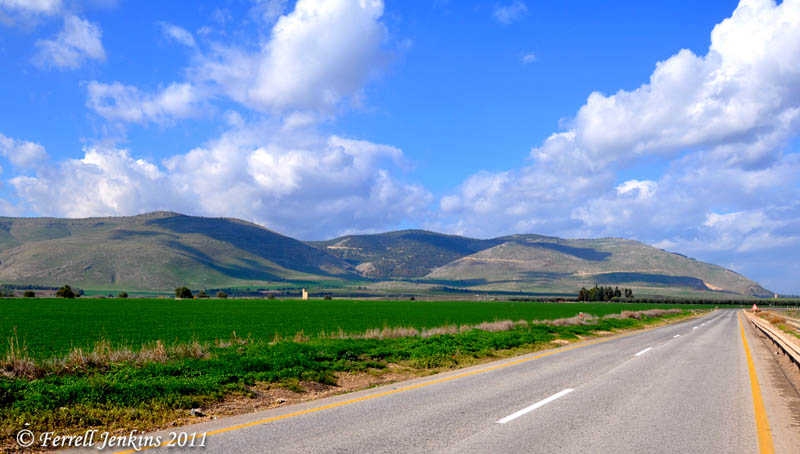
The photo of Mount Gilboa was made from Highway 669 west of Beth Shean. Mount Gilboa is remembered as the place where King Saul was defeated by the Philistines (1 Samuel 31). Notice David’s lament:

“You mountains of Gilboa, let there be no dew or rain upon you, nor fields of offerings! For there the shield of the mighty was defiled, the shield of Saul, not anointed with oil. (2 Samuel 1:21 ESV)

A view of Mount Gilboa from the east. Photo by Ferrell Jenkins.

A view of Mount Gilboa from the east. Photo by Ferrell Jenkins.

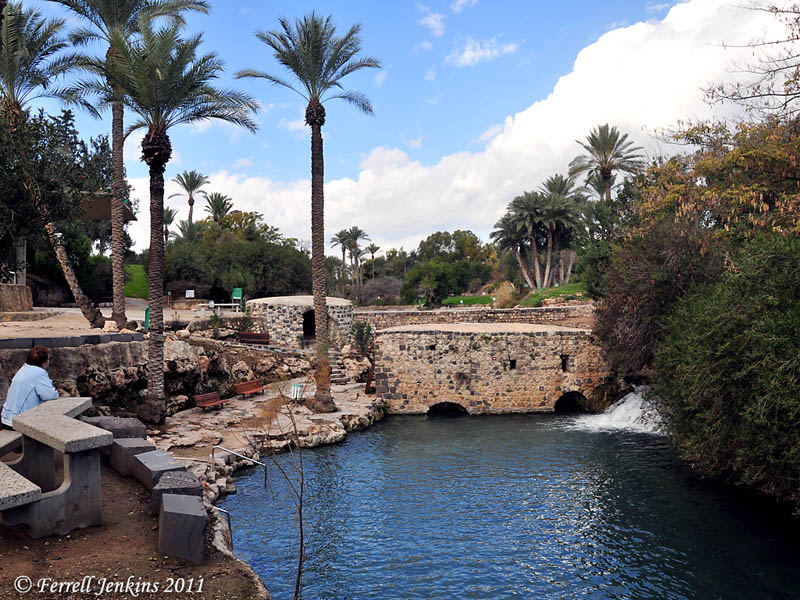
You may recall that the Spring of Harod, where Gideon chose the warriors the LORD wanted (Judges 7) is located at the base of Mount Gilboa in the Jezreel Valley. From that point east down to the Jordan River, there are numerous sources of water. One interesting place is known as Gan Hashlosha (Park of the Three), or by its Arabic name Sakhne (hot springs). There are other sources of water in the vicinity.

I suggest that it may have been in this general area that John the Baptist did some of his baptizing.

John also was baptizing at Aenon near Salim, because water was plentiful there, and people were coming and being baptized (John 3:23 ESV)

I know there are other suggestions, but I am writing on the run and not intending to explore all possibilities.

Gan Hashlosha. Photo by Ferrell Jenkins.

Gan Hashlosha. Photo by Ferrell Jenkins

We encountered rain a few miles north of  Jericho. I turned east on the road going to the traditional Baptism Site (in Israel), but came to the same closed military gate that I had seen before. I called a travel friend in Jerusalem who told me that the site was open for a couple of days in January. He said it will be open for two or three days a week to groups with special permission.

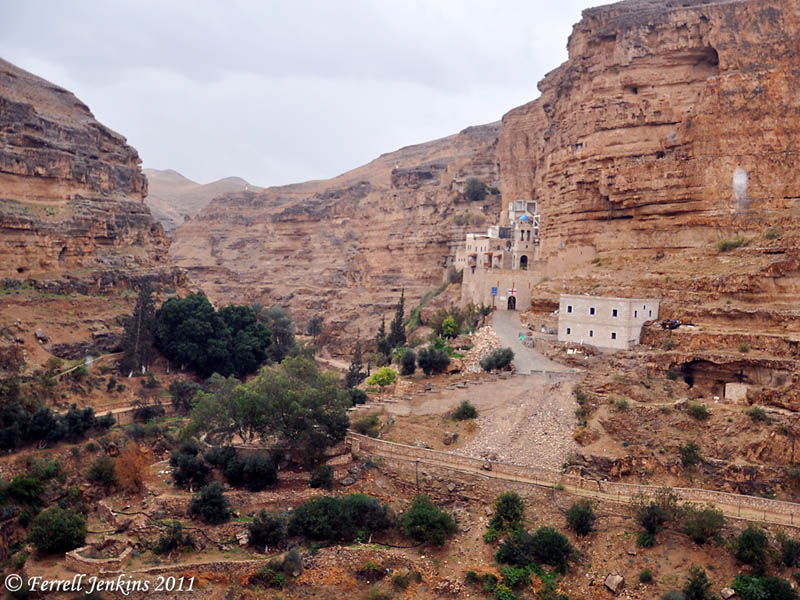
On the way up to Jerusalem we turned aside to view Wadi Qilt (Kelt) and the St. George Monastery. The view below was taken in the rain. The monastery was begun in the fourth century, but the structure you see was built in the late 5th century. For a brief summary and good photos see BiblePlaces.com.

St. George Monastery in the Wadi Qilt. Photo by Ferrell Jenkins.

St. George Monastery in the Wadi Qilt. Photo by Ferrell Jenkins.

We are in Jerusalem.

Sunshine, rain, and wind in Galilee

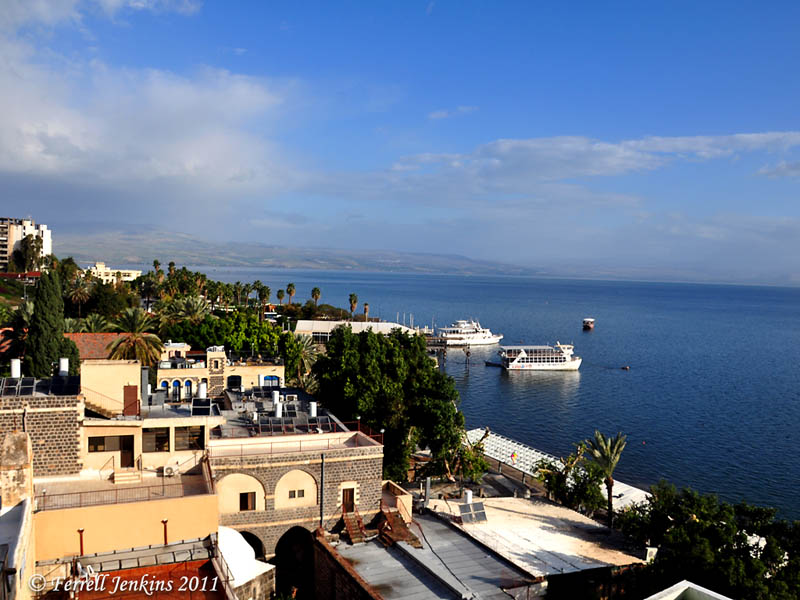
When I first looked from the hotel balcony in Tiberias this morning the sun was shining and the Sea of Galilee was calm.

The Sea of Galilee from my hotel balcony in Tiberias. Photo by Ferrell Jenkins.

The Sea of Galilee from my hotel balcony in Tiberias. Photo by Ferrell Jenkins.

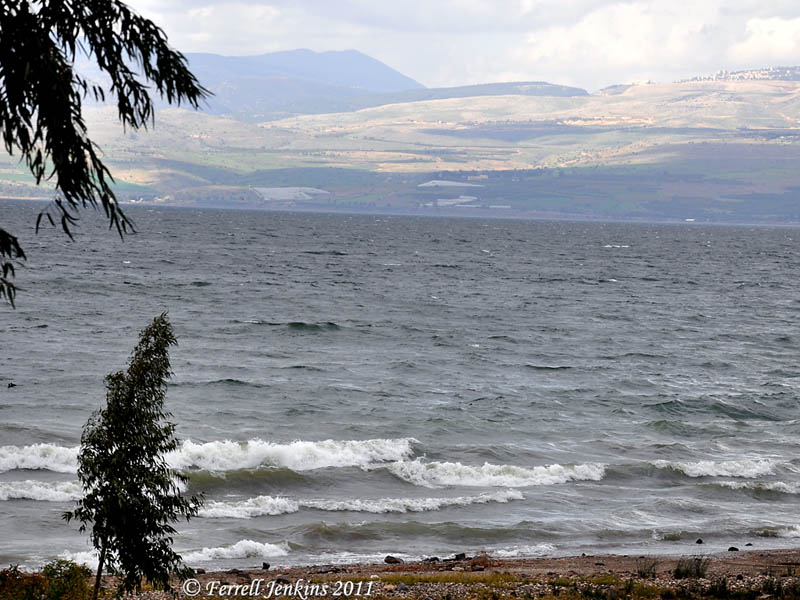
Later in the day, by early afternoon we were on the eastern side of the lake. The weather was cool and the wind from the west was rather strong. We stopped a few places along the shore to make photos. In the photo below you can see the small waves on the sea. In the distance, to the northwest, you will note that the sun is shining on the hills. While this may not qualify as a violent storm it demonstrates the sudden change that can take place when the wind comes down on the sea.

One day Jesus got into a boat with his disciples and said to them, “Let’s go across to the other side of the lake.” So they set out, and as they sailed he fell asleep. Now a violent windstorm came down on the lake, and the boat started filling up with water, and they were in danger. They came and woke him, saying, “Master, Master, we are about to die!” So he got up and rebuked the wind and the raging waves; they died down, and it was calm.
(Luke 8:22-24 NET)

A stormy Sea of Galilee looking West. Photo by Ferrell Jenkins.

A stormy Sea of Galilee looking West. Photo by Ferrell Jenkins.

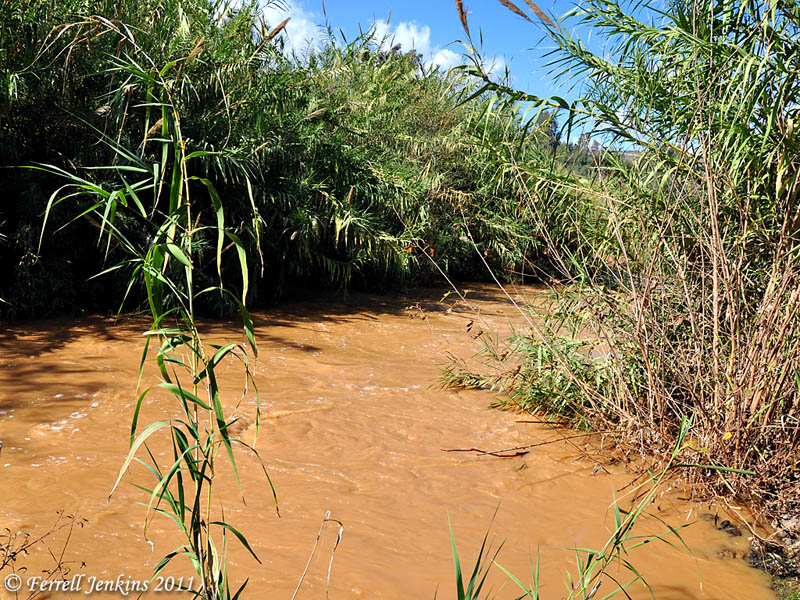
A little earlier we visited the suggested site of New Testament Bethsaida and Old Testament Geshur. While in the vicinity we went to the Jordan River in the Jordan River Park. This park is probably less than 2 miles north of the Sea of Galilee. The water was muddy and running swift because of the rains over the past few days in the north.

Jordan River at Jordan River Park, N of Sea of Galilee

Jordan River at Jordan River Park, N of Sea of Galilee. Photo by Ferrell Jenkins.

We circled the Sea of Galilee, went to En Gev, drove up into the Golan Heights past Susita (Greek Hippos), visited the Peace Vista for a view of the entire lake, and then down along the Yarmuk Valley, and back to Tiberias. Later in the day we went to Mount Arbel.

A profitable day, I think.

A rainy Sunday in Galilee

Sunday was a rainy day with periods of sunshine in Galilee. Sunday morning we went to Nazareth to meet with the Church of Christ there. Even though Nazareth is only a short distance from Tiberias, it was considerably cooler there. During the service we could hear rain falling on the roof.

On the outskirts of Nazareth I stopped to make a photo of the city. The dome of the Church of the Annunciation is visible in the left of the photo. The older part of the city, from the time of Jesus, is located there. The ridge slightly visible in the far distance is the eastern end of Mount Carmel.

View of Nazareth. Photo by Ferrell Jenkins.

View of Nazareth. Photo by Ferrell Jenkins.

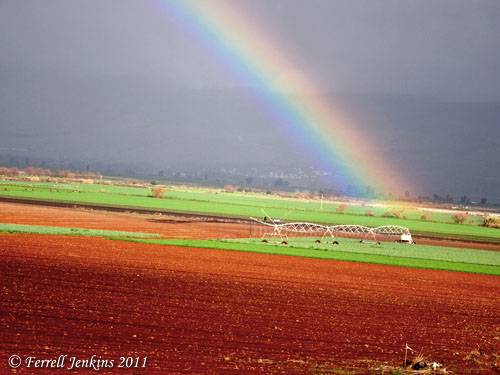
In the afternoon we drove north toward the border with Lebanon in hopes that the sky might clear there to give us a good view of Mount Hermon. We were not successful, but we did enjoy the drive as far as Dan and Caesarea Philippi. During the day we saw many beautiful rainbows. At one point over the fertile Hula Valley there was a complete rainbow visible at times. Here is a photo I made looking east toward the Golan Heights.

Rainbow over Hula Valley. View to Golan Heights. Photo by Ferrell Jenkins.

Rainbow over Hula Valley. View to Golan Heights. Photo by Ferrell Jenkins.

On the return to Tiberias we turned east to drive past Chorazin and get a view of the northeast corner of the Sea of Galilee. Those who have seen this view before will be impressed with how low the water level is.

Northeast corner of the Sea of Galilee. Photo by Ferrell Jenkins.

Northeast corner of the Sea of Galilee. Photo by Ferrell Jenkins.

We enjoyed the day, and thankful to visit the areas where Jesus did so much of His work, even when it rained.

Jesus went throughout all of Galilee, teaching in their synagogues, preaching the gospel of the kingdom, and healing all kinds of disease and sickness among the people. (Matthew 4:23 NET)

Free book about the James ossuary trial

Herschel Shanks, editor of Biblical Archaeology Review, reminds us that the trial brought by the Israel Antiquities Authority against Oded Golan and Robert Deutsch is about to come to an end.

If you are interested in this subject you should click here and sign up for the book entitled James, Brother of Jesus: Forged Antiquities and the Trial of Oded Golan and Robert Deutsch.

The book is described this way.

After five years, the “forgery trial of the century” has concluded in a Jerusalem courtroom. Defendants Oded Golan and Robert Deutsch await the judge’s verdict, and so does the rest of the world. Even if the verdict is “not guilty,” the question of authenticity of several ancient artifacts will still remain. In this free e-book, Hershel Shanks explains why he believes the now-famous “James Ossuary” inscription is authentic. Plus, he provides behind-the-scenes analysis of the trial and its key players.

Herschel also promises an English translation of the trial verdict as soon as it is released.

Understand that this is likely a book to be downloaded, and that in signing up for it you indicate that you wish to receive the BAR Companion newsletter. Not a bad trade-off in my judgment.