Category Archives: Israel

Rachel’s tomb?

During the past few weeks there has been controversy over a site immediately on the outskirts of Bethlehem called Rachel’s Tomb. My thought through the years has been that it is at best one of the “traditional” sites that may or may not be the tomb of Rachel.

Some bloggers have presented varying views on the association of the site with Rachel, the mother of Joseph and Benjamin (Genesis 35:24). I am going to direct you to places where you can read to your satisfaction.

  • Todd Bolen says this can not be the tomb of Rachel if we follow the biblical account in Genesis 35:19-20; 48:7, 1 Samuel 10:2, et al.  Read here. He includes a nice color photo of the traditional tomb from the Feinberg collection (probably 1950s or 1960s), and documentation.
  • A response to Bolen by Benj Foreman. Read here.
  • Leen Ritmeyer’s response to Bolen. Read here.

This old photo, which is dated sometime between 1898 and 1946,  is from The American Colony and Eric Matson Collection. Information on ordering is available at Life in the Holy Land.
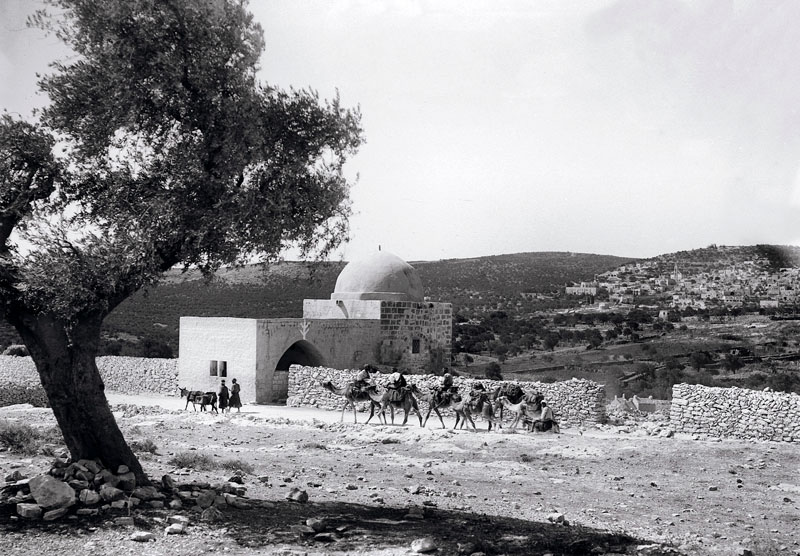
Rachel's Tomb, American Colony and Eric Matson Collection.

Rachel's Tomb, American Colony and Eric Matson Collection.

Along with the set of historic views of the Holy Land, Todd Bolen has included quotations about the site from scholarly books that discuss the site. The following comment is from Edward Robinson and Eli Smith, Biblical Researches in Palestine, Mount Sinai and Petraea, 1841. The entire book is available at Google Books.

“Someways up the gently acclivity, which here rises towards the N.E. from Wady Ahmed, stands the Kubbet Rahil, or Rachel’s Tomb . . . This is merely an ordinary Muslim Wely, or tomb of a holy person; a small square building of stone with a dome, and within it a tomb in the ordinary Muhammedan form; the whole plastered over with mortar. Of course the building is not ancient; in the seventh century there was here only a pyramid of stones. It is now neglected, and falling to decay; through pilgrimages are sill made to it by the Jews” (Robinson and Smith, Biblical Researches in Palestine, Mount Sinai and Petraea, 1841: 1: 322).
Water in a dry and weary land

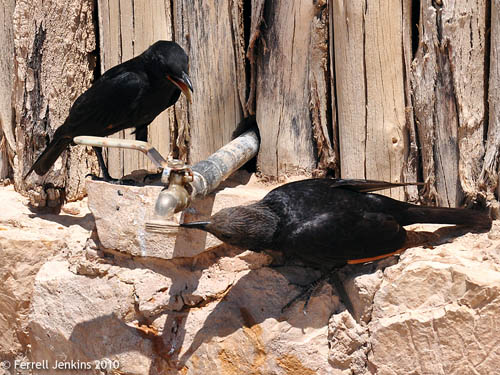
These Tristram’s Grackles, or Tristram’s Starlings, at Masada are trying to get a drop of water from one of the faucets supplying the tourists with lukewarm water during their visit to the site.

Tristram's Grackles at Madada. Photo by Ferrell Jenkins.

Tristram's Grackles at Madada. Photo by Ferrell Jenkins.

Henry B. Tristram wrote The Natural History of the Bible in 1868. In 1884 he wrote Fauna and Flora of Palestine.

A bird commonly seen at Masada, along the shore of the Dead Sea, is named for Tristram. The black bird has some distinctive orange feathers, as you can see in the bird on the right.

Psalm 63 is said to be “A Psalm of David, when he was in the wilderness of Judah.”

O God, you are my God; earnestly I seek you; my soul thirsts for you; my flesh faints for you, as in a dry and weary land where there is no water. (Psalm 63:1 ESV)

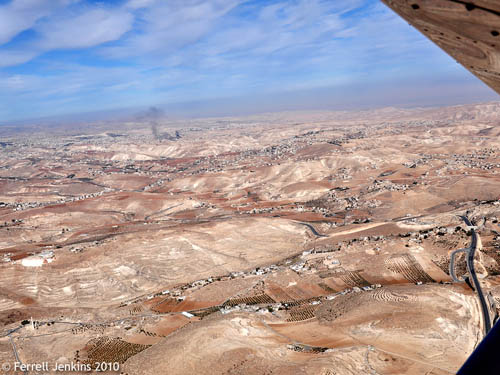
View east from the Herodium

During the past few months we have had considerable interest in our aerial photos of Herodium. Today I will share a photo showing the area east of the Herodium. This area is part of the Wilderness of Judea.

Aerial view east from over the Herodium. Photo by Ferrell Jenkins.

Aerial view east from over the Herodium. Photo by Ferrell Jenkins.

John the Baptist preached in the wilderness of Judea (Matthew 3:3), and Jesus was tempted in the wilderness (Matthew 4:1). This activity was likely in a region to the north of the area shown in this photo.

Jesus spoke to the crowds about John this way:

What did you go out into the wilderness to see? A reed shaken by the wind? (Luke 7:24 ESV)

Bauer describes the wilderness (Greek eremos) of Judea this way:

Of the Judean wilderness, the stony, barren eastern declivity of the Judean mountains toward the Dead Sea and lower Jordan Valley. (BDAG)

The Hebrew word for this wilderness is midbar. Charles F. Pfeiffer said the wilderness of Judea,

is the region of rugged gorges and bad lands in the eastern part of Judah where the land slopes off toward the Jordan Valley. In ancient times this area was infested with wild animals. Except for a brief time during the spring rains the wilderness is arid. (Baker’s Bible Atlas, 201)

Recently I was in a class covering the section of Scripture dealing with the conflict between Saul and David (1 Samuel 23-25).

  • The wilderness of Maon in the Arabah to the south of Jeshimon (1 Samuel 23:24). Jeshimon is another word used to describe the wilderness.
  • The strongholds and wilderness of Engedi (1 Samuel 23:29; 24:1).
  • The stronghold (possibly the area we know as Masada) (1 Samuel 22:4; 25:2).24:22).
  • Ziph, Horesh, Carmel (1 Samuel 23:14-15;

Some of that activity took place within this view, and some took place further to the south. The terrain is much the same. I note that Rainey uses the phrase “steppe land” in several of these references (Sacred Bridge, 148).

Many people who read the Bible in English, without checking into the matter, think of the wilderness as being a place filled with wild growth and underbrush. Jesus’ question to the crowds indicates that no reeds are to be found in the wilderness. In this case a picture really is worth a thousand words.

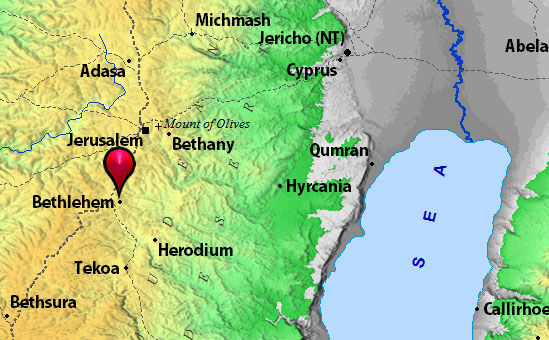
The map from BibleAtlas.org includes the region that we photographed.

Map to show area east of the Herodium. BibleMapper image from BibleAtlas.org.

Map to show area east of the Herodium. BibleMapper image from BibleAtlas.org.

“Lands of the Bible” 2011 calendar

Lands of the Bible 2011 CalendarEveryone who has visited Israel, or those who wish they had, enjoy seeing good pictures of the lands of the Bible. Orange Circle Studio, a leading calendar publisher, produced a beautiful calendar for 2011 using the photographs of Todd Bolen.

A friend sent me a copy of the calendar as a gift. I enjoyed it as soon as I browsed through it, and expect to enjoy it for the next 14 months. I thought some of our readers who appreciate good photos of the Bible land would enjoy the calendar. Todd has a few of the calendars available at a discount price (postpaid). For more information go to the Bible Places Blog, or directly to the order page here.

Royal gardens at Ramat Rachel

Archaeologists working at Ramat Rachel, between Jerusalem and Bethlehem, say they have uncovered an ancient royal garden. They say this will be “the first full-scale excavation of this type of [an] archaeological site anywhere in the pre-Hellenistic Levant.”

According to Prof. Oded Lipschits and graduate student Boaz Gross of Tel Aviv University’s Department of Archaeology, this dig is an unparalleled look into the structure and function of ancient gardens. “We have uncovered a very rare find,” says Prof. Lipschits, who believes that this excavation will lead to invaluable archaeological knowledge about ancient royal gardens in the Middle East.

The discovery, which dates back to the 7th century B.C.E., was recently reported in Quadmoniot, the journal of the Israel Exploration Society, and another paper on the dig is forthcoming in Near Eastern Archaeology.

Read the news release in its entirety here.

The identity of Ramat Rachel with a specific Bible city is not known.

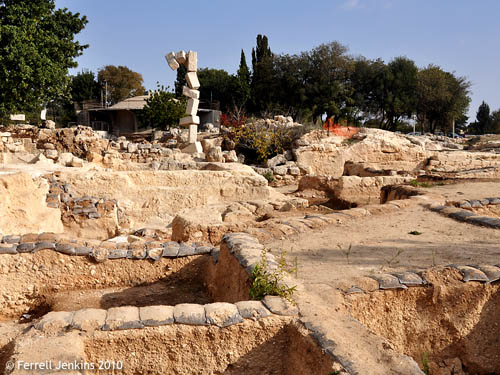
This photo shows some of the excavation area at Ramat Rachel after the 2009 season.

Excavation at Ramat Rachel. Photo by Ferrell Jenkins.

Excavation at Ramat Rachel. Photo by Ferrell Jenkins.

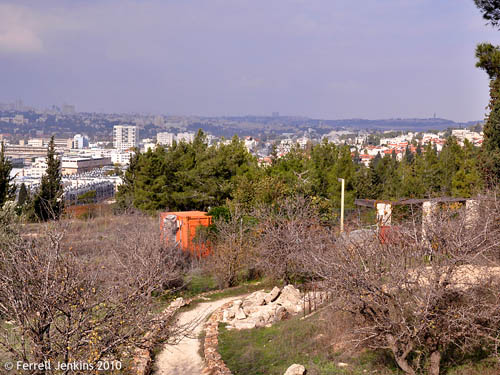
The elevation of Ramat Rachel is about 2684 feet above sea level. This gave the inhabitants a view of the ancient city of Jerusalem which was about 200 feet lower. Even on a less than clear day, you can see the Old City of Jerusalem on the far right of the photo below.

View to north of Jerusalem from Ramat Rachel. Photo by Ferrell Jenkins.

View to the north of the city of Jerusalem from Ramat Rachel. Photo by Ferrell Jenkins.

Ramat Rachel was inhabited from “the last century of the kingdom of Judah (7th century BCE) until the early Muslim reign in Palestine (10th century CE).” The excavators think the royal palace at Ramat Rachel was first built in the days of King Hezekiah (2 Kings 18-20).  More information is available at the excavation web site here.

Sea of Galilee now more than 701 feet below sea level

Arutz Sheva reports that the Sea of Galilee fell 20 centimeters last month.

Despite several periods of rain during the month, the Kinneret’s level fell 20 centimeters [7.87 inches] in October, the Hydrological Service of the Israel Water Authority said Tuesday. The lake’s level is now 213.88 [701.71 ft.] meters below sea level. According to the Service, the Kinneret lost 72 centimeters [28.35 in.] between July and September.

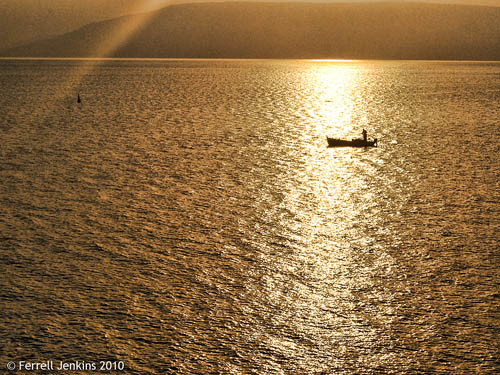
A lone fisherman on the Sea of Galilee at sunrise. View east. Photo by Ferrell Jenkins.

A lone fisherman on the Sea of Galilee at sunrise. View east. Photo by Ferrell Jenkins.

The Sea of Gailee/Kinneret played an important role in the ministry of Christ and His disciples.

When He heard that John had been arrested, He withdrew into Galilee. He left Nazareth behind and went to live in Capernaum by the sea, in the region of Zebulun and Naphtali. This was to fulfill what was spoken through the prophet Isaiah: Land of Zebulun and land of Naphtali, along the sea road, beyond the Jordan, Galilee of the Gentiles! The people who live in darkness have seen a great light, and for those living in the shadowland of death, light has dawned. From then on Jesus began to preach, “Repent, because the kingdom of heaven has come near!” (Matthew 4:12-17 CSB)

HT: Biblical Paths.

Model shrines from biblical sites

Model shrines have been uncovered in numerous excavations of biblical cities, but they are common throughout the Ancient Near East. Ziony Zevit says,

Some model shrines were found to contain built-in images of deities while others were empty. In the latter case, some scholars assume that a small portable image was placed inside when the shrine was in use. (The Religions of Ancient Israel, 328).

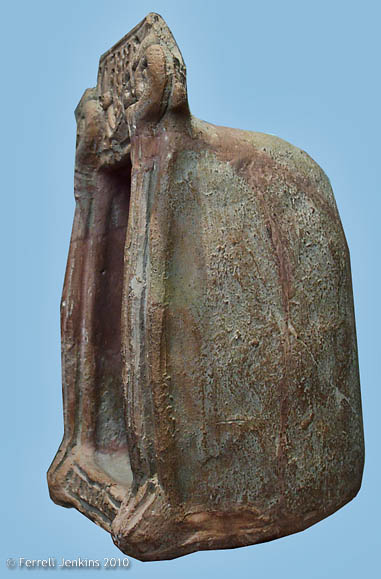
The model shrines come in a variety of sizes. Here is one excavated at Tell el-Farah, the biblical site of Tirzah.

Model shrine from Tell el Farah. The Louvre. Photo by Ferrell Jenkins.

Model shrine from Tell el Farah. The Louvre. Photo by Ferrell Jenkins.

Tirzah served as the capital of the northern kingdom of Israel during the reigns of Baasha (1 Kings 15:21) Elah and Zimri (1 Kings 16:17-18). Omri reigned six years in Tirzah before he purchased the hill of Samaria and moved the capital of Israel there (1 Kings 16:24).

The shrine discovered at Ashkelon is significant because it included a silver plated bull. See a low quality photo here.

Luke Chandler reports on the 2010 discovery of a shrine at Khirbet Qeiyafa, and includes two nice photos here.

Decorations from Herod’s tomb

Joseph I. Lauer calls attention to a photo-essay of the announcement of the discovery of Herod’s tomb at the Herodium. This essay dates back to May 10, 2007, but there may be new readers who have not seen this. Check here.

Shortly after the announcement, Elie Ben Meir, a guide/friend of mine in Israel, shared a few of his photos made at the Herodium on June 24, 2007. I had intended to publish, with his permission, some of these earlier but overlooked it. You might enjoy these closeup of some of the stone decorations found at the site.

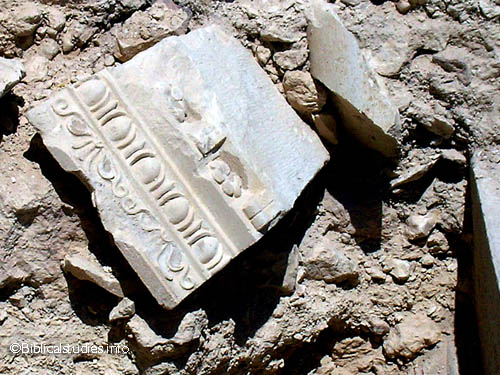
Herodium tomb ornament. Photo by Elie Ben Meir.

Herodium tomb ornament. Photo by Elie Ben Meir.

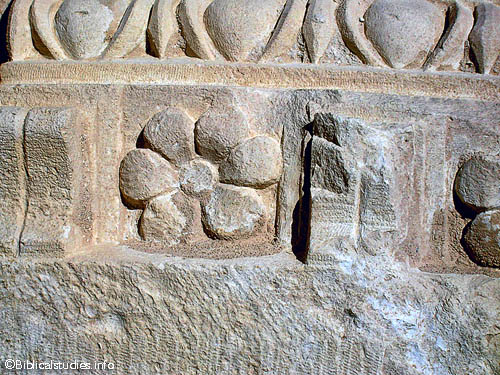
Notice the beautiful carvings.

Decoration of Herod's tomb at the Herodium. Photo by Elie Ben Meir.

Decoration of Herod's tomb at the Herodium. Photo by Elie Ben Meir.

I found Leen Ritmeyer’s post about the passing of Prof. Netzer interesting. Check it here.

Herod the Great was the “king of Judea” from 37 to 4 B.C. Near the close of his reign Jesus was born in Bethlehem.

After Jesus was born in Bethlehem of Judea in the days of King Herod, wise men from the east arrived unexpectedly in Jerusalem, (Matthew 2:1 CSB)

Archaeologist Netzer dies after fall

The Jerusalem Post reported here this afternoon that Prof. Netzer succumbed to the injuries sustained during his fall at the Herodium.

Renowned archaeologist Ehud Netzer died of his wounds at the Hadassah Ein Kerem hospital in Jerusalem Thursday night, days after he fell during an excavation.

On Monday Prof. Netzer was hospitalized in critical condition after a wooden railing he leaned on gave way, at the Herodion archeological site in the West Bank.

Jim West was kind enough to leave a comment on our blog this  morning once he was certain that Prof. Netzer had died.

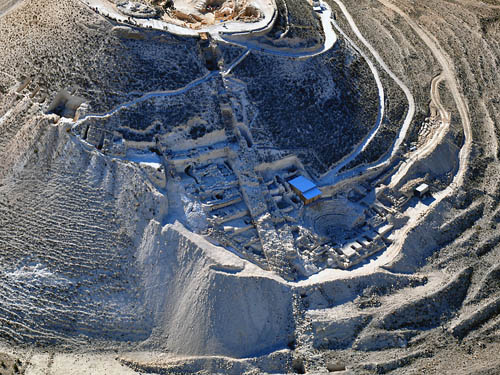
Recently we discussed here some of the work at the Herodium. Below I am including a closer view of the area where Prof. Netzer was working. This aerial photo shows a clear view of the theater. The roofed structure covers the royal theater box.

The Herodium excavation. Photo by Ferrell Jenkins, Dec. 15, 2009.

The Herodium excavation. Photo by Ferrell Jenkins. Dec. 15, 2009.

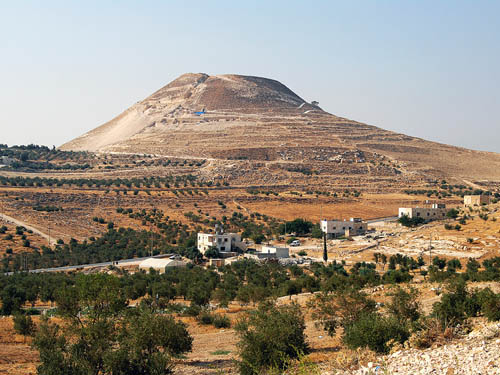
Without the determination of Ehud Netzer the north side of the Herodium would still look like the view below, and we would still be wondering about the location of Herod’s burial place.

The Herodium from the north. Photo by Ferrell Jenkins, Aug. 23, 2008.

The Herodium from the north. Photo by Ferrell Jenkins, Aug. 23, 2008.

The Herodium is located a few miles east of Bethlehem, the birthplace of Jesus (Matthew 2).

Prof. Ehud Netzer critically injured at Herodium

According to The Jerusalem Post, well known archaeologist Ehud Netzer has been critically injured in a fall at the Herodium (Herodion). The full report by Ben Hartman may be read here.

Well-known Israeli archeologist Ehud Netzer remained in critical condition Wednesday at Hadassah-University Medical Center, Ein Kerem, two days after he suffered a serious fall during a dig at the Herodion archeological site in the West Bank.

Netzer was reportedly leaning against a wooden railing on Monday when it gave way. He fell nearly 10 feet before landing – only to roll and fall an additional 10 feet. He suffered fractures in his cranium and vertebrae and was rushed to Hadassah in critical condition.

The 76-year-old archeologist is one of the foremost experts on Herodion, a man-made mountain built by King Herod near Bethlehem. Netzer has carried out digs at the site for more than three decades; three years ago, he found the site of Herod’s grave – a discovery that was considered the pinnacle of his career.

Digs he performed in 1968 in Jericho unearthed a Hasmonean winter palace that sported bathing pools and gardens, widely considered the most significant archeological site dealing with that period in Jewish history. The digs also unearthed the Jericho synagogue, considered the largest Jewish house of worship ever discovered.

In 1978, Netzer finished his PhD dissertation at Hebrew University, which focused on Herod’s palaces at Herodion and Jericho. He became a senior lecturer at the university in 1981, where he has taught ever since.

There were blog reports yesterday that Netzer had died, but these are being corrected this morning.