Category Archives: Israel

David — the sweet psalmist of Israel

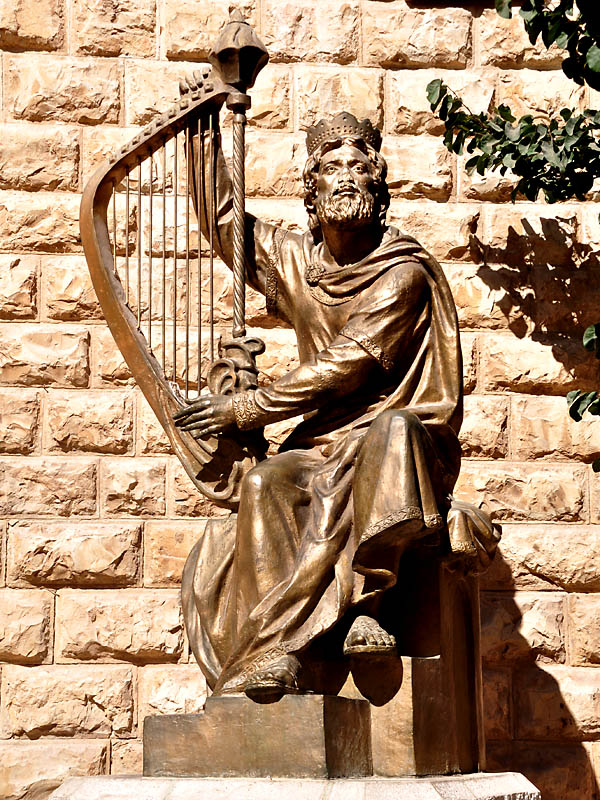
As a young man, David played the harp (lyre, Hebrew kinnor) for King Saul.

So it came about whenever the evil spirit from God came to Saul, David would take the harp and play it with his hand; and Saul would be refreshed and be well, and the evil spirit would depart from him. (1 Samuel16:23 NAU)

Later, David is called the “sweet psalmist of Israel.” We have many examples in the collections of Psalms.

Now these are the last words of David. David the son of Jesse declares, The man who was raised on high declares, The anointed of the God of Jacob, And the sweet psalmist of Israel, (2 Samuel 23:1 NAU)

On traditional Mount Zion, near the traditional Tomb of David there is a statue of King David playing the harp (lyre).

Statue of King David on Mount Zion, Jerusalem. Photo by Ferrell Jenkins.

Statue of King David on Mount Zion, Jerusalem. Photo by Ferrell Jenkins.

Our time in the Bible World has come to an end once more. It has been a profitable trip. I still learn something each time I come to this part of the world. Looking forward to next year in Jerusalem.

Our numbers have been extremely good during the past three weeks. I hope that you will continue to check the blog from time to time. Why not subscribe and receive a notification each time we post something new?

The archaeologist who lost his head

July 30th was the 70th anniversary of the death of Sir Flinders Petrie.

On [July 30, 2012] the Israeli Antiquities Authority conducted an unusual memorial service, to mark the 70th anniversary of the death of the British archaeologist and Egyptologist Flinders Petrie. Only one of the people who attended the ceremony at the Protestant Cemetery on Jerusalem’s Mount Zion, Israeli archaeologist Shimon Gibson, had ever met the deceased – or at least his head. In 1989, while Gibson was working at the Palestine Exploration Fund in London, he was contacted by the Royal College of Surgeons. “They asked me,” Gibson said at the ceremony, “to help identify a head preserved in a jar. They weren’t sure it belonged to Petrie,” Gibson related.

Gibson explains how he was able to identify Petrie’s head.

Petrie was born in England in 1853 and died in Jerusalem in 1942. His headless body was buried in the Protestant Cemetery on Mount Zion. He is widely regarded as the progenitor of modern archaeology. He laid the foundations for Egyptology, the study of ancient Egypt, and was the first biblical archaeologist in Palestine.

The story of how it came to be that Petrie’s body is in Jerusalem, and his head in London, is explained briefly in the Haaretz article here.

Petrie is sometimes described at the “father of archaeology.” He is noted for his discovery of the Merneptah Stele in Egypt. This is the stele that contains the name of Israel. For the importance of the stele to biblical studies, see here.

But Petrie’s most important contribution to archaeology is the knowledge that pottery can be used to date the layers of a tell (archaeological mound).

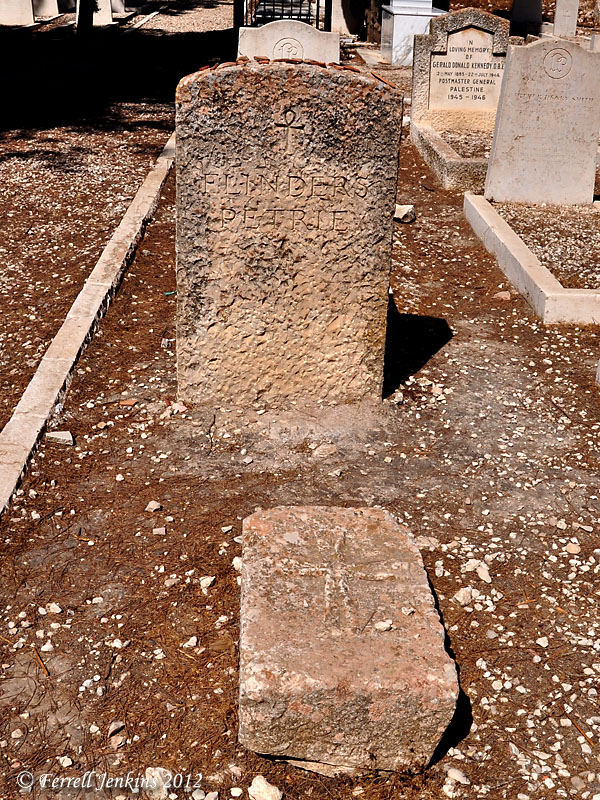
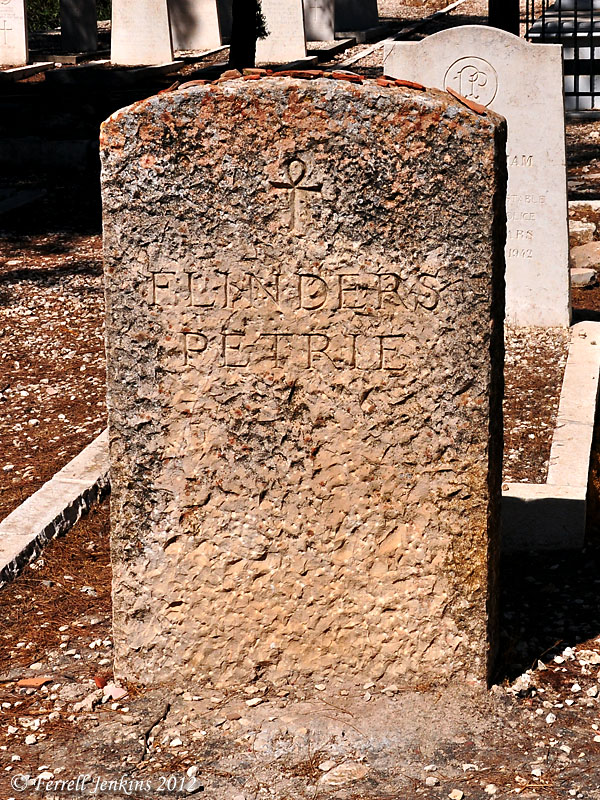
Today I visited the Jerusalem Protestant Cemetery to see the tomb of Petrie, as well as several other well-known persons of the past. Here is a photo of Petrie’s grave marker.
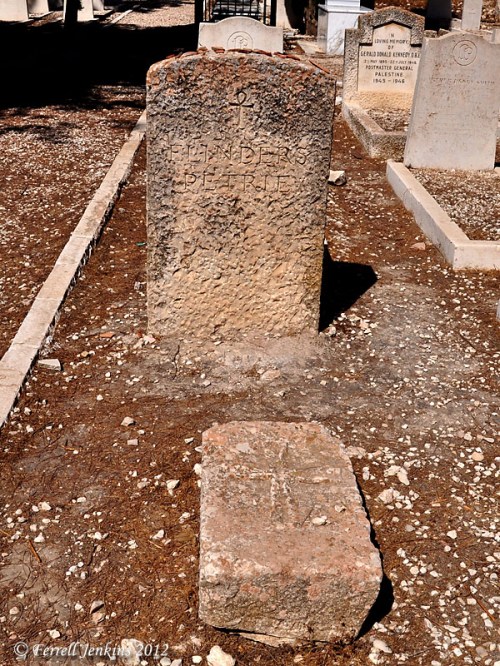
Grave marker for Flinders Petrie in Jerusalem Protestant Cemetery. Photo by Ferrell Jenkins.

Grave stone for Flinders Petrie, Jerusalem Protestant Cemetery. Photo: Ferrell Jenkins.

Besides the simplicity of the marker — only his name, there are two other things I find interesting. There is an ankh symbol (the life symbol) from ancient Egypt above the name. When Jews visit a tomb, small stones are left to show respect. Instead of stones, this marker has potsherds, pieces of broken pottery, on the top of it. I suspect that these were left by the visitors on the anniversary of his death.
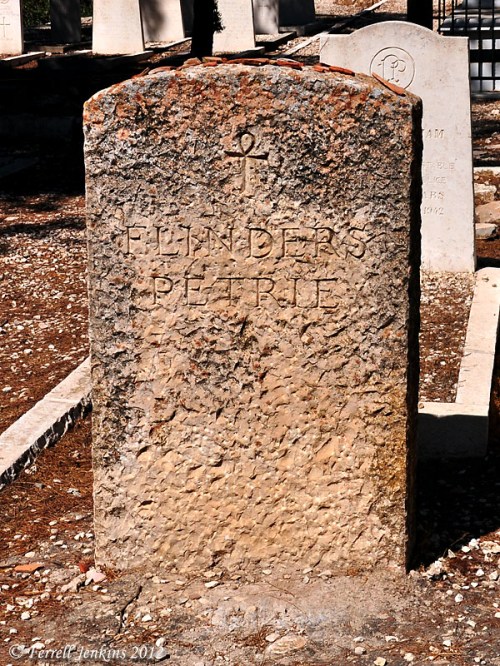
Flinders Petrie Grave in Jerusalem. Photo by Ferrell Jenkins.

Close up of Petrie’s grave marker in Jerusalem. Photo by Ferrell Jenkins.

In another post, perhaps later, I plan to tell you about some of the other persons of interest who are buried in the same cemetery

Camels figure prominently in the life of Isaac

When Abraham’s servant went from Canaan to far-away Mesopotamia to arrange a bride for Isaac, he took ten camels with him. These camels figure prominently in the account in Genesis 24.

Then the servant took ten of his master’s camels and departed with all kinds of gifts from his master at his disposal. He journeyed to the region of Aram Naharaim and the city of Nahor. (Genesis 24:10 NET)

The Hebrew Aram Naharaim of the text is often translated Mesopotamia in English versions.

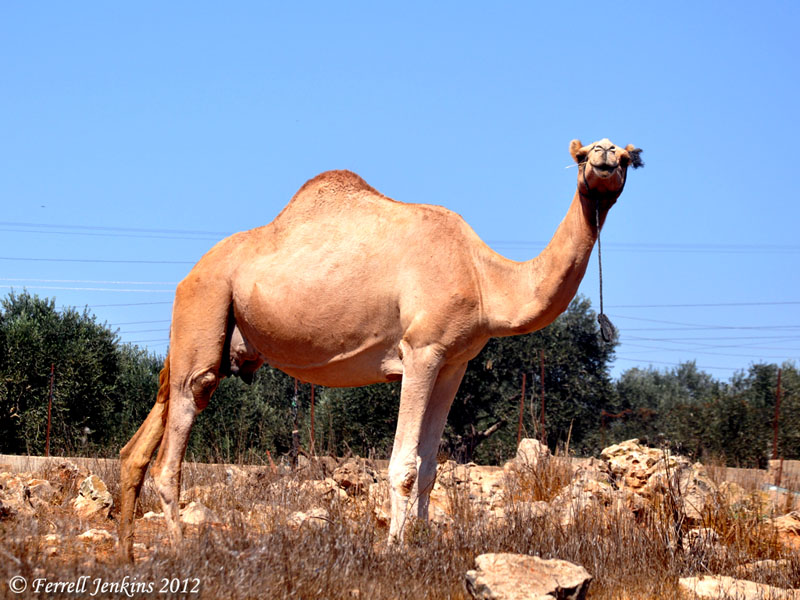
Yesterday I saw a nursing camel with her big “baby” as we drove north from Jerusalem toward Shiloh. This was a little east of the main north-south highway. I took the photo to share with my grandson, but I thought I would share it with you also.

A camel in the West Bank near the edge of the wilderness. Photo by Ferrell Jenkins.

A camel in the West Bank near the edge of the wilderness. Photo by Ferrell Jenkins.

Today we traveled south from Jerusalem past Bethlehem, Hebron, and into the Negev. We went west to the site of Gerar and Wadi Gerar. Later I will try to prepare some of the photos from these regions for the blog.

Visiting Mount Gerizim

Today we rented a car that could be driven in the West Bank and drove north to Nablus (site of ancient Shechem) and Mount Gerizim, the home of the Samaritans. Samaritans believe the temple was to be built on Mount Gerizim rather than Jerusalem. They think Abraham offered Isaac on the mountain. They accept only the first five books (the Pentateuch) of the Old Testament.

The blessings and curses of the Mosaic Law were to be read on Mount Gerizim and Mount Ebal once the children of Israel crossed into the promised land.

“It shall come about, when the LORD your God brings you into the land where you are entering to possess it, that you shall place the blessing on Mount Gerizim and the curse on Mount Ebal.” (Deuteronomy 11:29 NAU) cf. Joshua 8:33-35.

It is fairly easy to get to the new archaeological park except for a few bad places in the road in the modern Samaritan village of Kiryat Luza.

Rather than deal with the archaeological information, I thought I would share a couple of photos of some places of significant to the Samaritans. These are within the park.

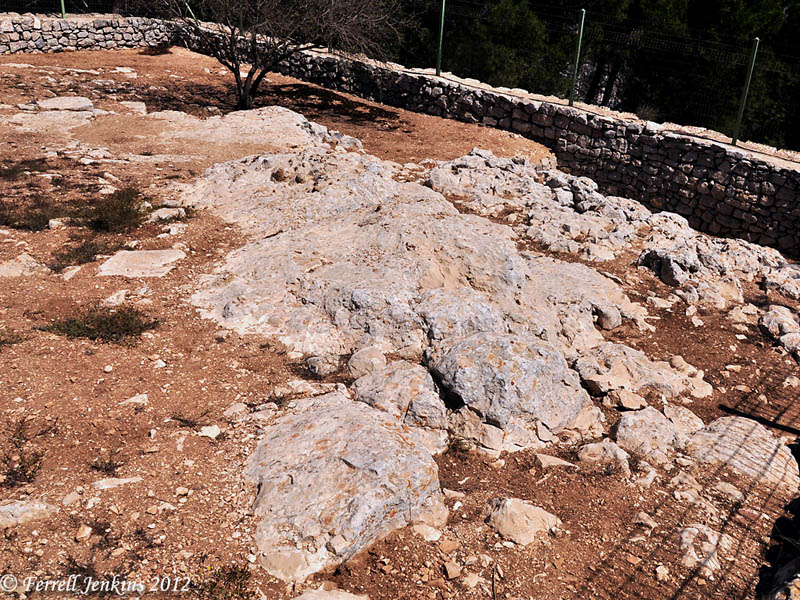
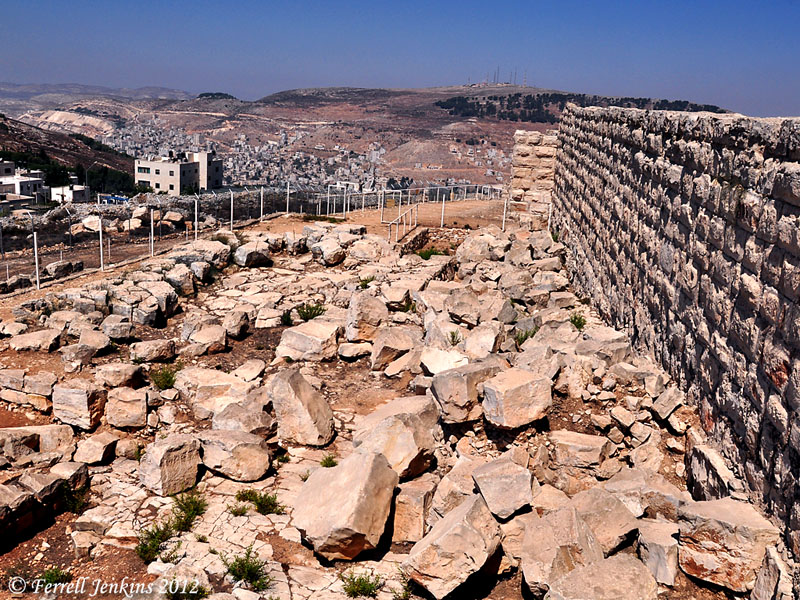
The first photo shows what according to Samaritan tradition is the altar on which Abraham was commanded to offer Isaac (Genesis 22:1-3). Remember that the Samaritans believe that this is Mount Moriah.

Altar of Isaac on Mt. Gerizim (Samaritan View). Photo by Ferrell Jenkins.

Samaritan tradition identifies this rock as the Altar of Isaac where Abraham began to offer Isaac. Photo by Ferrell Jenkins.

The next photo shows what the Samaritans call the “Twelve Stones.” Samaritans says that the Israelites built the altar they were commanded to built when they crossed the Jordan (Deuteronomy 27:4).

The Twelve Stones, according to Samaritan tradition. Photo by Ferrell Jenkins.

The Twelve Stones, according to Samaritan tradition. Photo by Ferrell Jenkins.

For more information about the archaeological park and the Samaritans see here. The park is under the direction of the Judea and Samaria Civil Administration and the (or of the) Israel Nature and Park Authority.

If you have an interest in the historical information about the temples on Mount Gerizim, check this article by Yitzhak Magen, the recent excavator, here. An attractive brochure is available at the entrance to the park with text by Magen. It is a pleasure to see a brochure written by a knowledgeable person.

Let the New Year begin

This evening at sundown the New Year began according to the Jewish calendar. Today is known as Rosh HaShanna — the head or first of the year.

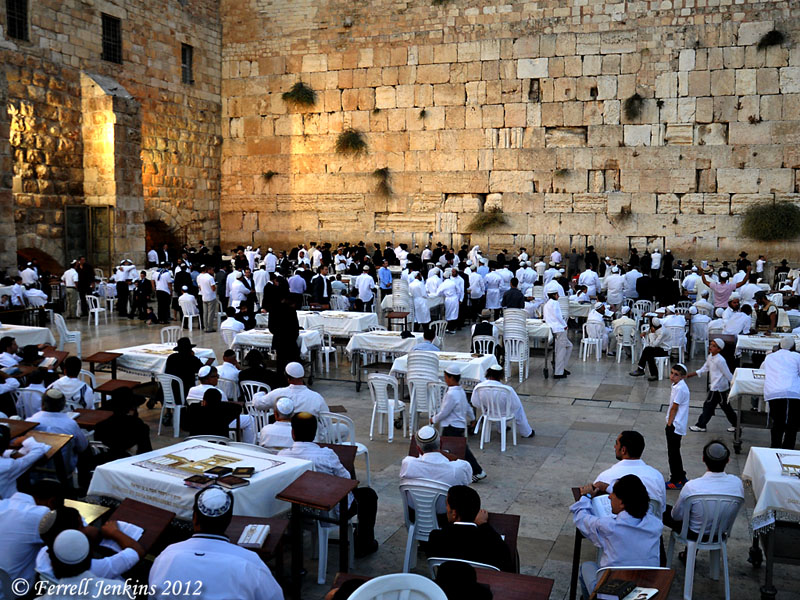
Late this afternoon I went to the Western Wall to observe some of the festivities of the beginning of the New Year.

The Western Wall on Rosh HaShanna. Photo by Ferrell Jenkins.

The Western Wall on Rosh HaShanna. Photo by Ferrell Jenkins.

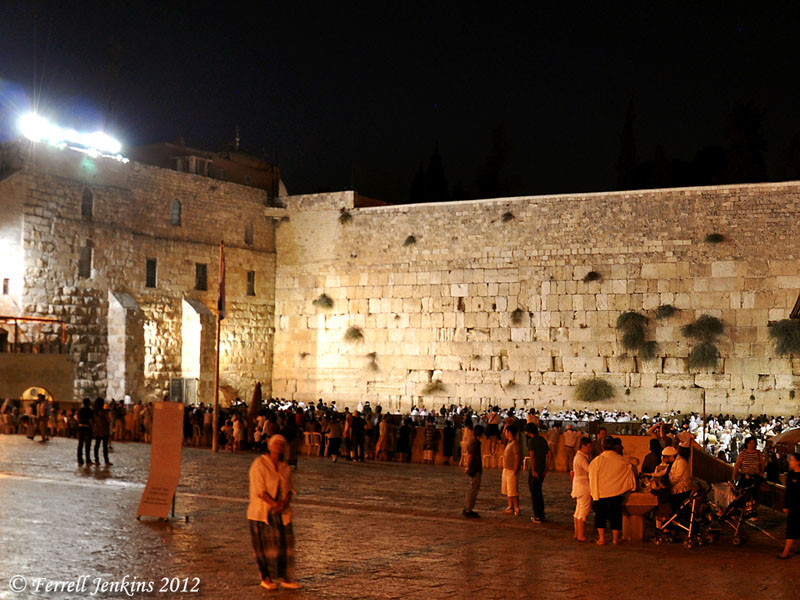
Finally, when the sun went down just a few minutes after 7 p.m., the new year had arrived to the sound of chanting and dancing.

The Western Wall at the beginning of Rosh HaShanna. Photo by Ferrell Jenkins.

The Western Wall at the beginning of Rosh HaShanna. Photo by Ferrell Jenkins.

Now in the seventh month, on the first day of the month, you shall also have a holy convocation; you shall do no laborious work. It will be to you a day for blowing trumpets. (Numbers 29:1 NAU)

Blow the trumpet at the new moon, At the full moon, on our feast day.
(Psalm 81:3 NAU)

We expect to hear the blowing of shophars during the next couple of days.

No work is to be done this day. Our hotel was again filled with Jews celebrating the New Year. The head waiter told me there were approximately 900 served in the dining room this evening.

Modern Jews no longer follow the commands of the following verses in Number 29 requiring the offering of a burnt offering, a grain offering, a drink offering, etc.

The horn or trumpet under consideration is the shophar or ram’s horn. For more about the ram’s horn, see here.

Sabbath in Jerusalem

Jerusalem is an interesting city for many reasons. At the moment I will limit myself to some cultural reasons. Friday evening and Saturday our hotel was filled with Jews who are “observing” Shabat (Sabbath). Instead of preparing food in advance at home, many register in a local hotel and let someone else prepare everything.

But when I went to East Jerusalem I saw kids on the way to/from school, shops open, and people moving about doing their shopping. If they took a weekly holiday, it was Friday.

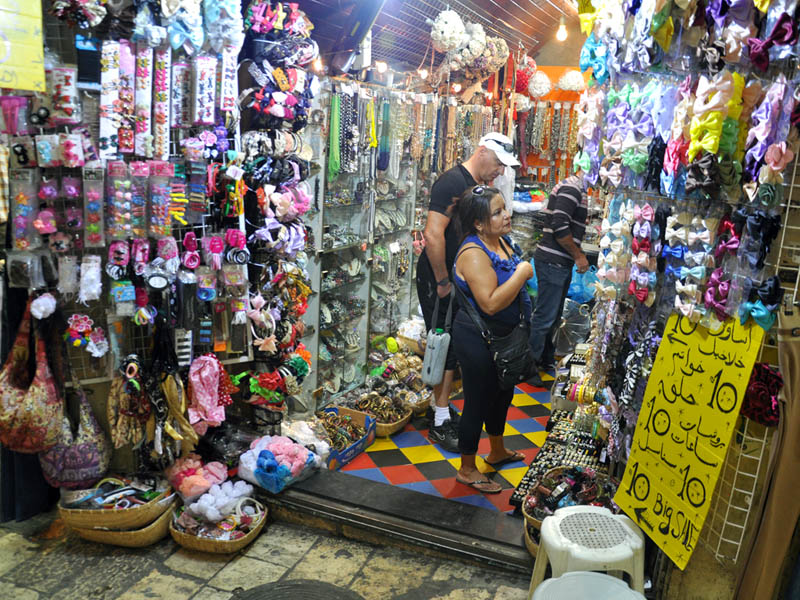
When I walked from Damascus Gate to Jaffa Gate and Zion Gate, I found all of the Moslem and Christian shops open and bustling with activity. Many Christian shops will be closed Sunday.

Colorful shop in the Moslem Quarter of Jerusalem. Photo by Ferrell Jenkins.

Colorful shop in the Moslem Quarter of Jerusalem. Photo by Ferrell Jenkins.

During the day I visited Damascus Gate, Zedekiah’s Cave (Solmon’s Quarry), the Russian Excavations, Jaffa Gate area, the roof of the Petra Hotel to see Hezekiah’s Pool, the Armenian Cathedral of St. James, “Mount Zion”, and maybe a few other places I don’t recall.

We get Fox News at our hotel. Several times we have seen reports about the anti-American riots and demonstrations in 21 countries including Israel (Tel Aviv and East Jerusalem). I am not saying it did not happen somewhere, but I was out all day and saw on indication of any such unrest. Perhaps the cameras had already left by the time I got out!

The Shephelah and the Coastal Plain

Today was an easy day of travel, but an extremely important one.We left Jerusalem headed for the Shephelah (lowland; Deuteronomy 1:7). We made a brief stop at Beth-shemesh where the ark of the covenant was returned from the Philistines to Israel (1 Samuel 6). This was also the territory of Samson (Zorah and Esthaol (Judges 13).

We drove through the Valley of Elah (1 Samuel 17) and called attention to the sites located in the area (Socoh, Azekah, and Khirbet Qeiyafa). We made a stops at Tel Goded, Maresha, Tel Burna, Lachish, and Tell es-Safi/Gath for photographs.

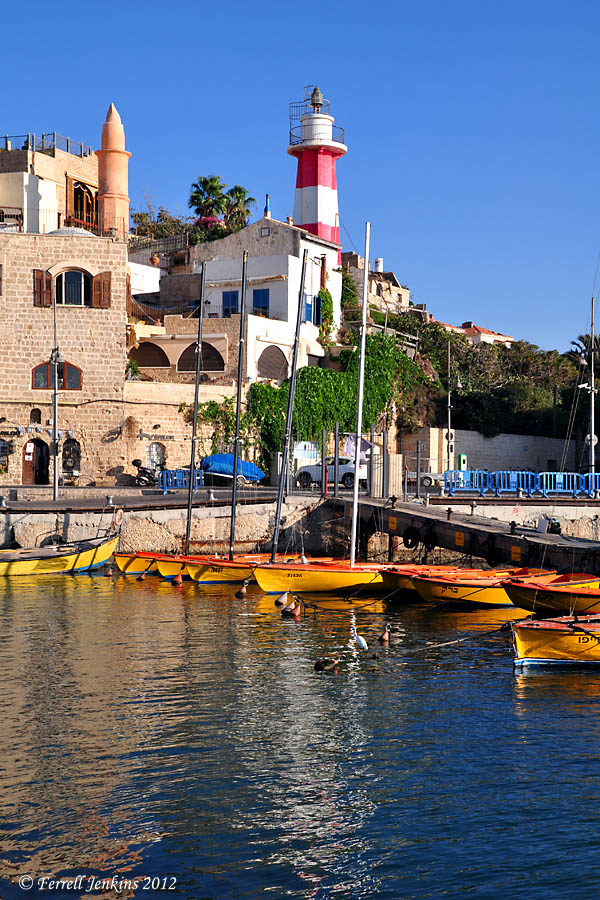
Our final stop was at Joppa (Yaffo). This is the site we intended to begin with, but our flight was delayed leaving New York and we were not able to go there on the first day of the tour. The photo below is of the fishing port and lighthouse at Old Joppa.

The fishing port and lighthouse at Old Joppa. Photo by Ferrell Jenkins.

The fishing port and lighthouse at Old Joppa. Photo by Ferrell Jenkins.

Joppa is located in the Plain of Sharon and served as the seaport for Jerusalem which is about 35 miles away. The city is now called Jaffa, or Yafo. Joppa was a walled town as early as the reign of Pharaoh Thutmose III (1490-1435 B.C.) who mentions Joppa in his town lists.

Here are a few of the biblical highlights for Joppa.

  • Joppa was assigned to the tribe of Dan, but was not controlled by the Israelites till the time of David (Joshua 19:46).
  • Hiram of Tyre floated cedar from Lebanon to Joppa for Solomon’s Temple (2 Chronicles 2:16).
  • Jonah sought a ship for Tarshish at Joppa to avoid going to Nineveh (Jonah 1:3).
  • Cedars from Lebanon again were floated to Joppa for the rebuilding of the temple (520-516 B.C.; Ezra 3:7). The port of the city is behind St. Peter’s Church.
  • Tabitha (Dorcas) lived in Joppa. When she died the disciples sent for Peter who was a Lydda. He came to Joppa and raised Dorcas (Acts 9:36-42). (Acts 10:6).
  • Peter stayed many days in Joppa with Simon the tanner (Acts 9:43). His house was by the sea (Acts 10:6). A house near the port is shown as the house of Simon, but there is no way to know this with certainty.
  • Peter received the housetop vision and learned that he was to go to Caesarea to preach the gospel to the Gentiles at the house of the Roman centurion Cornelius (Acts 10:23).

Benjamin plateau, Israel Museum, and the Garden Tomb

This morning we went out to Nebi Samwil [prophet Samuel], a site suggested as the location of Mizpah by some scholars. Others suggest Tell en-Nasbeh, a mound located at Al Bira in the West Bank. (See Jeffrey Zorn, “Mizpah: Newly Discovered Stratum Reveals Judah’s Other Capital.” BAR 23:05 (Sep/Oct 1997).

  • Samuel, the last judge of Israel, called all of the people of Israel to Mizpah and judged them (1 Samuel 7:5-6).
  • Samuel also anointed Saul to be the first king of Israel at Mizpah (1 Samuel 10:1).
  • Mizpah became the headquarters of Gedaliah as governor of Judah after the Babylonian destruction of Jerusalem  (2 Kings 25:23).

From the hill, we were able to look north to the Benjamin plateau. Both King Saul and Saul of Tarsus (Paul) were from the tribe of Benjamin. El Jib, the tell of Gibeon, is also visible from Nebi Samwil.

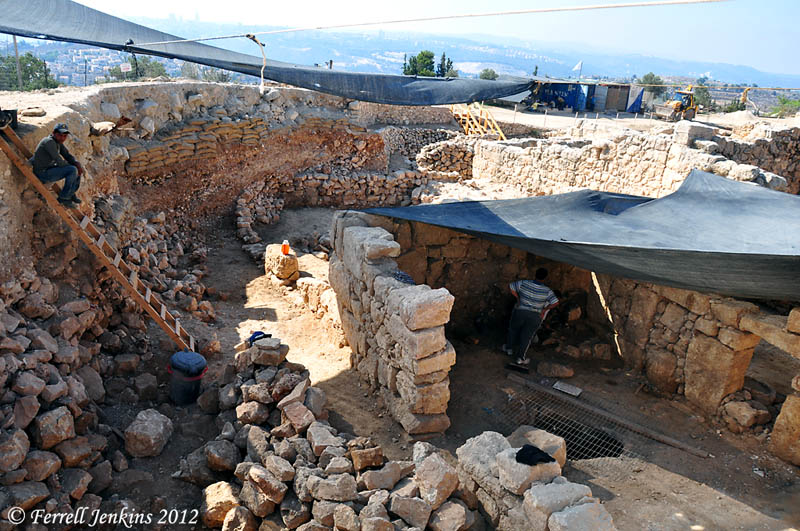
Some new excavations were underway under the direction of the National Parks Authority. We were told that Hasmonean ruins has been excavated, and there was some evidence from the Persian and Babylonian periods.

Excavations at Nebi Samwil - Sept. 13, 2012. Photo by Ferrell Jenkins.

Excavations at Nebi Samwil – Sept. 13, 2012. Photo by Ferrell Jenkins.

After Nebi Samwil we went to the Israel Museum campus for a visit of the Second Temple Model, the Shrine of the Book, and the Israel Museum. This is the first time I have been in the Museum since photos (without flash) have been allowed.

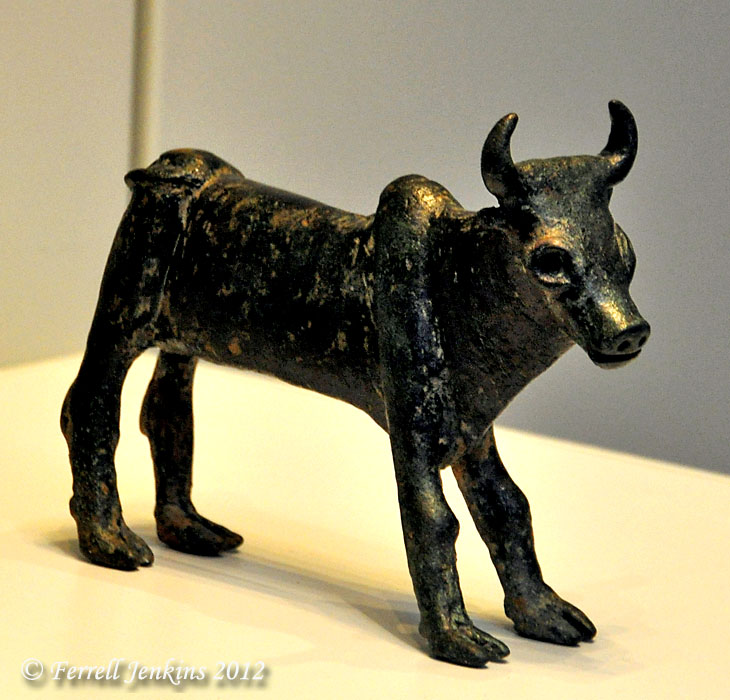
I will share one photo that I am pleased to have in my collection. It shows a bronze bull, dating to the 12th century B.C., found in the Samaria region.

Bronze Bull from Samaria Region - Israel Museum. Photo by Ferrell Jenkins.

Bronze Bull from Samaria Region – Israel Museum. Photo by Ferrell Jenkins.

This bull, and others those that have been found at Ashkelon and Hazor, remind us of the calf at Sinai (Exodus 32:24) and the calves set up by Jeroboam at Dan and Bethel (2 Kings 10:29).

The information posted with the statuette says,

Canaanite in inspiration, it attests to Israelite adoption of Canaanite motif. For the Israelites it may have symbolized God, or the pedestal of an unseen God.

Thank you, Israel Museum, for allowing photos.

In the late afternoon we visited The Garden Tomb. While this tomb is clearly not the tomb of Jesus, it provides a good illustration in a natural setting — far different from the Holy Sepulcher.

Visiting the Old City of Jerusalem

We left the hotel this morning at 7:15 in order to be at the security line going to the Temple Mount platform as soon as it opened. After that visit we followed the traditional Via Dolorosa. After a visit to the Church of the Holy Sepulchre we went to the Jewish Quarter to see the Broad Wall, the Burnt House (from A.D. 70), and the Herodian Mansion (or perhaps the house of priests).

We came down to the Western Wall Plaza to visit the Western Wall, then the Davidson Center excavations.

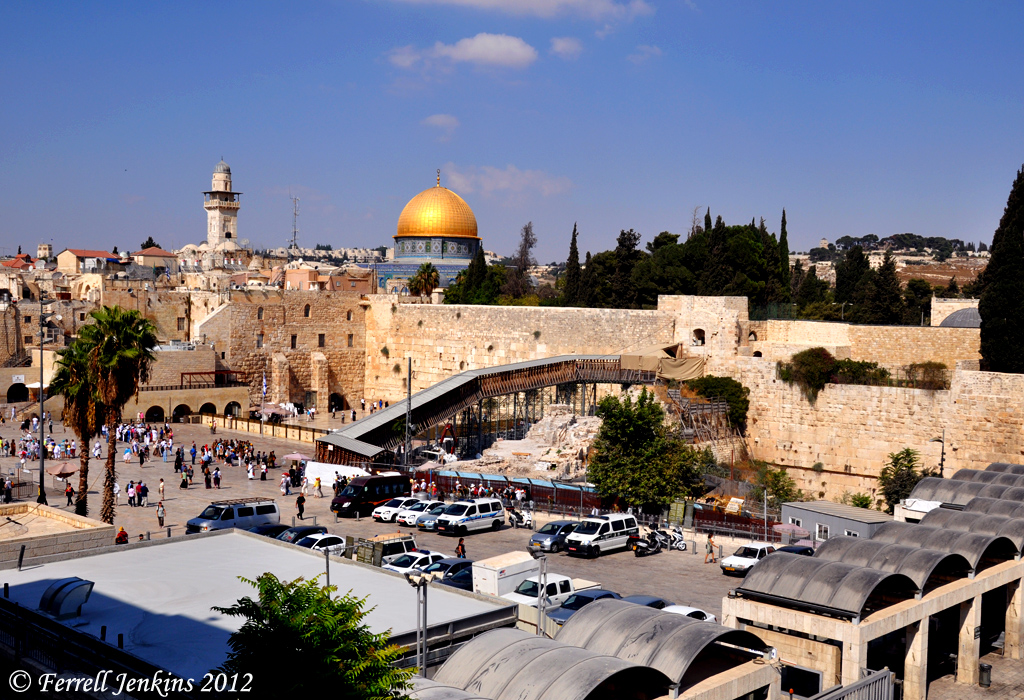
This photo of the Western Wall and Temple Mount platform was made from the southwest. You can see a portion of the Western Wall, the Mughrabi (temporary) Bridge, and the Dome of the Rock (where the biblical Temple once stood).

Temple Mount in Jerusalem from the SW. Photo by Ferrell Jenkins.

Temple Mount in Jerusalem from the SW. Photo by Ferrell Jenkins.

On the right side of the photo, in the distance, can be seen the hill between Mount Scopus and the Mount of Olives. I think this is where the Augusta Victoria Hospital is located.

It was a full day.

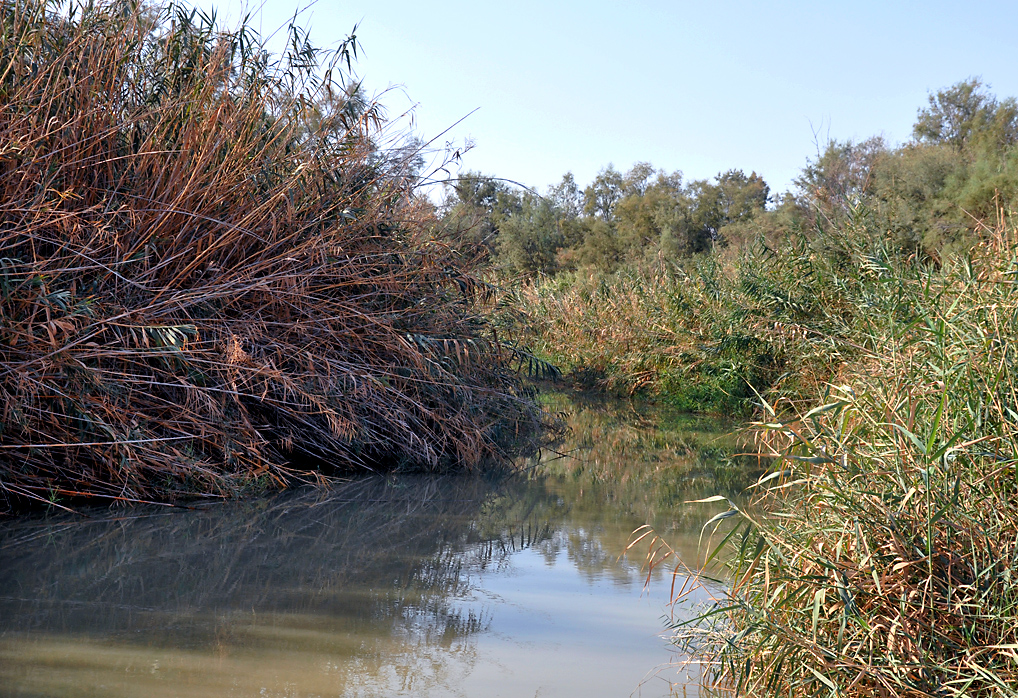
Visiting the Jordan River

Israel has opened access to the Jordan River at the traditional site of the baptism of Jesus.

Bible students enjoy visiting this site for several reasons.

  • Ancient Israel crossed the Jordan to enter the promised land (Joshua 3).
  • Elijah and Elisha crossed the river (2 Kings 2).
  • John baptized in the Jordan (Matthew 3:6ff.; Mark 1:5-9; John 1:28; 10:40).
  • Jesus was baptized in the Jordan (Matthew 3:13).
  • Naaman dipped in the Jordan at a site further north (2 Kings 5).

We were able to visit the site this morning.

The Jordan River at the site of the baptism of Jesus. View south. Photo by Ferrell Jenkins.

Jordan River at the site of the baptism of Jesus. View south. Photo by Ferrell Jenkins.

We also visited Masada, Qumran, and Jericho.