Category Archives: Church History

Armenians gather in Turkey

The 10th century Armenian church on Akdamar Island in Lake Van (Turkey) was restored and reopened as a museum by the Turkish government in 2007.  About three months after the opening I was able to visit the church.
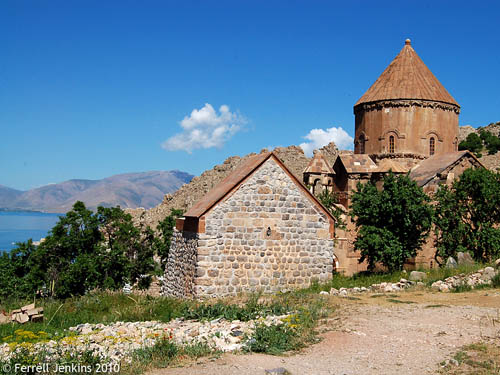
Armenian Church on Akdamar Island in Lake Van. Photo by Ferrell Jenkins.

Armenian Church on Akdamar Island in Lake Van. Photo by Ferrell Jenkins.

There are some marvelous frescoes and carvings of Bible stories inside and outside the church. The one pictured below shows the raising of Lazarus (John 11) and the Triumphal Entry of Jesus into Jerusalem (John 12). Scenes such as these served to remind those who saw them of the biblical accounts. An Armenian translation of the (Greek) Septuagint Old Testament “was made for the Christian communities of eastern Asia Minor” about A.D. 400 (Price, The Ancestry of Our English Bible, 3rd rev. ed., 119). The New Testament translation was made about the same time (198). Price says,

Armenian manuscripts are very numerous, probably more numerous than those of any other version except the Latin Vulgate.
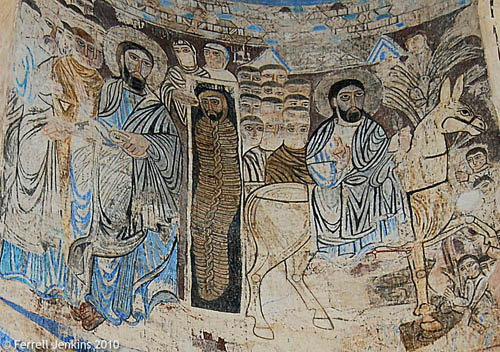
Bible stories in the Akdamar Island church. Photo by Ferrell Jenkins.

Bible stories in the Akdamar Island church. Photo by Ferrell Jenkins.

Earlier this week USA Today reported that the Turkish government allowed several Armenian Christian pilgrims to visit the Akdamar church last Sunday. This was the first time a service had been held in the church since it was “abandoned during the mass killings of Armenians 95 years ago.”

The media has directed much attention lately to the problems of minority religions in Turkey. The CBS news show 60 Minutes included a feature about restrictions on the Greek Orthodox in Turkey a few weeks ago.

The region around Lake Van in eastern Turkey was the ancient region of Urartu, known as Ararat in the Bible.

  • Noah’s ark landed on the mountains of Ararat (Genesis 8:4).
  • The men who assassinated the Assyrian king Sennacherib fled into the land of Ararat (2 Kings 19:37 = Isaiah 37:38).
  • The kingdoms of Ararat may have joined other nations in the capture of Babylon (Jeremiah 51:27).
The Book of Kells and the Scottish connection

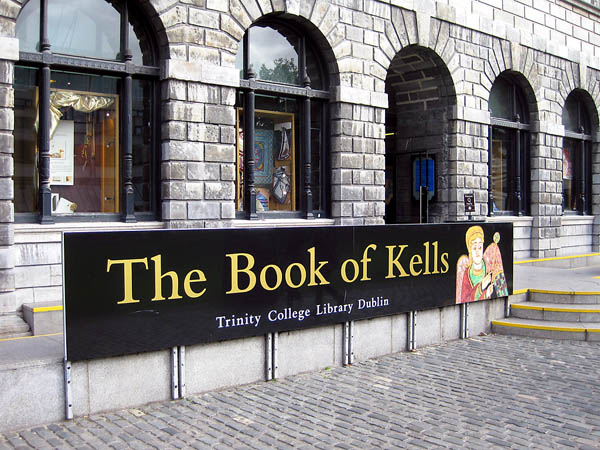
Last week I visited the Trinity College Library in Dublin, Ireland, to take another look at the Book of Kells which dates to about A.D. 800.

Entrance to Trinity College Library. Photo by Ferrell Jenkins.

Entrance to Trinity College Library and the Book of Kells. Photo by Ferrell Jenkins.

Two volumes of the famous illuminated Gospels in Latin were on display in a special case. One showed the first words of Luke 4.
And Jesus, full of the Holy Spirit, returned from the Jordan and was led by the Spirit in the wilderness. (Luke 4:1, ESV)

Two full pages were used for these words and the associated drawings. Another volume was open to John 7:31-40.

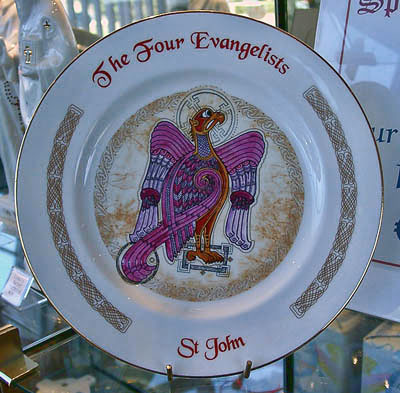
The Book of Kells is famous for its drawings showing the The Four Evangelists, that is, the four writers of the Gospels (Matthew, Mark, Luke, and John). Souvenirs may be seen in shops throughout Ireland with these images imprinted on them. Here is a plate depicting John as an eagle.

John as an Eagle. Photo by Ferrell Jenkins.

John as an Eagle. Photo by Ferrell Jenkins.

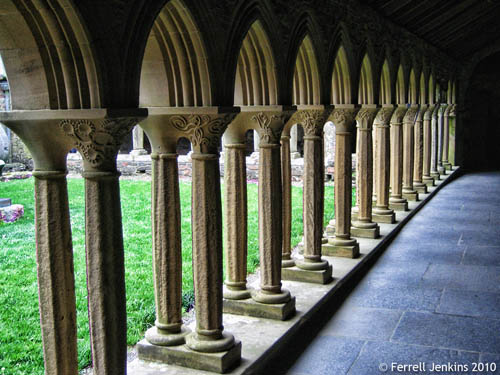
In A.D. 597 Saint Columba went from Ireland to Iona, an island near the coast of Scotland, to teach Christianity. The famous Book of Kells, an illuminated Gospels, was likely prepared by the monks of Iona about A.D. 800.

It is not certain that anything remains on the island of Iona from the time of Columba, but there are numerous medieval ruins. Here is a photo I made a couple of years on the island.

Columns on the Isle of Iona, Scotland. Photo by Ferrell Jenkins.

Columns on the Isle of Iona, Scotland. Photo by Ferrell Jenkins.

Eventually the Book of Kells was brought to the Abbey of Kells, a monastery that had been founded by Columba, about 40 miles north of Dublin.

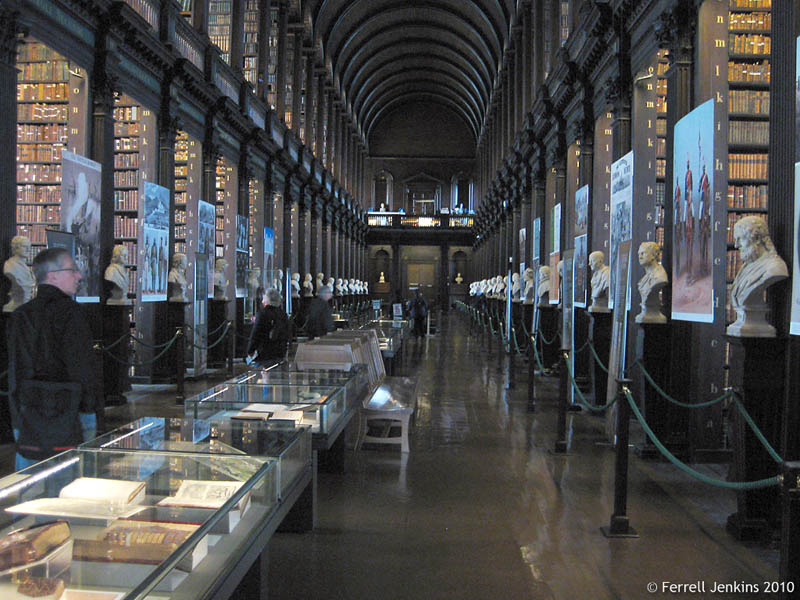
Trinity College was founded in in 1592 under a charter of  Queen Elizabeth. The oldest remaining buildings date to the early 1700s. Visitors are allowed to visit the Long Room of the Old Library. This room, almost 200 feet long, is impressive to anyone who loves books.

The Long Room of Trinity College Library

The Long Room of Trinity College Library. Photo by Ferrell Jenkins.

The Good Shepherd

When the Pharisees and scribes complained that Jesus received sinners and ate with them, He told them a parable that we call the parable of the lost sheep (Luke 15:1-7).

“What man among you, if he has a hundred sheep and has lost one of them, does not leave the ninety-nine in the open pasture and go after the one which is lost until he finds it? “When he has found it, he lays it on his shoulders, rejoicing. “And when he comes home, he calls together his friends and his neighbors, saying to them, ‘Rejoice with me, for I have found my sheep which was lost!’  “I tell you that in the same way, there will be more joy in heaven over one sinner who repents than over ninety-nine righteous persons who need no repentance. (Luke 15:4-7 NAU)

“When he has found it, he lays it on his shoulder, rejoicing.” This describes the work of good shepherds and a practice that was well known to those who heard Jesus. On another occasion Jesus called Himself the good shepherd (John 10:11, 14).

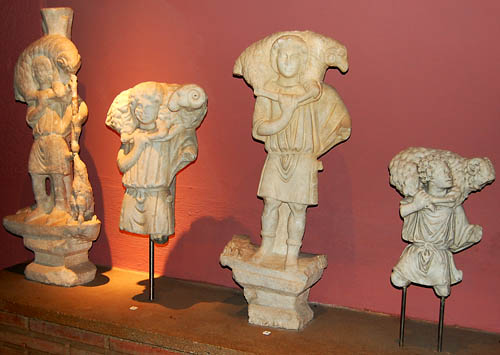
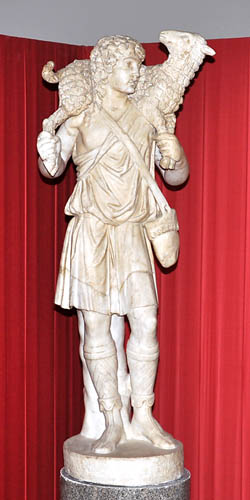
The motif of the good shepherd with the sheep on his shoulder became common in later Christian iconography. Similar drawings are known from the catacombs in Rome. The four statuettes shown below date from the 4th century A.D., and are displayed in the Istanbul Archaeological Museum.

Good shepherd statues. Istanbul Archaeological Museum. Photo by Ferrell Jenkins.

Good shepherd statues. Istanbul Archaeological Museum. Photo by Ferrell Jenkins.

Last September I saw a special exhibit of early Christian artifacts in the Vatican Museum. The photo below shows a wonderful early 4th century statuette of the Good Shepherd.

The Good Shepherd in the Vatican Museum. Photo by Ferrell Jenkins.

The Good Shepherd in the Vatican Museum. Photo by Ferrell Jenkins.

The observance of Easter

Have you ever thought about it? Was Easter celebrated in the churches of New Testament times? For a brief discussion of the historical information, read an article that I have posted here at the Biblical Studies Info Page.

The Via Dolorosa – the Way of the Cross

An incredible day in history. Early in the morning Jesus was transferred from Caiaphas, the Jewish High Priest, to Pontius Pilate, the Roman military governor. When Pilate learned that Jesus was from Galilee, he sent Him to Herod Antipas. Herod quickly sent Him back to Pilate. Under pressure from the religious leaders, Pilate delivered Jesus to be crucified. The numerous events from the last day prior to the crucifixion of Jesus are recorded in the New Testament (Matthew 26-27; Mark 14-15; Luke 22-23; John 18-19).

As early as Byzantine times Christians began to follow the final steps of Jesus on specified days. Over the centuries many changes were made in the route and the stops. The traditional Via Dolorosa, as known today, was fixed in the 18th century.

Jerome Murphy-O’Connor says,

The Via Dolorosa is defined by faith, not by history. (The Holy Land, 5th edition, 37)

He continues,

The present Way of the Cross has little chance of corresponding to historical reality… (38)

According to tradition, the third station of the cross is where Jesus falls the first time under His cross. It sounds reasonable, but the Gospels make no specific mention of this.

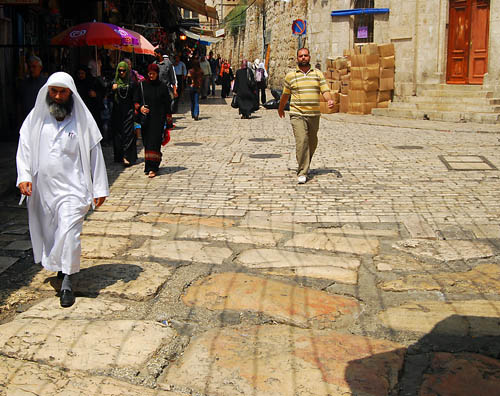
Roman period street near 3rd station of the cross. Photo by F. Jenkins.

Roman period street near 3rd station of the cross. Photo by F.  Jenkins.

This photo shows the street in front of the third station. The plaque in Hebrew, Arabic and English provides the following information about the street.

Paving stones, apparently from the Second Temple Period (ca. 100 B.C.E. – 100 C.E.). The street was found in its entirety 3 meters below the existing level and was partially restored by the Municipality of Jerusalem … 1980-1981.

This means that the street Jesus might have walked is at least 10 feet below the present street level.

[A portion of this post is repeated from April 8, 2009.]

Paul’s burial in Rome

The apostle Peter gets the most attention in Rome, but Paul also has his share of shrines. Paul was taken to Rome in the custody of the Roman Empire (Acts 27-28).

I appeal to Caesar. (Act 25:11)

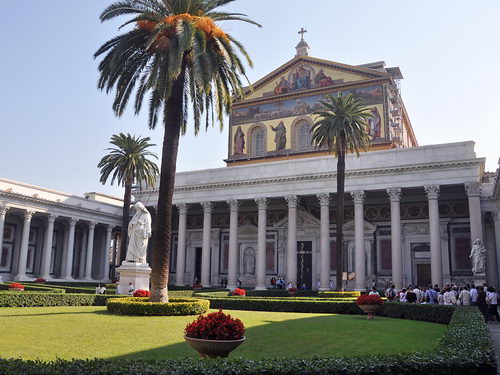
Tradition has it that Paul was buried outside the walls of Rome where we now find the Basilica of St. Paul Outside the Walls.

The basilica of St. Paul Outside the Walls in Rome. Photo by Ferrell Jenkins.

The basilica of St. Paul Outside the Walls in Rome. Photo by Ferrell Jenkins.

The statue in front of the church shows Paul with a drawn sword and a book. The inscription reads PREDICATORI VERITATIS and DOCTORI GENEIUM. Paul was a preacher of truth and a teacher of the Gentiles.

For this I was appointed a preacher and an apostle (I am telling the truth, I am not lying) as a teacher of the Gentiles in faith and truth. (1Timothy 2:7 NAU; see also 2 Timothy 1:11)

The Arch of Constantine

The Arch of Constantine was dedicated to the Emperor by the Senate and the People of Rome in A.D. 315. Constantine served as Emperor from A.D. 306 to 337. By the time of Constantine the church had made major departures from the New Testament pattern of church organization. The Emperor attended the Council of Nicea, but allowed the eastern bishops to preside over the meeting.

Grant comments on the question of Constantine’s conversion:

The question as to whether he was a “genuine” Christian or not depends on somewhat subjective definitions. (Encyclopedia of Early Christianity, 227).

The Arch of Constantine and the Colosseum. Photo by Ferrell Jenkins.

The Arch of Constantine and the Colosseum. Photo by Ferrell Jenkins.

Helena, the mother of Constantine, was responsible for the construction of many of the well-known churches of the Holy Land. Rosenberg says,

Her role in church history was due to her partnership in Constantine’s program of church building at Bethlehem and Jerusalem and to her discovery of what she believed to be the true cross, both of which led to the revival of Jerusalem and the encouragement of pilgrimage to the Holy Land. (Encyclopedia of Early Christianity 417).

How big is the Canon? Depends on who you ask.

Bible Study Magazine has made available a chart comparing various canons of Scripture. Those included are the SamWhat's in Your Bible? Find out at BibleStudyMagazine.comaritan Bible, Hebrew Bible, Greek Orthodox, Roman Catholic, Syriac, Ethiopian, and Protestant. By clicking on the small chart you will be taken to the complete large chart in Bible Study Magazine.

Dan Brown’s novels: Fact or Fiction?

On the plane from Rome last week I noticed someone reading The Lost Symbol. I think the Today Show made a lot of the book a few weeks ago. I gave some attention to The Da Vinci Code here, but don’t plan to do the same for this new book.

The Telegraph, in an article by Tom Chivers, mentions 50 factual errors in the two books by Dan Brown.

Dan Brown’s new novel The Lost Symbol opens with a bold word: FACT. “All rituals, science, artwork, and monuments in this novel are real”, it says.

The Da Vinci Code, his previous bestseller, began in a similar fashion. “All descriptions of artwork, architecture, documents, and secret rituals in this novel are accurate”, Brown says before the prologue.

Chivers discusses the categories of History, Geography, Science, Symbols, Religion and Mythology, Language, and Miscellany.

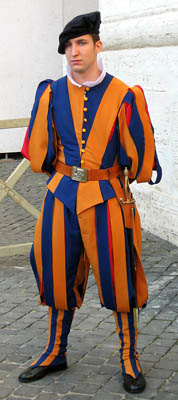
Swiss Guard at the Vatican. Photo by Ferrell Jenkins.

Swiss Guard at the Vatican. Photo by Ferrell Jenkins.

Here is one of the mistakes that would not matter much except for the fantastic claim that everything in the books are true.

Langdon says the Swiss Guard’s outfits were “designed by Michelangelo himself.” This is an urban myth: Michelangelo had nothing to do with them. The current uniforms were designed by Commandant Jules Repond between 1910 and 1921.

The Vatican’s official web site says,

The colours which make the uniform so attractive are the traditional Medici blue, red and yellow, set off nicely by the white of the collar and gloves. The blue and yellow bands give a sense of lightness as they move over the red doublet and breeches. The Guard’s every-day uniform is completely blue. With the passing centuries there have been a few minor changes, but on the whole the original dress has been maintained. It is commonly thought that the uniform was designed by Michelangelo, but it would seem rather that he had nothing to do with it. However, Raffaello certainly did influence its development, as he indeed influenced fashion in general in Italy in the Renaissance, through his painting.

I wondered how I would ever use this good photo of a Swiss Guard at the Vatican.

HT: Biblical Paths

The Colosseum in Rome

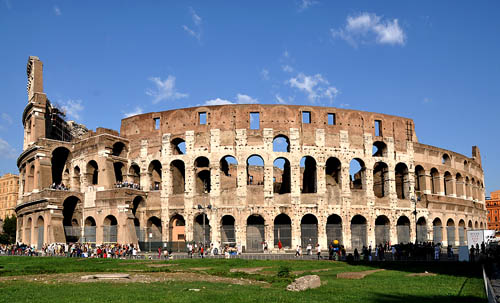
The Colosseum in Rome was built in A.D. 80 by the Emperor Titus. He used 10,000 of the slaves from Judea in this work. Titus was in command of the Roman army when Jerusalem was burned in A.D. 70.

I know that this photo will make some of our tour members jealous  🙂 , but I thought I would share a photo I made of the Colosseum Friday afternoon. You may recall that our group visited the Colosseum and Forum in the rain a week ago.

The Colosseum in Rome. Photo by Ferrell Jenkins.

The Colosseum in Rome. Photo by Ferrell Jenkins.

It is true that Christians were persecuted and even put to death in Rome, but there is no evidence that this occurred in the Colosseum. The persecution under Nero took place in the Circus of Nero. That is where St. Peter’s now stands. The persecution in the days of Claudius took place at least 30 years before the Colosseum was built. Luke describes Paul’s first visit to Corinth,

After these things he left Athens and went to Corinth.  And he found a Jew named Aquila, a native of Pontus, having recently come from Italy with his wife Priscilla, because Claudius had commanded all the Jews to leave Rome. He came to them,  and because he was of the same trade, he stayed with them and they were working, for by trade they were tent-makers. (Acts 18:1-3)