Category Archives: Biblical Studies

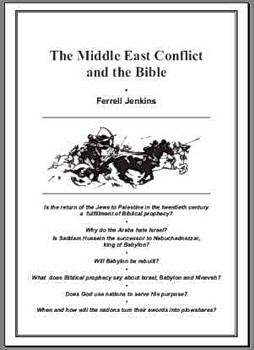
The Middle East Conflict and the Bible

Shortly before the first Gulf War I pulled together some of the material I had prepared about various problem associated with the Middle East conflict and the Bible. After going through several printings I allowed Mark Roberts to put the material for sale online at BibleClassMaterial.com. A single copy may be purchased, or a church may secure a license to use the material in classes. Take a look.

The Middle East Conflict and the Bible by Ferrell Jenkins

The book deals with the Arab-Israeli problem, whether the modern state of Israel is in fulfillment of Bible prophecy, and other important issues. There is also material about Iraq and Islam. At the BibleClassMaterial website you will find more details about the content.

Today is Yom Kippur

Today is Yom Kuppur, the Day of Atonement, for those who follow the Mosaic system. Information may be found in Leviticus 16 (NET Bible) in the Old Testament (Hebrew Bible). If you would like to read a modern Jewish description of the day read Judaism 101.

Christians who follow the New Testament believe that the Mosaic system has been removed and superseded by the gospel of Christ. Various New Testament writers have spoken on these matters. Here are a few significant references: Ephesians 2:14-16; Colossians 2:11-14; 2 Corinthians 3. Three entire New Testament epistles are devoted to discussions of the subject: Romans, Galatians, Hebrews. Hebrews 9:22-28 indicates that the offering of Christ is a one-time event, and sufficient to cover the sins of man.

Notice a few comments.

Hebrews 10:1-4 For the Law, since it has only a shadow of the good things to come and not the very form of things, can never, by the same sacrifices which they offer continually year by year, make perfect those who draw near. 2 Otherwise, would they not have ceased to be offered, because the worshipers, having once been cleansed, would no longer have had consciousness of sins? 3 But in those sacrifices there is a reminder of sins year by year. 4 For it is impossible for the blood of bulls and goats to take away sins (NASB).

Contrast this with the great proclamation of John the Baptist in the Gospel of John 1:29: “Behold, the Lamb of God who takes away the sin of the world”

Last year Todd Bolen posted a blog, with photos, of some residents of Jerusalem who “In the absence of a temple and the blood sacrifices that provide atonement for sins, some Jews today observe a sacrificial ceremony with a chicken.” You can find the full post here. I learned of a similar annual practice (not associated with Judaism) on a visit to Nepal a few years ago. Didn’t work before; won’t work now.

The Reformation and Restoration in Scotland

For those with an interest in Church History, Scotland provides many links. Scotland was influenced by the work of both Martin Luther and John Calvin, who were already advancing the Reformation principles in the early part of the 1500s. Sixteenth century Scottish leaders, who began their work a few years later, included George Wishart and John Knox.

Those of us with a background in the Restoration Movement in America find ourselves in agreement with many of the principles of the Reformation, but not with all of them. Thomas and Alexander Campbell came to America from Northern Ireland. In that area the people “were predominantly Anglo-Scottish in blood and Protestant in religion” (West). Thomas Campbell came to America in 1807. In 1808, when Alexander set out for America he was shipwrecked on the rugged shores of Scotland. Alexander entered Glasgow University where his father has studied earlier. He studied Greek, Logic, and Experimental Philosophy. He came in contact with several independent movements and was especially influenced by James and Robert Haldane. John Glas and Robert Sandeman influenced the young Campbell also. Their churches were congregational in government with a plurality of elders and deacons. They rejected human creeds, advocated weekly observance of the Lord’s Supper. See West, The Search for the Ancient Order, I:36-52.

In America, Barton W. Stone and the Campbells rejected the Calvinistic doctrines of inherited depravity, the direct operation of the Holy Spirit, etc. They determined that the New Testament was the standard of authority for Christians, and that baptism for forgiveness of sins is immersion. Infants did not need to be baptized because they are not sinners.

Writings of some of the Restoration leaders are available online at the Restoration Movement Page.

King James VI (James Stuart) of Scotland was King of Scots, King of England, and King of Ireland. He “authorized” the translation of the Bible that we still know as the King James Bible (1611). King James was born in Edinburgh Castle. The finished product was largely the work of William Tyndale whose New Testament was printed in 1525. His work on the Old Testament was completed by Miles Coverdale and the entire English Bible was first printed in 1535. Tyndale was strangled and burned at the stake in 1536. A nice time line on the Reformation can be studied at the Friends of Tyndale page.

Prior to the work of Tyndale in Scotland, Martin Luther was pushing the Reformation in Germany. Zwingli was at work in eastern Switzerland., and John Calvin was working with Theodore Beze in Geneva, Switzerland.

This beautiful and sunny morning I visited the John Knox house in Edinburgh. It is a house dating to the time of Knox and has been sparsely furnished in period furniture. It serves as a museum of the work of Knox. There are several printed volumes (including the Geneva Bible) of the time on display. The Knox house is located on the Royal Mile.
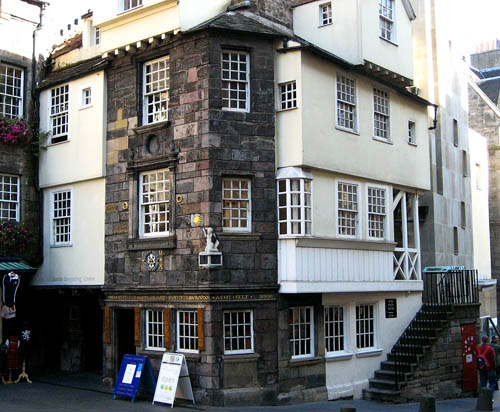
John Knox House, Edinburgh, Scotland.

This modern scribe, sitting at a table in the Knox house, is thinking about correcting some of the Calvinistic ideas advanced by Knox.
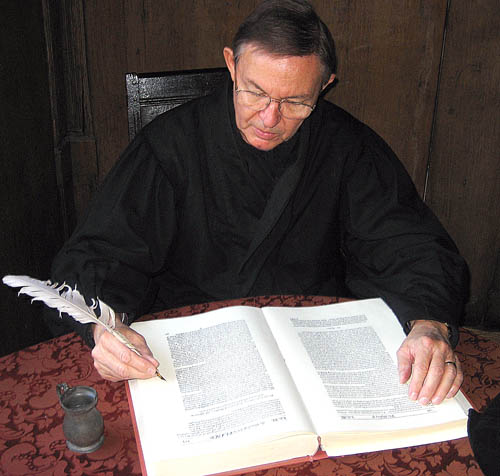
Modern Scribe in the John Knox House in Edinburgh.

I believe these men failed in some regards, but I am grateful for the work they did to bring us this far. To paraphrase the words of Bernard of Clairvaux, “If we can see further it is because we are standing on the shoulders of giants.”

“Let us therefore, as many as are perfect, have this attitude; and if in anything you have a different attitude, God will reveal that also to you; however, let us keep living by that same standard to which we have attained. Brethren, join in following my example, and observe those who walk according to the pattern you have in us.” – The Apostle Paul, Philippians 3:15-17.

From the Highlands to the Lowlands

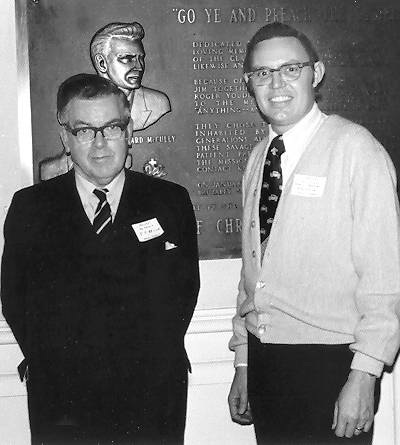
We left Inverness about 8 a.m. this morning headed south for Edinburgh. I began to notice road signs pointing to Elgin. This was the birth place of the late New Testament scholar, F. F. Bruce (1910-1990). He taught at Edinburgh, Leeds, Sheffield, and closed his academic career as Rylands Professor of Biblical Criticism and Exegesis at the University of Manchester. I have been greatly helped by the writings of Bruce, and was delighted to have the opportunity to meet him at a professional meeting in 1975. He was very gracious to an insignificant young teacher, and I have since appreciated that meeting.

F. F. Bruce and Ferrell Jenkins in 1975.

Elgin, Scotland, has a nice web page with a list of Famous Children. Alexander Graham Bell is listed among the famous from Elgin. (Poor guy never had to drive in front of a teenage girl with a cell (mobile  here) phone to her ear!). But F. F. Bruce, author of more than 30 books, is not listed among the Famous Children. Perhaps that will be corrected.

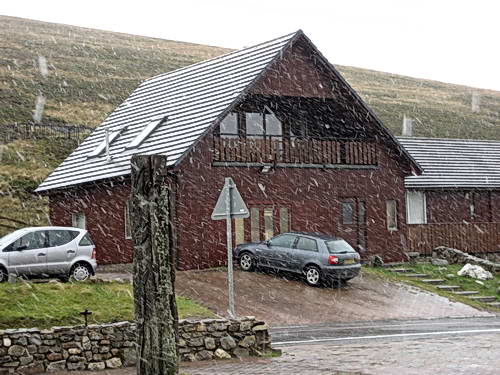
By the time we reached the area around Balmoral, summer residence of Queen Elizabeth and the Royal Family, the weather was very cold and windy. About the time we stopped at a ski lift snow flakes began to fall. The workers in the restaurant said it was the first snow of the season. Here is a photo I took. What appears to be white strips are actually snow flakes that were falling close to the camera.

Snow in the area of Balmoral. Sept. 17, 2007. Photo by Ferrell Jenkins.

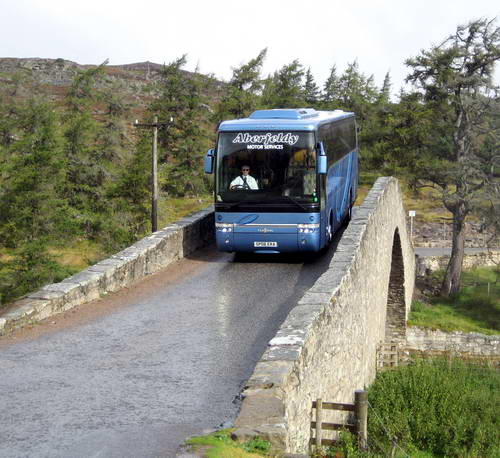
Because the Queen is at Balmoral we were not permitted to visit the estate. We did visit the Presbyterian church where the Queen, head of the Church of England, attends when she is in Scotland. Not enough time to tell you about this. If you saw The Queen, staring Helen Mirren, you saw scenes typical of this region. Here is a photo of our coach coming over a one lane bridge.

Coach coming over bridge near Balmoral. Photo by Ferrell Jenkins.

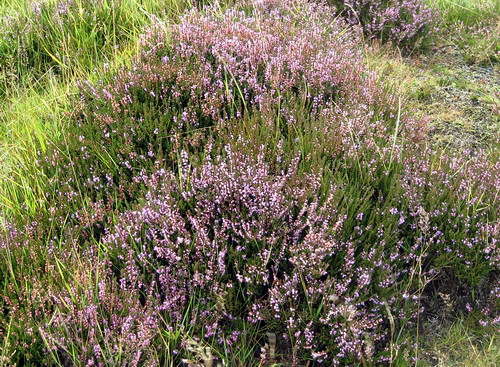
Heather is in abundance on the hills of the Highlands. Here is a close up.

Heather near Balmoral. Photo by Ferrell Jenkins.

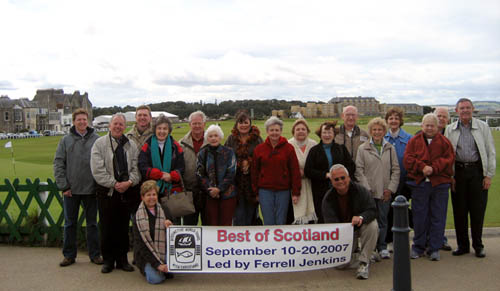
After lunch in Braemor we continued to St. Andrews, famous to all golfers as the birthplace of golf. We made a group photo here. The 18th hole is to the left.

Best of Scotland Group Led by Ferrell Jenkins.

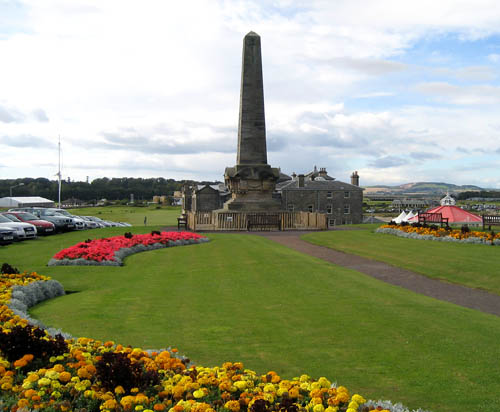
St. Andrews is home to one of the oldest universities. One of the blogs I read regularly is PaleoJudaica, a weblog by Jim Davila of St. Andrews University. St. Andrews has an important place in the Reformation Movement. John Knox preached here. At least four leaders of the Reformation, including Patrick Hamilton and George Wishart, were martyred in St. Andrews. I suspect that not many people who visit the Old Course know that the monument on the hill overlooking the course is a Martyrs Monument.

Martyrs Monument at St. Andrews. The Old Course in the distance. Photo by Ferrell Jenkins.

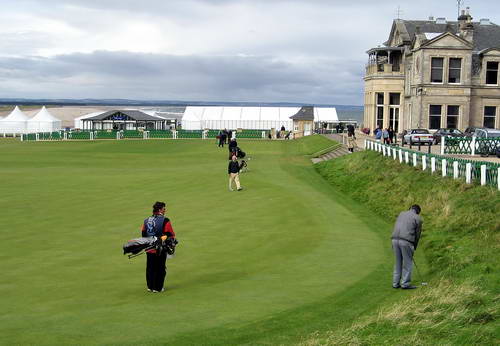
This golfer was having a little problem with the rough. That’s the North Sea in the distance. We had sun most of the time while here, but the wind was high and cold.

In the Rough at St. Andrews. Photo by Ferrell Jenkins.

We arrived in Edinburgh by 6:30 p.m. after an eventful day of beautiful scenery and unusual weather.

Temple Mount controversies

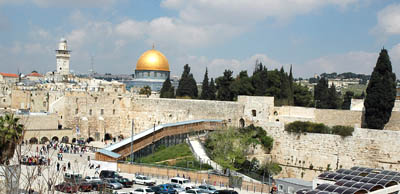
On recent tours to Israel we have been unable to visit the Temple Mount. The Islamic buildings there, the Mosque of Omar (Dome of the Rock) and the Al Aksa Mosque, have no spiritual significance for us. The site, however, is very important biblically. It was likely here on Mount Moriah that Abraham offered Isaac (Genesis 22). It is where David placed the ark of the covenant, and where the Temple was built by Solomon in 966 B.C. ( 2 Chronicles 3). That temple was destroyed by the Babylonians in 597 B.C.. After the return from captivity, the Jews rebuilt the temple with the help of the Persian king Darius in 520-516 B.C. Herod the Great more or less replaced this structure with his magnificent temple beginning in 19 B.C. Jesus visited this temple numerous times (John 2:19). In this area the gospel was preached for the first time on the Pentecost of Acts 2.

In the late 7th century A.D., a Muslim ruler constructed the building we now commonly call the Dome of the Rock.

The Temple Mount in Jerusalem

The photo above, made April 3, 2006, shows the Western Wall of the temple enclosure built by Herod. The temple platform, where you see the golden dome, is where the biblical temple once stood. Many news items have been written about the temporary bridge leading to the Temple Mount, and the removal of the earth by archaeologists to reveal more of the Western Wall. There has also been considerable controversy over repairs being made by the Muslims on the Temple Mount.

One good source to help you keep up with this controversy is Dr. Leen Ritmeyer’s blog. There you will find pictures of the terrible destruction taking place. Ritmeyer has drawn many of the excellent plans you may have seen published in various books.

Weeping for the Jordan

“Weeping for the Jordan” is the title of a short news item in Christianity Today, Sept., 2007, p. 17. The article from the RNS says the lower portion of the Jordan River “is so polluted that the World Monuments Fund (WMF) has designated it an Endangered Cultural Heritage Site.”

We often point out to audiences that the Jordan has much less water flowing through it now than it did even 50 years ago. This is because Israel uses much of the water of the Jordan and its tributaries for water and agricultural irrigation. Jordan has dams on the Yarmuk and Jabbok rivers, tributaries from the east.

There is not full agreement among scholars, but many believe that the site where Jesus was baptized by John is a few miles north of the Dead Sea. In 1967 I was able to visit that site. Since the 1967 war it has not been possible for tourists to visit there. A few years back a site was excavated in Jordan that has been claimed to be Bethany Beyond the Jordan (Jn. 1:28).

The CT article points out that the Jordan River is “highly polluted with sewage and agricultural runoff” near Bethany Beyond Jordan, but that some tourists do not realize this and wade in the water.

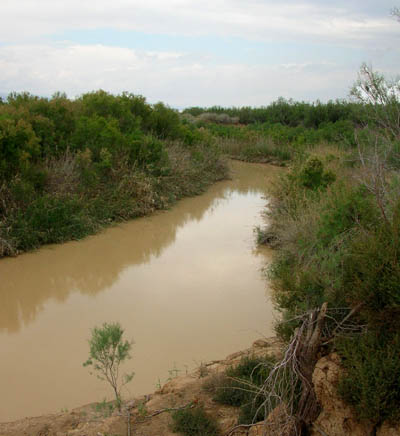
In 2006 I was able to take my group to Bethany Beyond Jordan and visit the Jordan River. Here is one of the photos made at that time.

Jordan River at Bethany Beyond the Jordan.

We are hopeful of visiting this site again in 2008. Perhaps it is in the area where John did some of his baptizing (cf. Jn. 10:40). The Israelites crossed the Jordan somewhere near here (Josh. 3), and the prophets Elijah and Elisha crossed in the opposite direction near here (2 Kings 3).

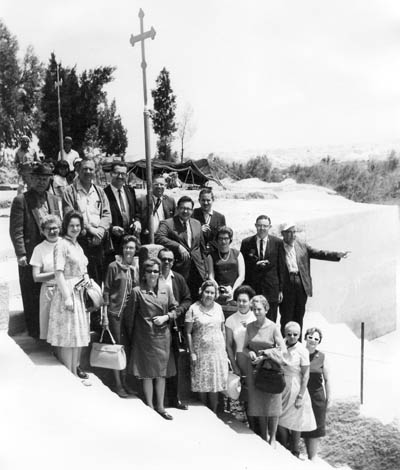
This photo was made on the West side of the Jordan River, in the country of Jordan, in 1967. This is directly across from the Bethany Beyond Jordan site.

1967 Bible Land Group led by Ferrell Jenkins and William E. Wallace.

The photo was made on or about May 5, 1967. Notice the attire. Women wore hosiery and other items to help their body hold an ideal shape. Most men wore a coat, and many wore ties on the plane and throughout the entire trip, even in hot weather. Some hotels would not allow a man in the dining room unless he was wearing a coat. Were these the good old days?

Psychological Study of Herod the Great

A historian from Tel Aviv University (Kasher) and a psychiatrist from Ben-Gurion Uniersity of the Negev (Witztum) have written King Herod: A Persecuted Persecutor: A Case Study in Psychohistory and Psychobiography. This book sells for $193, so I suspect that most of us will be satisfied to read a good review. Magen Broshi, a well-known Israeli archaeologist, has a review in Haaretz. Don’t expect this review to stay online very long. I suggest you go immediately and copy this good review.

With the recent interest in Herod due to the discovery of his tomb at the Herodium, this book is timely. If you had thought Herod was cruel, just wait till you read this.

I copy (print) article like the one mentioned above in Adobe PDF, and then save them in the appropriate folder on my computer (the new filing cabinet!).

HT: Paleojudaica.

Ben Witherington at Mount Nemrud [Nemrut]

Ben Witherington recently visited Mount Nemrud [or Nemrut] and has posted several good photos.  Note his point about the Greek of Ephesians and 2 Peter, and his theological comments on heaven and hell. Click here to go to the Ben Witherington blog.

And while looking at Ben’s blog, you might want to check his excellent stormy night photos of the Library of Celsus at Ephesus.  Click here.