Category Archives: Bible Study

Akko’s Hellentistic Harbor Revealed

The Israel Antiquities Authority announced the results of archaeological excavations carried out at the Mediterranean city of Akko (Acco in some English versions).
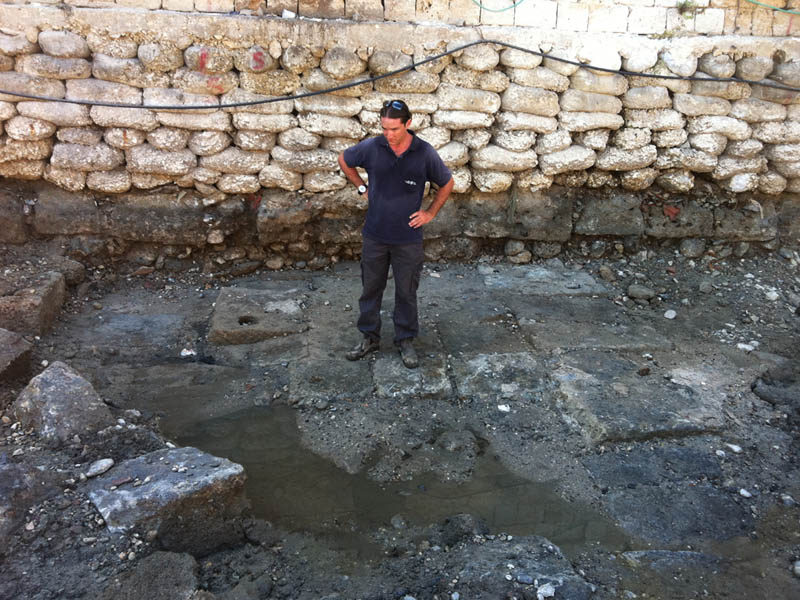
Akko Hellenistic Harbor quay. Photo: Kobi Sharvit, IAA.

A member of the Marine Archaeology Unit of the Israel Antiquities Authority standing on the ancient quay that was exposed in Akko. In the middle of the picture one can see the floor of the quay, built of large dressed stones. In some of the stones there is a hole for inserting a wooden pole – probably for mooring and/or dragging the boat. Photo: Kobi Sharvit, courtesy IAA.

Evidence of a harbor operating during the Hellenistic period (3rd-2nd century B.C.). This harbor was said to be the most important harbor in Israel at the time.

According to Kobi Sharvit, director of the Marine Archaeology Unit of the Israel Antiquities Authority, “Among the finds we’ve discovered now are large mooring stones that were incorporated in the quay and were used to secure sailing vessels that anchored in the harbor c. 2,300 years ago. This unique and important find finally provides an unequivocal answer to the question of whether we are dealing with port installations or the floor of a building. In addition, we exposed collapse comprised of large dressed stones that apparently belonged to large buildings or installations, which was spread of a distance of dozens of meters. What emerges from these finds is a clear picture of systematic and deliberate destruction of the port facilities that occurred in antiquity”

. Sharvit adds, “Recently a find was uncovered that suggests we are excavating part of the military port of Akko. We are talking about an impressive section of stone pavement c. 8 meters long by c. 5 meters wide that was partially exposed. The floor is delimited on both sides by two impressive stone walls that are also built in the Phoenician manner. It seems that the floor between the walls slopes slightly toward the south, and there was a small amount of stone collapse in its center. Presumably this is a slipway, an installation that was used for lifting boats onto the shore, probably warships in this case”. According to Sharvit, “Only further archaeological excavations will corroborate or invalidate this theory.”

The news release suggests that the pottery vessels came “from islands in the Aegean Sea, including Knidos [Cnidus], Rhodes, Kos [Cos] and others, as well as other port cities located along the Mediterranean coast.”
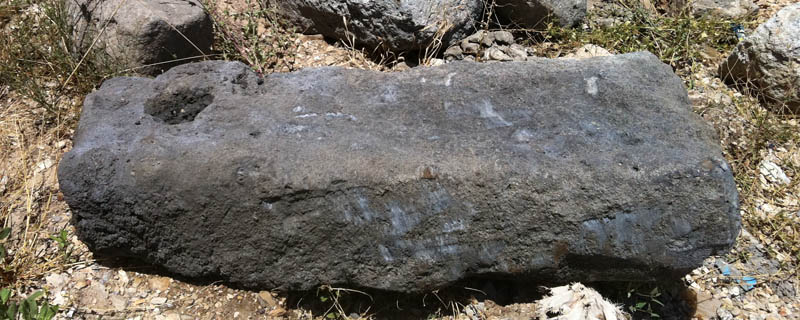
Akko Hellenistic harbor mooring stone. Photo: Kobi Sharvit, courtesy IAA.

A mooring stone that was incorporated in the quay. There was a hole in the stone in which the mooring/anchoring rope was inserted. Photo: Kobi Sharvit, courtesy IAA.

Acco is mentioned only once in the Bible. The city is within the territory originally allotted to the tribe of Asher, but the tribe was unable to conquer it.

Asher did not drive out the inhabitants of Acco, or the inhabitants of Sidon or of Ahlab or of Achzib or of Helbah or of Aphik or of Rehob, (Judges 1:31 ESV)

After about 100 B.C. the coastal city was known as Ptolemais (Acts 21:7). Paul spent one day with the brethren here on the return from his third journey.
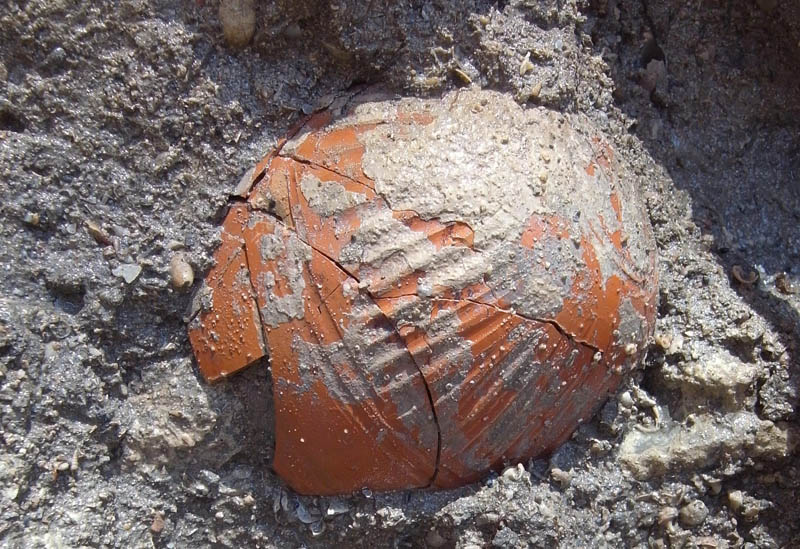
Imported bowl from Hellenistic period. Photo: Kobi Sharvit, courtesy IAA.

An imported bowl characteristic of the Hellenistic period. The bowl was found in a layer of harbor sludge. This layer contained thousands of intact pottery vessels, potsherds, etc. Photo: Kobi Sharvit, courtesy IAA.

The full IAA report with links to the photos is temporarily available here.

HT: Joseph Lauer
Acts 5 — Photo Illustrations

The temple held a central place in the early days of the church. The gospel was preached to the large number of Jews from “every nation under heaven” in the temple precinct. After their acceptance of Jesus as Lord and Christ, the disciples continued “in the temple” (Acts 2:5; 2:46).

Twice in Acts it is recorded that the followers of Jesus met in Solomon’s Portico.

Now many signs and wonders were regularly done among the people by the hands of the apostles. And they were all together in Solomon’s Portico. (Acts 5:12) ESV)

The Greek word for portico or porch is stoa. The term is used in Acts 3:11; 5:12; John 5:2; 10:23. BDAG says it is used of,

a roofed colonnade open normally on one side, portico.

During a winter visit to Jerusalem at the time of the Feast of Dedication, Jesus “was walking in the temple in the portico of Solomon” (John 10:23).

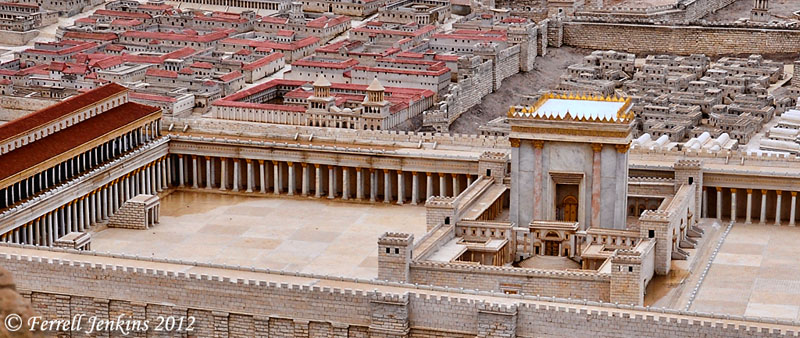
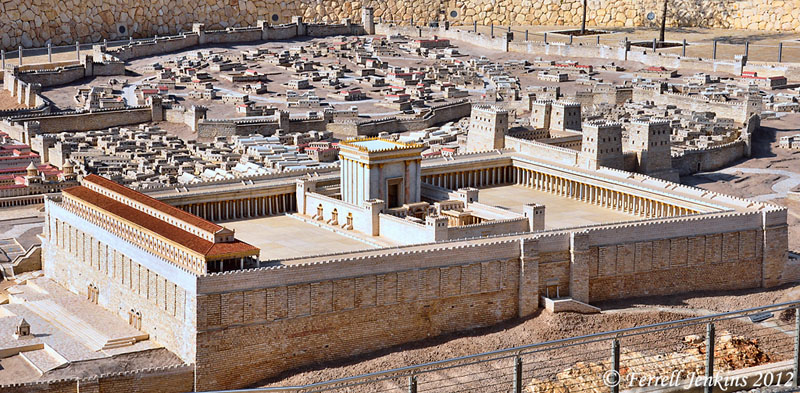
Second Temple Model showing porticoes around the perimeter of the Temple precinct. Photo by Ferrell Jenkins.

Notice porticoes around the perimeter of the temple precinct. Photo by Ferrell Jenkins.

This photo provides a better view of some of the Royal Portico on the south side of the temple platform (left). The other portico is on the west side. Solomon’s Portico is hidden by the wall on the east side.

Second Temple Model showing Porticoes. Photo by Ferrell Jenkins.

Second Temple Model showing Porticoes. Photo by Ferrell Jenkins.

Each portico was formed by two rows of columns and was 49 feet wide. These “lent great splendor and majesty to the lofty Mount and served also – the royal Portico in particular – as the gathering place for great assemblies” (Mazar, The Mountain of the Lord, 124). Fragments of these gigantic monolithic columns (27 ft. high; 4.6 ft. in diameter) have been uncovered during the Temple Mount excavations directed by Professor Mazar.

The Royal Portico was built by Herod along the southern end of the Temple courts and is described by Josephus as deserving to be mentioned above any under the sun (Antiquities 15.11.5).

Solomon’s Colonnade or Portico ran along the eastern portion of the outer court of the temple precincts.

Acts 4 — Photo Illustrations

In Acts 4 we have several public characters mentioned who had a part in the trial of Jesus or in the opposition to the new movement of believers in Jesus as Lord and Christ (Acts 2:36). I will call attention to two of them. The first is a religious leader, and the second is one of the Roman procurators or prefects.

Caiaphas. Caiaphas was the son-in-law of Annas. He was appointed high priest by Valerius Gratus, procurator of Judea, in A.D. 18 and deposed by Vitellius, legate of Syria, in A.D. 36 at the same time Pilate was removed as procurator of Judea. Caiaphas was the Jewish high priest before whom Jesus was tried (John 18:13-14, 24).

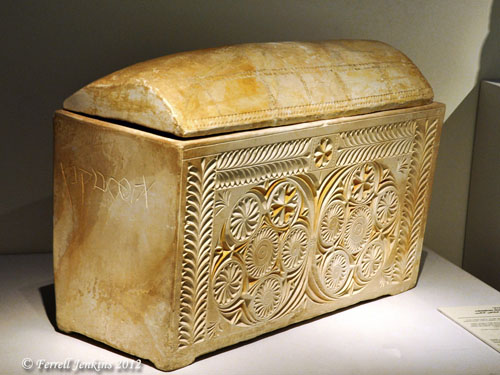
In November, 1990, a burial cave was found accidentally during construction of a water park at a promenade overlooking the Peace Forest just south of the old city of Jerusalem. The cave contained 12 ossuaries, two of which contained the name of the well-known family of the high priest Caiaphas. One ossuary bore the inscription Qafa, and the other bore the name Yehosef bar Qayafa (Joseph, son of Caiaphas) and Yehosef bar Qafa (Joseph, son of Caiaphas). Inside this beautiful ossuary was found the bones of six different people: 2 infants, a child between 2 and 5, a young boy between 13 and 18, an adult woman and “a male of about 60 years!”

According to Josephus, Caiaphas was named Joseph Caiaphas (Ant. 18.2.2).

The Caiaphas ossuary is on display in the Israel Museum. (See articles: Zvi Greenhut, “Burial Cave of the Caiaphas Family,” BAR 18.5 (1992): 29-36. Ronny Reich, “Caiaphas Name Inscribed on Bone Boxes,” BAR 18.5 (1992): 38-44.)

Decorated ossuary bearing the name of Caiaphas. Israel Museum. Photo by Ferrell Jenkins.

Ossuary bearing the name of Caiaphas. Israel Museum. Photo by Ferrell Jenkins.

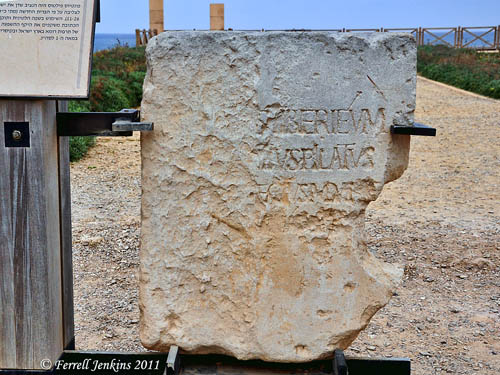
Pontius Pilate. Pilate was the Roman procurator of Judea when Jesus was crucified (A.D. 26-36). An inscription bearing the name of Pilate was discovered at Caesarea, the residence of the procurator, in 1961. The stone is thought to have been used in the dedication of a statue or some public building. The original is in the Israel Museum but a replica is displayed at Caesarea.

Murphy-O’Connor suggests the following translation of the Latin inscription: “Pontius Pilate, Prefect of Judaea, made and dedicated the Tiberieum to the Divine Augustus” (The Holy Land, 3rd ed., 215).

Pilate Inscription (Replica) at Caesarea Maritima. Photo by Ferrell Jenkins.

Pilate Inscription (Replica) at Caesarea Maritima. Photo by Ferrell Jenkins.

The Roman historian Tacitus (A.D. 55-117) writes about the persecution of a group commonly called Christians. He says the originator or author of the group,

Christ, was put to death by the procurator, Pontius Pilate, while Tiberius was emperor…

See John 18:28ff.

Digging in the Shephelah

Luke Chandler has joined the team working at Khirbet Qeiyafa again, and has begun to post some reports on the current excavation on Luke Chandler’s Blog. In a personal note, Luke tells me that there are 90 volunteers at Kh. Qeiyafa this season.

Prof. Aren Maeir is posting updates on new finds at Tell es-Safi/Gath. Click here.

Both of these sites have a connection with David.

Khirbet Qeiyafa is located on the hill overlooking the Valley of Elah.

 “For Saul and they and all the men of Israel are in the valley of Elah, fighting with the Philistines.” So David arose early in the morning and left the flock with a keeper and took the supplies and went as Jesse had commanded him. And he came to the circle of the camp while the army was going out in battle array shouting the war cry. Israel and the Philistines drew up in battle array, army against army.
(1 Samuel 17:19-21 NAU)

The following verses tell the rest of the story.

Goliath, the giant David faced in the Valley of Elah, was from Gath.

As he was talking with them, behold, the champion, the Philistine from Gath named Goliath, was coming up from the army of the Philistines, and he spoke these same words; and David heard them. (1 Samuel 17:23 NAU)

David later took refuge at Gath when he was fleeing from Saul.

Then David arose and fled that day from Saul, and went to Achish king of Gath. (1 Samuel 21:10 NAU)

Exciting things are happening in the Shephelah.

This evening I am speaking at Brooksville, Florida, on The World of Acts and he Epistles.

Acts 3 — Photo Illustrations

We begin today with a photo of the Second Temple Model of Jerusalem. This is the time of Jesus and the early days of the church. The wonderful model is now displayed on the grounds of the Israel Museum. Our view of the model shows pre-70 A.D. Jerusalem from the southwest (assuming we were photographing the city; not the modern setting of the model).

To the right of the photo is the dome of the Shrine of the Book. In the distance between the trees you will see Israel’s Knesset building.

Model of the city of Jerusalem in the time of Jesus. Photo by Ferrell Jenkins.

Model of the city of Jerusalem in the time of Jesus. Photo by Ferrell Jenkins.

Acts 3 begins with the account of Peter and John going up to the temple.

Now Peter and John were going up to the temple at the ninth hour, the hour of prayer. (Acts 3:1 NAU)

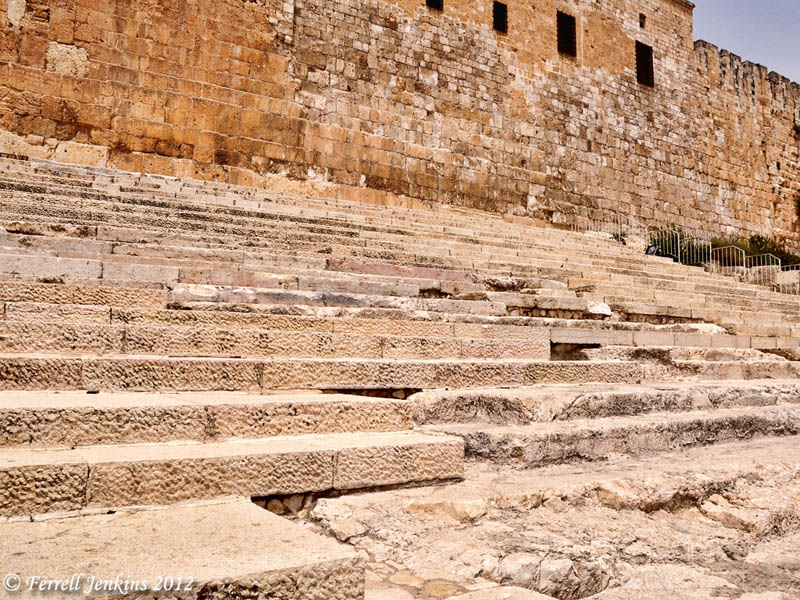
Following 1967 an excavation of area around the southern wall of the temple enclosure was conducted by Prof. Benjamin Mazar. Mazar describes the monumental stairway that was uncovered.

In the course of our excavations in the area facing the Western Hulda Gate, we uncovered a gigantic stairway which led from the Lower City (Ophel) to the gates. It is two hundred and fifteen feet wide; the foundation steps were cut into the natural bedrock on the slopes of the Temple Mount. The stairs were constructed of wide, trimmed and smoothed stone paving blocks, fitted together snugly. The stairway comprised thirty steps set alternately in wide and narrow rows. (The Mountain of the Lord, 143).

The Monumental Stairway led to the Double Gate which led into the temple precinct. We can safely say that Jesus and His disciples used these steps to enter the temple precinct.

Monumental Stairway leading to the temple. Photo by Ferrell Jenkins.

Monumental Stairway leading to the temple. Photo by Ferrell Jenkins.

Dr. Leen Ritmeyer, author of The Quest, calls attention to the virtual model of the Temple Mount in the time of Jesus. The brief video is helpful in understanding the area. Click here.

Perhaps another day we can discuss the Beautiful Gate (Acts 3:2, 10).

Mount Gerizim archaeological excavation site now open

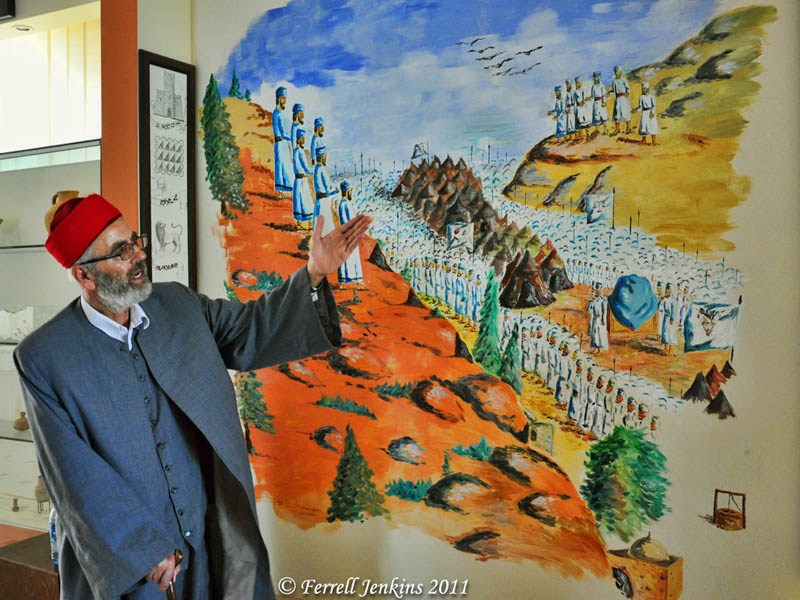
Last year I visited Mount Gerizim and the Samaritan Museum. Husney W. Cohen, a priest and director of the Museum, explained the Samaritan viewpoint about several biblical events. Samaritans believe the temple was to be built on Mount Gerizim rather than Jerusalem. They think Abraham offered Isaac on the mountain. They accept only the first five books (the Pentateuch) of the Old Testament.

Cohen used a large mural to explain the Biblical account of the blessing and the curse.

“It shall come about, when the LORD your God brings you into the land where you are entering to possess it, that you shall place the blessing on Mount Gerizim and the curse on Mount Ebal.” (Deuteronomy 11:29 NAU) cf. Joshua 8:33-35.

Notice Jacob’s well in the lower right hand corner of the mural (John 4:5-6).

Samaritan priest explains the Samaritan view of the reading of the blessings and curses of the Law. Photo by Ferrell Jenkins.

Samaritan priest, Husney W. Cohen, explains the Samaritan view of the reading of the blessing and curse of the Law. Photo by Ferrell Jenkins.

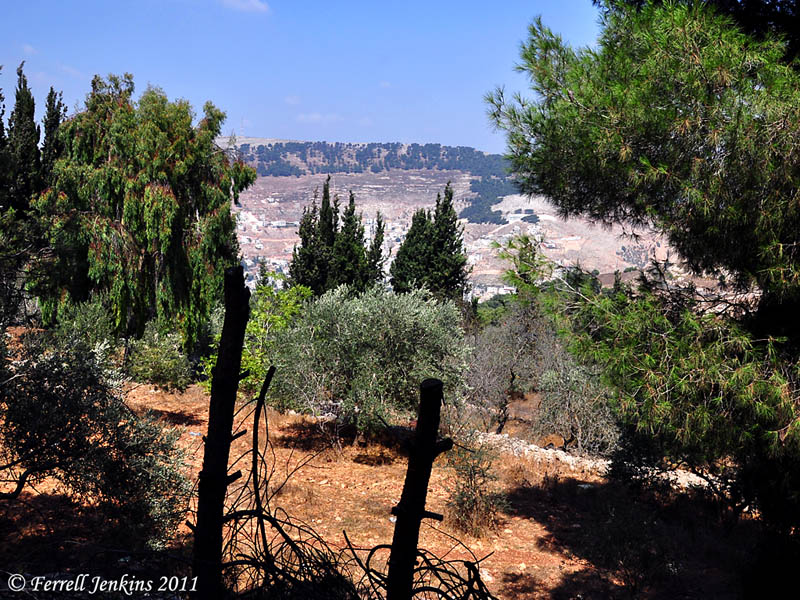
At one point during the visit the priest, who said he was third in line to become high priest, took us to an open window where we could see Mount Ebal across the valley to the north.

View of Mount Ebal from a window of the Samaritan Museum on Mount Gerizim. Photo by Ferrell Jenkins.

View of Mount Ebal from a window of the Samaritan Museum on Mount Gerizim. Photo by Ferrell Jenkins.

Robert J. Bull of Drew University excavated a site called Tell er Ras on Mount Gerizim between 1964 and 1968 when it was under the control of the Hashemite Kingdom of Jordan. His work uncovered evidence of Hadrian’s temple in the early second century A.D. In more recent excavations Y. Magen claims to have discovered the Samaritan temple destroyed by John Hyrcanus.

In 1982 I visited the archaeological site on Mount Gerizim. In 2011 the road to the site was closed. In 2009 it was possible to drive to the site, but it was closed to visitors. Here is a photo I made of some of the excavation and a Samaritan village on Mount Gerizim.

Archaeological site and Samaritan village on Mount Gerizim. Photo by Ferrell Jenkins.

Archaeological site and Samaritan village on Mount Gerizim. Photo by Ferrell Jenkins.

Two years ago we reported that the Samaritans wanted the archaeological site opened. See here. Now comes word that the site has been opened. No hours are given. See the Arutz Sheva article here.

This whole area is of great significance to students of the New Testament. The conversation between Jesus and the woman of Samaria dealt with this issue.

“Our fathers worshiped in this mountain, and you people say that in Jerusalem is the place where men ought to worship.” (John 4:20).

Information about the Samaritan Passover may be found here, and here.

HT: Joseph Lauer.

Acts 2 — Photo Illustrations

Acts 2 is one of those highly significant chapters of the Bible. It is a pivotal point, or as the late James D. Bales called it in one of his books, “The Hub of the Bible.” The reason is because so many Old Testament prophecies looked forward to their fulfillment in the events of Acts 2 (e.g., Isaiah 2, Joel 2, Daniel 2), and because many New Testament texts look back to the beginning of the gospel in that chapter (e.g., Ephesians 2). In fact, Peter refers to the events of Pentecost as “the beginning” (Acts 11:15).

The prophet Isaiah said,

Now it will come about that In the last days The mountain of the house of the LORD Will be established as the chief of the mountains, And will be raised above the hills; And all the nations will stream to it. And many peoples will come and say, “Come, let us go up to the mountain of the LORD, To the house of the God of Jacob; That He may teach us concerning His ways And that we may walk in His paths.” For the law will go forth from Zion And the word of the LORD from Jerusalem. (Isaiah 2:2-3 NAU)

From the beginning of His ministry, Jesus spoke of the establishment of the kingdom during the lifetime of some of those who heard him (Mark 1:14-15; 9:1).

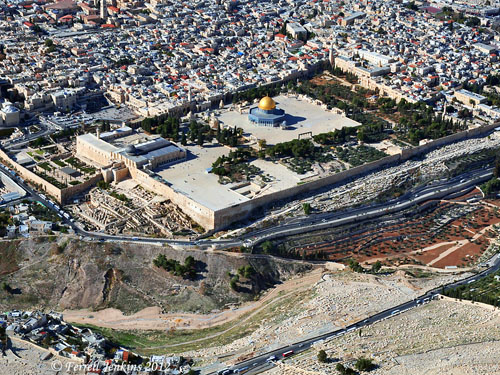
Our aerial photo shows the enclosed Islamic sanctuary area that is commonly called the Haram es-Sherif. Benjamin Mazar says that this area is about 40 acres. He points out that Josephus and the Mishna give smaller dimensions, and says that they apparently refer to “the Soreg or sacred enclosure” (The Mountain of the Lord, 119-120). Other writers say the area is 36 acres in size. Certainly large enough for the crowds who came to Jerusalem for festivals such as the Passover and Pentecost.

Solomon’s temple stood on Mount Moriah (2 Chronicles 3:1). Centuries later Herod the Great built the large platform and enclosure walls. Stones from that wall can still be seen in many places around this vast enclosure. The picture shows the southern wall and the eastern wall (the long one). The Kidron Valley and a portion of the slope of the Mount of Olives is visible in the bottom of the photo.

Aerial view of the temple precinct from the time of Herod the Great. Today the area is occupied by Moslem shrines, Al Aksa Mosque and the Mosque of Omar (Dome of the Rock). Photo by Ferrell Jenkins.

Aerial view of the temple precinct from the time of Herod the Great. Today the area is occupied by Moslem shrines, Al Aksa Mosque and the Mosque of Omar (Dome of the Rock). Photo by Ferrell Jenkins.

Click on the photo for an image suitable for use in teaching.

The New Testament (Greek) makes a distinction between the entire temple precinct, courts and all (Greek, hieron), and the sanctuary where only the priests were allowed (Greek, naos). John 2:14-15 uses hieron. John 2:19-21 uses naos.

Hieron is the term used in Acts 2:46. The new converts met in the temple precinct. They most likely assembled in one of the large porticoes built around the inside of the enclosure wall (cf. Acts 3:11; 5:12).

Day by day continuing with one mind in the temple, and breaking bread from house to house, they were taking their meals together with gladness and sincerity of heart,  praising God and having favor with all the people. And the Lord was adding to their number day by day those who were being saved. (Acts 2:46-47 NAU)

It also was within this precinct that the large crowd of devout Jews “from every nation under heaven” assembled on Pentecost. Here, Peter preached the gospel of the death, burial, and resurrection of Jesus for the first time.

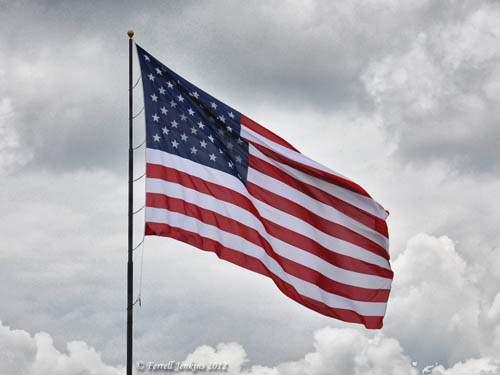
July 4, 2012 in the United States of America

Flag of the United States of America. Photo by Ferrell Jenkins.

Flag of the United States of America. Photo by Ferrell Jenkins.

Acts 1 — Photo Illustrations

Many churches study the book of Acts in various classes. I thought I might begin a series of brief blogs using at least one photo for each chapter in Acts. We will not run these photos daily, but one or two a week. The photos normally will be 800 pixels wide — wide enough for use in PowerPoint presentations. It will be best to leave some space around them. This will allow room for an identifying caption. There is no need to write for permission to use these photos for educational, non-commercial, purposes. I would appreciate a comment or note telling me how you used the material.

The first chapter of Acts includes:

  • The promise to the 11 apostles that they would be baptized with (in) the Holy Spirit (1:4-5; Cf. John 14-16).
  • Jesus’ restatement of the Great Commission (1:8).
  • The ascension of Jesus from the Mount called Olivet (1:9-12). In the Gospel, Luke says the ascension took place at Bethany (Luke 24:50). Bethany is on the eastern slope of the mountain.

Then they returned to Jerusalem from the mount called Olivet, which is near Jerusalem, a Sabbath day’s journey away. (Acts 1:12 ESV)

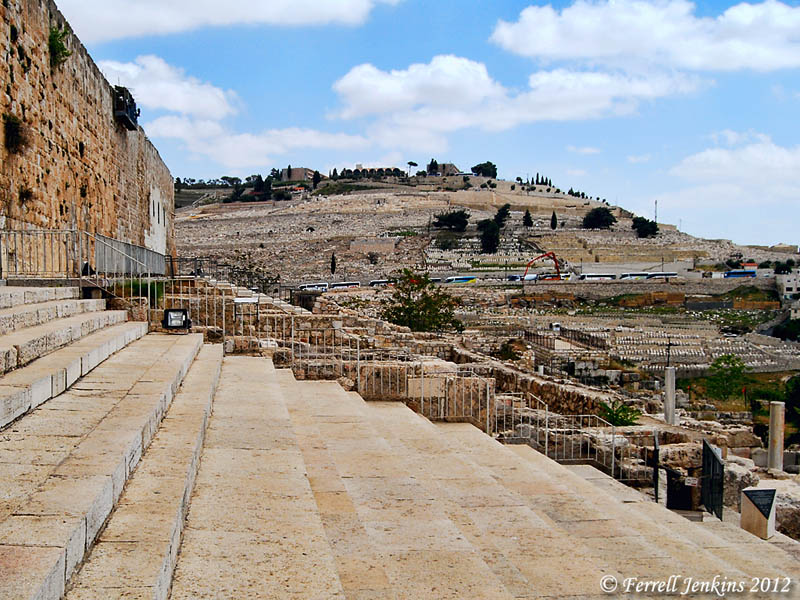
The photo shows the western slope of the Mount called Olivet from the steps on the southern end of the Temple enclosure (precinct) built by Herod the Great.

The Mount called Olivet from the Temple Mount. Photo by Ferrell Jenkins.

The Mount called Olivet from the Temple Mount. Photo by Ferrell Jenkins.

Other events in Acts 1 include:

  • The meeting of the 11 apostles in the upper room (1:13).
  • The record of the death of Judas (1:16-20).
  • The selection of Matthias to replace Judas (1:20-26).

Mosaic of Samson and the foxes discovered in Galilee synagogue

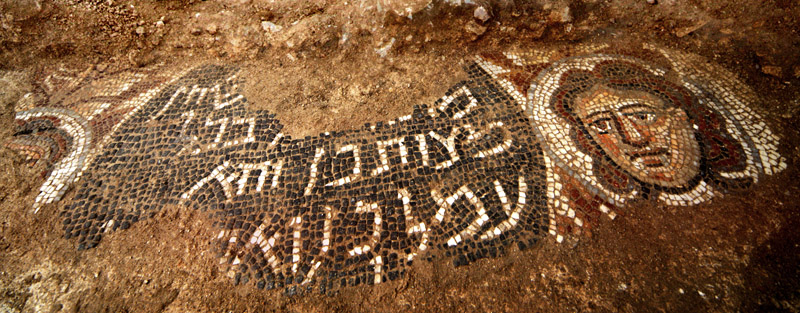
Excavations at Huqoq in Galilee have uncovered a mosaic floor depicting exploits of Samson. The photo below shows a female face and a partial Hebrew inscription referring to “rewards for those who perform good deeds .” No photo of the Samson portion of the mosaic has been provided.

Huqoq Galilee Synagogue Mosaic showing Samson. Photo by Jim Haberman.

Huquq Synagogue Mosaic with female face and inscription. Photo by Jim Haberman.

At the moment the most best information I have is from the Israel Antiquities Authority. Everything set off below, and the photo above, is from that source.

—•—

A monumental synagogue building dating to the Late Roman period (ca. 4th-5th centuries C.E.) has been discovered in archaeological excavations at Huqoq in Israel’s Galilee.

The excavations are being conducted by Jodi Magness of the University of North Carolina at Chapel Hill and David Amit and Shua Kisilevitz of the Israel Antiquities Authority, under the sponsorship of UNC, Brigham Young University in Utah, Trinity University in Texas, the University of Oklahoma and the University of Toronto in Canada. Students and staff from UNC and the consortium schools are participating in the dig

Huqoq is an ancient Jewish village located approximately two to three miles west of Capernaum and Migdal (Magdala). This second season of excavations has revealed portions of a stunning mosaic floor decorating the interior of the synagogue building. The mosaic, which is made of tiny colored stone cubes of the highest quality, includes a scene depicting Samson placing torches between the tails of foxes (as related in the book of Judges 15). In another part of the mosaic, two human (apparently female) faces flank a circular medallion with a Hebrew inscription that refers to rewards for those who perform good deeds.

“This discovery is significant because only a small number of ancient (Late Roman) synagogue buildings are decorated with mosaics showing biblical scenes, and only two others have scenes with Samson (one is at another site just a couple of miles from Huqoq),” said Magness, the Kenan Distinguished Professor in the department of religious studies in UNC’s College of Arts and Sciences. “Our mosaics are also important because of their high artistic quality and the tiny size of the mosaic cubes. This, together with the monumental size of the stones used to construct the synagogue’s walls, suggest a high level of prosperity in this village, as the building clearly was very costly.”

—•—

The web site of Dr. Magness may be accessed here.

Several centuries before the synagogue at Huqoq was built, Jesus visited synagogues in Galilee.

Jesus went throughout all of Galilee, teaching in their synagogues, preaching the gospel of the kingdom, and healing all kinds of disease and sickness among the people. (Matthew 4:23 NET)

HT: Joseph Lauer