Category Archives: Bible Places

The Golden Age of Ebla — before the biblical Patriarchs

My only visit to Ebla was in 2002. This means I do not have hi-res photos, except for a few slides that I have had digitized, but I am delighted to have any photos. At the site I picked up a small booklet, Tell Mardikh — Ebla, written by Faja Haj Muhammad that gives a short presentation of the history and remains of the kingdom of ancient Ebla. I will share a couple of photos with some brief info from that book.

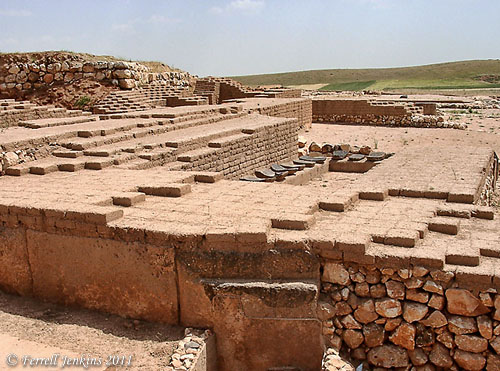
The first photo shows the reconstruction of the Palace of the Crown Prince (Palace Q or Western Palace). This palace, built of mud brick, is “located in the lower town, west of the Acropolis.” In the portion of the palace shown here you will see “a well preserved room, used for the grinding of cereals, in order to prepare bread for hundreds of persons.”
Ebla Western Palace Reconstruction. Photo by Ferrell Jenkins.

Ebla Western Palace Reconstruction. Note the grinding stones. Photo by Ferrell Jenkins.

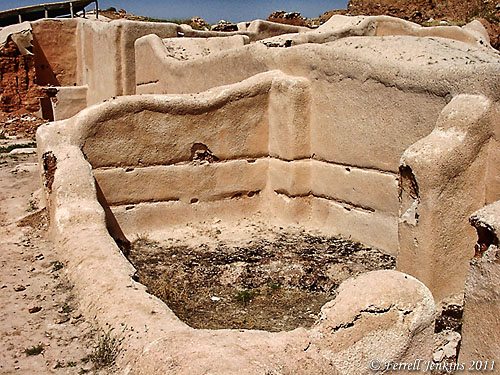
The Royal Archives. In 1975 the excavators discovered a square room west of the Administrative Wing, on the wall, filled with 17,000 clay tablets. The large square tablets had been on shelves. The small round one were found in baskets on the floor.

… the texts were placed according to their subject, and different subjects corresponded to different shapes of tablet.

… There are administrative, economical, historical, judicial, religious texts. The writing is cuneiform. The language is a local language, now called by scholars (Eblaite), which belongs to the same family as Akkadian of Mesopotamia.
Ebla Archives Room. Photo by Ferrell Jenkins.

Ebla Archives Room. Photo by Ferrell Jenkins.

The Western Palace and the Archive are dated to the first golden age of Ebla, 2400–2250 B.C. This is long before the time of Abraham who lived north of Ebla at Haran in Padan Aram for a time. Haran is about 150 miles north of Ebla.

So Abram went, as the LORD had told him, and Lot went with him. Abram was seventy-five years old when he departed from Haran.  (Genesis 12:4 ESV)

Isaac took Rebekah, the daughter of Bethuel the Aramean of Paddan-aram to be his wife (Genesis 25:20). Jacob spent more than two decades in the same area. Most of the children of Jacob (= Israel) were born in the region.

God appeared to Jacob again, when he came from Paddan-aram, and blessed him. (Genesis 35:9 ESV)

When did Abraham live? I don’t want to begin a fight, but I will note several dates suggested by scholars for Abraham.

  • Between 2000 and 1700 B.C. A large number of scholars such as Glueck, Albright, and Wright took this position.
  • 14th Century B.C. This was the view of Cyrus Gordon. (Too late for me.)
  • Born 2165 B.C. The view of John Davis in his excellent book, Paradise to Prison. Davis understands Galatians 3:17 to begin with the arrival of Abraham in Egypt.
  • Born 1950 B.C. This view says Galatians 3:17 is dated from the entrance to Canaan (Genesis 12:4). My inclinations are here.

Now you have something to work on. My only point here is to show that Ebla was a powerful, thriving, economic power long before Abraham. Ebla flourished again in Middle Bronze I-II (1850-1600 B.C.). It is possible that Isaac and Jacob knew of the city.
Fields white for harvest

Many biblical accounts contain information not easily understood without some knowledge of the history and culture of the time. Such is true in the account of Jesus traveling through Samaria in John 4. You probably recall that He met the woman of Samaria when she came to the well to draw water.

While His disciples were in the city buying food Jesus taught the Samaritan woman. She then went into the city and began to tell the men that she had met this man who knew her intimate life.

When the disciples returned to Jesus He said,

Do you not say, ‘There are yet four months, then comes the harvest’? Look, I tell you, lift up your eyes, and see that the fields are white for harvest. (John 4:35 ESV)

This is one of those statements with a literal meaning as well as a spiritual one. What did he mean by four months? Four months separate the sowing and the harvesting. Barley harvest could begin around April 15. Wheat harvesting begins six weeks later in late May or early June. In May the fields would be white unto harvest. This helps to date the episode in John 4 to December or January, depending on whether the crop was barley or wheat.

When Jesus said the fields were white for harvest He was speaking of a spiritual harvest. The disciples did not know that He and the woman had already sowed the seed. They would reap the harvest. It is not inappropriate to see the harvesting in the two days Jesus stayed there teaching (John 4:39-43), or in the later events of Acts 8:39-43.

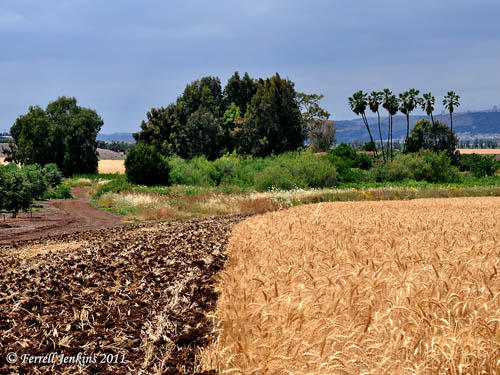
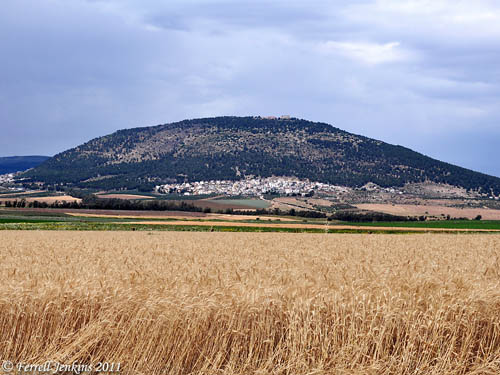
The photo below was made from En-Dor, looking north to Mount Tabor. The wheat fields are almost ready for harvesting.

Wheat ready for harvest at En-Dor near Mount Tabor. Photo by Ferrell Jenkins.

Wheat ready for harvest at En-Dor near Mount Tabor. Photo by Ferrell Jenkins.

Under some light the fields even have a white appearance, as you see in the photo below.

Wheat ready for harvest near En-Dor and Mount Tabor. May 13. Photo by Ferrell Jenkins.

Wheat white for harvest. May 13. Photo by Ferrell Jenkins.

These little tips, scattered here and there in Scripture, reveal much about the daily life and culture of Bible times.

The khamsin (hamsin) before and after

Yesterday we wrote about the effect of the east wind on Larry’s hike along the Jesus Trail. Here is a brief followup that should be helpful.

Dr. Carl G. Rasmussen, author of Zondervan Atlas of the Bible, also maintains the Holy Land Photos website. He has a series of photos showing the effect of the khamsin (which he spells without the silent k, as hamsin), and the same view with normal visibility. To see these fascinating photos, with additional descriptive info, click here.

Carl now has 3230 photos of 322 biblical sites available on his website. The photos are available for free download in various sizes. Perhaps the most helpful feature to teachers and preachers is that they are available PowerPoint ready. He also discusses “The Transitional Seasons”, with the same beautiful photos, in the Zondervan Atlas of the Bible (rev. ed.) pages 30-31.

Click Zondervan Atlas of the Bible to order this book for $25.20 (free shipping). This is a savings of 37%.

New difficulties on the “Jesus Trail”

We have reported about Larry’s hiking on the “Jesus Trail” from Nazareth to Bethsaida. Larry’s last post was at the end of Day 3. On his trek from Moshav Arbel eastward he encountered a new problem — the strong East winds.

Almost everyone who has visited Israel has learned of the West winds that make their way through the depressions around the Sea of Galilee and create storms on the Sea. Unless you travel in the “transitional season” or in the (dry) summer season you may not have learned about the East wind. This wind is called the sirocco. In Egypt it is known as the khamsin, and in Israel as the sharav.

Denis Baly, The Geography of the Bible (1974 ed., pp. 51-53), explains these winds. He says they occur in the transitional seasons from early April to mid-June (that is now), and from mid-September to the end of October. Baly says,

It is this intense dryness and the fine dust in the air which are so exhausting, for other hot days, though troublesome, do not have the same effect. People with a heart condition, nervous complaints, or sinus trouble are particularly affected, but even the mildest-tempered person is apt to become irritable and to snap at other people for no apparent reason. Tourists find the sirocco especially frustrating, for not only does travel become fatiguing, but the fine yellowish dust which fills the air drains it of all color, blots out all but the immediate vicinity, and makes photography a mockery.

Here is how Larry described his day in an Email to me overnight.

No blog last night because of the storm. I woke to high winds from the east which dusted up the air so badly that photos were mostly useless. Worst part was that it was directly against me and really HOT. Pushing against 20+ mph winds really took the steam out of me. By the end of the day I was utterly exhausted.  Drank my full 3 litres and had good dinners and breakfasts, but energy levels are still very low.

The photo below is one of the aerial shots we made a week ago. It was made while flying over the west shore of the Sea of Galilee, with the view to the west. You can see Mount Arbel and the Wadi Hamam below. The Via Maris runs in this valley which is also called the Valley of the Doves. You will notice two lines of mountains further west.

I am rather sure that this is the route Larry was walking yesterday. Larry has lived in Washington state for many years. I think he is not bothered by the sudden rains, but the intense heat and strong wind from the east may be another matter. I want you to think about the fact that all of the biblical characters from the Patriarchs to Jesus and His disciples encountered conditions similar to these (and worse).

Aerial view of Arbel and the Via Maris. Photo by Ferrell Jenkins.

Aerial view of Arbel, Wadi Hamam, and the Via Maris. Photo by Ferrell Jenkins.

Baly cites several biblical references to the east and south winds that bring in the hot air and the dust storms. He says, “Where the mountains come close to the sea a strong sirocco pours down the slopes like a flood, at 60 miles an hour or more, stirring the sea into a fury.”

By the east wind you shattered the ships of Tarshish. (Psalm 48:7 ESV)

In the prophecy against Tyre, Ezekiel says,

“Your rowers have brought you out into the high seas. The east wind has wrecked you in the heart of the seas. (Ezekiel 27:26 ESV)

Notice Elihu’s comments to Job about the south wind.

Do you know the balancings of the clouds, the wondrous works of him who is perfect in knowledge,  you whose garments are hot when the earth is still because of the south wind?  (Job 37:16-17 ESV)

Jesus also observed the effect of the south wind:

And when you see the south wind blowing, you say, ‘There will be scorching heat,’ and it happens. (Luke 12:55 ESV)

Do you remember Jonah’s problems after enjoying the shade of his plant?

When the sun rose, God appointed a scorching east wind, and the sun beat down on the head of Jonah so that he was faint. And he asked that he might die and said, “It is better for me to die than to live.” (Jonah 4:8 ESV)

Baly calls attention to the effect of the spring siroccos on the crops.

The spring siroccos destroy the winter grass and may damage the crops if they come too soon, and hence they appear constantly in the Bible as a symbol of the impermanence of riches or of human life.

Note these additional references in your own study: Psalm 103:16; Isaiah 40:6-8; Hosea 13:15; Ezekiel 17:10; James 1:11.

When Larry goes back on line I am sure his vivid descriptions of his experience will be well worth reading. Here is the link.

Update: Larry is back in Jerusalem Wednesday evening.

Saul visited a medium at En-Dor (Endor)

En-Dor (or Endor) is a fairly insignificant site. It is now located in the middle of wheat fields and groves. I had seen it from the road, but this time I was able in a car to drive to it and get some better photos. This one shows the low tel, and a wheat field ready for harvest. The view is to the north. Mount Tabor dominates the scene to the right, but it is not visible in this photo. One has to go with the light in making photos.

En-Dor on the shoulder of the Hill of Moreh. Photo by Ferrell Jenkins.

En-Dor on the shoulder of the Hill of Moreh. Photo by Ferrell Jenkins.

Shards of pottery are visible all around, especially in the low areas of the farm road as well as in the plowed field. This is a certain indication of an ancient inhabited site.

Pottery shards at En-Dor. Photo by Ferrell Jenkins.

Pottery shards at En-Dor. Photo by Ferrell Jenkins.

En-Dor was located in the territory of Issachar, but was allotted to the half tribe of Manasseh that settled on the west bank of the Jordan (Joshua 17:11).

The most significant biblical event recorded in connection with En-Dor is the visit of  King Saul to the medium of En-Dor.

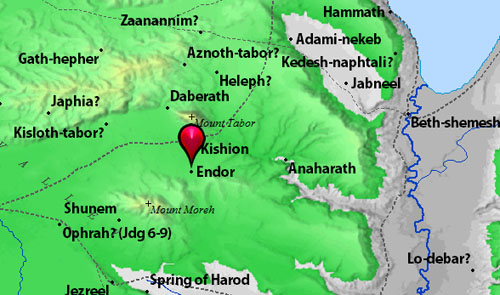
The Israelites were gathered with Saul on Mount Gilboa. When Saul saw the Philistines gathered against him in the valley below he was afraid and sought out a medium or necromancer, even though earlier he had them removed from the land. This medium lived over the Hill of Moreh on the northern slopes at En-Dor. This tel is located about 2½ miles south of Mount Tabor on the south and east side of Highway 65. It is easily discernible by the palm trees growing there.

Then Saul said to his servants, “Seek out for me a woman who is a medium, that I may go to her and inquire of her.” And his servants said to him, “Behold, there is a medium at En-dor.” (1 Samuel 28:7 ESV)

Map showing location of En-Dor. Courtesy of BibleAtlas.org.

Map showing location of En-Dor. Courtesy of BibleAtlas.org.

Following Larry on the “Jesus Trail”

Last week Larry and I spent the week traveling here and there in Israel to many places not easily accessible to a tour group. Friday afternoon I dropped Larry in Nazareth where he would spent the night and begin the next morning walking the five-day jaunt on the Jesus Trail from Nazareth to Capernaum and Bethsaida.

He tells about the beginning in Nazareth here. He reports on finding the Roman Road earlier on Friday, May 13 here.

The events of Saturday, May 14, from Nazareth through Sepphoris (Zippori) to Cana of Galilee, is recorded here.

Day 2 (May 15) of the journey from Cana (Kefr Kanna) of Galilee to Ilaniya is recounted here. He includes photos of flowers and butterflies that he saw along the way, and records his encounter with three vicious-appearing sheep dogs.

By the time you look at these blogs you will be ready to continue following the rest of the journey without any notification from me.

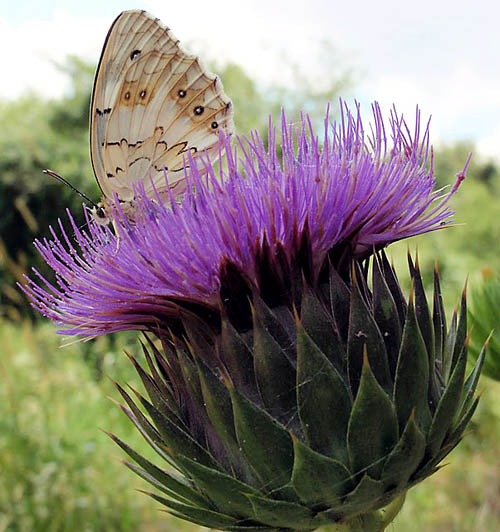
I am taking the liberty to include two of Larry’s many photos to entice you to take a look at his blog. The first shows one of the beautiful butterflies on a thistle bloom. There are several varieties of thistles (or briers) mentioned in the Bible. (If I am wrong about this, I know one of our readers who will send the correct information.)

Butterfly on a thistle bloom. Photo © Larry Haverstock.

Butterfly on a thistle bloom. Photo © Larry Haverstock.

This is where Larry spent the second night of his “Third Journey.”

Accommodation on the Jesus Trail - Night 2. Photo © Larry Haverstock.

Accommodation on the Jesus Trail - Night 2. Photo © Larry Haverstock.

No matter how “primitive” our accommodations may be, we are reminded of Jesus’ statement about his own situation on earth:

Jesus said to him, “The foxes have holes and the birds of the air have nests, but the Son of Man has nowhere to lay His head.” (Matthew 8:20 NAU)

Here is a self-photo of Ferrell (l) and Larry (r) on the Roman Road near Golani Junction.

Ferrell Jenkins & Larry Haverstock on Roman Road at Golani Jct.

Ferrell Jenkins & Larry Haverstock on Roman Road at Golani Jct.

For better photos of the Road see Larry’s blog (linked above) or this blog, here.


Safe arrival home

John Howard Payne (1791-1852) said it well, if not best, in “Home, Sweet Home.”

Mid pleasures and palaces though we may roam,
Be it ever so humble, there’s no place like home;
A charm from the sky seems to hallow us there,
Which, seek through the world, is ne’er met with elsewhere.
Home, home, sweet, sweet home!
There’s no place like home, oh, there’s no place like home!

I arrived on time this morning in Atlanta  non-stop from Tel Aviv after almost 13 hours. After clearing customs and the USA security I waited for my flight to Tampa. It was a little strange going through security in Atlanta and watching how the agents acted. I don’t recall hearing anyone in Israel yelling at the passengers or being rude to them. Neither belts not shoes had to be removed in Tel Aviv.

Waiting at Tampa International for my wife to meet me. I did not intend to be traveling on Sunday, but got mixed up on the 11:20 p.m. flight and the 12:05 a.m. flight. By the time I discovered it I did not have opportunity to make the change. I got an extra day in Israel to rest a little before departure.

Now I have to sort the nearly 4700 hi-res digital photos I made. Half of those were made in three hours on the flight over Galilee.

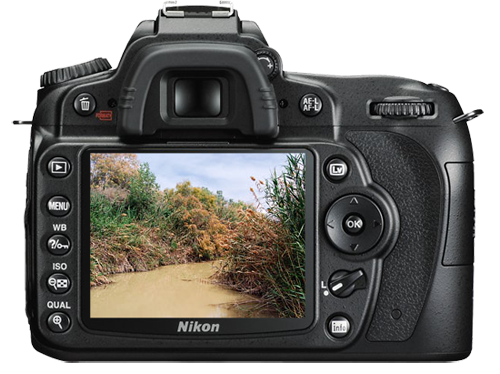
Nikon D90 showing photo of the Jordan River. Photo by Ferrell Jenkins.

My Nikon D90 showing photo of the Jordan River.

Several requests for info on a variety of subjects went unanswered. If you don’t receive a reply within a week or two please write again. To paraphrase the statement of Jesus about the evil or trouble of each day, “Sufficient unto the day are the Emails thereof.” 🙂

Take therefore no thought for the morrow: for the morrow shall take thought for the things of itself. Sufficient unto the day is the evil thereof. (Matthew 6:34 KJV)

“So do not worry about tomorrow; for tomorrow will care for itself. Each day has enough trouble of its own. (Matthew 6:34 NAU)

Thanks for following this recent trip. Hopefully we can continue to share important biblical information with you on a regular basis.

I learned by Email this morning that Larry completed his first day of the Jesus Trail o.k.

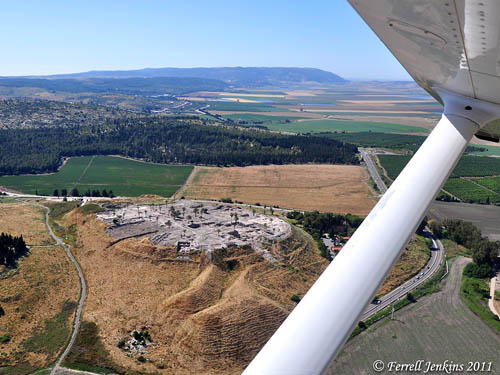
Aerial view of Megiddo

It is the Sabbath here in Israel and rather quiet. Israeli families fill the hotels on Friday night and do not leave until the afternoon of the Shabat. Some do not leave until sunset. Of course, there are many who are out hiking and engaging in other non-religious activities.

For this quiet day I wanted to share another of the aerial photos I made earlier in the week. In the photo below Megiddo looks like the model displayed in the tiny visitor’s center at the site. In the distance to the southwest we see Mount Carmel. A small portion of the Jezreel Valley (or Esdraelon) is also in view.

Aerial view of Megiddo and Mount Carmel. Photo by Ferrell Jenkins.

Aerial view of Megiddo and Mount Carmel. Photo by Ferrell Jenkins.

Notice just two of the significant biblical references to Megiddo.

And this is the account of the forced labor that King Solomon drafted to build the house of the LORD and his own house and the Millo and the wall of Jerusalem and Hazor and Megiddo and Gezer.  (1 Kings 9:15 ESV)

In his days Pharaoh Neco king of Egypt went up to the king of Assyria to the river Euphrates. King Josiah went to meet him, and Pharaoh Neco killed him at Megiddo, as soon as he saw him. (2 Kings 23:29 ESV)

A Roman Road in Galilee

Larry Haverstock was part of our tour group in 2010 and again in 2011. He and I have been traveling in Israel for the past week. He divides his time here this year into three journeys. The two week tour was the first journey.The past week was his second journey, and the next week will be his third journey. The third journey he will be all alone to walk the Jesus Trail from Nazareth to Bethsaida. This is a five day trek.

On our way from Tiberias to Nazareth, with several other stops here and there, we stopped at the area near Golani Junction to locate the stretch of Roman road that is part of the Jesus Trail. While we were looking for the road a strong rain came. We fled to the nearby McDonald’s and then decided that the trail would be too slick to return. Later in the day we returned and found the road without difficulty.

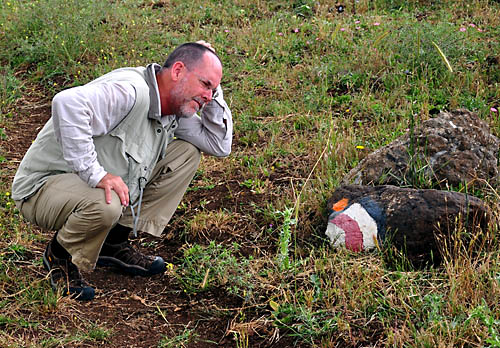
In this photo Larry pretends that he does not understand the trail markings. I would say he is well prepared in every way.

Larry tries to figure out the traill markings. Photo by Ferrell Jenkins.

Larry tries to figure out the trail markings. Photo by Ferrell Jenkins.

Since ordering Hiking the Jesus Trail and Other Biblical Walks in the Galilee I have wanted to see the Roman road which is part of the Trail between Cana and Capernaum.

The Jesus Trail web site describes the Roman road:

About 100 m past Golani Junction, you will come to a ridge with the remains of an ancient Roman road that linked Acre and Tiberias.  Jesus likely used this road on his journey from Nazareht to the Sea of Galilee, as it was a major east-west thoroughfare during his time.

Exquisite roads were one of the hallmarks of the Roman Empire.  the Romans were the first to create a comprehensive system of paved roads over such a large territory.  The roads served the primary purpose of supporting military and trade development.  The road networks also facilitated the movement of ideas and technology and allowed foods, fashions and other cultural artifacts to spread. As the Internet became the “information superhighway” of the 21st century, so were Roman roads at the time of the Roman empire.

The info in the guidebook is similar. This is just an excerpt.

Here is one of the photos I made this afternoon. The view is east toward the Sea of Galilee.

Roman Road near Golani Junction. Photo by Ferrell Jenkins.

Roman Road near Golani Junction. Photo by Ferrell Jenkins.

Information about the Jesus Trail is available from the web site here. Info on ordering the attractive guidebook for $24.95 (postpaid many places) is available here.

In the late afternoon I dropped Larry in Nazareth about 2 blocks from where he would check in and stay for the night. After a soft drink at Tishreen restaurant near Mary’s Well we said good bye to each other. That was as close as I could get to his overnight hotel in the car. Tomorrow Larry will hike from Nazareth to Sepphoris (Zippori) and then to Cana. I understand that the hiking time for that portion of the trip takes six hours.

Hopefully we will have some reports from along the way.

In the parable of the great dinner Jesus said,

And the master said to the servant, ‘Go out to the highways and hedges and compel people to come in, that my house may be filled. (Luke 14:23 ESV)

He also speaks of being forced (by Roman soldiers?) to go a mile.

And if anyone forces you to go one mile, go with him two miles. (Matthew 5:41 ESV)

Tabgha on the Sea of Galilee

Sacred Destinations describes Tabgha in these words:

Tabgha (also spelled Tabhka) is not a city, but a small area on the northwest shore of the Sea of Galilee, not far from Capernaum. In ancient times, Tabgha was known as Heptapegon – “Place of the Seven Springs.” These seven springs produce warm water, which increases the production of algae in this part of the lake, which attracts more fish. Fisherman have thus flocked to Heptapegon for thousands of years.

By the 4th century AD, Heptapegon had become a popular place for Byzantine pilgrims to rest and have their picnics, thanks to its shady trees and excellent fishing. It is probably not coincidence that two of the three pilgrimage destinations in this relate to abundant food: the miracle of the loaves and fishes during Jesus’ Galilean ministry and a lakeside fish breakfast after Jesus’ resurrection.

For more information read here. Sacred Destination is a nice site to use in locating brief info about biblical sites in Israel and other countries.

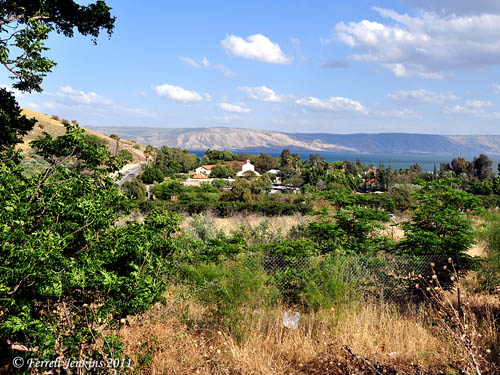
Today we spent some time again in the Hula Valley. This time on the ground instead of in the air. As we returned to Tiberias we noted that the air around the Sea of Galilee had cleared considerably since this morning. A wonderful scene presented itself as we approached Tabgha.

The view in our photo shows the church at Tabgha from the North West. Look carefully and you will see the Northeastern portion of the Sea of Galilee, the shore, and the biblical area known as Bashan. In New Testament times the region was known as the land of the Gerasenes.

Then they sailed to the country of the Gerasenes, which is opposite Galilee. (Luke 8:26 ESV)

Then all the people of the surrounding country of the Gerasenes asked him to depart from them, for they were seized with great fear. So he got into the boat and returned. (Luke 8:37 ESV)

Tabgha on the NW corner of Sea of Galilee. Photo by Ferrell Jenkins.

Tabgha on the NW corner of Sea of Galilee. Photo by Ferrell Jenkins.