Category Archives: Bible Places

Sunset at Hierapolis

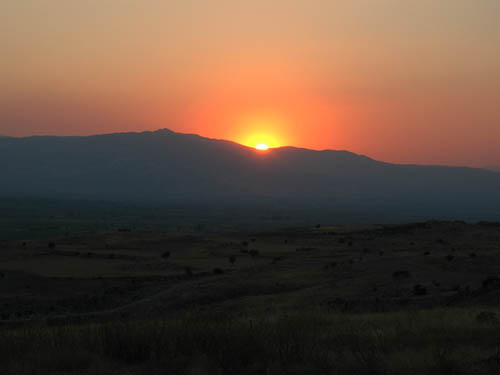
This is a sunset view I made at Pamukkale (biblical Hierapolis; Colossians 4:13). Hierapolis is famous for hot mineral springs and terraced travertine formations. It is now a World Heritage site.

For I bear him witness that he [Epaphras] has worked hard for you and for those in Laodicea and in Hierapolis. (Colossians 4:13 ESV)

Sunset at Hierapolis in the Lycus River Valley. Photo by Ferrell Jenkins.

Sunset at Hierapolis in the Lycus River Valley. Photo by Ferrell Jenkins.

Move evidence of Babylonian-Egyptian contacts

Austrian Times reports here on the discovery of a Babylonian seal impression at Tell el-Dab’a in Egypt.

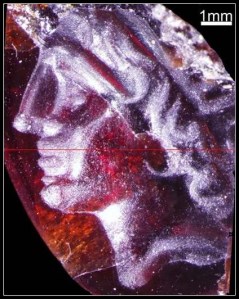
Austrian archaeologists have found a Babylonian seal in Egypt that confirms contact between the Babylonians and the Hyksos during the second millennium B.C.

Irene Forstner-Müller, the head of the Austrian Archaeological Institute’s (ÖAI) branch office in Cairo, said today (Thurs) the find had occurred at the site of the ancient town of Avaris near what is today the city of Tell el-Dab’a in the eastern Nile delta.

The Hyksos conquered Egypt and reigned there from 1640 to 1530 B.C.

She said a recently-discovered cuneiform tablet had led archaeologists to suspect there had been contact between the Babylonians and the Hyksos.

Forstner-Müller added that Manfred Bietak had begun archaeological research on the period of Hyksos dominance at the remains of a Hyksos palace at Avaris in 1966.
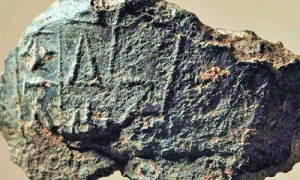
Babylonian seal impression.

Babylonian seal impression.

Earlier in the year we reported on the discovery of a Babylonian tablet at Tell el-Dab’a here.

The report  says the Austrian plan to build a museum in the area. A more complete report in Die Presse says they also have plans to restore the river. The Pelusiac branch of the Nile once flowed by this ancient site. Below is a photo of the canal which often follows the course of the Pelusiac.
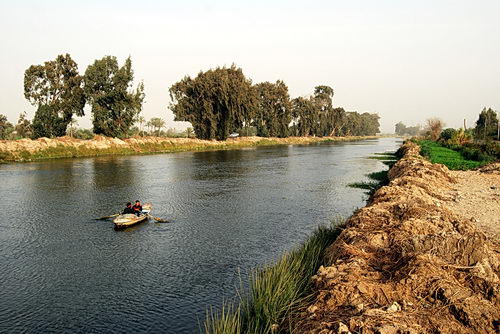
A canal where the Pelusiac branch of the Nile once flowed. Photo by F. Jenkins.Canal along the Pelusiac Branch of the Nile near Tell el-Dab’a. Photo by FJ.

Tell el-Dab’a is in the eastern Nile Delta. In Biblical times it was known as the Land of Goshen, and served as the home of the Israelites.

“Hurry and go up to my father, and say to him, ‘Thus says your son Joseph, “God has made me lord of all Egypt; come down to me, do not delay. “You shall live in the land of Goshen, and you shall be near me, you and your children and your children’s children and your flocks and your herds and all that you have. “There I will also provide for you, for there are still five years of famine to come, and you and your household and all that you have would be impoverished.” (Genesis 45:9-11 NAU)

These new findings might shed some light on the plausibility of Achan finding a garment from Shinar (Babylon) at Jericho (Joshua 7).

HT: Biblical Paths

The Tel Dor Excavation Project

About two months ago we wrote about Tel Dor here. The day before that we noted the discovery of the miniature carving of Alexander the Great here.

Alexander carving from Tel DorAlexander Carving from Tel Dor

Paula Waiman, a PhD student at the University of Haifa, left a comment on the post about the Alexander carving. Her advisor is Dr. Ayelet Gilboa, co-director of the Tel Dor Excavation. I suggested to her that we move up her comment so it would be easier for readers to see.

The exquisite gemstone of Alexander the great that captured your attention, as seen in you website, is only the tip of the iceberg, so to speak, of one of the largest, long lasting and high profile archaeological projects in Israel. If you care about the archaeology of biblical times (Israelites, Phoenicians and Sea People), the Classical periods, and the cultural heritage of Israel and the Mediterranean; and if you are interested in forging a bond between Israel and the international community – please take a moment to look at the attached file [see Tel Dor website for full info]. Like almost cultural projects around the globe, we need your help to endure.

We would be grateful if you could pass this message to any other interested parties.

Tel Dor website: dor.huji.ac.il
Tel Dor has also a facebook wall. You are welcome to visit us.

Prof. Sarah Stroup, University of Washington, has posted some nice photos of the excavation here.

Looking for Libnah

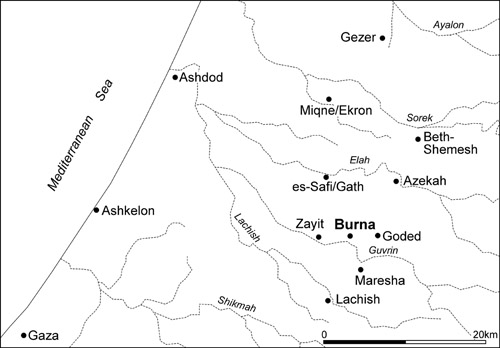
A new blog, called The Tel Burna Excavation Project, has been launched to report on the preliminary survey of Tel Burna. The tel is located in the Shephelah of Israel among such sites as es-Safi/Gath, Zayit, Goded, Mareshah, Azekah and Lachish.

The Shephelah. Map: Tel Burna Excavation Project.

The Shephelah. Map: Tel Burna Excavation Project.

In the case of Tel Burna, with no excavation material available, the problem is even more difficult. despite this, several scholars have suggested identifying the site with Biblical Libnah (although one should note that nearby Tel Zayit is a very likely candidate as well – as Ron Tappy, the excavator there, has recently published).

Libnah was a Canaanite town that was conquered by Joshua who allotted it to the tribe of Judah (Joshua 10:29-30; 15:42). The city was chosen as one of the Levitical cities (Joshua 21:13), which points to its role as a border site. According to 2 Kings 8:22 (and 2 Chronicles 21:10), the city of Libnah was involved in the rebellion against Jehoram the king of Judah (in 9th century BCE) and later, a woman from Libnah married King Josiah in the 7th century BCE (Kings 23:31-32;2 Kings 24:17-18; Jeremiah 22:11).

In any case, even if the site is not Libnah, it is clear for the survey results (which will be mentioned in an upcoming post) that the site was a very important site in the Iron Age, along the border between Judah and the Philistines.

HT: Luke Chandler’s Blog; Aren Maeir.

Israel plans major excavation at Western Wall

Israel National News reports, in an article by Samuel Sokol, plans to conduct a archaeological dig under the Western Wall in Jerusalem.

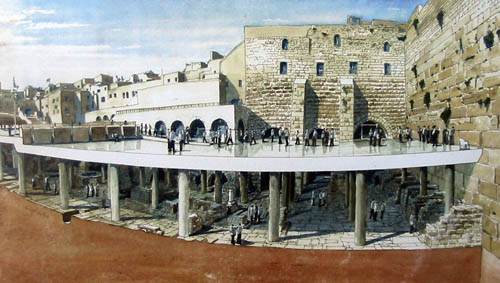
Israel is planning a major archaeological dig under the Western Wall (Kotel) plaza, opposite the Temple Mount, officials announced Thursday. The excavations will create an archaeological park directly underneath the area where worshippers currently stand while praying at the Kotel.

The current prayer area will remain open, supported by pillars, while a new area will be added underneath, at the level at which worshippers at the ancient Temple stood in the past.

The complete article may be read here, and another here from The Jerusalem Post.

This drawing shows the planned part underneath the present pavement at the Western Wall.

Proposed Western Wall archaeological park. Photo: Antiquities Authority.

Proposed Western Wall archaeological park. Photo: Antiquities Authority.

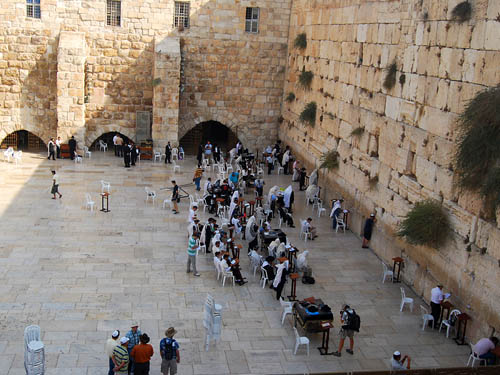
Here is the way this area looks at the present time.

The Western Wall platform. View to north toward Wilson's Arch. Photo by F. Jenkins.

The Western Wall platform. View to north toward Wilson's Arch. Photo by F. Jenkins.

HT: Joseph Lauer

Paul’s burial in Rome

The apostle Peter gets the most attention in Rome, but Paul also has his share of shrines. Paul was taken to Rome in the custody of the Roman Empire (Acts 27-28).

I appeal to Caesar. (Act 25:11)

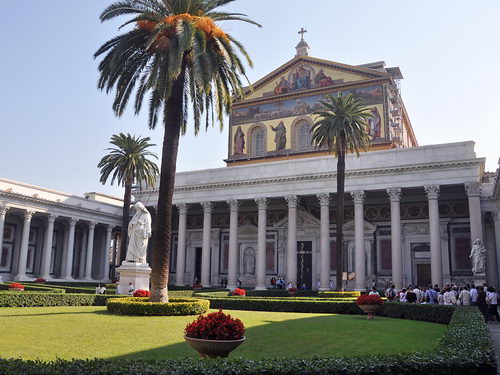
Tradition has it that Paul was buried outside the walls of Rome where we now find the Basilica of St. Paul Outside the Walls.

The basilica of St. Paul Outside the Walls in Rome. Photo by Ferrell Jenkins.

The basilica of St. Paul Outside the Walls in Rome. Photo by Ferrell Jenkins.

The statue in front of the church shows Paul with a drawn sword and a book. The inscription reads PREDICATORI VERITATIS and DOCTORI GENEIUM. Paul was a preacher of truth and a teacher of the Gentiles.

For this I was appointed a preacher and an apostle (I am telling the truth, I am not lying) as a teacher of the Gentiles in faith and truth. (1Timothy 2:7 NAU; see also 2 Timothy 1:11)

Tomb of Caecilia Metella on the Appian Way

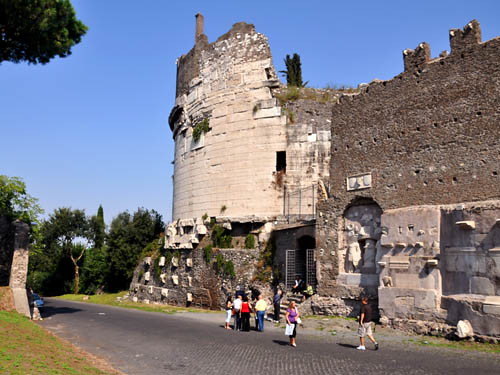
Several ancient structures may be seen along the Appian Way south of Rome. One of the most impressive is the Tomb of Caecilia Metella. The woman for whom this tomb is named was the wife of a certain M. Crassus who shared power in Rome with Julius Caesar and Pompey.

The decorations on the tomb seem to date it to the beginning of the Augustan period (Wycliffe Historical Geography 538). I think we can safely conclude that Paul passed this structure on his way to Rome (Acts 28:13-14).

The Tomb of Caecilia Metella on the Appian Way. Photo by Ferrell Jenkins.

The Tomb of Caecilia Metella on the Appian Way. Photo by Ferrell Jenkins.

Thebes in Bible Prophecy

Luxor was known as Thebes in Old Testament times. Both Jeremiah and Ezekiel prophesied the Lord’s judgment of the city. Jeremiah says,

“The LORD of hosts, the God of Israel, says, ‘Behold, I am going to punish Amon of Thebes, and Pharaoh, and Egypt along with her gods and her kings, even Pharaoh and those who trust in him’” (Jeremiah 46:25; see also Ezekiel 30:14-16)

A visit to the ruined and unoccupied temples of Karnak and Luxor, where Amon (or Amun) was worshiped as a great god, illustrates the fulfillment of this prophecy. Shortly after the time of Jeremiah (c. 586 BC), Egypt and Thebes began to decline as a world power.

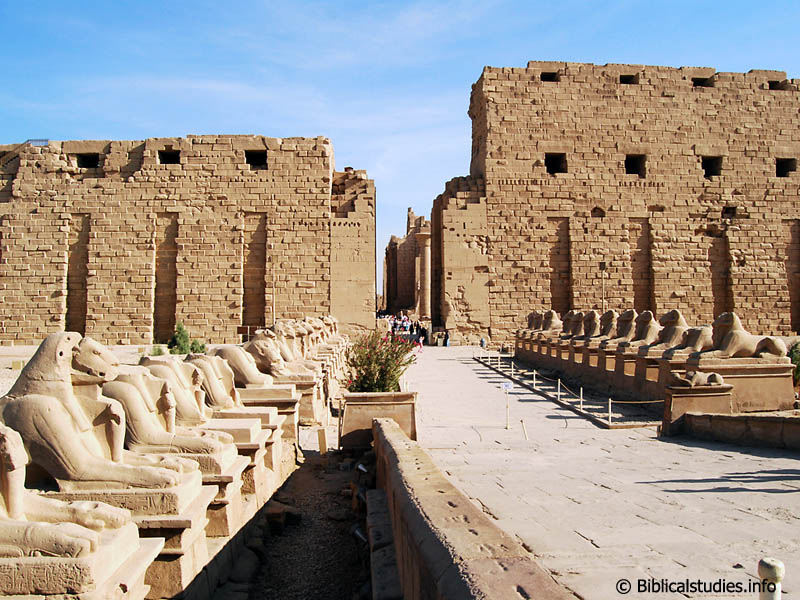
This photo of the avenue of the ram-headed sphinxes leads to the first pylon of the great temple of the god Amon (or Amun). The first pylon was the last part of the temple constructed (about 700 BC) and remains unfinished. This photo is large enough to be used in teaching presentations. Click on the photo for a larger image. I hope you will enjoy using it.

The avenue of ram-headed sphinxes and the first pylon at Karnak. Photo by Ferrell Jenkins.

The avenue of ram-headed sphinxes and the first pylon of the great temple of Amun at Karnak. Photo by Ferrell Jenkins.

In 663 BC the Assyrian king Ashurbanipal had already conquered Thebes (Hebrew, No Amon). The prophet Nahum, in prophesying the fall of Nineveh, calls attention to this event (3:8ff.).

Visiting the Bible Lands with Mother

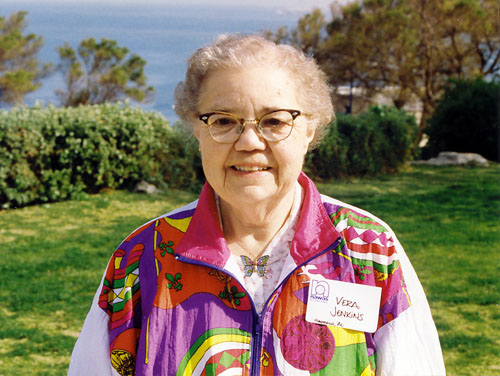
I regretted that my Father never was able to visit the Bible lands with me, but Mother made two trips. The first in 1980, a year after my father died, and the second in 1993. I enjoyed having her as part of the group. She could walk faster and longer than anyone in the group, I think.

Vera Jenkins at Joppa in 1993. Photo by Ferrell Jenkins.

Vera Jenkins at Joppa in 1993. Photo by Ferrell Jenkins.

This has been one of my favorite pictures of Mother. I made it at ancient Joppa in Israel, March 13, 1993, with the Great Sea in the background.

The Arch of Constantine

The Arch of Constantine was dedicated to the Emperor by the Senate and the People of Rome in A.D. 315. Constantine served as Emperor from A.D. 306 to 337. By the time of Constantine the church had made major departures from the New Testament pattern of church organization. The Emperor attended the Council of Nicea, but allowed the eastern bishops to preside over the meeting.

Grant comments on the question of Constantine’s conversion:

The question as to whether he was a “genuine” Christian or not depends on somewhat subjective definitions. (Encyclopedia of Early Christianity, 227).

The Arch of Constantine and the Colosseum. Photo by Ferrell Jenkins.

The Arch of Constantine and the Colosseum. Photo by Ferrell Jenkins.

Helena, the mother of Constantine, was responsible for the construction of many of the well-known churches of the Holy Land. Rosenberg says,

Her role in church history was due to her partnership in Constantine’s program of church building at Bethlehem and Jerusalem and to her discovery of what she believed to be the true cross, both of which led to the revival of Jerusalem and the encouragement of pilgrimage to the Holy Land. (Encyclopedia of Early Christianity 417).