Category Archives: Archaeology

Colonial archaeologists and the Ishtar Gate

Recently we called attention to an article in The New York Times about Babylon. Writer Steven Lee Myers says,

Colonial archaeologists packed off its treasures to Europe a century ago.

This statement seemed significant enough to be repeated under the photo of the miniaturized Ishtar Gate at the site. My immediate reaction to the statement is, “Well, aren’t we glad!” Anyone who has visited the Pergamum Museum in Berlin has seen the reconstructed Ishtar Gate. It looks like this.
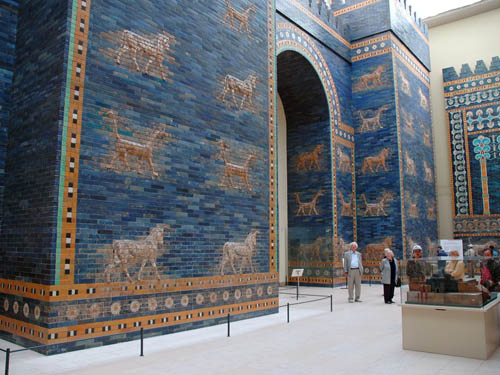
Ishtar Gate in the Pergamum Museum of Berlin. Photo by Ferrell Jenkins.

Ishtar Gate in the Pergamum Museum of Berlin. Photo by Ferrell Jenkins.

Now, it’s not that the German archaeologists, under the direction of Robert Koldewey, “packed off” what you see here. All of these lions, bulls, and dragons were excavated from the mound of ancient Babylon between 1899 and 1912. Eventually they were taken to Berlin in 1926. Even under the Communist government of East Germany this gate was preserved. I saw it a few times before the Berlin Wall came down. Anyone able to travel to Berlin may see the Ishtar Gate as well as the reconstructed Procession Street. Can one say as much for the ruins of Babylon and the museum in Baghdad?

Babylon was once the greatest city of the world when the Neo-Babylonian Empire reigned supreme in the Ancient Near East (626-539 B.C.). The prophet Daniel was active in Babylon from 605 B.C. until after the fall of the city to the Persians (Daniel).  I can not imagine that he failed to see this gate.

Nebuchadnezzar was a megalomaniac. His pride is evident in the statement recorded by the prophet Daniel.

The king uttered these words: “Is this not the great Babylon that I have built for a royal residence by my own mighty strength and for my majestic honor?” (Daniel 4:30 NET Bible)
Babylon ruins reopen to tourists

The New York Times recently carried an article about the reopening of Babylon to tourists. Most of the attention is given to locals getting a chance to see Saddam Husein’s former palace built to overlook the ruins of the ancient city. Some of the photos are nice. (HT: Todd Bolen, BiblePlaces Blog)

Here is an article I published in Biblical Insights several years back.

– – – – – –

The site of Babylon is located about 55 miles southwest of Baghdad near Hillah in Iraq. The city was located on the River Euphrates, but is now a few miles east of the river on one of the canals. The rivers of Mesopotamia have frequently changed their course.

The earliest ancient name for Babylon, given in the table of nations, was Babel (Gen. 10:10). Babylon was ruled by Hammurabi, best known for his law code, in the 18th century B.C.

The city reached its peak during the Neo-Babylonian empire (626-539 B.C.). The Bible refers to Babylon as “the beauty of kingdoms, the glory of the Chaldeans’ pride” (Isaiah 13:19).

The greatest king of the Neo-Babylonian empire was Nebuchadnezzar (605-562 B.C.). There is abundant evidence of the activities of his reign. The best collections of artifacts are to be found in the British Museum in London and the Museum of the Near East (part of the Pergamon Museum) in Berlin. In Berlin one may see the reconstructed Procession Street, the Ishtar Gate, and the decorated facade of the Throne Room of Nebuchadnezzar from Babylon.

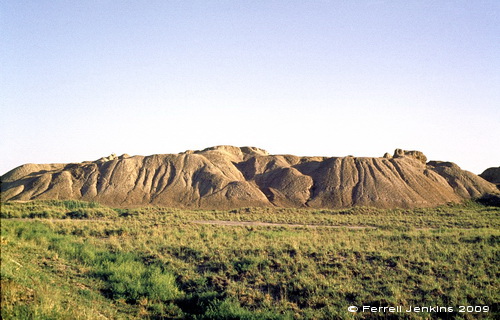
The photo below shows my first view of the site of ancient Babylon in 1970. Jeremiah 51:37 provides a wonderful caption: “And Babylon will become a heap of ruins.”

My first view of Babylon in 1970. Photo by Ferrell Jenkins.

My first view of Babylon in 1970. Photo by Ferrell Jenkins.

The kingdom of Judea had much contact with the Babylonians. Daniel was in the first group of Judean royal youths taken into Babylonian exile in 605 B.C., and was educated in the literature and language of Babylon (Daniel 1:1-6). Jerusalem fell to Nebuchadnezzar’s army March 15/16, 597 B.C. At that time Jehoiachin and 10,000 captives were taken as prisoners to Babylon (2 Kings 24:8-16). The prophet Ezekiel was among that group of captives. His prophetic call came in the fifth year of his exile by the river Chebar, a tributary of the Euphrates (Ezekiel 1:1-3).

The Judean captives remained in Babylon until the time of the Medes and Persians (Jeremiah 25:11-12). Cyrus, according to a clay cylinder now in the British Museum, allowed captives to return to their home land, build their temples and serve their own gods. This is in harmony with the biblical account in 2 Chronicles 36 and Ezra 1.

Excavations were conducted at Babylon by German archaeologists between 1899 and 1917. Discoveries included the main palace of Nebuchadnezzar, the procession street, some temples, and the Ishtar gate. The most fabulous of the items to be found have been reconstructed in the Museum of the Near East in Berlin. I have been able to visit Babylon only once in 1970.

Shebna – Presumptuous Steward

The May/June issue of Biblical Archaeology Review carries an article by Robert Deutsch about how an artifact bought on the antiquities market helped to solve a 42-year-old excavation puzzle.

Back in 1870 Charles Clermont-Ganneau excavated a tomb on a cliff overlooking the Kidron Valley in Silwan, but he was unable to read the inscription over the tomb. He cut the inscription from the rock and sent it to the British Museum.

In 1953 Nahman Avigad translated the inscription:

This is [the sepulcher of…] -yahu who is over the house. There is no silver and gold here but [his bones] and the bones of his slave-wife with him. Cursed be the man who will open this.

Numerous scholars have identified this Shebna with the person by the same name who was the secretary and head steward of King Hezekiah. This was the view taken by Avigad in 1953.

Inscription from the tomb of Shebna. Photo by Ferrell Jenkins in the British Museum.

Inscription from the tomb of Shebna. Photo by Ferrell Jenkins in the British Museum.

The LORD spoke out against the arrogance of Shebna through the prophet Isaiah.

Thus says the Lord GOD of hosts, “Come, go to this steward, to Shebna, who is over the household, and say to him: What have you to do here, and whom have you here, that you have cut out here a tomb for yourself, you who cut out a tomb on the height and carve a dwelling for yourself in the rock? (Isaiah 22:15-16 ESV)

Avigad says that Shebna’s sepulcher “stands in the midst of the necropolis where persons of rank and high distinction were laid to rest” (Israel Exploration Journal 3 (1953): 152)

Deutsch picks up on this discovery and continues with the saga of a bulla [impression of a seal] found at Lachish in the 1960s. One of the small pieces of clay had the name of Shebnayahu on it. The bulla was broken and the archaeologists were uncertain whether one of the words read son of the king or servant of the king.

Deutsch says,

The puzzle remained unsolved for 42 years. Aharoni has long since passed away. Then in 2007, another bulla stamped with the same seal surfaced on the Jerusalem antiquities market. A simple examination leaves no doubt that it is an impression of the same seal as the Lachish bulla. It, too, is broken off at the right edge. But on this bulla, part of an additional letter to the right of ha-melekh, “the king,” has survived: a dalet! The word before ha-melekh ended in a dalet. The word was eved, “servant.” The seal that made this impression belonged to “the servant of the king”!

You may read Deutsch’s full article with photos and drawings online here.

The Jesus Tomb Unmasked

unmasked_thumbExpedition Bible has produced a high-quality DVD entitled The Jesus Tomb Unmasked. This is an expose of the Discovery Channel “documentary” about the Talpiot Tomb. You remember the claim that this was the tomb of Jesus and his wife Mary. The Jesus Tomb Unmasked may be ordered as a DVD, or watched online free. Information here.

The film features several of the scholars who were quoted in the Discovery Channel film. In this film they say their comments were taken out of context in The Lost Tomb of Jesus.

HT: Todd Bolen, BiblePlaces Blog.

Inscription from time of Kings of Judah

The Israel Antiquities Authority announced the discovery of a fragment of a Hebrew inscription from the period of the Kings of Judah. Here is the complete news release.

In Archaeological Excavations the Israel Antiquities Authority is Conducting at the City of David, in the Walls Around Jerusalem National Park:

A Fragment of a Hebrew Inscription from the Period of the Kings of Judah was Found

A fragment of a limestone plaque bearing several letters of ancient Hebrew script was discovered while sifting soil that was excavated in the vicinity of the Gihon Spring, within the precincts of the “Walls around Jerusalem National Park”. The excavation is being carried out on behalf of the Israel Antiquities Authority, under the direction of Professor Ronny Reich of the University of Haifa and Eli Shukron of the IAA, and is sponsored by the ‘Ir David Foundation.

The stone fragment dates to the eighth century BCE and this is based on the numerous pottery sherds that were discovered together with it, as well as the shape of the Hebrew letters that are engraved in the inscription.

The plaque is broken on all sides. All that remains of the inscription are two lines of writing: In the upper line the last part of a given name is preserved: …]קיה, or as it is transliterated into English …]kiah. Unfortunately the remains of another letter before the kof cannot be discerned. If the letter preceding the kof was a zayin, we could complete the name to read חזקיה, or Hezekiah in English, and perhaps ascribe historical importance to the inscription. On the other hand, there are other first names that were used in Judah and Jerusalem at that time that could be mentioned here such as Hilkia, Amekiya, etc.

In the second line are the remains of two words. Here too, is a suffix of a word: …]כה, or as it is transliterated into English …]ka. Here we have several possibilities for completing the word such as: בְּרָכָה, or birqa, that is, a greeting expressing best wishes (a possible ending for some sort of commemorative inscription). Another possibility is the word בְּרֵכָה, or brecha, meaning water reservoir. The reconstruction of this word is possible based on the fact that Brechat HaShiloah, or the Shiloah Pool in English, is located nearby, and also based on the fact that a pool is mentioned in the famous Shiloah inscription that was discovered close by.

In any event the fact that we are dealing with a stone plaque indicates that this is a commemorative inscription that may have been meant to celebrate some sort of building project.

All that remains is to wait and hope that in time other fragments of the inscription will be found.

The IAA news release is available here. Below is a photo of the inscription.

Inscription from Kingdom of Judah.  Photo: Vladimir Naikhin, courtest IAA.

Inscription from time of the Kingdom of Judah. Photo: Vladimir Naikhin, courtest IAA.

According to Thiele’s chronology, Hezekiah was king of Judah from 716/15 to 687/86 B.C. The book of Chronicles mentions his important work of bringing water from the Gihon spring to the west side of the city of David.

It was Hezekiah who stopped the upper outlet of the waters of Gihon and directed them to the west side of the city of David. And Hezekiah prospered in all that he did. (2 Chronicles 32:30; see 2 Kings 20:20 also).

HT: Joe Lauer

Hellenistic pier found at Akko – Ptolemais

A harbor from the Hellenistic period was found at Akko on the Mediterranean coast. Here is a brief description of the discovery provided by the Israel Antiquities Authority.

The part of the floor that has been revealed so far extends for a distance of 15 meters and is 4 meters wide (the full dimensions of the floor have not yet been exposed). The floor was built of rectangular, smoothly dressed kurkar stones that were placed atop a foundation course of roughly hewn kurkar stones arranged next to each other as “headers”. In probes that were conducted beneath the floor, numerous fragments of ceramic jars of Aegean provenance (from Rhodes, Kos and elsewhere) were found that were used to transport wine, as well as tableware and cooking vessels. Among the other artifacts recovered were a Greek style bronze arrowhead and bronze coins that are covered with marine encrustations. A preliminary identification of the finds shows that the floor was constructed in the Hellenistic period (end of the third century until the middle of the second century BCE) as part of a national project.

Akko Crusader wall. Excavated area of Hellenstic Harbor. Photo: Kobi Sharvit, IAA.

Akko Crusader wall. Excavated area of Hellenistic pier. Photo: Kobi Sharvit, IAA.

The photo below shows some of the kurkar stone pavement discovered one meter under the present water level.

The floor from the Hellenistic period. Photo: Kobi Sharvit, IAA.

The floor from the Hellenistic period. Photo: Kobi Sharvit, IAA.

Akko (Acre or Accho) is mentioned in Judges 1:31 as a city of the tribe of Asher. During the late 3rd or early 2nd century B.C. Akko was given the name Ptolemais by Ptolemy I or II of Egypt. Ptolemais is the name we read in the New Testament. Paul and his companions stopped at Ptolemais for one day on the return from his third journey in the Greco-Roman world.

When we had finished the voyage from Tyre, we arrived at Ptolemais, and we greeted the brothers and stayed with them for one day. (Acts 21:7 ESV)

Several things are learned from this text (and context). The previous stop was a few miles north at Tyre where they had stayed for seven days (Acts 21:4-6). After Ptolemais they arrived at Caesarea.

Paul’s companions included all of those “messengers” of the churches who were taking the contributions of the churches of Macedonia and Achaia to the poor among the saints at Jerusalem (Romans 15:25-27; 2 Corinthians 8-9). A list of names is given in Acts 20:4.

A view of the Mediterranean from the Crusader ramparts at Akko. Photo by Ferrell Jenkins.

A view of the Mediterranean from the Crusader ramparts. Photo by Ferrell Jenkins.

The monastery of the Gerasene swine

Stephen G. Rosenberg, senior fellow of the W. F. Albright Institute of Archeological Research in Jerusalem, has an article about the monastery of the Gerasene swine in The Jerusalem Post here. Take a look.

This site, located on a hill above the eastern shore of the Sea of Galilee, marks the traditional site of the miracle of the swine running down the steep cliff into the sea.

When He came to the other side into the country of the Gadarenes, two men who were demon-possessed met Him as they were coming out of the tombs. They were so extremely violent that no one could pass by that way. And they cried out, saying, “What business do we have with each other, Son of God? Have You come here to torment us before the time?” Now there was a herd of many swine feeding at a distance from them. The demons began to entreat Him, saying, “If You are going to cast us out, send us into the herd of swine.” And He said to them, “Go!” And they came out and went into the swine, and the whole herd rushed down the steep bank into the sea and perished in the waters. The herdsmen ran away, and went to the city and reported everything, including what had happened to the demoniacs. And behold, the whole city came out to meet Jesus; and when they saw Him, they implored Him to leave their region. (Matthew 8:28-34 NAS)

The article by Rosenberg points out that this would have been the land of Geshur in Old Testament times. David was married to Maacah, “the daughter of Talmai, king of Geshur” (2 Samuel 3:3). Maacah was the mother of Absalom. The Bible points out that Absalom spent three years in exile after killing Amnon.

Rosenberg says,

Geshur is well-known from the Bible. King David married Maacah, the princess of Geshur, in the early years of his reign. That will have been for political reasons, to ensure a security pact with Geshur, which could shield David from the power of Aram (Syria) to the north, but this lady must have been powerfully beautiful as well. Her two children by David, Tamar and Absalom, are both described as being unusually good-looking. Tamar was “beautiful” and as for Absalom, “there was none in Israel to be so much praised for his beauty.”

Remember that the excavators of et-Tell like to identify it as Old Testament Geshur and New Testament Bethsaida. The sites are not far apart and both belonged in the general region of Geshur.

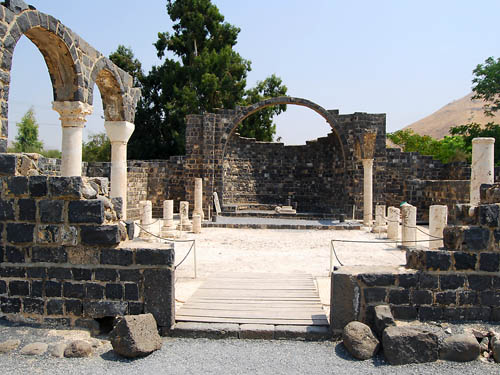
This photo of the basilica, made of black basalt with white limestone columns, was made last August. This site provides a wonderful view west across the Sea of Galilee.

The basilica at Kursi. Photo by Ferrell Jenkins.

The basilica at Kursi. Photo by Ferrell Jenkins.

Murphy-O’Connor says this has been a place of pilgrimage since the fifth century A.D. He suggests the name of the place, Kursi, “is possibly a dialectical deformation” of Chorazin. (The Holy Land).

HT: Joseph I. Lauer

A visit to the Siegfried H. Horn Museum

Andrews University in Berrien Springs, Michigan, has long been associated with archaeological work, especially in Jordan. This work is carried out under the name of the Institute of Archaeology.

The interesting history of the Siegfried H. Horn Museum may be read here. The name of Siegfried H. Horn is well known to anyone who had read about biblical archaeology in modern times.

Last week I was at Valparaiso, Indiana, presenting a series of lessons on Bible History and Archaeology. I had long wanted to visit the Horn Archaeological Museum. When we learned that we were slightly more than an hour away, Mark Russell, Steve Wolfgang and I made the trip one morning. The Museum is hopeful of moving into a new facility as soon as the project can be funded. At this time the small museum is open only on Saturday afternoon, but they will open by appointment, as they did for us.

The Siegfried H. Horn Archaeological Museum houses over 8,500 artifacts, but only a small portion of those are on display. There are replicas of a few famous artifacts such as the Black Obelisk of Shalmannessar II and the Moabite Stone

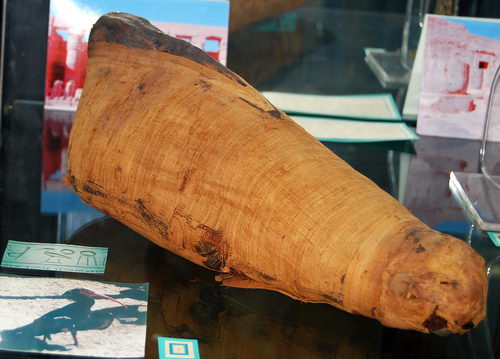
There are significant original pieces from most areas of the Bible world with Mesopotamia and Transjordan being featured. There is a mummified Ibis from Egypt. The Egyptian god Thoth was portrayed with the head of an Ibis. I never see representations of these gods without thinking of Paul’s description of the Roman world prior to the coming of Christ.

Claiming to be wise, they became fools, and exchanged the glory of the immortal God for images resembling mortal man and birds and animals and creeping things. (Romans 1:22-23 ESV)

Mummfied Ibis from Egypt. Photo by Ferrell Jenkins.

Mummified Ibis from Egypt. Photo by Ferrell Jenkins.

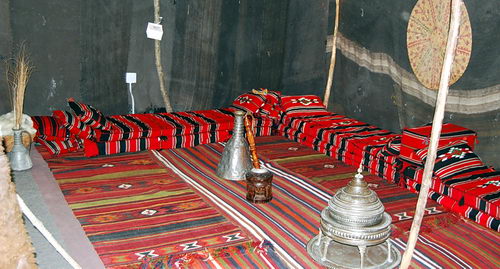
In the main exhibit hall there is a life-size Bedouin tent. This makes a good background for explaining patriarchal life.

Authentic Bedouin Tent at Horn Museum. Photo by Ferrell Jenkins.

Authentic Bedouin Tent at Horn Museum. Photo by Ferrell Jenkins.

By faith Abraham obeyed when he was called to go out to a place that he was to receive as an inheritance. And he went out, not knowing where he was going. By faith he went to live in the land of promise, as in a foreign land, living in tents with Isaac and Jacob, heirs with him of the same promise. For he was looking forward to the city that has foundations, whose designer and builder is God. (Hebrews 11:8-10 ESV)

Two other things should be mentioned. There are some wonderful models. One that impressed me was of the Roman rolling-stone tomb at Heshbon. The murals covering biblical and modern church history are impressive.

I recommend that anyone traveling in the vicinity of Berrien Springs, or those living within driving distance, take advantage of this opportunity to visit. Bible class teachers would do well to become familiar with this Museum and arrange for their students to see it.

Our thanks to Jody Washburn, an Administrative Assistant at the Institute of Archaeology, for her help in making our visit pleasant.

The Oriental Institute

Yesterday I visited the Oriental Institute of the University of Chicago.  When I visit a museum such as this I am not only looking for items with a specific connection to a biblical account, such as the prism which mentions Hezekiah, but also for artifacts that might illustrate daily life in Bible times.

Cooking pots are mentioned several times in the Scripture. One such reference is a sort of proverb.

It is better for a man to hear the rebuke of the wise than to hear the song of fools.  For as the crackling of thorns under a pot, so is the laughter of the fools; this also is vanity. (Ecclesiastes 7:5-6 ESV)

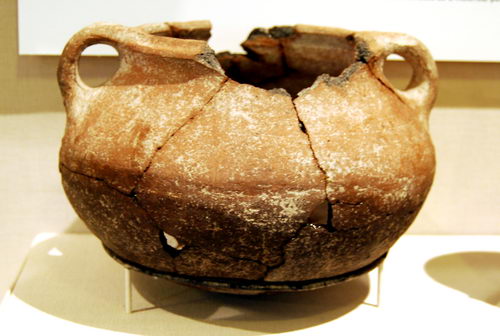
This cooking pot is from Iron IIc at Megiddo (732-600 B.C.).

Cooking pot from Megiddo. OIUC. Photo by Ferrell Jenkins.

Cooking pot from Megiddo. OIUC. Photo by Ferrell Jenkins.

Notice the interesting account from the days of the prophet Elisha.

When Elisha returned to Gilgal, there was a famine in the land. As the sons of the prophets were sitting before him, he said to his servant, “Put on the large pot and boil stew for the sons of the prophets.” Then one went out into the field to gather herbs, and found a wild vine and gathered from it his lap full of wild gourds, and came and sliced them into the pot of stew, for they did not know what they were. So they poured it out for the men to eat. And as they were eating of the stew, they cried out and said, “O man of God, there is death in the pot.” And they were unable to eat. But he said, “Now bring meal.” He threw it into the pot and said, “Pour it out for the people that they may eat.” Then there was no harm in the pot.  (2 Kings 4:38-41 NASB)

One wonders what might have been cooked in that now-broken pot from Megiddo.

The Oriental Institute at the University of Chicago

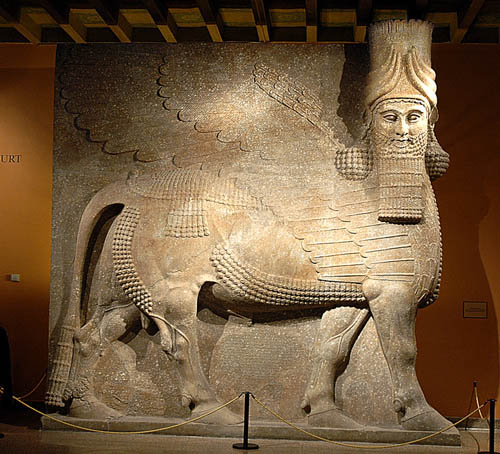
The Oriental Institute at the University of Chicago is one of the great museums of biblically related artifacts in the world. The University of Chicago excavated at the Neo-Assyrian city of Khorsabad from 1928 to 1935. This site was the fortress of King Sargon II (721-705 B.C.).

Assyrian winged bull, OIUC. Photo by Ferrell Jenkins.

Assyrian winged bull, OIUC. Photo by Ferrell Jenkins.

The OIUC web page describes the winged bull this way:

This colossal sculpture was one of a pair that guarded the entrance to the throne room of King Sargon II. A protective spirit known as a “lamassu”, it is shown as a composite being with the head of a human, the body and ears of a bull, and the wings of a bird. When viewed from the side, the creature appears to be walking; when viewed from the front, to be standing still. Thus it is actually represented with five, rather than four, legs.

Sargon II is mentioned only once in the Bible (Isaiah 20:1). There was a time when some critics denied the existence of Sargon II and suggested that the Bible writer made up the name. The great museums, Oriental Institute, British Museum, and the Louvre, have abundant evidence of his existence.

Photography is allowed in the museum.

The museum website will provide all the info you need to plan your visit to the Oriental Institute Museum.