Category Archives: Archaeology

From the Temple Mount to the Pool of Siloam

Chris Mitchell, CBN News, reports on the steps leading from the Temple Mount to the Pool of Siloam.

Ancient steps and a storm sewer dating back to King Herod are two of the recent finds in Jerusalem.

The discoveries help tell the story of the Jewish pilgrimage to the Temple in the time of Jesus.

“I was glad when they said to me let us go to the house of the Lord,” King David wrote in the Psalms.

Some 2,000 years ago, Jewish pilgrims might have recited this psalm of ascents as they climbed stairs on their way to worship at the Temple.

Three times a year, the Bible commanded the Jewish people to go up to Jerusalem to celebrate the Feasts of the Lord.

“They probably camped outside the city in the valleys in the Kidron Valley… came in the city through the southern gate into the pool to take a ritual bath and then went up to the Temple Mount to pay their respects to the God of Israel,” said Haifa University archaeologist Roni Reich.

The excavation is located just outside the City of David. Many believe the area was Jerusalem at the time of King David.

Recently archaeologists uncovered the other side of the broad stairway leading to the Temple Mount. Paved with large limestone blocks, it is thought to be about 140 feet wide and climbs less than a half mile uphill to the Temple Mount.

Reich said Jesus, too, most likely walked the steps.

Just outside is the pool of Siloam, where Jesus healed the blind man as mentioned in the Gospel of John.

Read the full report, or watch a nice video featuring Archaeologists Ronnie Reich, here.

HT: Dr. Claude Mariottini

Shechem in biblical history

Tell Balata (Shechem) was excavated by Germans working periodically between 1907 and 1934. In 1956, G. Ernest Wright led the Drew-McCormick Expedition. Work continued in 1969 under the direction of Edward F. Campbell.
I had the privilege of visiting the ruins of Shechem last December. At the time I thought how sad to see such an important site neglected. Shechem is important in biblical history. Some of the significant events associated with the city are listed below.
  • Shechem is the first city of Canaan mentioned in the Bible. The land promise to Abraham was restated here (Genesis 12:6-7).
  • Jacob and his family settled at Shechem (Genesis 33:18). Jacob purchased a parcel of ground and erected an altar here.
  • Joseph’s brothers had gone from Bethlehem to near Shechem to graze their flocks (Genesis 37:12-13).
  • After entering Canaan, the Israelites gathered at Shechem on Mount Gerizim and Mount Ebal to hear Joshua read the blessings and cures of the Law (Joshua 8:30-34; cf. Deuteronomy 28-30).
  • Shechem was within the territory of Ephraim and served as a city of refuge (Joshua 20:7; 21:21).
  • Joseph was buried in a parcel of ground bought by Jacob (Joshua 24:32).
  • The Shechemites supported Abimelech in his bid to be ruler and gave him money from their temple of Baal-berith (Judges 8:33; 9). Jotham’s addressed the people of Shechem from Mount Gerizim with a fable (Judges 9:7ff.).
  • After the Exile, Shechem became a major religious center of the Samaritans. Their temple was built on Mount Gerizim (John 4:20-21).
  • Jesus visited Jacob’s Well near Shechem (John 4).

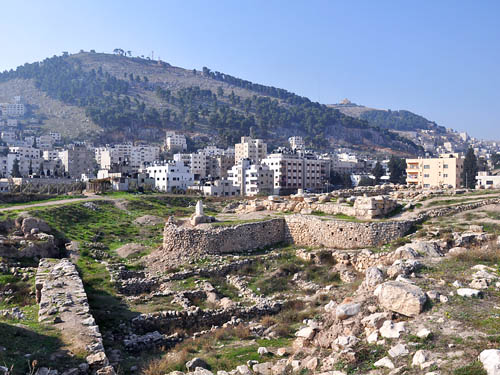
The photo below shows the excavated ruins of Tell Balata (Shechem). Mount Gerizim is on the left (to the south). Mount Ebal is on the right (to the North). The view is toward the west. The modern Arab town of Nablus is in the valley between these two mountains.

Shechem in the valley between Mount Gerizim & Mount Ebal.

Shechem — in the valley between Mount Gerizim and Mount Ebal.

Palestinian archaeology gets a boost at Shechem

Ha’aretz reports that the Dutch government has donated 300,000 euros (about $408,000) to the Palestinian Authority to finance the excavation and conservation of Tell Balata in Nablus. This is the biblical city of Shechem. The full account is here.

The site, according to the Ma’an report, is listed by UNESCO in the Inventory of Cultural and Natural Heritage Sites of Potential Outstanding Universal Value in Palestine, with experts estimating some of its towers and buildings from the Chalcolithic and Bronze Age dating back 5,000 years.
The Netherlands’ representative to the PA, Jack Twiss Quarles van Ufford, said the initiate was meant to bolster PA Prime Minster Salam Fayyad’s plan to work toward a unilateral declaration of Palestinian by 2011.
“The creation of institutions can only be sustainable if it goes hand in hand with the strengthening of the cultural identity of the Palestinian people,” Twiss told Ma’an, adding that “sites like Tell Balata are simply too important to be neglected.”
The photo shows the previously excavated ruins of Tell Balata (Shechem) in the valley below Mount Gerizim.
Ruins of Tell Balata (Shechem) below Mount Gerizim. Photo by Ferrell Jenkins.

Ruins of Tell Balata (Shechem) below Mount Gerizim. Photo by Ferrell Jenkins.

In the next post we will note the importance of Shechem in biblical history.

HT: Joseph I. Lauer

Older than the pyramids

Newsweek, March 1, 2010, has an article here about a temple complex in Turkey that is said to predate the pyramids.
Göbekli tepe in southeastern Turkey. The site is southeast of Sanliurfa, the Moslem traditional birthplace of Abraham. It is east of Haran, the home of Abraham according to Genesis 12:4, and north of the Syrian border.

German archaeologist Prof. Klaus Schmidt is directing the dig at the site said to have a temple built 11,500 years ago — 7,000 years before the pyramids.

Ben Witherington has a good post about this temple and some of the biblical implications at his Bible and Culture blog here. Among other good things he says,

The importance of this find for Biblical thinking is this— the Bible says that from the outset, human beings were created in God’s image.  Human beings were religious creatures from Day One.  Archaeologists and sociologists have long dismissed this theory saying organized religion comes much later in the game than the beginning of civilization and city building.  As  Ian Holder director of Stanford’s prestigious archaeology program says— this is a game changer. Indeed, it changes everything experts in the Neolithic era have been thinking.   Schmidt is saying that religion is the cause of civilization, not the result of it. Towns were built to be near the Temple complex. Agriculture was undertaken to feed those living there and supply the temple complex, and so on. The first instincts of humans were to put religion first. Maybe there is more to that Genesis story than some have been willing to think or admit. Maybe human beings are inherently homo religiosis.

This short video features Prof. Schmidt at Göbekli tepe.

HT: Ben Witherington

First Temple Period gate and wall

The headline writers are going wild. Arutz Sheva says, “Dig Supports Biblical Account of King Solomon’s Construction” here. The article includes a short video featuring Dr. Eilat Mazar at the site here.

The Associated Press article is headed “Archaeologist Sees Proof For Bible In Ancient Wall” here. The AP headline at Yahoo News reads, “Archaeologist sees proof for Bible in ancient wall,” here.

The news release from the Israel Ministry of Foreign Affairs reads, “Jerusalem city wall from 10th century B.C.E. uncovered,” here.

A good report in the Trumpet (here) reads, “Solomonic Wall Discovered in Jerusalem.”

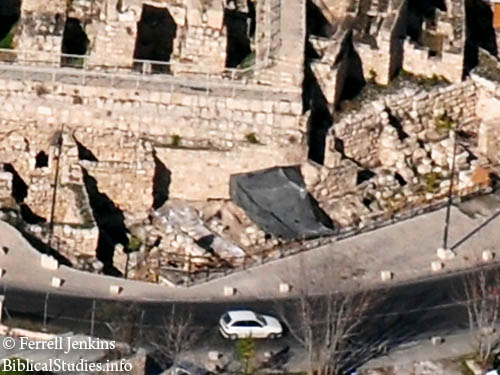
Dr. Eilat Mazar, of Hebrew University, has been working for several years in the City of David excavation. For the past three months she has been working in the area north of the City of David next to the street that runs along the south side of the Temple Mount. The area is part of what is called the Ophel. Eilat Mazar worked here with her grandfather, Benjamin Mazar, in the 1980s. You can see the area in this aerial photo I made December 15, 2009. In fact, a portion of the excavation is covered by a tarp.

Jerusalem Aerial of Second Temple excavation. Photo by Ferrell Jenkins.

Aerial view of Second Temple excavation. Photo by Ferrell Jenkins.

Thirteen photos are posted on the Hebrew University Facebook album here.

Todd Bolen (here and here and here) and Leen Ritmeyer (here and here) point out that, in spite of the news release, this excavation goes back many years. Dr. Eilat Mazar has spent the past three months working in the area.

Below is a photo of the gate area showing the west chambers that I made in 2005. Benjamin Mazar and his grand daughter Eilat published a report on this area in 1989.

Gate from First Temple Period. Photo by Ferrell Jenkins 2005.

Gate from First Temple Period. Photo by Ferrell Jenkins 2005.

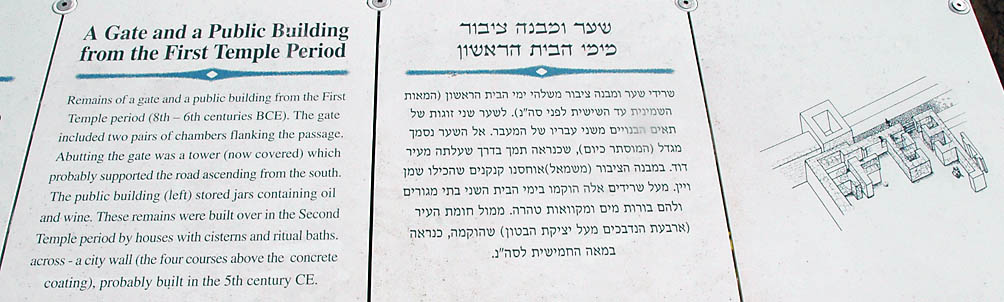
Compare the photo above, and the schematic drawing on the sign below (from 2005), with photos 12 and 13 in the HU Facebook album.

Marker indicated First Temple Period gate. Photo by Ferrell Jenkins 2005.

Marker indicated First Temple Period gate. Photo by Ferrell Jenkins 2005.

It seems uncertain whether this gate belongs to the 8th century B.C., 9th century, or 10th century. Eilat Mazar says it belongs to the 10th century B.C. based on pottery and a comparison of the architecture with that in other excavated cities. We must patiently wait to see the evidence. [See the comment by barnea levi selavan on Ritmeyer’s blog. He points out several significant things not included in the news reports.]

I look forward to seeing the area that has been recently cleaned. The news reports, including the video by Prof. Mazar, do not distinguish between what we already knew and what is new.

No one would enjoy seeing an inscription reading “Built in the 950 B.C. by King Solomon, son of David” more than I. Until more evidence is forthcoming we must leave Solomon out of this picture.

And this is the account of the forced labor that King Solomon drafted to build the house of the LORD and his own house and the Millo and the wall of Jerusalem and Hazor and Megiddo and Gezer. (1 Kings 9:15 ESV)

P.S. I was about 5 minutes away from posting this early today when my wife came to say that we must leave to pick up our grandson for the day. I chose the better part!

Jaffa Gate and the Christian Quarter from the air

In the past few days we have called attention to the excavations being conducted by the Israel Antiquities Authority at Jaffa Gate in Jerusalem. Archaeologists working in the area announced the discovery of an East-West road of the 4th century Byzantine city and the high-level aqueduct that brought water into the city in the second and third century.

The photo below shows Jaffa Gate and the Citadel from the air. Hezekiah’s Pool is visible just to the left (north) of the main street (David Street), almost in the center of the photo. The dome of the Church of the Holy Sepulchre is visible on the upper left side of the photo. Most of the area shown in this photo is called the Christian Quarter of the Old City of Jerusalem.

    Aerial view of the Christian Quarter of the Old City. Photo by Ferrell Jenkins.

Aerial view of the Christian Quarter of the Old City. Photo by Ferrell Jenkins.

Click on the photo for a larger image.

Second century aqueduct found in Jerusalem

The Israel Antiquities Authority announced earlier today the discover of the High-Level Aqueduct that brought water into Hezekiah’s Pool in the Roman city of Jerusalem.

A beautiful aqueduct, standing 1.50 meters [4.92 feet] high and built of large stones, has been situated for almost two millennia right under one of the most familiar and traveled places in Jerusalem – beneath the road that leads from Jaffa Gate toward the David Citadel Museum and the shops on David Street.

The High-Level Aqueduct of Jerusalem, which dates from the second-third century CE, was exposed in excavations the Israel Antiquities Authority is conducting, with funding provided by the Jerusalem Development Authority for the purpose of replacing the infrastructure in the region.

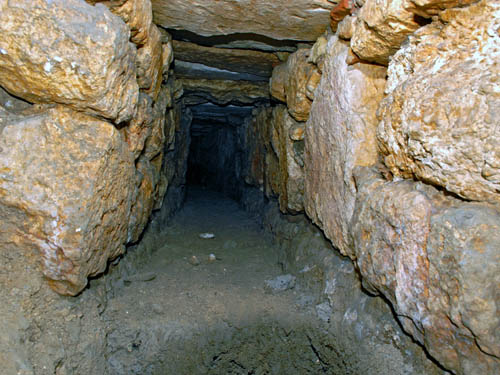
According to Dr. Ofer Sion, excavation director on behalf of the Israel Antiquities Authority, “The side of the aqueduct was discovered during the course of the excavation. When we removed the stones in its side and peeked into it we saw a splendidly built aqueduct covered with stone slabs where one can walk crouched down for a distance of approximately 40 meters. It is very exciting to think that no one has set foot there for many hundreds of years”. According to Sion, “The noted Land of Israel scholar, Dr. Conrad Schick, described a specific section of the aqueduct in a survey he conducted at the end of the nineteenth century. In 1898 a building was erected in this area which afterward became what we know of today as the Imperial Hotel. Schick’s documentation provided us with the clue that led to exposing this section of the aqueduct”.

The aqueduct is c. 60 centimeters [23.64 inches] wide and 1.5 meters [4.92 feet] high. Shafts were exposed at fifteen meter intervals or so that allowed the ancients to check the state of the aqueduct from what was the surface level in those days.

Second century upper aqueduct in Jerusalem. Photo: Assaf Peretz, IAA.

Second century high-level aqueduct in Jerusalem. Photo: Assaf Peretz, IAA.

A short video from ITN features Dr. Ofer Sion and the upper aqueduct here.

Todd Bolen calls attention to Tom Powers — View From Jerusalem in which he includes the late 19th century plans by Conrad Schick. Tom has some great photos made during the excavation.

For centuries, the water for Jerusalem came from the Gihon Spring on the east side of the city. From the time of Herod the Great, at least, water for the city was brought from Solomon’s Pools south of Bethlehem by aqueduct. This was a distance of about 8 miles.

Once the water reached Jerusalem it was brought into the city by two main aqueducts — the Low-Level Aqueduct and the High-Level Aqueduct. [UPDATE: See the comment by Tom Powers. Tom correctly points out that there were two separate aqueducts bringing the water into the city. I plan to say more about this later. Thanks for the correction, Tom.]

The High-Level Aqueduct conveyed water to the high part of the city where King Herod’s palace and Hezekiah’s Pool were situated, the latter being the main source of water for all those arriving in the city; and the Low-Level Aqueduct carried water to the Temple Mount and the Temple.

So many names in the Holy Land have nothing to do with the person for whom they are named. The Citadel of David is not. Solomon’s Pools are not. Hezekiah’s Pool may not be. These names were attached to various structures by later pilgrims.

Jerome Murphy-O’Connor describes Hezekiah’s Pool.

This great reservoir is entirely surrounded by buildings, and is accessible through the Coptic Khan…. At present the dry pool is used as a rubbish dump by the dwellings which surround it on all sides, but a much needed restoration project is on the drawing board.

Murphy-O’Connor says the pool “is thought to date from the Herodian period when it was fed by an aqueduct (visible outside Jaffa Gate) coming from Mamilla Pool.” He says Josephus mentions the pool under the name Amygdalon (Almond Tree) (War 5:468). He says this name, Amygdalon, is probably a deformation o f the Hebrew migdal (tower). The reference is to the towers of Herod’s palace.

I have been upstairs, or on the roof, of the Petra Hotel several times to photograph Hezekiah’s Pool. The photo below was made in early September, 2008. The area was the cleanest I had seen it. The Petra Hotel is immediately east of the Imperial Hotel mentioned in Tom Powers blog.

The view from the hotel roof is good. To the left is the dome of the Holy Sepulchre. The Lutheran Church tower is in the middle of the photo. The Dome of the Rock is visible to the right. In the distant left is Mount Scopus. To the right is the Mount of Olives.
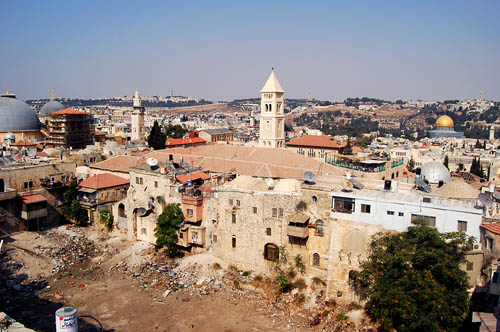
Hezekiah's Pool from roof of Petra Hotel. Photo by Ferrell Jenkins.

Hezekiah's Pool from roof of the Petra Hotel. Photo by Ferrell Jenkins.

The full news release by the IAA may be read here.

HT: Todd Bolen, Bible Places Blog; Joseph I. Lauer.

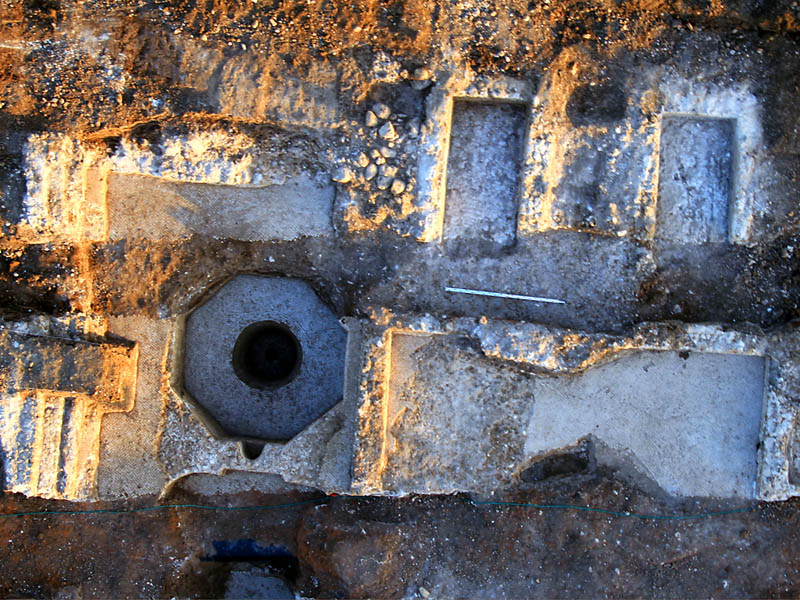
Larger photo of the Sorek wine press

The Israel Antiquities Authority has provided a higher resolution photo of the Byzantine-period wine press found in the Sorek Valley. Click for a larger image.

Sorek Wine Press. Aerial view courtesy of IAA.

Sorek Wine Press. Aerial view courtesy of IAA.

Todd Bolen calls attention to an article in the Jerusalem Post with a better photo (here).  It certainly provides a better view of the octagonal collecting vat. Take a look.

1,400 year old wine press discovered in Sorek Valley

The wine press was found during an excavation by the Israel Antiquities Authority in an agricultural area in the vicinity of Nahal Soreq [English, Sorek]

One of the largest wine presses ever revealed in an archaeological excavation in the country, which was used to produce wine in the Late Byzantine period (sixth-seventh centuries CE), was recently exposed in excavations conducted by the Israel Antiquities Authority. The excavation was carried out in a region that will be the farmland of Ganei Tal, a new settlement slated to be built for the evacuees from Gush Katif.

The impressive wine press is 1,400 years old and measures 6.5 x 16.5 meters [c. 21 x 54 feet]. It was discovered southwest of Kibbutz Hafetz-Haim and was partly damaged during the installation of the infrastructure there.

According to Uzi Ad, excavation director on behalf of the Israel Antiquities Authority, “What we have here seems to be an industrial and crafts area of a settlement from the sixth-seventh century CE, which was situated in the middle of an agricultural region. The size of the wine press attests to the fact that the quantity of wine that was produced in it was exceptionally large, and was not meant for local consumption. Instead it was intended for export, probably to Egypt, which was a major export market at the time, or to Europe.

wine-press from Sorek Valley

Aerial view of wine press from Sorek Valley. Photo: IAA.

The excavation director says,

“This is a complex wine press that reflects a very high level of technology for this period, which was acquired and improved on from generation to generation”.

According to the press release,

Rectangular surfaces were also discovered around the treading floor. These too were originally paved with a mosaic floor and were connected to the treading floor by way of a hole in the wall they shared with it. The grapes were probably placed on these surfaces before being trod on, and sometimes the initial fermentation process of the grapes would begin.

A spokesman for the Nahal Soreq Regional Council says the Council will converse the site and open it to the public.

The full press release may be read here. I am hopeful that later in the day we will have a better photo to share.

Wine presses were in common use throughout biblical times, and we learn that some of them were large. One, during the period of the Judges, is described as large enough to use for a threshing floor for wheat.

The LORD’s angelic messenger came and sat down under the oak tree in Ophrah owned by Joash the Abiezrite. He arrived while Joash’s son Gideon was threshing wheat in a winepress so he could hide it from the Midianites. (Judges 6:11 NET)

We posted an aerial view of the Sorek Valley here.

HT: Joseph I. Lauer

Ritmeyer on Solomon’s Temple

Dr. Leen Ritmeyer is well known for his archaeological work and his architectural designs. Ritmeyer Archaeological Design provided illustrations for the ESV Study Bible. A few years ago I was privileged to hear Ritmeyer discuss the evidence that led him to his conclusion about the location of Solomon’s temple. Recently he spoke at New Orleans Baptist Theological Seminary on the same subject. A well-written account of this lecture is available at the NOBTS here.

Here are a few excepts from the report of that lecture:

Leen Ritmeyer. Photo by F. Jenkins.

Leen Ritmeyer. Photo by F. Jenkins.

Without digging a single shovel of dirt, archaeologist Leen Ritmeyer found the location of Solomon’s Temple using a keen eye, biblical and historical knowledge and a tape measure.

Later, Ritmeyer became one of the leading scholars in Temple Mount research. And it all started with one unique stone….

For many years, Ritmeyer served as surveyor and field-architect of the archaeological expedition at the Temple Mount in Jerusalem as well as throughout the Jewish Quarter….

According to Ritmeyer, the original Temple Mount platform measured 500 cubits by 500 cubits. The “royal cubit” used for the Temple was 20.67 inches long. Later, King Herod expanded the platform on the Temple Mount doubling its size. It is the expanded, Herodian platform that tourist in Jerusalem visit today.

The current platform has two levels. Eight staircases lead from the lower level to the higher level where the Muslim Dome of the Rock stands.

Because the Muslims who control the Temple Mount will not allow excavations, Ritmeyer relied on observational skills as he search for the location of the Solomon’s Temple. And on the surface of the platform, he found his breakthrough.

At the bottom of a staircase in the northwest corner of the higher section, Ritmeyer noticed a stone with a unique chiseled edge. The stone resembled the pre-Herodian blocks visible on the eastern wall of the platform. He also noted that the stone was not aligned with the rest of the raised platform.

Ritmeyer believed this stone was not placed there as a step, but was actually part of the original Temple platform wall built by King Hezekiah (8th Century B.C.). Such a find would be helpful in locating the original Temple.

“This step was the archaeological beginning of my research into the pre-Herodian Temple Mount,” Ritmeyer said.

Books, CDs, and digital images by Dr. Ritmeyer are available at his website here. Look under Product Categories. I have appreciated the opportunity to download the drawings of Solomon’s Temple when needed for a class or sermon.