Category Archives: Archaeology

Prof. Ehud Netzer critically injured at Herodium

According to The Jerusalem Post, well known archaeologist Ehud Netzer has been critically injured in a fall at the Herodium (Herodion). The full report by Ben Hartman may be read here.

Well-known Israeli archeologist Ehud Netzer remained in critical condition Wednesday at Hadassah-University Medical Center, Ein Kerem, two days after he suffered a serious fall during a dig at the Herodion archeological site in the West Bank.

Netzer was reportedly leaning against a wooden railing on Monday when it gave way. He fell nearly 10 feet before landing – only to roll and fall an additional 10 feet. He suffered fractures in his cranium and vertebrae and was rushed to Hadassah in critical condition.

The 76-year-old archeologist is one of the foremost experts on Herodion, a man-made mountain built by King Herod near Bethlehem. Netzer has carried out digs at the site for more than three decades; three years ago, he found the site of Herod’s grave – a discovery that was considered the pinnacle of his career.

Digs he performed in 1968 in Jericho unearthed a Hasmonean winter palace that sported bathing pools and gardens, widely considered the most significant archeological site dealing with that period in Jewish history. The digs also unearthed the Jericho synagogue, considered the largest Jewish house of worship ever discovered.

In 1978, Netzer finished his PhD dissertation at Hebrew University, which focused on Herod’s palaces at Herodion and Jericho. He became a senior lecturer at the university in 1981, where he has taught ever since.

There were blog reports yesterday that Netzer had died, but these are being corrected this morning.

Cenchrea — a port used by Paul and Phoebe

Cenchrea is located a few miles east of Corinth on the Saronic Gulf, an arm of the Aegean Sea. In the time of the Apostle Paul Cenchrea was considered the eastern port of Corinth. It was here that Paul had his hair cut before sailing for Syria.

Paul, having remained many days longer, took leave of the brethren and put out to sea for Syria, and with him were Priscilla and Aquila. In Cenchrea he had his hair cut, for he was keeping a vow. (Acts 18:18 NAU)

Our photo provides a view of the port and the northern breakwater.

The port of Cenchrea with view toward the northern breakwater. Photo by Ferrell Jenkins.

Port of Cenchrea with view toward the northern breakwater. Photo by Ferrell Jenkins.

Cenchrea was the home of Phoebe, who was a servant of the church there. Cenchrea would have been one of the unnamed churches “in the whole of Achaia” (2 Corinthians 1:1).

I commend to you our sister Phoebe, who is a servant of the church which is at Cenchrea; that you receive her in the Lord in a manner worthy of the saints, and that you help her in whatever matter she may have need of you; for she herself has also been a helper of many, and of myself as well. (Romans 16:1-2 NAU)

I think we may safely conclude that Phoebe sailed from this port to Rome with the epistle Paul write to the saints at Rome about A.D. 57.

Except for the port, little is to be seen of ancient Cenchrea. Some underwater excavations have taken place. Perhaps at a later time we will call attention to some of the discoveries.

Click on the image if you would like to have a copy of the photo suitable for use in teaching Acts, Romans, or the life and ministry of Paul.

About 30,000 Dead Sea Scrolls to be put online

The Israel Antiquities Authority announced today a partnership with Google R&D Center in Israel to make the Dead Sea Scrolls available online. The project will be called the Leon Levy Dead Sea Scrolls Digital Project because the major lead gift is from the Leon Levy Foundation. Here are some excepts from the IAA press release.

A major lead gift from the Leon Levy Foundation, with additional major funding from the Arcadia Foundation and the support of Yad Hanadiv Foundation, will enable the Israel Antiquities Authority to use the most advanced and innovative technologies available to image the entire collection of 900 manuscripts comprising c. 30,000 Dead Sea Scrolls fragments in hi-resolution and multi spectra and make the digitized images freely available and accessible to anyone anywhere in the world on the internet. This is the first time that the collection of Scrolls will be photographed in its entirety since the 1950’s.

The IAA announced this morning that it is collaborating with the Google R&D center in Israel in this milestone project to upload not only all of the digitized Scrolls images but also additional data online that will allow users to perform meaningful searches across a broad range of data in a number of languages and formats, which will result in unprecedented scholarly and popular access to the Scrolls and related research and scholarship and should lead to new insights into the world of the Scrolls.

The innovative imaging technology to be used in the project has been developed by MegaVision, a U.S. based company, and will be installed in the IAA’s laboratories in early 2011. The MegaVision system will enable the digital imaging of every Scroll fragment in various wavelengths in the highest resolution possible and allow long term monitoring for preservation purposes in a non-invasive and precise manner. The images will be equal in quality to the actual physical viewing of the Scrolls, thus eliminating the need for re-exposure of the Scrolls and allowing their preservation for future generations.  The technology will also help rediscover writing and letters that have “vanished” over the years; with the help of infra-red light and wavelengths beyond, these writings will be brought “back to life”, facilitating new possibilities in Dead Sea Scrolls research.

Uploading the images to the internet will be achieved with the assistance of Google-Israel and will be accompanied by meta-data including transcriptions, translations and bibliography.

According to Shuka Dorfman, IAA General Director, “we are establishing a milestone connection between progress and the past to preserve this unique heritage for future generations. At the end of a comprehensive and profound examination we have succeeded in recruiting the best minds and technological means to preserve this unrivaled cultural heritage treasure which belongs to all of us, so that the public with a click of the mouse will be able to freely access history in its fullest glamour. We are proud to be embarking on a project that will provide unlimited access to one of the most important archaeological finds of the 20th Century, crucial to Biblical studies and the history of Judaism and early Christianity. We are profoundly grateful to Shelby White and the Leon Levy Foundation for their lead major gift and to the Arcadia Foundation for its major gift to this project.”

The IAA press release with a link to several photographs is available here.

IAA photo from the pilot project in St. Paul

IAA photo from the pilot project in St. Paul

If you thought the Dead Sea Scrolls had not been made public, take a look at this sentence from the News Release:

This is the first time that the collection of Scrolls will be photographed in its entirety since the 1950’s.

HT: Joseph Lauer

Replica Phoenician ship completes 20,000 mile voyage

A replica of a 600 B.C. Phoenician ship has almost completed 20,000 miles and two years at sea.

The replica Phoenician ship, captained by British explorer Philip Beale, has completed the circumnavigation of Africa – a voyage made by Phoenicians in 600 BC. With up to 16 crew members on any one leg the replica vessel has welcomed sailors from all corners of the globe.

The voyage has presented Captain Beale and his international crew with many challenges including losing one of the ship’s rudders in the Red Sea, the threat of piracy off the Somali coast and gale force weather conditions around the Cape of Good Hope. At the end of the expedition the ship will have visited 14 countries – each time sparking interest in the achievements of ancient Phoenician mariners.

The successful completion of the voyage is of enormous significance to historians and archaeologists as it proves that the Phoenician vessels were capable of sailing around the African continent – something that has been the cause of much speculation over centuries.

The ship will complete its voyage  at Arwad, Syria, where it was built.

Phoenician Ship under sail in the North Atlantic. Courtesy Phoenicia Ship Expedition.

Phoenician Ship under sail in the North Atlantic. Courtesy Phoenicia Ship Expedition.

For more information read the short article in the Gibraltar Chronicle here. A web site about the expedition is available at Phoenicia.

The prophet Ezekiel foretold the fall of the ancient Phoenician city of Tyre. I suggest you read the entire account in Ezekiel 26-28. Notice especially these verses about the effect that the fall of Tyre had on other nations and merchants.

The ships of Tarshish traveled for you with your merchandise. So you were filled and heavily laden in the heart of the seas. “Your rowers have brought you out into the high seas. The east wind has wrecked you in the heart of the seas. Your riches, your wares, your merchandise, your mariners and your pilots, your caulkers, your dealers in merchandise, and all your men of war who are in you, with all your crew that is in your midst, sink into the heart of the seas on the day of your fall.

At the sound of the cry of your pilots the countryside shakes, and down from their ships come all who handle the oar. The mariners and all the pilots of the sea stand on the land and shout aloud over you and cry out bitterly. They cast dust on their heads and wallow in ashes; they make themselves bald for you and put sackcloth on their waist, and they weep over you in bitterness of soul, with bitter mourning. In their wailing they raise a lamentation for you and lament over you: ‘Who is like Tyre, like one destroyed in the midst of the sea? (Ezekiel 27:25-32 ESV)

For a larger image of the photo suitable for use in teaching click on the photo above.

HT: PaleoJudaica.

CBS 60 Minutes to include feature on archaeology in Jerusalem

The promo for 60 Minutes, October 17, 2010, includes the following:

Lesley Stahl reports on an archeological dig in Jerusalem that is stirring up controversy.

This is likely a reference to the City of David excavations.

Jericho celebrates 10,000 years on 10-10-10

Since the excavations of Tell es-Sultan by Kathleen Kenyon (1952-1958), Jericho has publicized itself as the oldest city in the world. Kenyon thought she had found the earliest known fortifications.

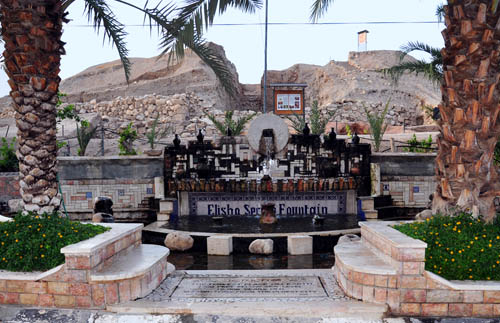
Tell es-Sultan has been neglected as a tourist site over the years. In May I was pleased to see that the site had been cleaned up a bit with clearly marked paths and new signs. One new thing I saw was a fountain marked as “Elisha Spring Fountain.” It is probably the same water one would find in the toilet [for those who have not traveled outside the USA, that is a Restroom].

Jericho Fountain and Tel es-Sultan

Elisha Spring Fountain & Tell es-Sultan (Jericho). Photo by Ferrell Jenkins.

Elisha’s Spring is on the east side of the tell. See our earlier post here. But, back to the 10,000 years. The mosaic in front of the fountain touts Jericho as “the lowest place on earth” and  “10,000 years old.” In fact, Jericho is about 82o feet below sea level (Encyclopaedia Judaica, 2nd ed., Vol. 11).

Jericho sign in 2010 claims to be oldest city. Photo by Ferrell Jenkins.

Jericho sign in 2010 claims to be oldest city. Photo by Ferrell Jenkins.

The Palestinian Prime Minister held his weekly Cabinet meeting at Jericho Sunday “to mark the town’s birthday.” Authorities said the choice of October 10, 2010 (10-10-10) was random.

Biblical Jericho attracts a steady flow of pilgrims, but the small Jordan Valley oasis is making a major push these days to become a magnet for tourists, presenting itself as the oldest city on earth. Marking the 10,000th birthday Sunday is entirely random, though, with archaeologists saying they could be off by hundreds of years in dating the first human settlement in the area.

Read the complete article, which is mostly about Hisham’s Palace from the 8th century A.D., here.

One Sunday my wife and I were eating with an attorney and his wife. Through the window we could see the sign of the restaurant next door. It said something about serving the world’s best chicken. I asked my friend about the legality of signs like that. He said it was “acknowledged puffery.” I suspect we should view the signs at Jericho, and a lot of other places, in the same light.

Todd Bolen has a post about this subject, with additional photos, on the Bible Places Blog here.

Report on Khirbet Qeiyafa — the Elah Fortress

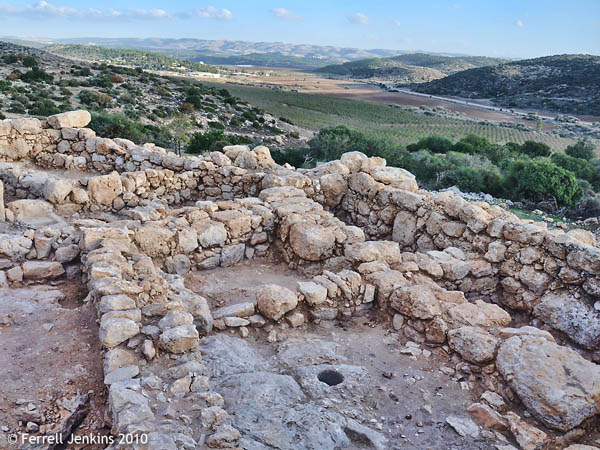
Luke Chandler has participated in the excavation at Khirbet Qeiyafa the past two summers. Recently he posted two brief articles on some of the discoveries during the past summer. Read here and here.

This area is associated with the events of 1 Samuel 17 (David and Goliath).

View to southeast over Elah Valley from Khirbet Qeiyafa. Photo by F. Jenkins.

View to southeast over Elah Valley from Khirbet Qeiyafa. Photo by Ferrell Jenkins.

Five year long ossuary forgery trial may be coming to an end

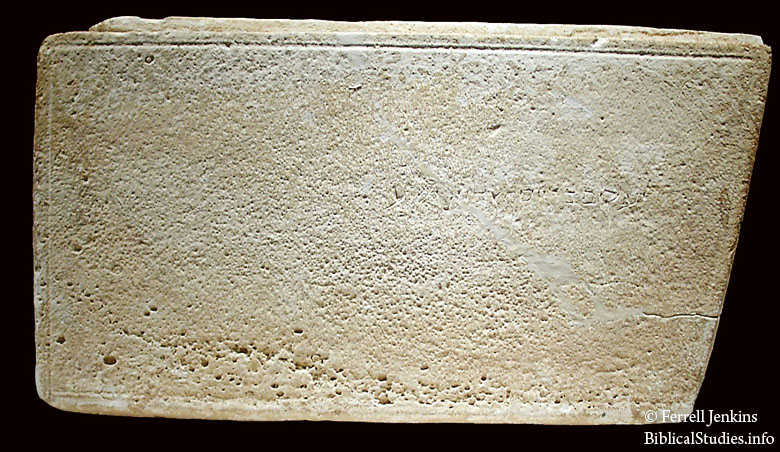
More than five years ago prosecutors in Israel brought charges against Oded Golan for forging the inscription on the ossuary bearing the Aramaic title, “Ya’akov bar Yosef akhui diYeshua” [James the son of Joseph the brother of Jesus].

Matthew Kalman reports that the trial seems to be coming to an end.

The indictment leveled 44 charges of forgery, fraud and deception against Golan and 13 lesser counts against a co-defendant, antiquities dealer Robert Deutsch. The trial of Golan, Deutsch and three other defendants opened at the Jerusalem District Court in September 2005.

Last Sunday, the defense ended its summing up with just two men left in the dock, bringing to an end five years of court proceedings that spanned 116 sessions, 133 witnesses, 200 exhibits and nearly 12,000 pages of witness testimony. The prosecution summation alone ran to 653 pages.

Yet despite the flood of strong scientific testimony, the feeling in the tiny courtroom, where fewer than a dozen people (including only one reporter) have followed the proceedings, was that the prosecution had failed to prove the items were forgeries or that Golan and Deutsch had faked them.

You may read Kalman’s full report here.

The "James" Ossuary. Photo by Ferrell Jenkins.

The "James" Ossuary. Photo by Ferrell Jenkins.

Once the judge issues his decision we still will not have certainty about this artifact.

HT: Joseph I. Lauer

Sarcophagus of the Queen of Adiabene returns to Israel

Haaretz tells the interesting story of the discovery of the return of the sarcophagus of Helena of Adiabene to Jerusalem from Paris.

Nearly 2,000 years passed between the time the coffin of Queen Helena of Adiabene first came to Jerusalem and its recent return there. In an impressive ceremony on September 21, the coffin was put on display in the reopened archaeology wing of the Israel Museum, after having been flown in from France.

In keeping with the customs of the time, the body of the first-century C.E. queen, who was a convert to Judaism, was interred in a stone coffin, a sarcophagus, weighing around 1,200 kilograms. The coffin looks massive, says the French ambassador to Israel, Christophe Bigot, who attended the ceremony, but any careless movement could damage it.

Queen Helena’s sarcophagus wound up in France after it was discovered almost by accident in Jerusalem in 1863, when Louis Felicien de Saulcy was excavating the site called the Tombs of the Kings, in the Sheikh Jarrah neighborhood, not far from the U.S. consulate. On the third day of the dig – which was undertaken after the Ottoman authorities issued a firman, or formal permit, for it — one of the workers stepped on a tile in the floor of a structure. The tile moved, revealing an alcove beneath it that contained the sarcophagus.

De Saulcy, a French military man and the scion of a noble family, turned his attention to archaeological research in the Middle East in the mid-19th century. Hagit Maoz Lin, curator of the Israel Museum exhibition that features the sarcophagus, says that he traveled to Palestine after the death of his first wife, because he was searching for something of interest “in a place fraught with danger.” On de Saulcy’s first trip to Palestine, in 1850, he toured the Dead Sea area and, among other things, falsely identified Sodom and Gomorrah, and drew the first map of Masada and the Roman camps that surrounded it.

The sarcophagus is on loan to the Israel Museum for four months.

Queen Mother Helena of Adiabene came to Jerusalem with her son, King Izates, as a convert to Judaish in A.D. 46. Adiabene was located in northern Mesopotamia east of the Tigris River. During the famine in Judea, mentioned in Acts 11:28-30, the queen sent to Egypt for grain and to Cyprus for dried figs (Josephus, Ant. 20.51).

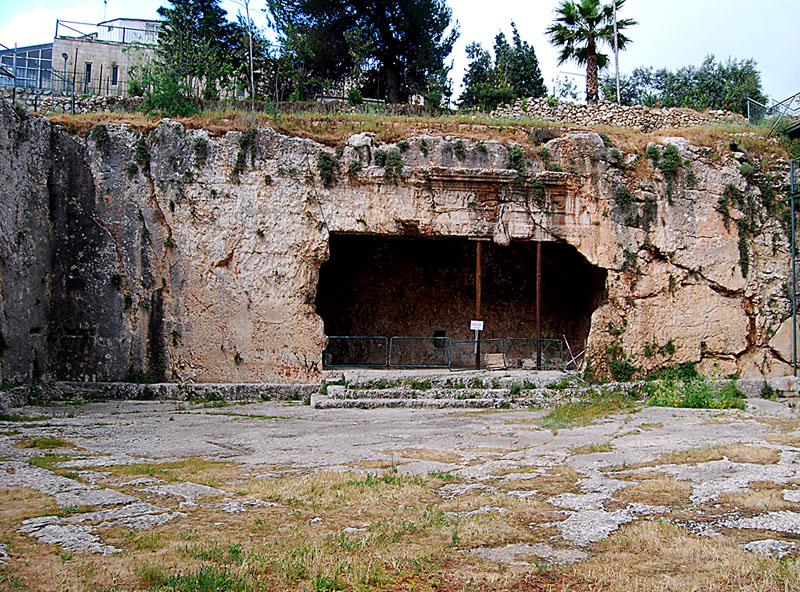
We have written about the Queen of Adiabene and her famous tomb, along with a photo of the rolling stone here. The tomb is no longer open to the public and is badly in need of repair.

The Tomb of the Kings. Photo by Ferrell Jenkins.

The Tomb of the Kings. Photo by Ferrell Jenkins.

You may read the entire article about the sarcophagus and the return of it to Israel here. There is a tiny, poor quality, image with the article.

HT: Joseph Lauer

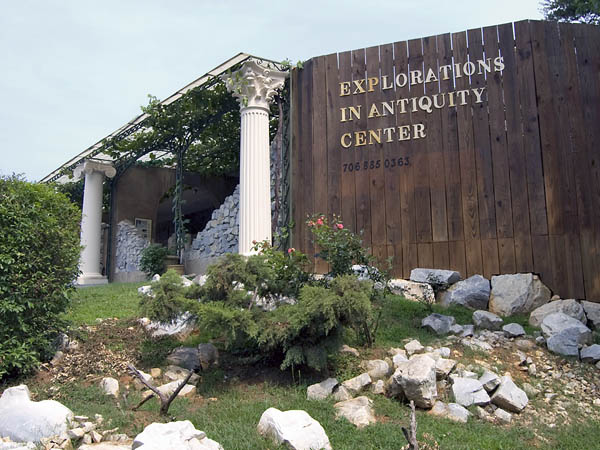
Explorations in Antiquity Center — change of web site

We have called attention to the Explorations in Antiquity Center, LaGrange, Georgia, here, here, here, and here.

Explorations in Antiquity Center. Photo by David Padfield.

Explorations in Antiquity Center. Photo by David Padfield.

Derrick Lewis, manager of EIA, informs us that the website address has changed to http://www.explorationsinantiquity.com. We are pleased to pass along this information.