Category Archives: Apostle Paul

The Importance of the Cornerstone

Many of us think of the cornerstone of a building as a marble or bronze plaque somewhere near the outside corner of a building. It will contain the name of the organization using the building and perhaps a note about the donor, engineer, etc. The Dictionary of Biblical Imagery describes the cornerstone this way:
The cornerstone is the principal stone around which construction in antiquity was achieved. In the lexicon of biblical images of architecture, no image is more evocative than the cornerstone, the focal point of a building, the thing on which it most depends for structural integrity. Thus early in the catalog of God’s acts of creation in Job 38:6, the divine voice from the whirlwind asks regarding the world, “Who laid its cornerstone?” (Ryken, Leland et al. The Dictionary of Biblical Imagery. 2000: 166. Print).
There are repeated references to Jesus as the cornerstone rejected by the builders. Paul explains that Christ Jesus is the chief cornerstone of the church which is built upon the foundation of the apostles and prophets (Ephesians 2:20). This concept is the fulfillment of Old Testament prophecies (1 Peter 2:6; Psalm 118.22; Matthew 21:42; Acts 4:11, et al. The Louw-Nida Lexicon says the Greek word used in these texts refers to “The cornerstone or capstone of a building, essential to its construction – ‘cornerstone, important stone.” I notice that several sources use the term capstone. I have seen these capstones at the top center of an arch used in the construction of an entry arch to a large building. Without the capstone the arch would soon fall.

One of the largest cornerstones of the Temple Mount enclosure wall. This is the area of Robinson’s Arch.

Wiemers describes the large cornerstone pictured above:
A very large corner stone with margin and boss, located on the southwest corner of the Temple Mount. This southwest corner has some of the largest ashlar stones of the entire Temple Mount complex, measuring 39 feet 4 inches long by 7 feet 10 inches wide and 43 inches high. The large stone shown here is called the master course stone and weighs about 80 tons. All these stones form a strong corner as they alternate back and forth as headers and stretchers all the way up. The larger stones helped stabilize the smaller stones stacked below. (Wiemers, Galyn. Jerusalem History, Archaeology and Apologetic Proof of Scripture. Waukee, Iowa, Last Hope Books and Publications, 2010, p. 105.)
We noted earlier that several sources suggest the Greek word for cornerstone could also describe a capstone. I have seen several of these capstones used in arches. The next photo shows an example from Patara (Acts 21:1; now in Turkey). It is a triple-arched gate. For more information see Wilson, Biblical Turkey. The capstone may be seen above each of the arches, but is especially noticeable above the center arch. These capstones are not just for beauty; they are essential to hold the arch together.

The gate was built “around AD 100 during the reign of Trajan” (Wilson, Biblical Turkey).
The Appian Way

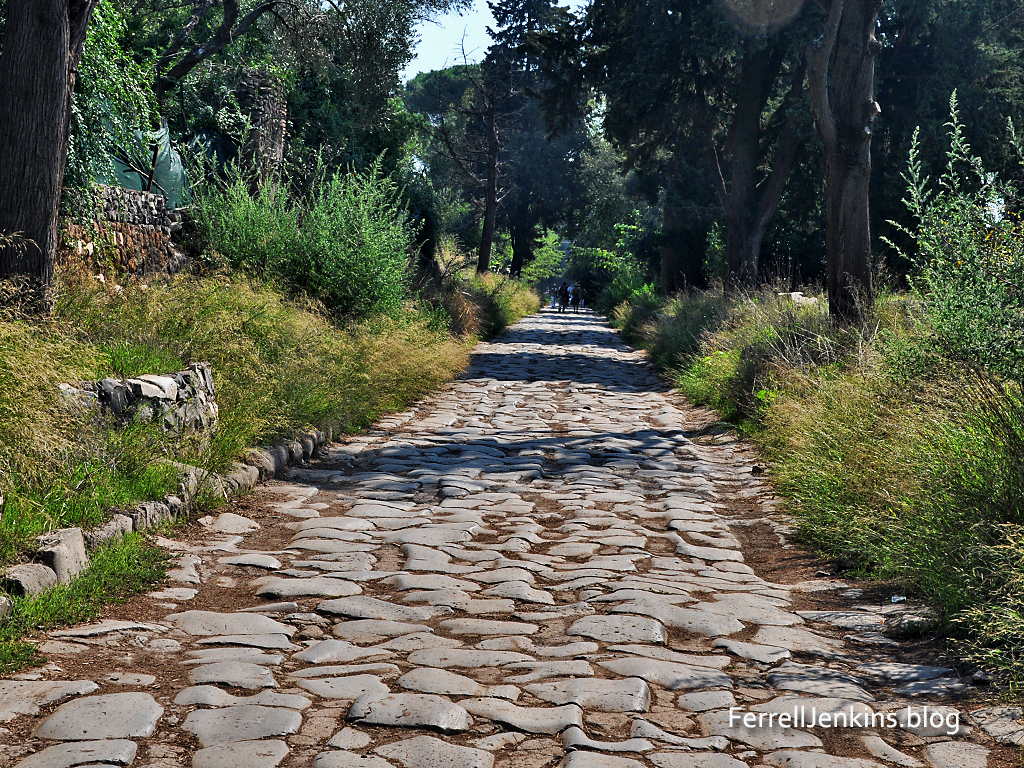
During his preaching journeys, the apostle Paul used several of the famous Roman roads. On the way to Rome as a prisoner he traveled the Appian Way (Latin Via Appia).

The Appian Way on the south side of Rome.

There we found brothers and were invited to stay with them for seven days. And so we came to Rome. And the brothers there, when they heard about us, came as far as the Forum of Appius and Three Taverns to meet us. On seeing them, Paul thanked God and took courage. And when we came into Rome, Paul was allowed to stay by himself, with the soldier who guarded him. (Acts 28:14-16 ESV)

Corinth and Neighboring Cities

After Jerusalem, Corinth is one of the best-known cities mentioned in the New Testament. The apostle Paul visited Corinth on his second preaching tour (Acts 18). At the “judgment seat” (Greek, bema) in the agora Paul stood before the proconsul Gallio. Based on the inscription now exhibited in the museum at Delphi we think that Paul entered Corinth in the fall of A.D. 51, and left in the spring of A.D. 53.

The map is cropped from a larger map of the area around Corinth on the Bible Mapper Blog here.

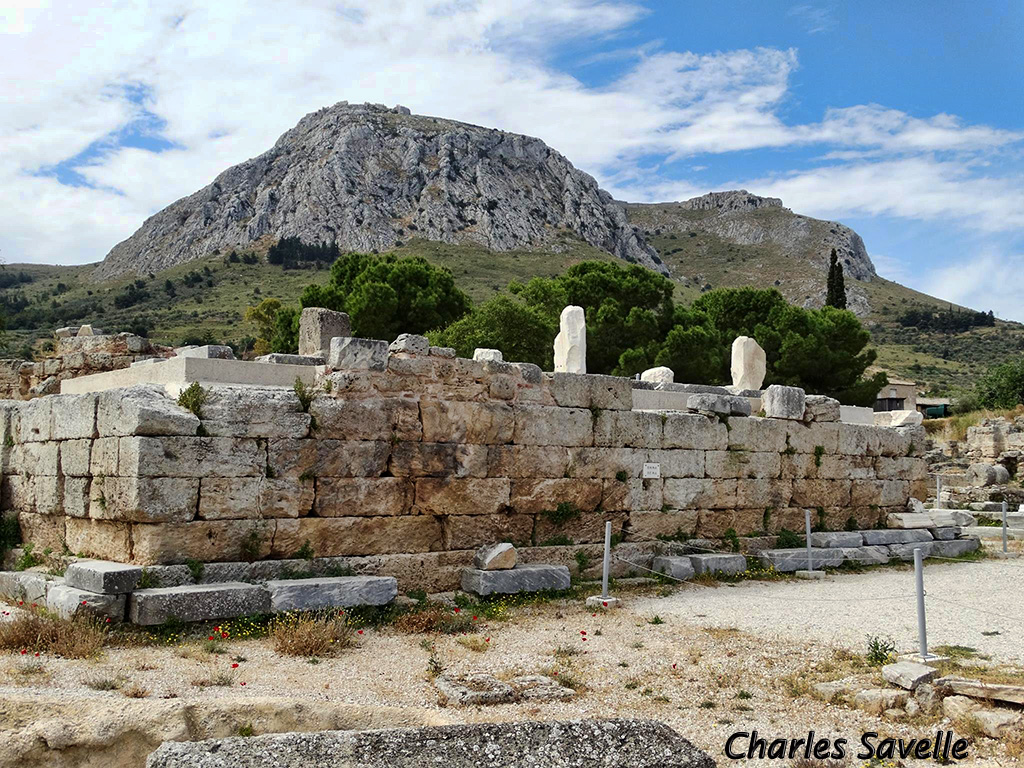
Since my last visit to Corinth some reconstruction has been made on the Bema and our photo below is published courtesy of Charles Savelle of BibleX.

The Bema at Corinth with the Acrocorinth in the background.
The Bema where Paul stood before proconsul Gallio. The Acrocorinth looms over the city. Photo courtesy of Charles Savelle.

Corinth is located about two miles south of the narrow isthmus which forms the land bridge, and controlled access, between the main land mass of Greece and the Peloponnese. The isthmus is less than five miles wide. Small ships were dragged across the isthmus on the paved road now called the diolkos; larger ships unloaded their cargo which was carried across and reloaded. This avoided the long 200-mile journey around the Peloponnese. Nero abandoned his attempts to dig a canal across the isthmus (A. D. 67). Some scholars think the road only allowed the “occasional movement of military ships, conveyance of building materials from the southern to northern Corinthia, small-scale portaging of luxury goods, and [served as] the principal road from the Corinthian Gulf to the pan-Hellenic sanctuary of Poseidon at Isthmia” (Pettegrew, CorinthianMatters.com blog). The canal one sees today was constructed in 1881–1893.

Corinth “was situated on a plateau overlooking the Isthmus of Corinth about two miles from the Gulf. It lay at the foot of Acrocorinth, an acropolis which rises precipitously to 1,886 ft.…” and was easily defended in ancient times (Rupprecht 960).

Corinth had two good ports. Lechaion, to the west, on the Gulf of Corinth (an arm of the Ionian Sea), and Cenchrea, to the east, on the Saronic Gulf (an arm of the Aegean Sea).

The harbor of Cenchrea, home of Phoebe. From here Paul set sail for Judea.
The harbor of Cenchrea where Paul had his hair cut before departing for Jerusalem. Cenchrea was the home of Phoebe (Romans 16:1).

Another important community near Corinth was Isthmia. The biennial Isthmian games, second in importance to the Olympic games, were held there in honor of Poseidon at the isthmus of Corinth. Some scholars think Paul may have been present for one of these events while he was at Corinth. He frequently used athletic illustrations in his letters. See 1 Corinthians 9:24-25 as an example.

The location of the ancient Isthmian games of Greece.
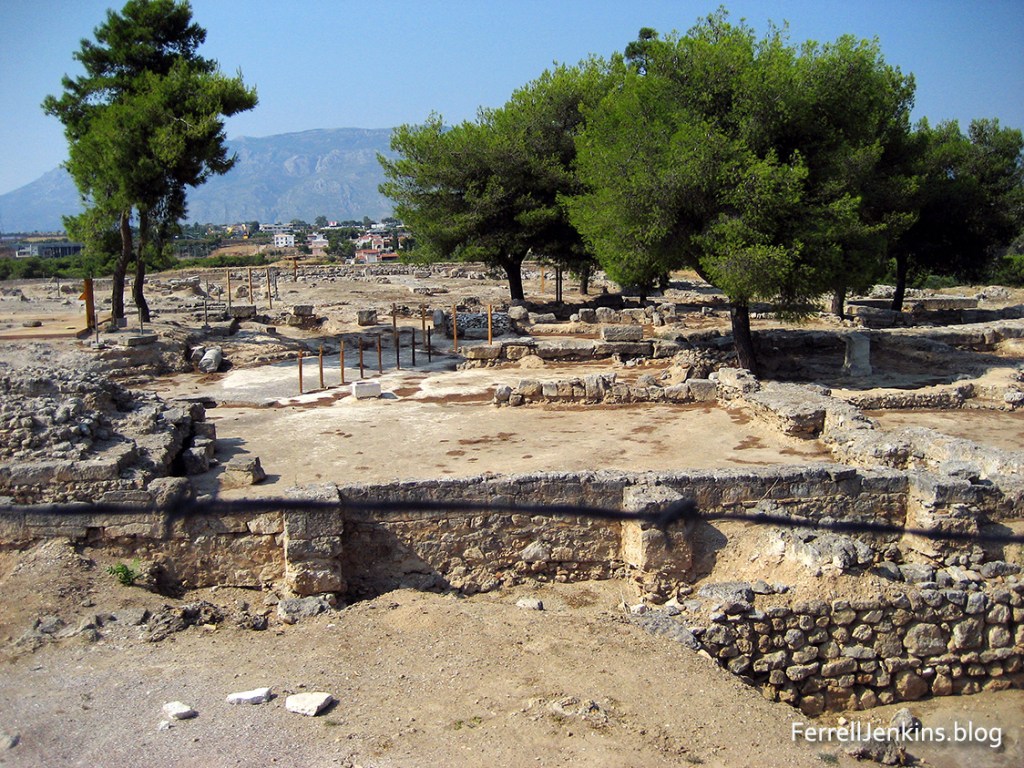
Ruins of the ancient site of Isthmia. The Corinth canal is to the right of this image. View is to the North West.

Over the years since the beginning of this blog I have posted several articles about Corinth. I suggest you put the name Corinth in the Search Box for a list of these posts. I think of this blog as a mini-dictionary of Bible lands and customs. I hope you will find it useful in your study of the Bible. Share it with you friends and suggest that they join our mailing list.