Author Archives: Ferrell Jenkins

The Good Shepherd

When the Pharisees and scribes complained that Jesus received sinners and ate with them, He told them a parable that we call the parable of the lost sheep (Luke 15:1-7).

“What man among you, if he has a hundred sheep and has lost one of them, does not leave the ninety-nine in the open pasture and go after the one which is lost until he finds it? “When he has found it, he lays it on his shoulders, rejoicing. “And when he comes home, he calls together his friends and his neighbors, saying to them, ‘Rejoice with me, for I have found my sheep which was lost!’  “I tell you that in the same way, there will be more joy in heaven over one sinner who repents than over ninety-nine righteous persons who need no repentance. (Luke 15:4-7 NAU)

“When he has found it, he lays it on his shoulder, rejoicing.” This describes the work of good shepherds and a practice that was well known to those who heard Jesus. On another occasion Jesus called Himself the good shepherd (John 10:11, 14).

The motif of the good shepherd with the sheep on his shoulder became common in later Christian iconography. Similar drawings are known from the catacombs in Rome. The four statuettes shown below date from the 4th century A.D., and are displayed in the Istanbul Archaeological Museum.
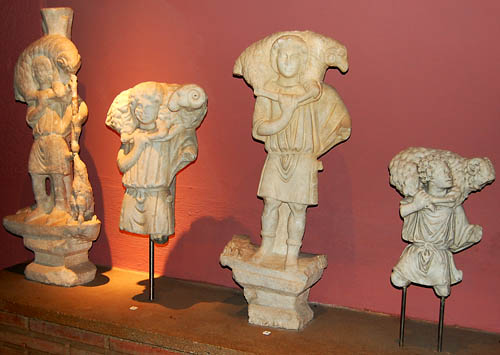
Good shepherd statues. Istanbul Archaeological Museum. Photo by Ferrell Jenkins.

Good shepherd statues. Istanbul Archaeological Museum. Photo by Ferrell Jenkins.

Last September I saw a special exhibit of early Christian artifacts in the Vatican Museum. The photo below shows a wonderful early 4th century statuette of the Good Shepherd.
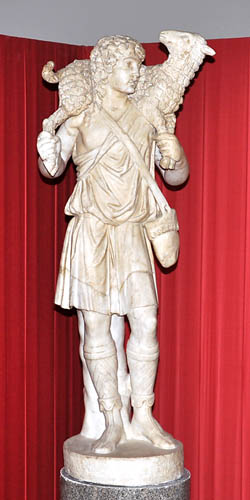
The Good Shepherd in the Vatican Museum. Photo by Ferrell Jenkins.
The Good Shepherd in the Vatican Museum. Photo by Ferrell Jenkins.

Judean Desert scholar Hanan Eshel dead

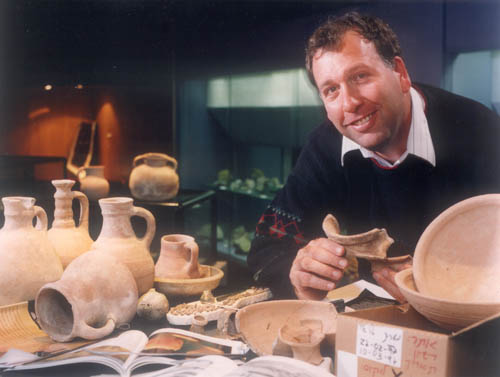
Word comes of the passing of Professor Hanan Eshel. Aren Maeir, who taught with Eshel says,

Hanan Eshel, my good friend and colleague from the Department of Land of Israel Studies and Archaeology at Bar-Ilan University, and one of the leading scholars in the field of Dead Sea Scrolls, the Bar Kochba Revolt, and many other issues, passed away last night, after a long illness.

Three field guides (Ein Gedi, Masada, and Qumran) by Hanan Eshel were published by Carta last fall. Todd Bolen provides a report and ordering information here.

The photo is taken here from the Trinity Western University web site here.

Hanan Eshel

HT: Joseph I. Lauer; Aren Maeir

The Vineyard

The prophet Isaiah records the song of the LORD for His vineyard that had become unfruitful.

1 Let me sing now for my well-beloved A song of my beloved concerning His vineyard. My well-beloved had a vineyard on a fertile hill.
2 He dug it all around, removed its stones, And planted it with the choicest vine. And He built a tower in the middle of it And also hewed out a wine vat in it; Then He expected it to produce good grapes, But it produced only worthless ones.
3 “And now, O inhabitants of Jerusalem and men of Judah, Judge between Me and My vineyard.
4 “What more was there to do for My vineyard that I have not done in it? Why, when I expected it to produce good grapes did it produce worthless ones?
5 “So now let Me tell you what I am going to do to My vineyard: I will remove its hedge and it will be consumed; I will break down its wall and it will become trampled ground.
6 “I will lay it waste; It will not be pruned or hoed, But briars and thorns will come up. I will also charge the clouds to rain no rain on it.”
7 For the vineyard of the LORD of hosts is the house of Israel And the men of Judah His delightful plant. Thus He looked for justice, but behold, bloodshed; For righteousness, but behold, a cry of distress. (Isaiah 5:1-7 NAU)

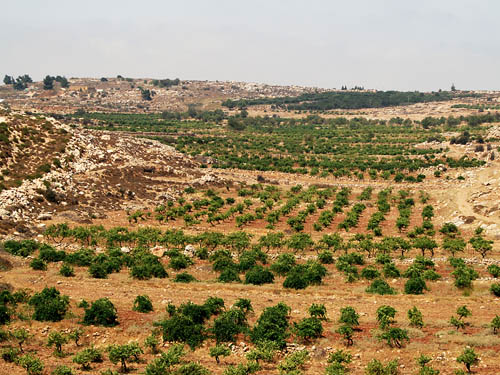
The photo was made in the hill country of Judah south of Bethlehem near the Patriarchs Way. This region of the country is filled with vineyards.

Vineyard in the hill country of Judah near the Patriarchs Way. Photo by Ferrell Jenkins.

Vineyard in the hill country of Judah. Photo by Ferrell Jenkins.

Perfume of pure nard

Shortly before His death, Jesus went to Bethany. The event we are considering today took place at the home of Simon the Leper, but Mary, Martha, and Lazarus, His friends, were present.  On this occasion Mary anointed the feet of Jesus with perfume of pure nard.

Mary therefore took a pound of expensive ointment made from pure nard, and anointed the feet of Jesus and wiped his feet with her hair. The house was filled with the fragrance of the perfume. (John 12:3 ESV)

The Greek word for perfume is muron, and the word for nard is nardos. Our word myrrh comes from muron. While it might be used of a specific type of fragrance, in this place it is probably used in the general sense of perfume. Nard (or spikenard) is “a fragant oil derived from the root and spike (hair stem) of the nard plant which grows in the mountains of northern India” (Brown, Anchor Bible, I:448). Mary anointed His feet. The parallel accounts are Matthew 26:6-13 and Mark 14:3-9. This act is to be told wherever the gospel is preached. This took place in the house of Simon the leper. The account in Luke 7:36-50 took place in Galilee and is different.

The Eretz Israel Museum at Tel Aviv University has one entire building devoted to glassware. I was especially interested in a large collection of perfume bottles from the first century A.D.

Perfume Bottles at Eretz Israel Museum at Tel Aviv University

First Century A.D. Perfume Bottles at Eretz Israel Museum. Photo by Ferrell Jenkins.
The museum sign associated with this collection identifies these bottles as “Free-blown vessels of colored opaque and translucent glass, probably produced in the same centers.”

“He is not here, for He has risen”

The women who came to the tomb of Jesus on the first day of the week found the stone rolled away from the tomb. When they entered the tomb the body was not there (Luke 24:1-3).

The angel said to the women,

He is not here, for he has risen, as he said.  (Matthew 28:6a ESV)

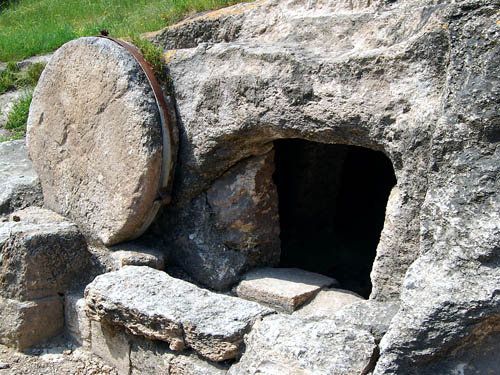
Several tombs of the type in which Jesus was buried have survived the centuries. This one was discovered during road construction a few years ago near Mount Carmel.

A Roman Period tomb with a rolling stone. Photo by Ferrell Jenkins.

A Roman Period tomb with a rolling stone. Photo by Ferrell Jenkins.

Paul says that Jesus was “delivered up for our trespasses and raised for our justification.” (Romans 4:25 ESV).

Last year I wrote about “The empty tomb” here, and “The Tomb of Jesus” here. Use the search box to locate other posts about tomb.

The observance of Easter

Have you ever thought about it? Was Easter celebrated in the churches of New Testament times? For a brief discussion of the historical information, read an article that I have posted here at the Biblical Studies Info Page.

The Via Dolorosa – the Way of the Cross

An incredible day in history. Early in the morning Jesus was transferred from Caiaphas, the Jewish High Priest, to Pontius Pilate, the Roman military governor. When Pilate learned that Jesus was from Galilee, he sent Him to Herod Antipas. Herod quickly sent Him back to Pilate. Under pressure from the religious leaders, Pilate delivered Jesus to be crucified. The numerous events from the last day prior to the crucifixion of Jesus are recorded in the New Testament (Matthew 26-27; Mark 14-15; Luke 22-23; John 18-19).

As early as Byzantine times Christians began to follow the final steps of Jesus on specified days. Over the centuries many changes were made in the route and the stops. The traditional Via Dolorosa, as known today, was fixed in the 18th century.

Jerome Murphy-O’Connor says,

The Via Dolorosa is defined by faith, not by history. (The Holy Land, 5th edition, 37)

He continues,

The present Way of the Cross has little chance of corresponding to historical reality… (38)

According to tradition, the third station of the cross is where Jesus falls the first time under His cross. It sounds reasonable, but the Gospels make no specific mention of this.

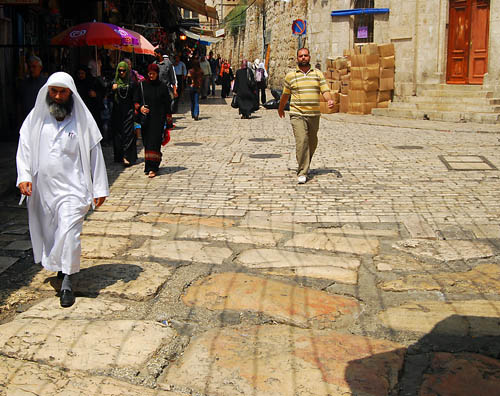
Roman period street near 3rd station of the cross. Photo by F. Jenkins.

Roman period street near 3rd station of the cross. Photo by F.  Jenkins.

This photo shows the street in front of the third station. The plaque in Hebrew, Arabic and English provides the following information about the street.

Paving stones, apparently from the Second Temple Period (ca. 100 B.C.E. – 100 C.E.). The street was found in its entirety 3 meters below the existing level and was partially restored by the Municipality of Jerusalem … 1980-1981.

This means that the street Jesus might have walked is at least 10 feet below the present street level.

[A portion of this post is repeated from April 8, 2009.]

BiblioBlogger rankings for March

The Top 50 BiblioBlogger rankings for March are posted here. Thanks to our readers for moving us into 10th place. This list is based on the Alexa traffic rank.

Peter’s denial of Jesus

Thursday was another activity-filled day for Jesus, but we pick up on the activity late in the day. The Gospel of John fills in a lot of information not contained in the other accounts of His life. Here is what John records:

  • The passover meal (John 13:1-38). John includes no account of the institution of the Lord’s Supper which took place at the time of this meal (Matthew 26:26-29; Mark 14:22-25; Luke 22:17-20). Only John records the washing of the disciples’ feet.
  • His farewell discourses (John 14-16).
  • His priestly prayer for His disciples and those who believe on Him through their word (John 17).
  • His betrayal and arrest (John 18). Note that it would have been fairly late in the evening before He was arrested.
  • He is taken to the house of Annas (John 18:12-14), where he was delivered over to Caiaphas (John 18:24-28). I think the text indicates that Jesus remained there throughout the night.
  • The denial by Peter (John 18:15-18).

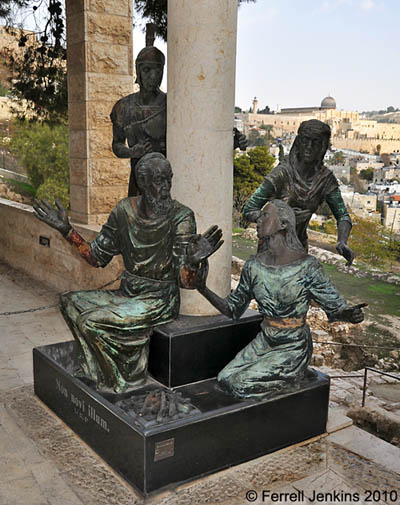
The traditional location for the house of Caiaphas is known as St. Peter in Gallicantu (St. Peter of the Cock Crowing). We have written about the site here, and I will not discuss the authenticity of the place now. The site has a nice statue of Peter saying, “mulier non novi illum.”

Peter denies knowing Jesus. Photo by Ferrell Jenkins at St. Peter in Galicantu.

Peter denies knowing Jesus. Photo by Ferrell Jenkins.

Having arrested Him, they led Him away and brought Him to the house of the high priest; but Peter was following at a distance. After they had kindled a fire in the middle of the courtyard and had sat down together, Peter was sitting among them. And a servant-girl, seeing him as he sat in the firelight and looking intently at him, said, “This man was with Him too.” But he denied it, saying, “Woman, I do not know Him.” (Luke 22:54-57 NAU)

This must have been one of the most hurtful things to Jesus. It is one thing to have acknowledged enemies mistreat you, but when it is done by a supposed friend it is doubly hurtful.

A quiet day for Jesus

The Gospel accounts indicate no activity  for Jesus on Wednesday of the final week. After all of the conflict on Tuesday, one can imagine He needed a time for seclusion. We should consider another possibility. Had He continued the intense conflict with the religious leaders it might have affected the time of His death.

Jesus carefully orchestrated His death. From the beginning He spoke of His hour. After the raising of Lazarus he withdrew to a place northwest of Jerusalem on the edge of the wilderness at Ephraim.

Jesus therefore no longer walked openly among the Jews, but went from there to the region near the wilderness, to a town called Ephraim, and there he stayed with the disciples. (John 11:54 ESV)

Jesus would offer Himself as the sacrificial lamb at the time of the Passover meal. This took intricate planning.

The crowds of pilgrims who had come to Jerusalem for Passover overloaded the system. Many of them likely slept in the open on the Mount of Olives and other places near the city. On Monday evening,

And he entered Jerusalem and went into the temple. And when he had looked around at everything, as it was already late, he went out to Bethany with the twelve. (Mark 11:11 ESV)

Luke tells us that it was His custom to do so.

And he came out and went, as was his custom, to the Mount of Olives, and the disciples followed him. (Luke 22:39 ESV)

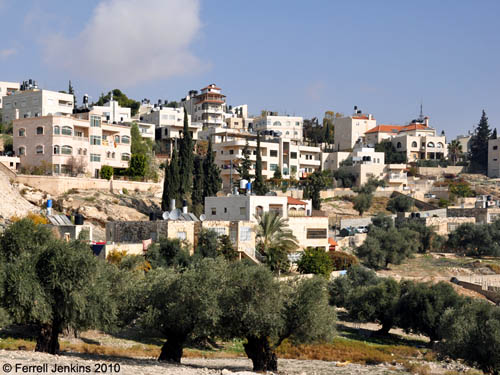
Bethany, the village of Mary, Martha and Lazarus (John 11:1), was located on the eastern slope of the Mount of Olives about two miles from Jerusalem (John 11:1, 18). The photo below of the eastern slope of Olivet was made from near the traditional tomb of Lazarus at Bethany. In the time of Jesus the mountain was likely filled with olive trees. Today we see modern housing. Jerusalem may be seen only after one reaches the crest of the mountain.

Eastern slope of Mount of Olives near Bethany. Photo by Ferrell Jenkins.

Eastern slope of Mount of Olives near Bethany. Photo by Ferrell Jenkins.