
Normally I make multiple photos of any scene when possible, especially if there is a good chance I will not get a second opportunity. Our photo today is literally one of a kind. It is from the tomb of Rekhmire in the Valley of the Nobles in Egypt. While my group visited the Valley of the Kings our guide arranged transportation for me to visit this unique tomb which shows the process of brick-making in ancient Egypt.
A guard at the tomb allowed me to enter and make ONE photo. I gave him a tip of $5.00. I asked to make another photo, but he showed no interest in a second payment. This is my only photo and I was pleased with it.
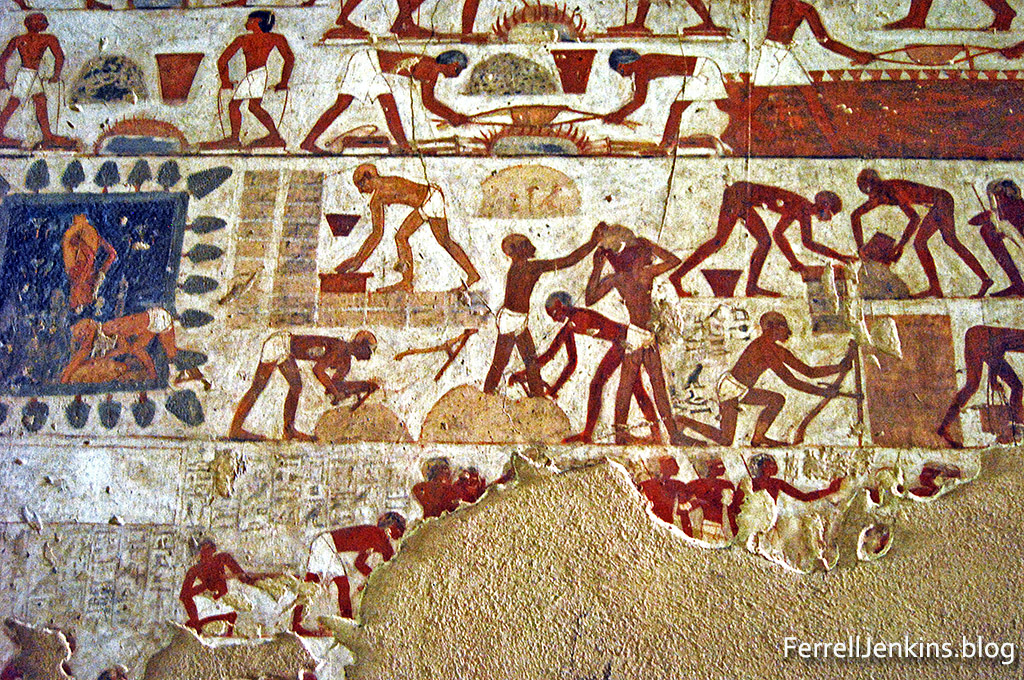
Brick-making scene in the tomb of Rekhmire, Valley of the Nobles in lower Egypt..
In preparation for my tour I had enjoyed studying the Fall 2004 issue of Bible and Spade (Vol. 17 No. 4). Gary A. Byers wrote an article titled “The Bible According to Karnak.” I had become acquainted with Gary at the annual Near East Archaeological Society meetings and appreciated his work. Notice this paragraph which includes a mention of the scene above.
Also on the Nile’s west bank were the tombs of the nobles. Not being royally. they could not be buried within the Valley of Kings, the resting place of the Pharaohs they served. Within these tombs are colorful paintings of significant events in their lives. From Mena’s tomb (ca. 1385 RC) was a grain harvest scene that helps us imagine the seven years of plenty from Joseph’s time (Gn 41:47-49). The Tomb of Userhat (ca. 1280 BC) shows barbers cutting hair, also reminiscent of the Joseph story (Gn 4 1:14). From the Tomb of the Vizier Rekhmire (ca. 1470- 1445 BC) is a brickmaking and building scene depicting Asiatics from the actual period of the Israelites bondage (Ex 1:11 – 14; 5:7- 19).
We are not saying that these are Israelites, but that they are Asiatics from the same period that, according to the Bible, made brick and did other slave labor in Egypt.
These additional photos show more examples of brick making in Egypt.
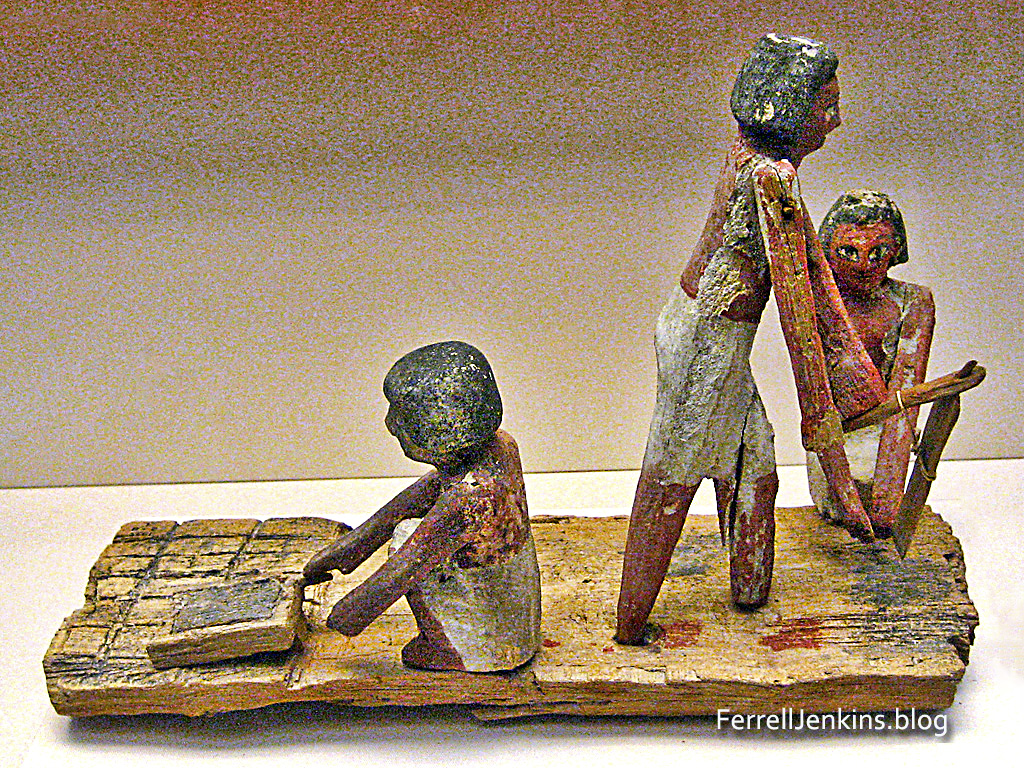
Model of brick making in ancient Egypt now displayed in the British Museum. Photo by Ferrell Jenkins.
The text mentioned in Byers’ article says,
11 Therefore they set taskmasters over them to afflict them with heavy burdens. They built for Pharaoh store cities, Pithom and Raamses.
12 But the more they were oppressed, the more they multiplied and the more they spread abroad. And the Egyptians were in dread of the people of Israel.
13 So they ruthlessly made the people of Israel work as slaves
14 and made their lives bitter with hard service, in mortar and brick, and in all kinds of work in the field. In all their work they ruthlessly made them work as slaves. (Exodus 1:11-14 ESV)
Exodus 5:7-19 specifically says that the Israelites were using straw to make brick. Our photo below, also from the British Museum, shows a brick with straw in it.
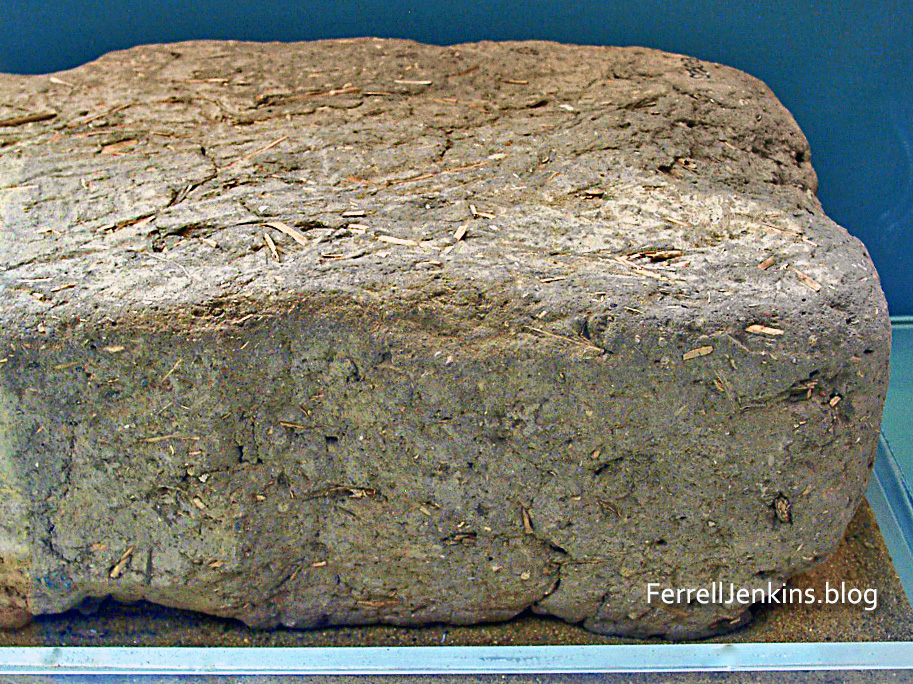
This brick from ancient Egypt was made with straw. Displayed in the British Museum. Photo by Ferrell Jenkins.
The Bible and Spade article may be located online here. There you will find a drawing showing the brick making scene as well as other types of labor.
Bible and Spade is published four times a year by Associates for Biblical Research.
 Ferrell's Travel Blog
Untrue Events: The Hebrews come from Eber, and they were not Jews. Servants in ancient times were not slaves. The Bible proves how easily Moses escaped and how the Egyptians provided the straw. Jews are from Japheth’s son, Gomer. He had a son named Ashkenazi, and this tribe is mentioned in other places in the Bible. They adopted the belief of the Pharisees, who were the scribes who returned to the Babylonian captivity. They were against THE MESSIAH, YAHSHUA! Their religion or belief became the central belief after the death of the disciples and apostles of YAHSHUA and the temple’s destruction. The belief is called the Judiaic Rabbinical belief, historically known to be related to the Pharisees. Secondly, other proof that they were not slaves is where they lived in Goshen, even when Amose took Egypt back from the Hyksos. Aaron came to Moses and was the one who spoke to Pharaoh.Another problem is the writing was not Semitic but Phoenicians who created the alphabet and the writing. A comb has been found 3700 years to prove this as well. Finally, it was not Hatshepsut who found Moses. It was her daughter, Neferure , that found Moses and named him. She left with him, that is why no tomb has been found.
My husband is not black but southern Italian(mixes of arab, jewish and etruscan ).When he works outside in the sun, he is literally blacker than my African American grandson!!Song of Soloman1;6 Look not upon me, because I am black ,because the sun hath looked upon me. I believe Beth ,the bible is very accurate and so were the artisans of Egypt. If you are implying this cant be jewish slaves because their skin color doesn’t match what you know of ancient or present day Jews, I challenge you to think again.
I believe the accounts of brick making in Egypt had to be preserved as this site claims to do; however, we should understand that Jews living in Egypt, who made the bricks, were never black. There may have been Jewish converts who were a dark race, but Israel was not then nor now a dark race.
Thanks, Ferrell: Great pictures.