Tag Archives: Book of Acts

Acts 5 — Photo Illustrations

The temple held a central place in the early days of the church. The gospel was preached to the large number of Jews from “every nation under heaven” in the temple precinct. After their acceptance of Jesus as Lord and Christ, the disciples continued “in the temple” (Acts 2:5; 2:46).

Twice in Acts it is recorded that the followers of Jesus met in Solomon’s Portico.

Now many signs and wonders were regularly done among the people by the hands of the apostles. And they were all together in Solomon’s Portico. (Acts 5:12) ESV)

The Greek word for portico or porch is stoa. The term is used in Acts 3:11; 5:12; John 5:2; 10:23. BDAG says it is used of,

a roofed colonnade open normally on one side, portico.

During a winter visit to Jerusalem at the time of the Feast of Dedication, Jesus “was walking in the temple in the portico of Solomon” (John 10:23).
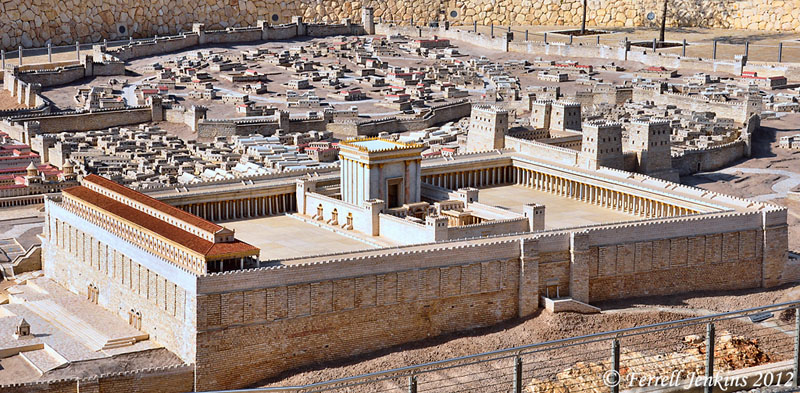
Second Temple Model showing porticoes around the perimeter of the Temple precinct. Photo by Ferrell Jenkins.

Notice porticoes around the perimeter of the temple precinct. Photo by Ferrell Jenkins.

This photo provides a better view of some of the Royal Portico on the south side of the temple platform (left). The other portico is on the west side. Solomon’s Portico is hidden by the wall on the east side.
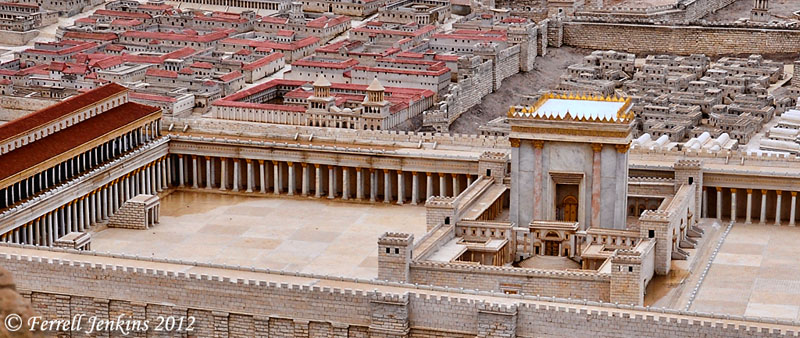
Second Temple Model showing Porticoes. Photo by Ferrell Jenkins.

Second Temple Model showing Porticoes. Photo by Ferrell Jenkins.

Each portico was formed by two rows of columns and was 49 feet wide. These “lent great splendor and majesty to the lofty Mount and served also – the royal Portico in particular – as the gathering place for great assemblies” (Mazar, The Mountain of the Lord, 124). Fragments of these gigantic monolithic columns (27 ft. high; 4.6 ft. in diameter) have been uncovered during the Temple Mount excavations directed by Professor Mazar.

The Royal Portico was built by Herod along the southern end of the Temple courts and is described by Josephus as deserving to be mentioned above any under the sun (Antiquities 15.11.5).

Solomon’s Colonnade or Portico ran along the eastern portion of the outer court of the temple precincts.
Acts 4 — Photo Illustrations

In Acts 4 we have several public characters mentioned who had a part in the trial of Jesus or in the opposition to the new movement of believers in Jesus as Lord and Christ (Acts 2:36). I will call attention to two of them. The first is a religious leader, and the second is one of the Roman procurators or prefects.

Caiaphas. Caiaphas was the son-in-law of Annas. He was appointed high priest by Valerius Gratus, procurator of Judea, in A.D. 18 and deposed by Vitellius, legate of Syria, in A.D. 36 at the same time Pilate was removed as procurator of Judea. Caiaphas was the Jewish high priest before whom Jesus was tried (John 18:13-14, 24).

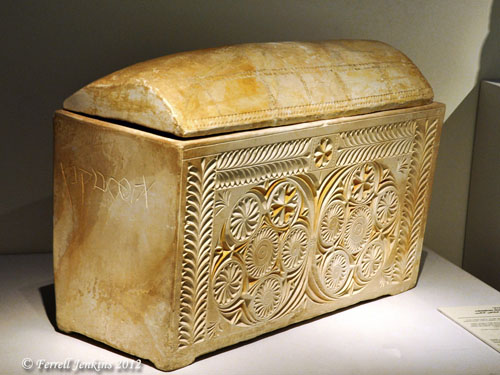
In November, 1990, a burial cave was found accidentally during construction of a water park at a promenade overlooking the Peace Forest just south of the old city of Jerusalem. The cave contained 12 ossuaries, two of which contained the name of the well-known family of the high priest Caiaphas. One ossuary bore the inscription Qafa, and the other bore the name Yehosef bar Qayafa (Joseph, son of Caiaphas) and Yehosef bar Qafa (Joseph, son of Caiaphas). Inside this beautiful ossuary was found the bones of six different people: 2 infants, a child between 2 and 5, a young boy between 13 and 18, an adult woman and “a male of about 60 years!”

According to Josephus, Caiaphas was named Joseph Caiaphas (Ant. 18.2.2).

The Caiaphas ossuary is on display in the Israel Museum. (See articles: Zvi Greenhut, “Burial Cave of the Caiaphas Family,” BAR 18.5 (1992): 29-36. Ronny Reich, “Caiaphas Name Inscribed on Bone Boxes,” BAR 18.5 (1992): 38-44.)

Decorated ossuary bearing the name of Caiaphas. Israel Museum. Photo by Ferrell Jenkins.

Ossuary bearing the name of Caiaphas. Israel Museum. Photo by Ferrell Jenkins.

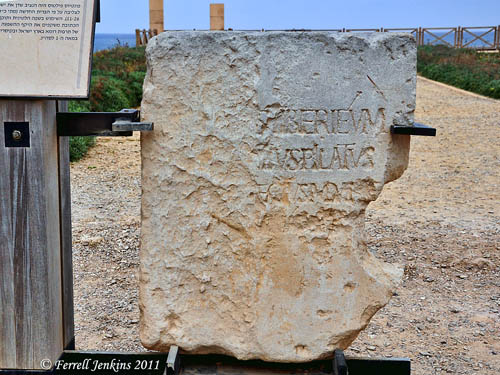
Pontius Pilate. Pilate was the Roman procurator of Judea when Jesus was crucified (A.D. 26-36). An inscription bearing the name of Pilate was discovered at Caesarea, the residence of the procurator, in 1961. The stone is thought to have been used in the dedication of a statue or some public building. The original is in the Israel Museum but a replica is displayed at Caesarea.

Murphy-O’Connor suggests the following translation of the Latin inscription: “Pontius Pilate, Prefect of Judaea, made and dedicated the Tiberieum to the Divine Augustus” (The Holy Land, 3rd ed., 215).

Pilate Inscription (Replica) at Caesarea Maritima. Photo by Ferrell Jenkins.

Pilate Inscription (Replica) at Caesarea Maritima. Photo by Ferrell Jenkins.

The Roman historian Tacitus (A.D. 55-117) writes about the persecution of a group commonly called Christians. He says the originator or author of the group,

Christ, was put to death by the procurator, Pontius Pilate, while Tiberius was emperor…

See John 18:28ff.

Acts 3 — Photo Illustrations

We begin today with a photo of the Second Temple Model of Jerusalem. This is the time of Jesus and the early days of the church. The wonderful model is now displayed on the grounds of the Israel Museum. Our view of the model shows pre-70 A.D. Jerusalem from the southwest (assuming we were photographing the city; not the modern setting of the model).

To the right of the photo is the dome of the Shrine of the Book. In the distance between the trees you will see Israel’s Knesset building.

Model of the city of Jerusalem in the time of Jesus. Photo by Ferrell Jenkins.

Model of the city of Jerusalem in the time of Jesus. Photo by Ferrell Jenkins.

Acts 3 begins with the account of Peter and John going up to the temple.

Now Peter and John were going up to the temple at the ninth hour, the hour of prayer. (Acts 3:1 NAU)

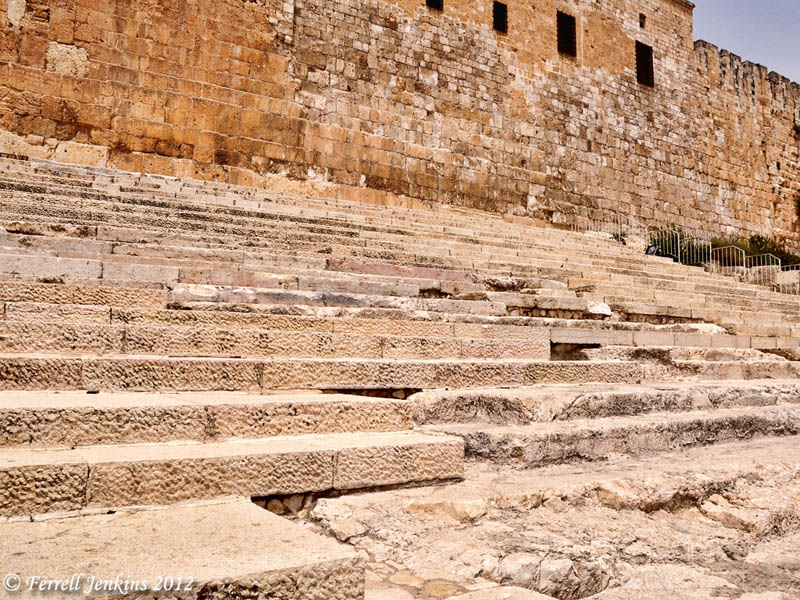
Following 1967 an excavation of area around the southern wall of the temple enclosure was conducted by Prof. Benjamin Mazar. Mazar describes the monumental stairway that was uncovered.

In the course of our excavations in the area facing the Western Hulda Gate, we uncovered a gigantic stairway which led from the Lower City (Ophel) to the gates. It is two hundred and fifteen feet wide; the foundation steps were cut into the natural bedrock on the slopes of the Temple Mount. The stairs were constructed of wide, trimmed and smoothed stone paving blocks, fitted together snugly. The stairway comprised thirty steps set alternately in wide and narrow rows. (The Mountain of the Lord, 143).

The Monumental Stairway led to the Double Gate which led into the temple precinct. We can safely say that Jesus and His disciples used these steps to enter the temple precinct.

Monumental Stairway leading to the temple. Photo by Ferrell Jenkins.

Monumental Stairway leading to the temple. Photo by Ferrell Jenkins.

Dr. Leen Ritmeyer, author of The Quest, calls attention to the virtual model of the Temple Mount in the time of Jesus. The brief video is helpful in understanding the area. Click here.

Perhaps another day we can discuss the Beautiful Gate (Acts 3:2, 10).

Acts 2 — Photo Illustrations

Acts 2 is one of those highly significant chapters of the Bible. It is a pivotal point, or as the late James D. Bales called it in one of his books, “The Hub of the Bible.” The reason is because so many Old Testament prophecies looked forward to their fulfillment in the events of Acts 2 (e.g., Isaiah 2, Joel 2, Daniel 2), and because many New Testament texts look back to the beginning of the gospel in that chapter (e.g., Ephesians 2). In fact, Peter refers to the events of Pentecost as “the beginning” (Acts 11:15).

The prophet Isaiah said,

Now it will come about that In the last days The mountain of the house of the LORD Will be established as the chief of the mountains, And will be raised above the hills; And all the nations will stream to it. And many peoples will come and say, “Come, let us go up to the mountain of the LORD, To the house of the God of Jacob; That He may teach us concerning His ways And that we may walk in His paths.” For the law will go forth from Zion And the word of the LORD from Jerusalem. (Isaiah 2:2-3 NAU)

From the beginning of His ministry, Jesus spoke of the establishment of the kingdom during the lifetime of some of those who heard him (Mark 1:14-15; 9:1).

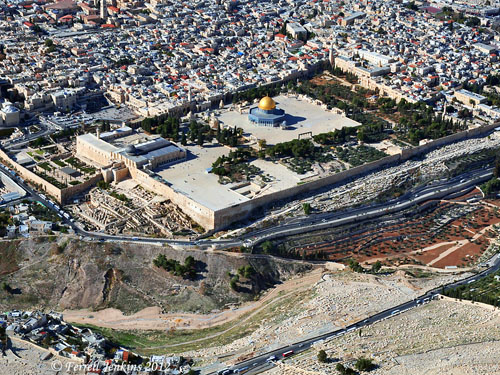
Our aerial photo shows the enclosed Islamic sanctuary area that is commonly called the Haram es-Sherif. Benjamin Mazar says that this area is about 40 acres. He points out that Josephus and the Mishna give smaller dimensions, and says that they apparently refer to “the Soreg or sacred enclosure” (The Mountain of the Lord, 119-120). Other writers say the area is 36 acres in size. Certainly large enough for the crowds who came to Jerusalem for festivals such as the Passover and Pentecost.

Solomon’s temple stood on Mount Moriah (2 Chronicles 3:1). Centuries later Herod the Great built the large platform and enclosure walls. Stones from that wall can still be seen in many places around this vast enclosure. The picture shows the southern wall and the eastern wall (the long one). The Kidron Valley and a portion of the slope of the Mount of Olives is visible in the bottom of the photo.

Aerial view of the temple precinct from the time of Herod the Great. Today the area is occupied by Moslem shrines, Al Aksa Mosque and the Mosque of Omar (Dome of the Rock). Photo by Ferrell Jenkins.

Aerial view of the temple precinct from the time of Herod the Great. Today the area is occupied by Moslem shrines, Al Aksa Mosque and the Mosque of Omar (Dome of the Rock). Photo by Ferrell Jenkins.

Click on the photo for an image suitable for use in teaching.

The New Testament (Greek) makes a distinction between the entire temple precinct, courts and all (Greek, hieron), and the sanctuary where only the priests were allowed (Greek, naos). John 2:14-15 uses hieron. John 2:19-21 uses naos.

Hieron is the term used in Acts 2:46. The new converts met in the temple precinct. They most likely assembled in one of the large porticoes built around the inside of the enclosure wall (cf. Acts 3:11; 5:12).

Day by day continuing with one mind in the temple, and breaking bread from house to house, they were taking their meals together with gladness and sincerity of heart,  praising God and having favor with all the people. And the Lord was adding to their number day by day those who were being saved. (Acts 2:46-47 NAU)

It also was within this precinct that the large crowd of devout Jews “from every nation under heaven” assembled on Pentecost. Here, Peter preached the gospel of the death, burial, and resurrection of Jesus for the first time.

Acts 1 — Photo Illustrations

Many churches study the book of Acts in various classes. I thought I might begin a series of brief blogs using at least one photo for each chapter in Acts. We will not run these photos daily, but one or two a week. The photos normally will be 800 pixels wide — wide enough for use in PowerPoint presentations. It will be best to leave some space around them. This will allow room for an identifying caption. There is no need to write for permission to use these photos for educational, non-commercial, purposes. I would appreciate a comment or note telling me how you used the material.

The first chapter of Acts includes:

  • The promise to the 11 apostles that they would be baptized with (in) the Holy Spirit (1:4-5; Cf. John 14-16).
  • Jesus’ restatement of the Great Commission (1:8).
  • The ascension of Jesus from the Mount called Olivet (1:9-12). In the Gospel, Luke says the ascension took place at Bethany (Luke 24:50). Bethany is on the eastern slope of the mountain.

Then they returned to Jerusalem from the mount called Olivet, which is near Jerusalem, a Sabbath day’s journey away. (Acts 1:12 ESV)

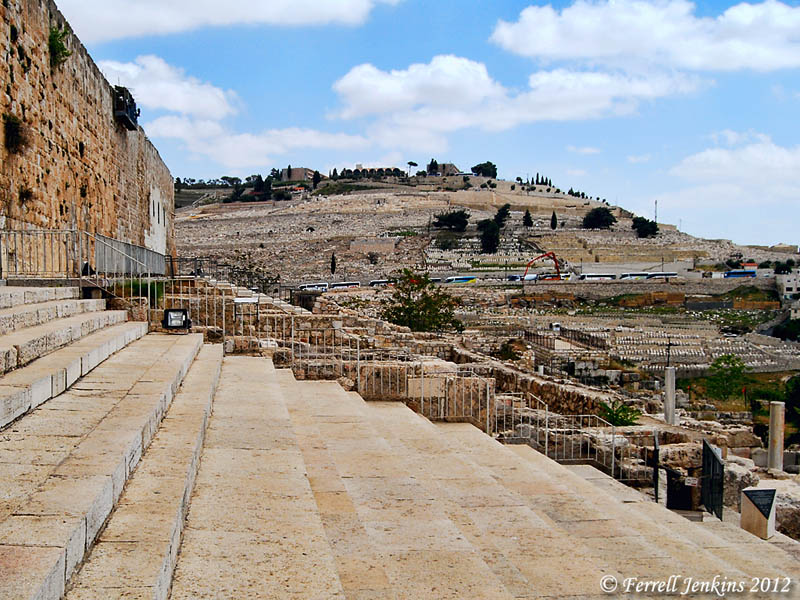
The photo shows the western slope of the Mount called Olivet from the steps on the southern end of the Temple enclosure (precinct) built by Herod the Great.

The Mount called Olivet from the Temple Mount. Photo by Ferrell Jenkins.

The Mount called Olivet from the Temple Mount. Photo by Ferrell Jenkins.

Other events in Acts 1 include:

  • The meeting of the 11 apostles in the upper room (1:13).
  • The record of the death of Judas (1:16-20).
  • The selection of Matthias to replace Judas (1:20-26).