Tag Archives: Apostle Paul

Assos temple to be restored

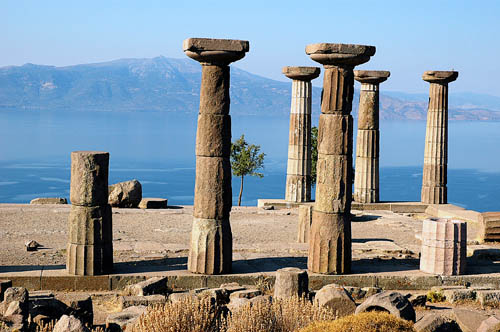
The current issue of Artifax reports that the temple of Athena at Assos in northwestern Turkey is to be restored. The temple was built originally about 540-530 BC. The project is expected to take about three years. Many pieces of the temple are scattered in museums (Istanbul Archaeological Museum, Louvre, Boston Museum of Fine Arts). The temple is built on a high cliff overlooking the sea. Here is the way the temple looks now.

The apostle Paul undoubtedly saw the temple of Apollo when he traveled the approximate 20 miles from Alexandria Troas to Assos by land. His companions had traveled by boat from Troas to Assos. The historical account reads this way:

But going ahead to the ship, we set sail for Assos, intending to take Paul aboard there, for so he had arranged, intending himself to go by land. And when he met us at Assos, we took him on board and went to Mitylene. (Acts 20:13-14 ESV)

The island across the strait is Lesbos. Further south is the town of Mitylene on Lesbos. Lesbos is now a Greek island in the Aegean.

Paul’s journey in Macedonia

During his second journey, while at Troas, Paul saw a vision of a man of Macedonia. Luke gives the following record of the vision and of the subsequent action of the apostle.

A vision appeared to Paul in the night: a man of Macedonia was standing and appealing to him, and saying, “Come over to Macedonia and help us.” When he had seen the vision, immediately we sought to go into Macedonia, concluding that God had called us to preach the gospel to them. (Acts 16:9-10)

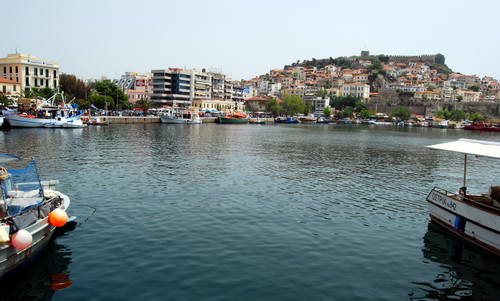
Paul and his companions, including Luke, landed at Neapolis (modern Kavalla). The text indicates that the real goal of their mission was to reach the Roman colony of Philippi. Someone has commented that it is often the case that preachers have a call from a man to come preach somewhere. When they arrive they find mostly women. Paul found Lydia of Thyatira. She was a seller of purple. Whether the cloth or the dye, we are not told. She was the first convert on European soil. We make much of the fact that this was the first preaching in Europe. At the time the most important thing is that it was the first preaching in the Roman province of Macedonia (now northern Greece). Here is a photo of the modern port at Kavalla.

Luke’s account of the first convert in the city is recorded in Acts 16.

And on the Sabbath day we went outside the gate to a riverside, where we were supposing that there would be a place of prayer; and we sat down and began speaking to the women who had assembled. A woman named Lydia, from the city of Thyatira, a seller of purple fabrics, a worshiper of God, was listening; and the Lord opened her heart to respond to the things spoken by Paul. And when she and her household had been baptized, she urged us, saying, “If you have judged me to be faithful to the Lord, come into my house and stay.” And she prevailed upon us. (Acts 16:13-15)

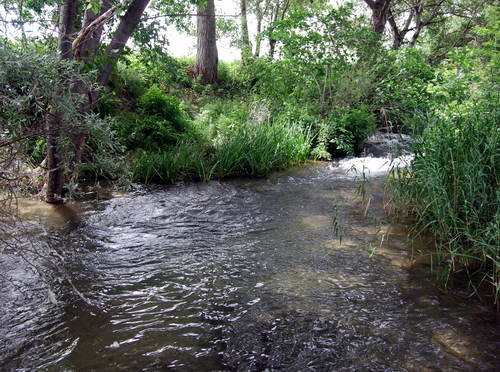
The river Ganga (some say Gangites) is a short distance north of the Agora of Philippi (IDB, III.787). This must be the river under consideration in the biblical account. Here is a photo of the river that I made yesterday.

We also visited Neapolis (modern Kavalla), Amphipolis and Appollonia.

Now when they had traveled through Amphipolis and Apollonia, they came to Thessalonica, where there was a synagogue of the Jews. (Acts 17:1)

Today we plan to visit some important sites in Thessalonica.

On the road in the Steps of Paul and John

Tuesday afternoon, May 6, our group should land in Istanbul, Turkey, to begin a tour that I have called Steps of Paul and John. This area of travel has been one of my favorites for many years. My first visit here was in 1968. We will visit Istanbul, a city rich in church history. It has been called Constantinople and Byzantium.

From Istanbul we plan to fly to Izmir, the site of biblical Smyrna. There we begin a visit to the sites of the seven churches of the book of Revelation (chapters 2-3), and a few other sites (Hierapolis, Colossae, Miletus, and Aphrodisias). We will be discussing important themes from the book of Revelation during this portion of the tour.

Our group will then spend 3 days cruising the Aegean Sea in order to visit some of the islands associated with the travels of Paul and John. Our first stop will be at Patmos (Revelation 1:9). Then Rhodes (Acts 21:1) and Crete (Acts 27; Titus 1:5). There is also a stop at Santorini.

Upon arrival in Athens, Greece, we will visit the city of Athens (Acts 17). We have planned a visit to ancient Corinth also (Acts 18).

We hope you will join us for these visits. I will do my best to write a post each day of the tour.

The Corinth Canal

The city of Corinth is located about two miles south of the narrow isthmus which forms the land bridge, and controlled access, between the main land mass of Greece and the Peloponnesus.

The isthmus is less than five miles wide. In ancient times small ships were dragged across the isthmus on a paved road called the diolkos. Small portions of the diolkos may still be seen. Larger ships unloaded their cargo which was carried across and reloaded. This avoided the long 200 mile journey around the Peloponnesus. Nero abandoned his attempts to dig a canal across the isthmus (A. D. 67).

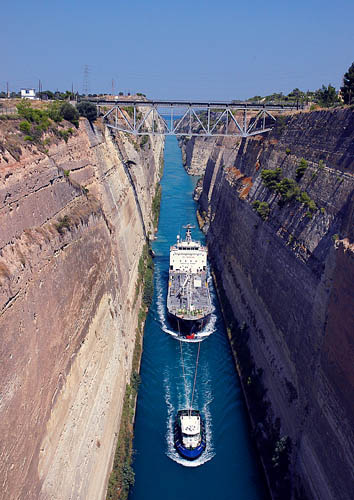
A canal was constructed between 1881 and 1893. Here is a photo of that canal with a tug boat pulling a ship through the canal.

Corinth Canal. Photo by Ferrell Jenkins.

The apostle Paul likely came to Corinth about A.D. 51, during the reign of the Roman Emperor Claudius, and remained there for eighteen months (Acts 18). The book of Acts records the success of that work:

Crispus, the leader of the synagogue, believed in the Lord with all his household, and many of the Corinthians when they heard were believing and being baptized. (Acts 18:8).

Archaeological excavations have been conducted at the ancient city of Corinth since 1896 by the American School of Classical Studies in Athens.

Archaeological work at Ephesus might take centuries

Today’s Zaman, reports that the archaeological excavation at Ephesus may continue “for centuries.” The article says that work began at Ephesus 138 years ago. This reference seems to be to 1869 when the English architect J. T. Wood found the marble floor of the temple of Diana. Some research had been done as early as 1845.

Most of the archaeological work at Ephesus has been done by Austrians. They began the work in 1895 and have continued until the present time.

The article reports an interview with Dr. Fritz Krinziner, director of the dig and head of the Austrian Archaeology Institute. I note that Dr. Krinziner wrote Preface 2 in Ephesus: 100 Years of Austrian Research, published in 1996. Here are a few interesting comments from the article.

” He [Krinziner] stressed that it would be impossible to uncover the entire ancient city at once, underlining that only 10-15 percent of the site has been unearthed so far.”

“The excavation work may last for centuries. This is not an easy job. We focus on spots where we are likely to find something important as we cannot carry out the entire excavation at once.”

The article says that 1.5 million people visited Ephesus last year. An added note says that the Greater Izmir Municipality has announced plans “to establish an electric railway connection, similar to a tram, in Ephesus.”

The complete article may still be available here.

I speak to some people who seem to think that most of the archaeological work in various biblical cities has already been done. The work is complete! Think again.

Ephesus is visited by many tourists who have no interest in the Bible. They arrive on the cruise ships that dock at nearby Kusadasi. Others find the ruins interesting because the city was the site of Paul’s work (Acts 19). I think the tradition that the apostle John was here prior to being exiled to Patmos is a reliable one. The first letter within the book of Revelation is addressed to the church at Ephesus (Rev. 2).

This photo shows the Library of Celsus and some costumed actors from one of the cruise ships putting on a show for the passengers.
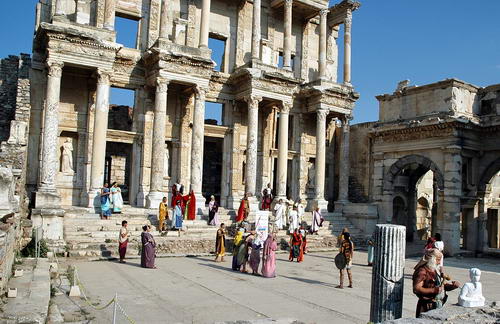
Library of Celsus at Ephesus. Photo by Ferrell Jenkins.

The Library was built in A.D. 135, after the time of Paul and John. The first time I saw this area, in 1968, only the steps were visible. The Austrian excavators did a marvelous job of reconstruction between 1970 and 1978. It is estimated that the Library could hold between 9,500 and 12,000 rolls. The arch to the right leads to the ancient agora.

We visit Ephesus on our Steps of Paul and John tour.