Category Archives: Turkey

Looking for the Ancient Crossroads Tour blog?

If you are looking for the blogs and photos of the Ancient Crossroads Tour of Biblical and Historical Turkey, please look to the right under Archives and go to May 2007. Start at the bottom of the page and make your way up. Then move on to June, etc.

The Ancient Crossroads tour covered the area of the Hittites and Paul’s first missionary journey. In addition, I spent a week visiting biblical sites in Eastern Turkey. These included the land of Ararat, traditional Mount Ararat, Harran [Haran], Mesopotamia, the Tigris and Euphrates rivers, etc.

All of WordPress.com is blocked in Turkey!

WordPress.com is reporting tonight that the entire site has been blocked in Turkey. It seems to involve someone’s disagreement about one blog that has disagreed with a Turkish author. This is sad. WordPress has 1,348.871 bloggers (probably more by the time you read this). Without me they would only have 1,348,870!

Since beginning this blog I have observed that there are many Turkish bloggers. I think this blog helps to promote tourism in Turkey. Why should I be blocked in Turkey? I suspect that many Turks disagree with such censorship. Hopefully the issue will be resolved so our friends in Turkey can once again see the information we have written about some of the biblical and historical sites in the country.

Edward Bulwer-Lytton is credited with saying, in 1839, “The pen is mightier than the sword.” Others have said the same thing, or something similar.

Comments by tour members

At the close of the Ancient Crossroads tour, I asked any of our tour members who wished to write a brief comment about the tour. As I was catching up and cleaning my desk today I ran across these comments. There may have been others that I have misplaced. We are blessed with some really fine people and good Bible students and teachers who travel with us.

“We feel so blessed to have been a part of the tour these two weeks. To have traveled in the footsteps of Paul provides an insight into Scripture never before realized. Thanks so much Ferrell.” (Mike and Peg, Alabama).

“The houses, churches, and shops carved from the formation of tufa were so unique and unusual and the balloon ride over the area [of Cappadocia] was a real highlight. Discovery of the Roman road was great! Walking along and reflecting that Paul and others probably walked that way was very moving. And speaking of moving — to be where they were first called Christians — Antioch!” (Dave and Marge, California).

“Seeing the areas where the apostle Paul lived and preached extremely rewarding. We feel confident our travels will now heighten our appreciation for Paul and his work. Great trip.” (Larry and Joan, Kentucky).

“Wonderful trip to a fascinating country. Visiting the sites where Paul and others spread the gospel makes a unique connection to the first century Christians. The most memorable [unanticipated] stop was the native [nomad] girl caring for the camels. But also the Roman road. Fantastic! And the friendly and hospitable people of Turkey. Thanks Ferrell and Elizabeth for all your efforts to help us grow.” (Doug and Linda, California).

“We appreciate so much the attention that was given to relating the places we have visited to the biblical text. And the special effort that you make to show us the people and places, such as the Roman road, added to our understanding of first century life.” (Olen and Jane, Alabama).

“This has been our fourth trip to the lands of the Bible (Israel, Steps of Paul and John, Egypt, and now the Ancient Crossroads). Each trip has been different and extremely helpful in better understanding God’s revealed word. This trip has made us more acutely aware of the hardships that Paul and his brethren faced as they endeavored to carry out God’s instruction to preach the gospel in Judea, Samaria, and the uttermost parts of the world. Somehow it makes our burdens a little lighter!” (Jackie and Donna Jo, Alabama).

“I cannot describe what a blessing it was to listen to brother Jenkins as we traveled through Turkey. Ferrell is a man of incredible ability and his knowledge of life in Bible times would be hard to beat! He is truly a “scholar and a gentleman.” I consider it a great honor to count him as my friend.” (David, Illinois).

Padfield’s photos of Tarsus

David Padfield has begun to post photos of the Ancient Crossroads tour suitable for use in PowerPoint presentations. His first photos are of Tarsus. See the photos here. David is a good photographer. He has no explanation with his photos. Perhaps you can find some helpful information in this blog.

Looking for the Turkey travel blogs?

If you have come to this site looking for the blogs (and photos) of the Ancient Crossroads Tour of Biblical and Historical Turkey you might like to start at the beginning. You can use the calendar (or the Archives) to the right and go back to May 23 for the first blog. Or, you can just read backward to that point. It works either way.

Ben Witherington at Mount Nemrud [Nemrut]

Ben Witherington recently visited Mount Nemrud [or Nemrut] and has posted several good photos.  Note his point about the Greek of Ephesians and 2 Peter, and his theological comments on heaven and hell. Click here to go to the Ben Witherington blog.

And while looking at Ben’s blog, you might want to check his excellent stormy night photos of the Library of Celsus at Ephesus.  Click here.

Mission Accomplished — Turkey is done

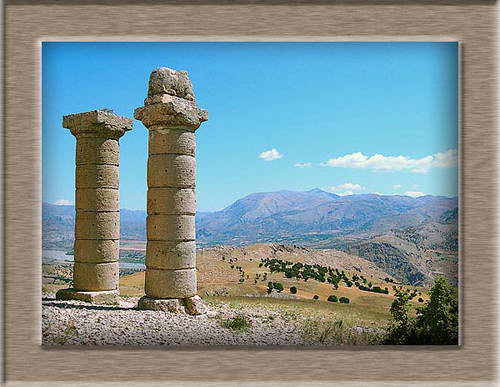
This morning we left the hotel in Kahta about 10 a.m. and headed back toward Mount Nemrut to visit the Karakus Tumulus. This site was built in 36 B.C. by King Mithridates II as a burial mound for three female relatives. This, like Nemrut, was part of the Kingdom of Commangene. From here we had a nice, distant view of Mount Nemrut. This photo shows the mound at Karakus. Nemrut is the high pointed peak.

Karakus Tumulus. Mount Nemrut in distance. Photo by Ferrell Jenkins.

We continued a few miles to see a Roman bridge over the Cendere River that was built in the 2nd century A.D. in the time of Septimius Severus. Some of the limestone blocks in this bridge we made from columns that once surrounded the Karakus Tumulus.

Then we drove to the Gaziantep airport to wait for our flight to Istanbul. Lord willing, tomorrow morning we will depart for home.

I am writing this blog in a restaurant in the airport while eating spaghetti.

During the Ancient Crossroads tour the group traveled 1953 miles by coach. On the excursion to Eastern Turkey we drove 1376 miles. That’s a total of 3328 miles. We did not see an accident during the entire 3 weeks. It is also significant that we did not encounter anything unpleasant except for kids at some locations who tried to become our guide.

David Padfield says that Ferrell drives surprisingly well for a man of his age. Is that a slam, or what?

We did not expect the hotels in the East to be as good as we have used in the western and central part of the country. Our hotels ranged from the less than desirable one at Mount Ararat to a 5-star hotel in Gaziantep. Every hotel (for the three weeks had wireless Internet available except for the one at Mount Ararat. This was very nice, and allowed me to keep this blog fairly current every day. It is time consuming. Most nights I only got about 6 to 6 1/2 hours sleep. I need to get home and rest a while!

We are thankful to the Lord for the safety of our travel. We are thankful to have been able to make this trip and to have shared it with you. We hope to be able to share it with our brethren in many ways in the coming years.

We arrived safely in Istanbul and are now in the Airport Hotel. We have to be up at 3 a.m. to make the flight to the USA.

Gaziantep Museum, Mayberry, and Mount Nemrut

This morning we visited the Muze in Gaziantep. This museum contains many of the mosaics and some statues from the Roman city of Zeugma. Zeugma has been covered by the waters of the Euphrates River due to one of the dams built by the Turkish government to provide hydro-electric power and water for irrigation for southeastern Turkey. Archaeologists worked diligently over a period of years to preserve as much of the material as possible. The small mosaic below had been called Gypsy Girl. I think it would rival the Mona Lisa.

Gypsy Girl from Zeugma in Gaziantep, Turkey, Museum. Photo by Ferell Jenkins.

By 11 a.m. we headed for Mount Nemrut. We stopped at a gas station in Bezni for a comfort break. The locals who were sitting around talking did their best to communicate with us. Everyone we meet is friendly. I call this photo “Mayberry, Turkey.”

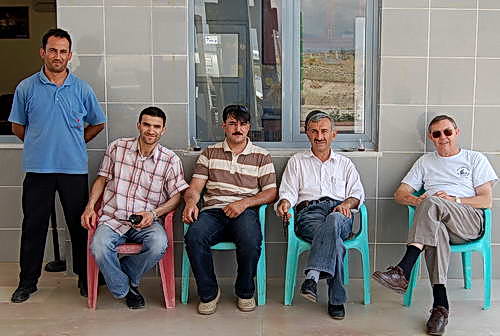
“Mayberry” Turkey. Ferrell with men at Besni. Photo by Gene Taylor.

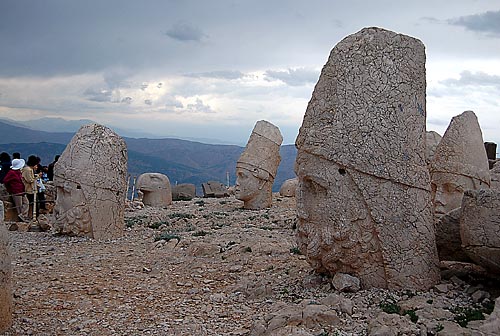
After checking in at the Zeus Hotel in Kahta, we arranged for transportation to Mount Nemrut. In 1995 I drove to the parking lot in a rental car, but decided that it would be best to leave the driving to someone else. It took about 1 1/2 hours to get to Nemrut Dagi. This mountain is part of the Anti Taurus range and is more than 7000 feet above sea level. This area was known as the Kingdom of Commangene in the three centuries preceding the Christian ear. It served as a buffer between the Seleucids and the Parthians in the third century B.C. In the first century B.C. it served as a buffer between the Romans and the Parthians. The most famous ruler was Antiochos I Epiphanes (ruled 64-38 B.C.). In 72 A.D. Vespasian made the Commangene part of Roman Asia. Being away from home I have relied on LonleyPlanet Turkey (April, 2007) for some of the facts. The sunset was not very brilliant this evening. In fact we left a little early because of an approaching shower. The tumulos was made of loose stones in the form of a pyramid. Antiochus ordered this built as a burial site for himself and some relatives. The remaining tumbled statues of rulers and gods are impressive. Some of the heads are between 6 and 7 feet tall. Take a look at the people beside one of them. The site overlooks the Euphrates River to the East.

Mount Nemrut (Nemrut Dagi). Photo by Ferrell Jenkins.

By 8:30 our driver had us back to the hotel and we enjoyed the evening meal. We thought Leon would have arrived in the USA, so we called him to tell him that this was the best day of the tour!

Regarding Your Emails; Euphrates River.

Even though we are in a very nice hotel in Gaziantep, the wireless connection has been less than ideal. That gets time consuming and a bit frustrating. Thanks for writing about tours and other things you want me to take care of. I would like to do so but do not have the time. This is a study tour and we stay busy.

If you have written about one of the future tours I will keep your Email and respond when I can back at home.

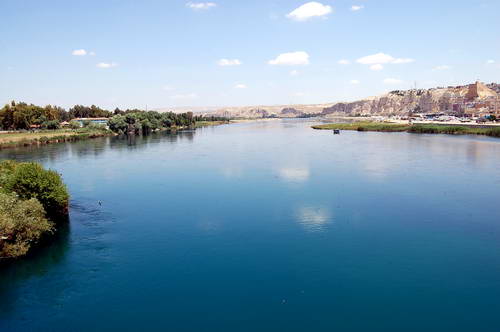
Here is a photo of the Euphrates River that I made yesterday. Read an article I have written on the Euphrates with a photo of the river I made in 1971 near the Persian Gulf. Note the difference in the color of the water in the mountainous region and in the flat area in the south of Iraq.

Euphrates River in southeastern Turkey. Photo by Ferrell Jenkins.

Today we are going to Mount Nemrut (Nemrut Dagi) after a visit to the Gaziantep Museum.

We had a good visit to the museum and have now arrived at Katha. At 4 p.m. we will begin the trip to Nemrut Dagi in time for sunset photos.

Harran – Home of Abraham

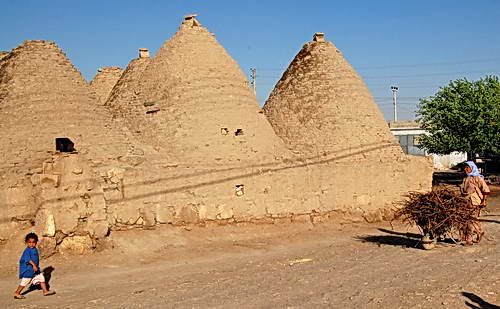
Yesterday afternoon we visited Harran (some English Bible versions use Haran). Harran is located in biblical Padan-Aram (Genesis 25:29, et al). Abraham and his family lived in the area (Genesis 11:21). The city has a long history which I will not go into now. For the past two hundred years the people who live here have built mud brick conical, beehive-shaped houses. We also see some of these houses in northern Syria. Here is a photo showing one of the houses. Due to the heat in this area we waited until late in the afternoon to visit. The lines you see going across the buildings are made by the shadow from the power lines. An oven can be seen to the right of the boy. The woman is bringing a load of pruned grape vines to be used in her oven.

Beehive Type Houses in Harran.

Today we visit Sanliurfa, claimed by the Muslims to be the birthplace of Abraham, and the Euphrates River.