Category Archives: Turkey

The Greek side of Istanbul

Today’s Zaman has an interesting article about Greeks in Istanbul. The article discusses mainly a few Greek remains to be seen in the city and some information about remaining Greek Orthodox churches.The article is interesting because of the historical developments and conflicts between Greek and Turks. The note about the Serpentine Column caught my attention.

Being approximately 2,500 years old, the Serpentine Column is said to be İstanbul’s oldest remaining Greek monument. Erected to honor the triumph of the Greeks over the Persians at Plataea, it originally stood at Delphi (both ancient cities on Greek ground) and was moved to İstanbul in 324 B.C. by Constantine the Great to mark the declaration of the new capital city of the then-founded Roman Empire under the name of Constantinople. The originally eight-meter-high piece was made up of three intertwined serpents which supported a golden bowl. The bowl is believed to have been lost or stolen when the city was sacked during the Fourth Crusade. Some say the heads were hit and cut off by a drunken nobleman in the 17th century but one of them can still be seen in the İstanbul Archaeology Museum. The rest of the column can be found today at the Hippodrome in the Sultanahmet quarter.

There is a serious mistake in the article. The Serpentine Column was originally erected at Delphi in 479 B.C., but it was placed in the hippodrome of Constantinople by Constantine in 324 A.D.

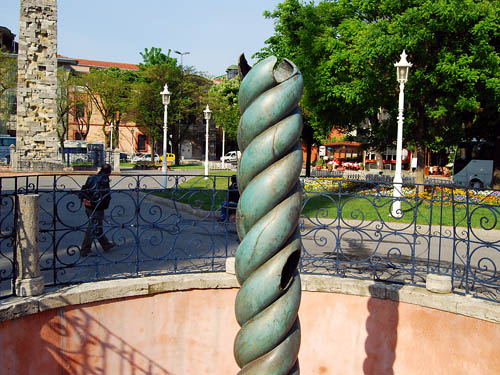
Here is a photo of the bronze Serpentine Column as it stands in the hippodrome.

Serpentine Column in Istanbul. Photo by Ferrell Jenkins.

Bronze Serpentine Column in Istanbul. Photo by Ferrell Jenkins.

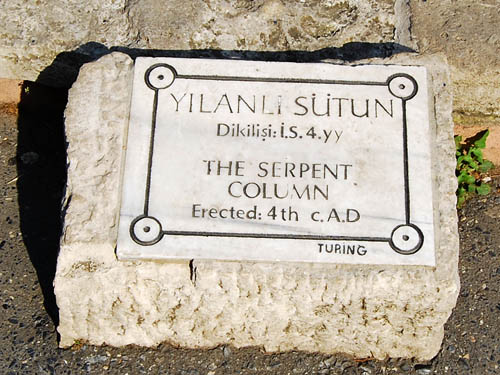
A sign marking the Serpentine Column indicates that the column was erected in the 4th century A.D. That is the date when Constantine had it erected in the hippodrome, but the column dates to the 5th century B.C.

Sign marking the Serpentine Column. Photo by Ferrell Jenkins.

Read the full  Today’s Zaman article here.

HT: Biblical Paths.

Plea for help comes too late

The Times Online recently carried an article by Hannah Devli about a dig in southeastern Turkey under this headline: “Desperate plea for help came too late for ancient Assyrian leader.”

A letter scratched into a clay tablet reveals a desperate plea for reinforcements that came just too late. Alone, petrified and facing almost certain death, the ancient Assyrian leader Mannu-ki-Libbali scrawled a call for help to his commander, but his cry for extra troops came too late.

Soon after it was sent, the ancient city of Tushan was overrun by Babylonian invaders, its temples and palaces pillaged, then torn down or set aflame.

The letter, scratched into a clay tablet in 630BC, may never have reached its intended recipient. But more than 2,500 years later it has been unearthed almost intact by archaeologists, offering an unprecedented glimpse into the downfall of the one of the most powerful empires of the ancient world.
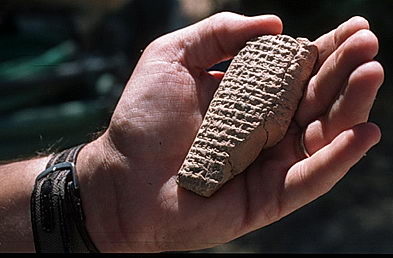
Assyrian tablet with plea of Mannu-ki-Libabli. Photo: Times Online.

Assyrian tablet with plea of Mannu-ki-Libabli. Photo: Times Online.

The archaeologists working at the site say that the author of the letter was a city treasurer who was responsible for building an army to defend the city of Tushan. The article continues…

John MacGinnis, an archaeologist from the University of Cambridge who led the excavation, said: “The letter is written during the process of downfall. The chances of finding something like this are unbelievably small.” Mannu-ki-Libbali laments that he has neither the equipment nor the troops needed for the onerous task ahead. He lists cohort commanders, craftsmen, coppersmiths, blacksmiths, bow makers and arrow makers as essential to building a resistance.

It is apparent that all of the above have already fled the city and that he has been left with a near-impossible task. “Nobody mentioned in this letter, not one of them is there!” he writes. “How can I command?”

He also lacked horses, containers, bandage boxes and chariots.

Expecting the imminent arrival of the Babylonians, armed with arrows, spears, boulders and battle rams, the letter ends with the despairing declaration: “Death will come out of it! No one will escape. I am done!”

Irving Finkel, a British Museum specialist in Assyrian history, said that the tablet captured an epic event. “It has almost a Hollywood quality, this sense of the enemy are coming. I can hear their hooves,” he said.

The Times Online article only mentions Cambridge archaeologist Dr. John MacGinnis as being involved in the dig. Checking on the web I discovered that this project has been carried out by teams from Akron University, Cambridge, Johannes Gutenberg University in Mainz, Marmara University in Istanbul, University of Helsinki, University of Copenhagen, University of Munich, and Sweet Briar College.

The site is known today as Ziyaret Tepe.

Here are some important links:

  • Johannes Gutenberg University (2008 report with photos). It appears that this university is no longer a participant.
  • Ziyaret Tepe website at the University of Akron. There we are told that Dr. Timothy Matney of Akron is the Project Director. This is a nice web site.
  • The Times Online full article is available here.

The cuneiform tablet is now in the Diyarbakir Museum. I had the opportunity to visit this small Museum in 2007.

This photo from the Johannes Gutenberg University shows the “discovery of a rare treasure trove of more than 20 bronze vessels under the paving stones in the courtyard.” Photo courtesy of the Ziyaret Tepe Archaeological Project. This discovery seems to have been in 2008.
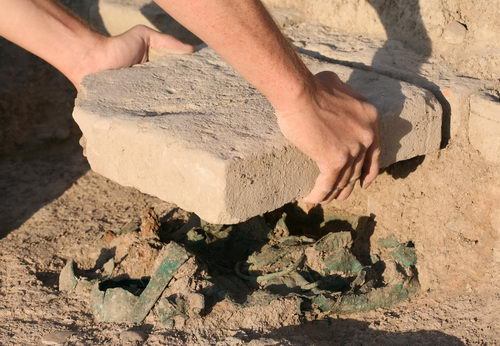
Bronze vessels under paving stones at Ziyaret Tepe in SE Turkey.

Bronze vessels under paving stones at Ziyaret Tepe in SE Turkey.

Why is this of interest to our readers? The Assyrians dominated the politics of the Middle East, including Israel and Judah, between 853 B.C. and 605 B.C. Numerous of the biblical kings had contact with the Assyrians. The Judean king at 630 B.C., the time of the cuneiform plea for help, was Josiah (2 Kings 22-23). Josiah was killed at Megiddo by Pharaoh Neco who was on his way to assist the Assyrians at Carchemish in 609 B.C. (2 Kings 23:28-30).

———–

HT: J. P. van de Giessen, Aantekeningen bij de Bijbel.

The Hasankef Dam on the Tigris River halted

The Biblical Archaeology Review Daily News for June 26, 2009, reports a halt in the building of the dam on the Tigris River in southeastern Turkey. BAR calls attention to an report by the BBC about the halting of the project. Note this portion of the report:

Insurers have suspended their support for a controversial dam project in southeastern Turkey amid concern about its environmental and cultural impact.Export credit insurers in Austria, Germany and Switzerland said on Tuesday they had told suppliers to suspend work on the Ilisu dam on the Tigris river.

They are giving Ankara 180 days to meet standards set by the World Bank. The ancient Hasankeyf fortress is in the area that would be flooded and more than 50,000 people would have to move.

The hydroelectric project near Turkey’s borders with Syria and Iraq is part of a scheme to develop the mainly Kurdish region, which has suffered for decades from poverty, neglect and conflict.

Environmentalists say the dam would destroy archaeological treasures, including Roman remains. The dam consortium plans to create a culture park on the edge of the reservoir and transfer key monuments from Hasankeyf there.

The full (brief) report may be read here. See information about the history of the site here.

I had the opportunity to visit this area in June, 2007. This is one of the most fascinating places I have visited. The site of ancient Nineveh is less than 125 miles south of Hasankef on the Tigris.

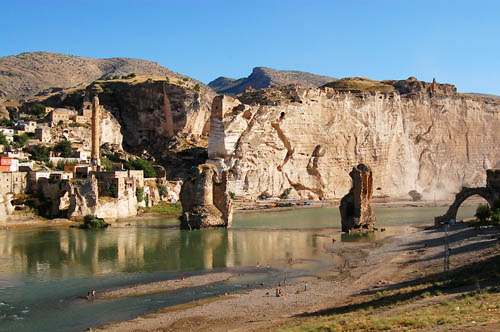
Tigris River at Hasankief. Ruins of Roman bridge. Photo by Ferrell Jenkins.

Tigris River at Hasankef. Note ruins of Roman bridge. Photo by Ferrell Jenkins.

The Tigris River formed the eastern border of Mesopotamia, the land between the rivers (Tigris and Euphrates). It is mentioned by name only twice in the Bible.

  • The Tigris was the third of the rivers flowing from the Garden of Eden. It is said to be east of Assyria (Genesis 2:14). Was this in the north near the source of the river in the mountains of Ararat? Or was it in the south near the Persian Gulf? I don’t know.
  • The prophet Daniel was by the bank of the great river, the Tigris (Daniel 10:4). This would have been further south in present Iraq.

Did Paul visit Samos?

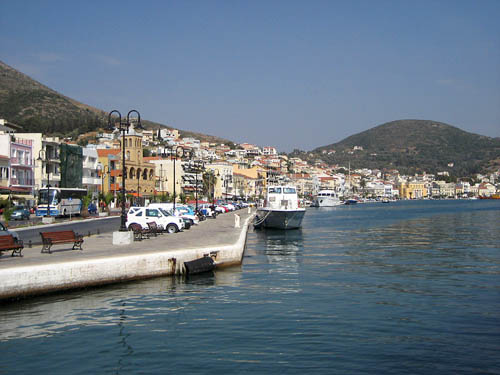
Samos is a mountainous island in the SE part of the Aegean Sea off the coast of Asia Minor. It is 27 miles long (E-W) and about 14 miles wide. The island is separated from the mainland by a strait of one mile.

The port of Samos on the island of Samos. Photo by Ferrell Jenkins.

Paul and his companions stopped at, or passed near, Samos on the return from his third journey.

Sailing from there [Mitylene], we arrived the following day opposite Chios; and the next day we crossed over to Samos; and the day following we came to Miletus. (Act 20:15 NAU)

English versions do not make it clear whether Paul stopped at Samos or came within sight of the island. These comments by Floyd Filson might be helpful.

Paul’s ship…either ‘touched at’ and anchored overnight at Samos (so RSV, though this is an unusual meaning for parebalomen) or ‘came near’ to Samos and passed by it on the E or the W to anchor for the night at Trogyllium. (Interpreter’s Dictionary of the Bible. IV:197)

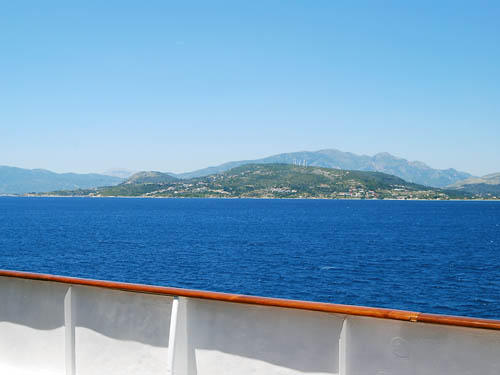
Here is a view of the eastern end of Samos as a ship passes through the most narrow part of the strait between the island and the Turkish mainland.

View of Samos from a ship in the strait between island and mainland. Photo by F. Jenkins.
Samos from a ship in the strait between island & mainland. Photo: F. Jenkins.

Paul may not have visited Samos, but it is clear that he came very close.

Sunset on the Aegean

This photo was made from one of the resort hotels overlooking the Aegean Sea at Kusadasi, Turkey, near the ancient city of Ephesus.

Sunset on the Aegean near Ephesus. Photo by Ferrell Jenkins.

Sunset on the Aegean near Ephesus. Photo by Ferrell Jenkins.

The Aegean is not mentioned by name in the New Testament, but it plays a prominent role in the journeys of the Apostle Paul. Perhaps in a few days I will pull together some of this information and share it with you.

Apollos, the eloquent man of Alexandria, learned the way of the way of God more accurately at Ephesus. When he heard of the work in Achaia (Corinth) he wanted to go there. He likely sailed west from Ephesus to Cenchrea, a port of Corinth.

But when Priscilla and Aquila heard him, they took him aside and explained to him the way of God more accurately. And when he wanted to go across to Achaia, the brethren encouraged him and wrote to the disciples to welcome him; and when he had arrived, he greatly helped those who had believed through grace, for he powerfully refuted the Jews in public, demonstrating by the Scriptures that Jesus was the Christ. (Act 18:26-28 NAU)

Euphrates River in northern Syria

The photos we post of the Euphrates River are always popular. I suppose this is because of the historic events associated with the river, and because so few people have seen the river. The Euphrates begins in the mountains of eastern Turkey (ancient Urartu/Ararat), flows south through Syria and Iraq before ending at the Persian Gulf.

Some of the great Bible characters are associated with the River, even when it is not named. We can be sure that Abraham crossed the Euphrates when he left Haran and headed south to Canaan (Genesis 11:32 – 12:1-9). I like the account of Jacob fleeing from Laban.

He left with all he owned. He quickly crossed the Euphrates River and headed for the hill country of Gilead. (Genesis 31:21 NET)

This photo was made in northern Syria, northeast of Aleppo in 2002. Here the river is wide because of a series of dams built by the Syrians. This can not be far from the place where the biblical patriarchs crossed the river.

The Euphrates River in northern Syria. Photo by Ferrell Jenkins.

The Euphrates River in northern Syria. Photo by Ferrell Jenkins.

Cappadocia was home to early Christians

John Freely describes Cappadocia in these words:

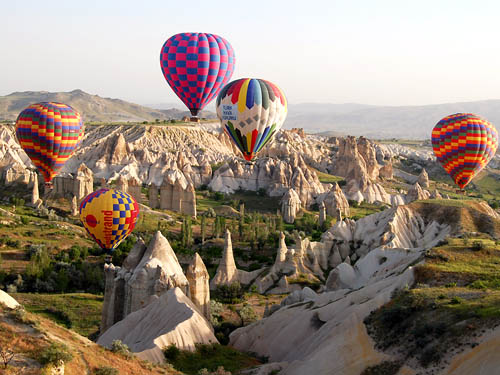
“Most of this part of Cappadocia is covered with a deep layer of tufa, a soft stone of solidified mud, ash and lava which once poured down from the now extinct volcanoes on Hasan Dagi and Ericiyes Dagi, the two great mountain peaks of Cappadocia. In the eons since then the rivers of the region have scoured canyons, gorges, valleys and gulleys through the soft and porous stone, and the elements have eroded it into fantastic crags, folds, turrets, pyramids, spires, needles, stalagmites, and cones, creating a vast outdoor display of stone sculptures in an incredible variety of shapes and colours” (The Companion Guide to Turkey, 238).

Devout Jews from Cappadocia were present in Jerusalem on Pentecost (Acts 2:9). Peter=s letters were addressed to Christians living in Cappadocia (1 Pet. 1:1). In the centuries after New Testament times many Christians settled in this volcanic region of perhaps 50,000 cones.

Gliding gently over Cappadocia. Photo by Ferrell Jenkins.

Gliding gently over Cappadocia. Photo by Ferrell Jenkins.

The best way to enjoy the Cappadocian landscape is by taking a hot air balloon early in the morning. Drifting gently over the landscape is a unique experience.

Todd Bolen calls attention to a nice photo gallery of Cappadocia in the Los Angeles Times here.

Another reason to attend Bible study

“Kansas girl rides ‘Laodicean’ to National Spelling Bee victory”

According to  USA Today, 13 year old Kavya Shivashankar won the national Spelling Bee championship by correctly spelling the word Laodicean. Several news reports say the word means lukewarm or indifferent in religion or politics, but they fail to mention that the concept comes from the Bible.

Laodicea was one of three cities of the Lycus River Valley in Asia Minor (Colossians 2:1; 4:15-16). Today this area is in Turkey. Toward the end of the first century the book of Revelation was distributed to several churches of Asia (Revelation 1:11).

The water of Laodicea came from hot springs immediately south of the city. By the time the water reached Laodicea it was lukewarm.  Jesus described the church as being like the water supply of the city.

I know your deeds, that you are neither cold nor hot; I would that you were cold or hot.  16 ‘So because you are lukewarm, and neither hot nor cold, I will spit you out of My mouth. (Revelation 3:15-16 NAS)

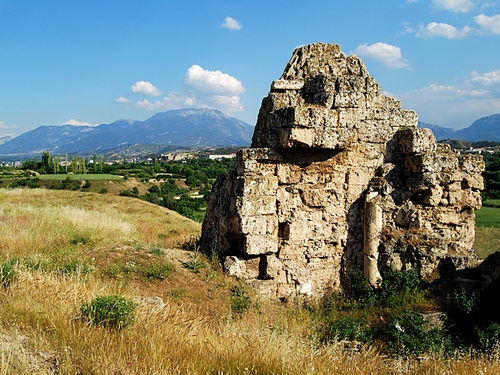
This photo shows part of the water distribution tower at ancient Laodicea. Mount Cadmus is seen in the distance.

Ruins of the water distribution tower at Laodicea. Photo by Ferrell Jenkins.

Ruins of the water distribution tower at Laodicea. Photo by Ferrell Jenkins.

We might also define Laodicean as a member of the body of Christ in the city of Laodicea.  Or, simply, a citizen in the city of Laodicea.

HT: Olen, Harriet

Sir William M. Ramsay – New Testament Scholar

As a student Ramsay had been influenced by Baur and the Tubingen School and doubted the historical trustworthiness of the New Testament. His studies in Asia Minor caused him to study the book of Acts, which he accepted as a document of the second half of the second century. He tells in The Bearing of Recent Discovery on the Trustworthiness of the New Testament how he came to change his mind about this. In a study of Acts 14, Ramsay saw that Luke listed Lystra and Derbe as cities of Lycaonia, but did not include Iconium (Acts 14:6). He thought this had been deliberately invented by Luke because he was under a false impression. Check maps you have in your Bible and various Bible Atlases. You will probably see that some of them still have this incorrect. The SN (Study Note) in the NET Bible contains this note:

Iconium was a city in Lycaonia about 90 mi (145 km) east southeast of Pisidian Antioch. It was the easternmost city of Phrygia.

This comment relies on the older classical location of Iconium, but it was not this way during the Roman Imperial period.

In The Bearing of Recent Discovery…, Ramsay says that the purpose of his book, St. Paul the Traveler and the Roman Citizen, is to show:

“that Luke is a historian of the first rank; not merely are his statements of fact trustworthy; he is possessed of the true historical sense; he fixes his mind on the idea and plan that rules in the evolution of history, and proportions the scale of his treatment to the importance of each incident. He seizes the important and critical events and shows their true nature at greater length, while he touches lightly or omits entirely as much that was valueless for his purpose. In short, this author should be placed along with the very greatest of historians” (222).

The people of Lystra spoke the Lycaonian language (14:11). They called Barnabas, Zeus, and Paul, Hermes (14:12). Inscriptions have been found that identify these particular gods with Lycaonia.

F. F. Bruce mentions his debt to the writings of Sir William Ramsay, and frequently calls attention to Ramsay’s works. Colin Hemer’s works on Acts and Revelation build on the work of Ramsay.

Dr. Mark W. Wilson, of Seven Churches Network has edited and updated at least four of Ramsay’s works: The Letters to the Seven Churches (Hendrickson), St. Paul the Traveler and Roman Citizen (Kregel), and Historical Commentary on First Corinthians (Kregel). This makes these older works much more valuable.

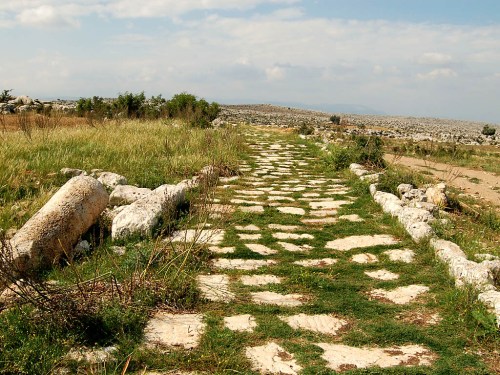
Our photo below shows a portion of a Roman road a few miles north of Tarsus, home of Saul of Tarsus. I think this is the route that would have been taken by Paul and Silas to connect them to the Cilician Gates and the Anatolian plateau. See Acts 15:41 – Acts 16:2.

Roman Road north of Tarsus. Note the fallen milestone. Photo by Ferrell Jenkins.

Roman Road north of Tarsus. Note the fallen milestone. Photo by Ferrell Jenkins.

Sir William M. Ramsay

William M. Ramsay (1851-1939), a native of Scotland, studied classics at the University of Aberdeen. In 1880 he won a traveling studentship to study in Asia Minor. For several decades he was able “to study the geography and archaeology of Roman proconsular Asia, Phyrgia, Lycaonia, Cappadocia, and Galatia” (Gasque, Sir William M. Ramsay Archaeologist and New Testament Scholar, 15; I am indebted to this work for much information about Ramsay). He was knighted in 1906.

Gasque’s book has recently been made available here by Rob Bradshaw of Biblical Studies.org.uk in either PDF or Scribd. Grab it while it is available. Rob is providing a wonderful service in making works like this available.

Some of Ramsay’s more significant writings include The Historical Geography of Asia Minor, The Cities and Bishoprics of Phrygia, St. Paul the Traveller and the Roman Citizen, The Bearing of Recent Discovery on the Trustworthiness of the New Testament, The Letters to the Seven Churches, and A Historical Commentary on St. Paul’s Epistles to the Galatians. He wrote many articles for the 9th edition of Encyclopedia Britannica and for the five-volume Dictionary of the Bible by Hastings, including “Roads and Travel in the New Testament.”

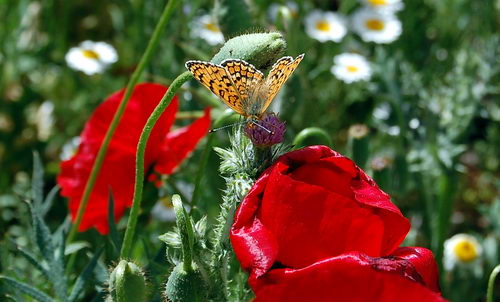
This photo of a butterfly among wild flowers was made west of Konya, Turkey. Konya was biblical Iconium (Acts 13:51 – Acts 14).

Spring wild flowers growing west of Konya, Turkey. Photo by Ferrell Jenkins.

Spring wild flowers growing west of Konya, Turkey. Photo by Ferrell Jenkins.

In the next post we will explain more about the significance of Ramsay to New Testament studies.