Category Archives: Revelation

Pergamum and Thyatira

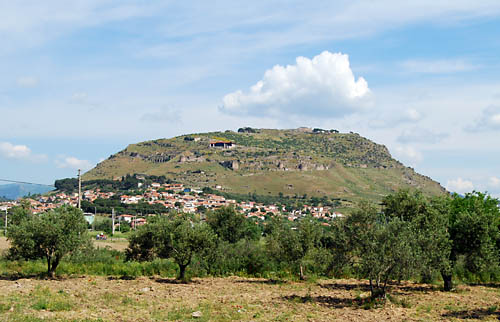
Today we drove north of Izmir to visit the Pergamum (modern Bergama), another of the cities of the seven churches of the book of Revelation. This visit included the acropolis temple of Athena, the famous library, the royal palace, the temple of Trajan, the steepest theater of the world, and site of the altar of Zeus. The weather was perfect for photography most of the day. This photo shows the acropolis of Pergamum.

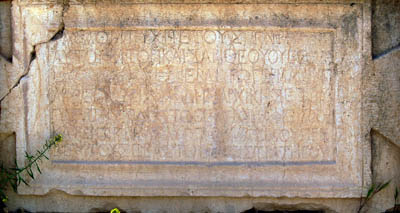
We made a short visit at the Archaeological Museum to see the inscription that states that Pergamum had twice been named NEOKOROS. This term means that two temples dedicated to the Roman emperors had been erected in the city. In fact, later there was a third temple. Emperor worship presented a serious problem for the Christians of Asia Minor in the last part of the first century, and the following centuries.

We visited the ruins of the Asclepieum, the medical center of the ancient world.

After lunch we drove to Thyatira (modern Akhisar) to see the few archaeological remains of the city. Lydia, the seller of purple who was converted to Christ at Philippi, was from Thyatira (Acts 16:14).

For the letter to the church at Pergamum read Revelation 2:12-17. For the letter to Thyatire read Revelation 2:18-29.

Izmir (Smyrna of the Book of Revelation)

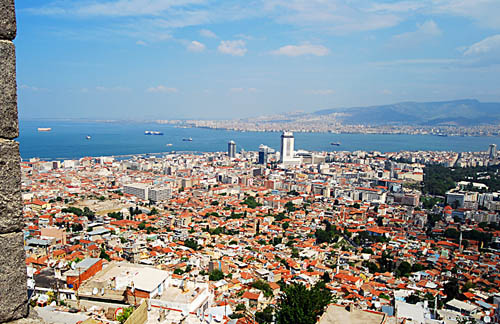
This morning we flew from Istanbul to Imzir, Turkey’s second largest city. Our sightseeing included Mount Pagos with its magnificent view of the city and harbor. Most of the ancient city of Smyrna is buried underneath the modern buildings. A portion of the Agora (marketplace) of Smyrna has been unearthed in the past. Houses have been demolished the a large area adjoining the agora, and preparations are being made for additional excavations. This will be exciting to watch.

There are two important archaeological museums in Izmir. We made short visits to each of them. In the older museum we saw the likeness of Flavius Damianus, an imperial priest under Emperor Septimius Severus, wearing a diadem. This provides an impressive image of the place of emperor worship in Asia Minor in the days following the writing of the book of Revelation.

And to the angel of the church in Smyrna write: ‘The first and the last, who was dead, and has come to life, says this: ‘I know your tribulation and your poverty (but you are rich), and the blasphemy by those who say they are Jews and are not, but are a synagogue of Satan. ‘Do not fear what you are about to suffer. Behold, the devil is about to cast some of you into prison, so that you will be tested, and you will have tribulation for ten days. Be faithful until death, and I will give you the crown of life. ‘He who has an ear, let him hear what the Spirit says to the churches. He who overcomes will not be hurt by the second death.’ (Revelation 2:8-11).

Domitian, a hated emperor

One coin at a time is Brett Telford’s blog about coins. He has a marvelous photo of a silver Tetradrachm showing the image of Domitian. It was struck in Tarsus about A.D. 93-95. Please take a look.

Telford says,

The portrait reveals an emperor weary from insecurity and suspicion of conspiracy in the later years of his reign. His gaze bears witness to the demons that incited his paranoia. Domitian’s reign of terror began at around AD 93 and lasted until his death in AD 96… about the same time that this coin was struck.

After an interesting discussion of Ethelbert Stauffer’s theory that the titles of Domitian equal 666, Telford comments on the coincidence that this coin was minted at Tarsus, home of the apostle Paul.

This coin isn’t without its own Biblical reference. Tarsus, the city in which this coin was minted, was the birthplace of the Apostle Paul. Isn’t it ironic then, that a coin of the purported Biblical “Beast” was struck in the very city that brought us the most notable of early Christian missionaries.

Previously I have called attention to my books on Revelation. I failed to mention another brief publication about Domitian. Several years back Arthur M. Ogden and I wrote a series of exchanges. This publication, Did Domitian Persecute Christian? is available free in PDF at BibleWorld.

I have seen various inscriptions on which the name of Domitian has been scratched off. It means that he was a person of damnable memory. Recently on our trip to Jerash in Jordan we saw two inscription discovered when the theater was being restored. Here is a photo of one of them.

The inscription, which dates to the year A.D. 90/91, bears the title of the Emperor Domitian, but his name has been erased. The emperor is said to be the son of “divine (theou) Vespasian.” At the moment I can’t put my hands on it, but I recall that a translation of both inscriptions is included in the Newsletter of the American Schools of Oriental Research, Oct., 1974. Inscriptions like this definitely need to be in a controlled environment rather than outside in the weather.

On our upcoming Steps of Paul and John tour the name of Domitian will be used often.

HT: Georg S. Adamsen, Revelation Resources.

Archaeological work at Ephesus might take centuries

Today’s Zaman, reports that the archaeological excavation at Ephesus may continue “for centuries.” The article says that work began at Ephesus 138 years ago. This reference seems to be to 1869 when the English architect J. T. Wood found the marble floor of the temple of Diana. Some research had been done as early as 1845.

Most of the archaeological work at Ephesus has been done by Austrians. They began the work in 1895 and have continued until the present time.

The article reports an interview with Dr. Fritz Krinziner, director of the dig and head of the Austrian Archaeology Institute. I note that Dr. Krinziner wrote Preface 2 in Ephesus: 100 Years of Austrian Research, published in 1996. Here are a few interesting comments from the article.

” He [Krinziner] stressed that it would be impossible to uncover the entire ancient city at once, underlining that only 10-15 percent of the site has been unearthed so far.”

“The excavation work may last for centuries. This is not an easy job. We focus on spots where we are likely to find something important as we cannot carry out the entire excavation at once.”

The article says that 1.5 million people visited Ephesus last year. An added note says that the Greater Izmir Municipality has announced plans “to establish an electric railway connection, similar to a tram, in Ephesus.”

The complete article may still be available here.

I speak to some people who seem to think that most of the archaeological work in various biblical cities has already been done. The work is complete! Think again.

Ephesus is visited by many tourists who have no interest in the Bible. They arrive on the cruise ships that dock at nearby Kusadasi. Others find the ruins interesting because the city was the site of Paul’s work (Acts 19). I think the tradition that the apostle John was here prior to being exiled to Patmos is a reliable one. The first letter within the book of Revelation is addressed to the church at Ephesus (Rev. 2).

This photo shows the Library of Celsus and some costumed actors from one of the cruise ships putting on a show for the passengers.
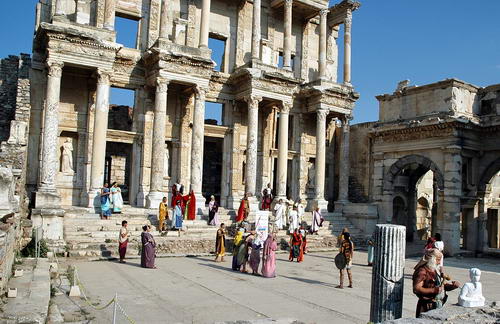
Library of Celsus at Ephesus. Photo by Ferrell Jenkins.

The Library was built in A.D. 135, after the time of Paul and John. The first time I saw this area, in 1968, only the steps were visible. The Austrian excavators did a marvelous job of reconstruction between 1970 and 1978. It is estimated that the Library could hold between 9,500 and 12,000 rolls. The arch to the right leads to the ancient agora.

We visit Ephesus on our Steps of Paul and John tour.

The UP Museum of Archaeology

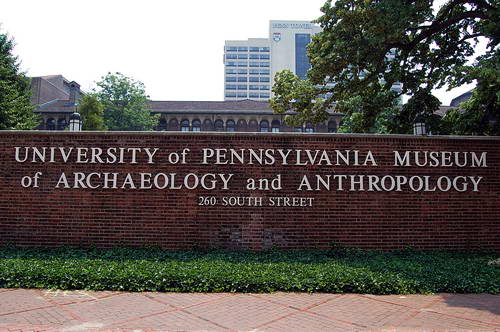
Tuesday I spent some time in the University of Pennsylvania Museum of Archaeology and Anthropology, Philadelphia. The museum has a nice collection of artifacts of interest to the student of the Bible. One of the best known names associated with the museum in the field of biblical archaeology is that of James Pritchard. Professor Pritchard edited The Ancient Near East Texts and The Ancient Near East in Texts and Pictures. He was also well known for his work at Gibeon and the book, Gibeon, Where the Sun Stood Still.

The museum has a nice collection from Egypt, Canaan, and Mesopotamia. The section on Mesopotamia is now closed with many of the items included as part of a traveling exhibit. One of the retired professors at UP told me 4 years ago that the museum has 40,000 clay cuneiform tablets, but I saw none of them on display during this visit. Currently there is an exhibit on Amarna, but I did not find it especially impressive after having visited museums in Egypt, London, and Berlin.

There is a good section on Rome, especially dealing with Emperor Worship. This is a helpful resource in studying Revelation.

University of Pennsylvania Musem of Archaeology and Anthropology

The Museum does not permit copies of photos made in the museum to be posted on other web sites (without some special permission, perhaps). If you are in the area, it is a worthwhile visit.

Perga and Attalia in Pamphylia

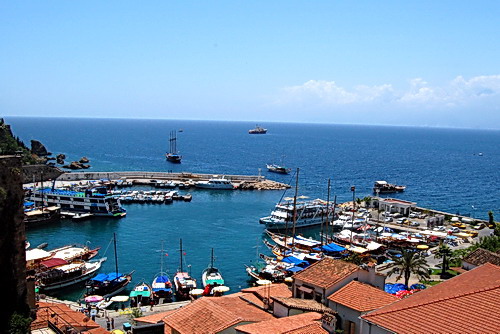
Friday we visited the historic ruins of ancient Pamphylia: Antalya (biblical Attalia, Acts 14:25) and Perge. Antalya is the modern name for Attalia which served as the port of entry from Egypt and Syria to the interior of Asia. From here Paul sailed back to Antioch (Acts 14:25). Our visit included the harbor, and Hadrian’s Gate, The photo below is of the harbor in Antalya (biblical Attalia).

The Harbor of Antalya, Turkey. This was the city of Attalia in New Testament times. Photo by Ferrell Jenkins.

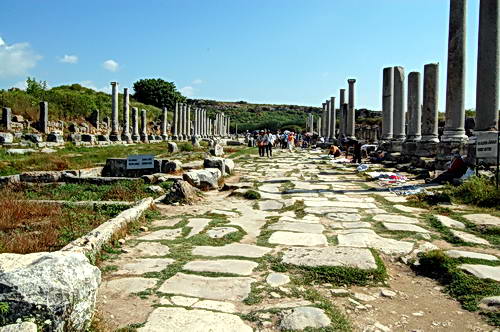
We enjoyed the visit to Perga very much. There are impressive Hellenistic and Roman ruins. Most of the Roman structures date to the second century A.D. This is where John Mark turned back from the work (Acts 13:13-14; 15:37-39). On his return from the first journey, Paul spent some time preaching here (Acts 14:25).

The Roman City of Perga in Pamphylia. Photo by Ferrell Jenkins.

The museum in Antalya is one of the nicest regional museums I have visited. Many of the artifacts, especially the statuary, are from the second century Roman city of Perga. Here is a photo of an Imperial Priest. A knowledge of the Roman Cult is important when one begins to study the book of Revelation. These were the men who gave the certificates to those who had worshiped the Emperor.

Second century Roman Imperial Priest in the Antalya, Turkey, Museum. Photo by Ferrell Jenkins.

Antalya is a popular Mediterranean resort town with many nice hotels. I would have enjoyed a few days just to relax. Next is Istanbul.

Ankara, the capital of Turkey

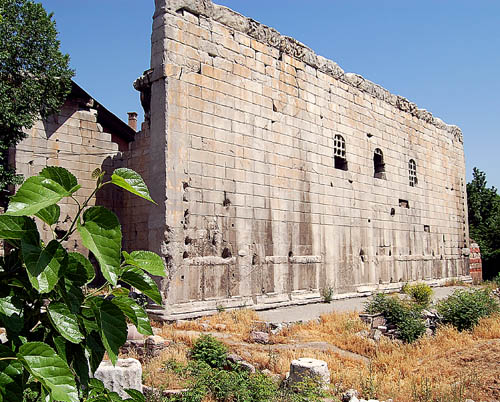
Temple of Emperor Augustus, Ankara, Turkey.

In addition to some of the highlights of the modern city, we visited the Temple of Augustus and the priceless collection of Hittite artifacts in the Museum of Anatolian Civilizations. This museum is often referred to as the Hittite Museum. The Temple of Augustus, shown above, was built about 20 B.C. when Ankara was known as Ancyra and was in the province of Galatia. The deeds of Augustus are recorded on the outside wall in Greek, and on the inside wall in Latin. Augustus is referred to as DIVI in Latin and THEOS in Greek. Worship of the emperors was widespread in Asia Minor. This information helps us with our understanding of the setting of the book of Revelation.

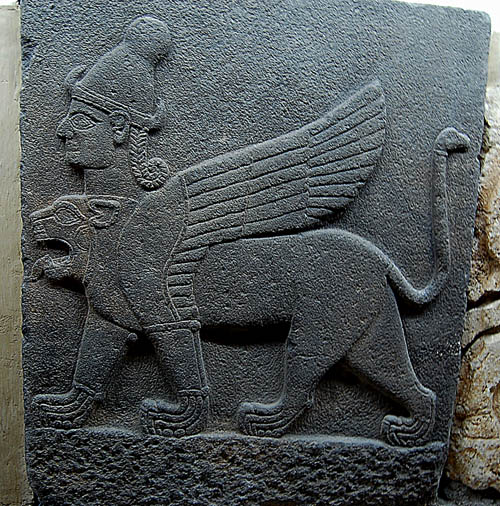
The Museum of Anatolian Civilizations is a small, but very impressive museum. This is because of the great collection of Hittie artifacts. There is one large room devoted to Neo-Hittite reliefs from Carchemish on the Euphrates River. Carchemish was the site of the defeat of the Assyrian Empire in 605 B.C. The photo below shows a three-head sphinx. It is a winged lion with the head of a bird of prey on the tail. On top of the head is a human head wearing a conical hat. Composite images such as this were common during Old Testament times. An understanding of this helps us with our study of the apocalyptic books of the Bible, Ezekiel, Daniel, Zechariah, and Revelation.

Three-head sphinx from Carchemish on the Euphrates. Photo by Ferrell Jenkins.

In the afternoon we headed south to the region of Cappadocia, or as they call it s here, Kappadokia. More tomorrow, hopefully.