Category Archives: Egypt

Tirhakah of Cush

Frequently the Bible records the statements of various foreign rulers. One such record is that of the Assyrian king Sennacherib.

When he heard them say concerning Tirhakah king of Cush, “Behold, he has come out to fight against you,” he sent messengers again to Hezekiah saying,  “Thus you shall say to Hezekiah king of Judah, ‘Do not let your God in whom you trust deceive you saying, “Jerusalem will not be given into the hand of the king of Assyria.”  (2 Kings 19:9-10)

The Theological Wordbook of the Old Testament comments on the term Cush (Ethiopia) as it is used in several Old Testament prophecies.

In several cases, especially in the prophets, Ethiopia is used in parallel construction as a synonym of Egypt (Isa 20:3-5; Ezek 30:4; Nah 3:9). This probably represents the dominance of Ethiopia (or, more precisely, Nubia) over Egypt between 750 and 663 B.C. Terhakah was a notable Nubian pharaoh who tried, unsuccessfully, to block Sennacherib’s westward expansion (2Kings 19:9 ; Isa 37:9). After 663 B. C. Egypt was independent of Nubia (Jer 46:9; Ezek 25:4, 5, 9).
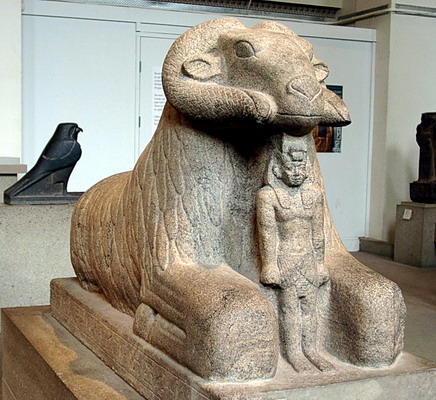
Tirhakah under the protection of the god Amun. British Museum photo by F. Jenkins.

Tirhakah under the protection of the god Amun. British Museum photo by Ferrell Jenkins.

This colossal statue shows Tirhakah standing under the protection of the god Amun shown as a recumbent ram. The gray granite sculpture, dating to about 675 B.C., was found at Karnak. This granite is typical of the Aswan area.

Yesterday afternoon we visited a Nubian Village on the banks of the Nile River at the first cataract of the Nile at Aswan. The Nubians at the village originally lived south of Aswan in the ancient territory of Cush. When the new High Dam was built on the Nile the Nubians were moved to other settlements.

One of the interesting things I observed at the village was a shop of some sort called House of Kush (Cush). A sign on top of the building added “Welcome to Taharka Kingdom.”
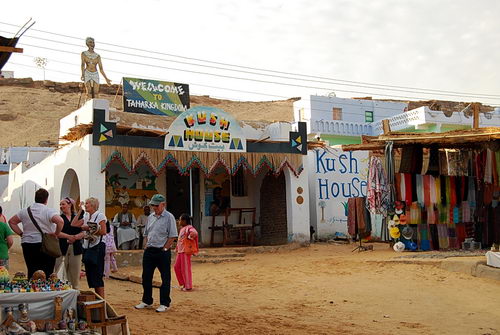
House of Kush at Nubian Village, Aswan, Egypt. Photo by Ferrell Jenkins.

House of Kush at Nubian Village, Aswan, Egypt. Photo by Ferrell Jenkins.

This photo is especially for Mrs. Caldwell’s class at the Florida College Academy. I hope you are enjoying the photos of Egypt.
Visiting the Valley of the Kings

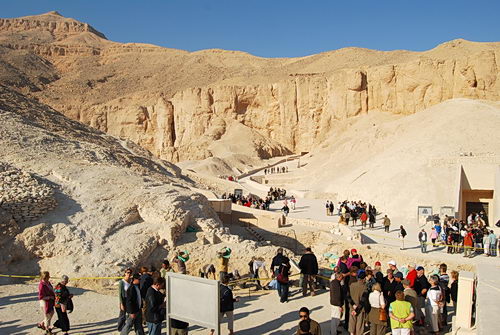
While at Luxor we visited the Valley of the Kings. This is where the Pharaoh’s of the New Kingdom Period of Egyptian history are buried. There are no pyramids during this periods, but at least sixty four tombs are known in the Valley of the Kings. Our group visited two or three.

The Valley of the Kings is located on the West Bank of the Nile River a short distance from the Nile valley.

The Valley of the Kings. Photo by Ferrell Jenkins.

The Valley of the Kings. Photo by Ferrell Jenkins.

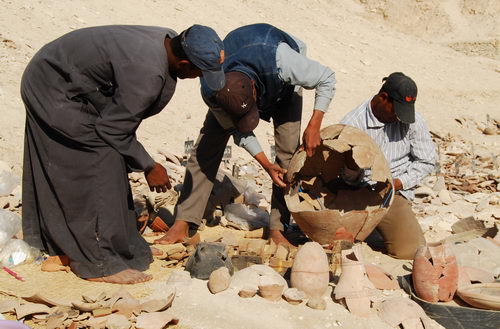
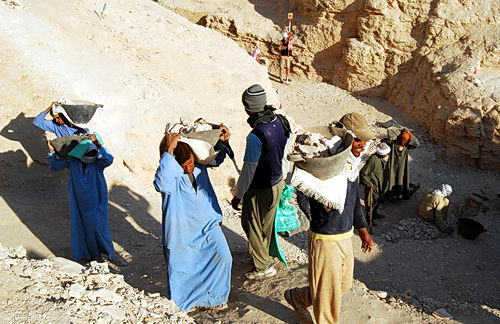
New archaeological excavations continue in the Valley of the Kings. It was fascinating to see workers carrying buckets filled with debris. This is reminiscent of old photos of workers in Mesopotamia or Palestine in the early nineteenth century. Beginning with the excavation of Masada by Yigal Yadin, volunteers are used. Students often pay their own transportation, room and board, to work on a dig. It is a form of educational slavery, one might say.

Workers at archaeologicaly site in the Valley of the Kings. Photo by Ferrell Jenkins.

Workers at archaeological site in the Valley of the Kings. Photo by Ferrell Jenkins.

Some archaeologists were busy surveying. Others were photographing small items. I saw four individuals washing and restoring broken pottery.

Pottery reconstruction in the Valley of the Kings. Photo by Ferrell Jenkins.

Pottery reconstruction in the Valley of the Kings. Photo by Ferrell Jenkins.

Travel can be exciting and educational.

Visiting the Ptolemaic Temple at Edfu

At Edfu, 64 miles south of Luxor, we visited the temple of the sun god Horus who is represented by the falcon. Begun by Ptolemy III in 237 B.C. and completed by 57 B.C., it is the finest example of the ancient Egyptian temples that I have seen. At Luxor we saw Alexander the Great represented as a Pharaoh. His successors, the Ptolemies, brought this practice to an extreme in the temple at Edfu. Ptolemy is pictured repeatedly on the limestone walls standing before Horus; Horus is always the taller figure. Idolatry was not something new to the Greeks, of course (Acts 17; 1 Corinthians 8:5-6).

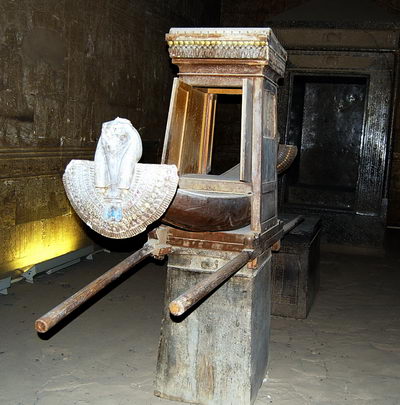
There is a scene inside the temple showing 12 priests carrying an ark on poles. This box on a boat contained the important books pertaining to the temple and the religion of Horus. I think it dates to the time of Pharaoh Neco (late seventh century BC). Neco was the Pharaoh who killed Josiah, the king of Judah, at Megiddo. He continued to Carchemish where he met defeat at the hands of Nebuchadnezzar, king of Babylon. A replica of the ark is on display in the most holy place in the temple.

The ark at Edfu. Photo by Ferrell Jenkins.

The ark at Edfu. Photo by Ferrell Jenkins.

A visit to Edfu demonstrates that, in the Ptolemaic period, we are no longer observing an Egypt ruled by Egyptians but one ruled by foreigners. The prophecy of Ezekiel had been fulfilled.

Thus says the Lord GOD, “I will also destroy the idols And make the images cease from Memphis. And there will no longer be a prince in the land of Egypt; And I will put fear in the land of Egypt. (Ezekiel 30:13).

Descendants of Ham no longer controlled the land, but it was dominated by foreigners who were descendants of Japheth. In the 7th century A.D. the country came under the control of Arab rulers who were descendants of Shem. This same rule by foreigners now continues in the present Egyptian government headed in recent time by presidents Nasser, Sadat, and Mubarak. The modern Egyptians are simply caretakers of the ruins of ancient Egypt.

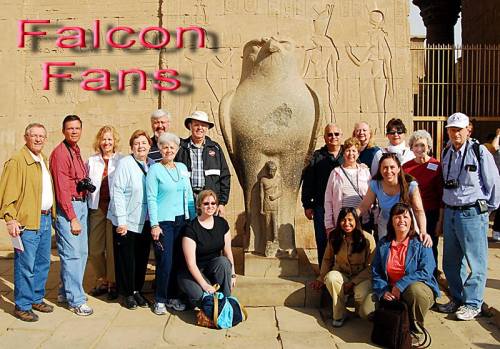
We do a lot of studying and learning on the tour, but we also have fun. Of our 42 person on the tour, about 15 have attended Florida College. Two board members are among the group. The college mascot for the sport teams is the Falcon. We posed with Horus, the falcon god, for a photo.

Note: I left the boat at Aswan to come to a nice Internet Cafe. It seems that I failed to include the photo referenced above on my flash drive. I will try to get it on later.

Note: We are back in Cairo. Here is the photo.

Florida College Falcon fans at Edfu, Egypt. Photo by Sharon Cobb.

Florida College Falcon fans at Edfu, Egypt. Photo by Sharon Cobb.

No opportunity to post tonight

We are on a Nile River cruise boat. Even though I uploaded some photos last night, I was told tonight that it would cost $25 for 30 minutes if I uploaded any photos, etc. Since I don’t have a “Donate to this web site now” on my blog I will just wait until I can get to an Internet cafe in Aswan tomorrow night, or Friday night in the hotel in Cairo.

Thanks for keeping in touch. I appreciate the interest you have in this trip.

Thoughts on the Nile during the Inauguration

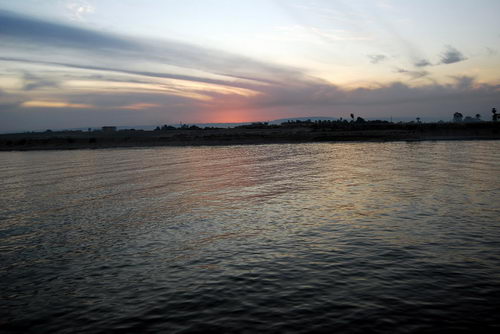
Shortly before sunset I made a few photos of the Nile River looking toward the west bank of the river. I thought I would share this one with you.

Sunset on the Nile. Photo by Ferrell Jenkins.

Sunset on the Nile. Photo by Ferrell Jenkins.

We are anchored on the Nile a few miles south of Luxor. From my cabin on the Tu Ya cruise boat I am watching the Al Jazeera Network live coverage of the inauguration ceremonies in Washington. The choice of the majority of voters on November 2 was not my choice, but I must say that I am proud at this moment to be an American.

The American ideal of freedom and justice for all is a noble one. Surely there are times when this ideal is not met, but it remains the dream that holds us together, many as one. The diversity of our nation is a testimony to the vitality of that dream.

The inaugural ceremony is the same whether watching it live in Washington, on Al Jezeera in Egypt, or on NBC, CNN, Fox, or one of the other networks in the United States. Well, maybe. The thing that makes the difference is the commentary afterwards and the news chosen to run underneath the live event.

Luxor and the World Powers

Luxor was known as Thebes in Old Testament times. Both Jeremiah and Ezekiel prophesied the Lord’s judgment of the city. Jeremiah says,

The LORD of hosts, the God of Israel, says, ‘Behold, I am going to punish Amon of Thebes, and Pharaoh, and Egypt along with her gods and her kings, even Pharaoh and those who trust in him’” (Jeremiah 46:25; see also Ezekiel 30:14-16).

A visit to the ruined and unoccupied temples of Karnak and Luxor, where Amon (or Amun) was worshipped as a great god, certainly convinces us of the fulfillment of this prophecy. Shortly after the time of Jeremiah (about 586 B.C.), Egypt and Thebes began to decline as a world power.

In 663 B.C. the Assyrian king Ashurbanipal had already conquered Thebes (Hebrew, No Amon). The prophet Nahum, in prophesying the fall of Nineveh, calls attention to this event (3:8ff.).

Jeremiah and Ezekiel prophesied during the Babylonian period of world dominance. Darius the Great (521-486 BC), who befriended the Judeans, helping them rebuild the temple in Jerusalem, depicted himself as a Pharaoh on a shrine door now displayed in the British Museum.

The young Alexander of Macedon came to Thebes in 336 BC and left reliefs of himself portrayed as a Pharaoh making offerings to the god Amon. Cassander rebuilt the city in 315 B.C. The later Ptolemaic kings who succeeded Alexander built temples to the gods at Edfu and Kom Ombo and regularly pictured themselves as worshiping the gods of Egypt. Likewise, the Roman emperors built temples beside the ancient temples of the Pharaoh. The temple of Philae has a small temple to Augustus ( 30 B.C. to A.D. 14) and another to Trajan (A.D. 98-117).

Daydreaming a little

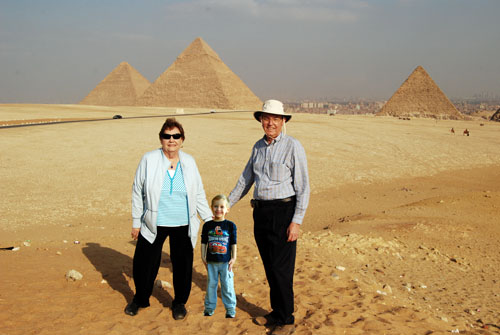
Family and friends who know us personally know that our greatest joy for the past four years has been our grandson. He stayed overnight with us recently prior to this tour. Almost the first question after he woke up was, “What were the pyramids?” I think his mind was satisfied when I finished the explanation. I promised that I would put him in a picture with us at the pyramids. He willingly posed for me to get a suitable photo.

Traveling with our grandson in our heart.

Traveling with our grandson in our heart.

We sent this photo to him yesterday, and he emailed back his hearty approval. He said that he read the sign in front of the group all by himself. Maybe someday he can come to Egypt with us. What a joy that would be.

And this fits in well with our recent theme of composite creatures. Let him who has understanding receive it.

The Giza Pyramids

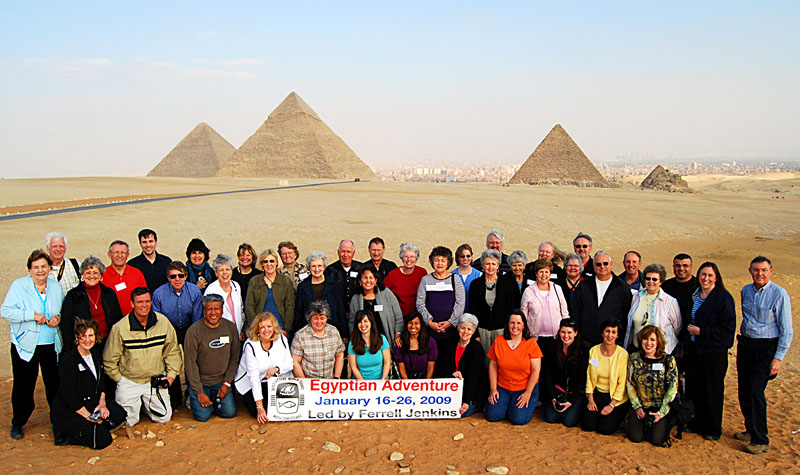
Today has been a long and busy day. Our group visited the Cairo Museum and the Giza Pyramids. This photo of the group was made on the west side of the Pyramids. In the distance you see some of the buildings of Cairo in the Nile Valley.

Egyptian Adventure Group at the Giza Pyramids.

Egyptian Adventure Group at the Giza Pyramids.

Click on the photo for a larger copy.

Tomorrow morning we have a flight scheduled for Luxor. There, after visiting the Luxor and Karnak Temples, we will begin a four day cruise on the Nile with stops along the way to visit important historical sites.

I am not sure if I will be able to have a good Internet connection during most of that time. Keep checking back.

For a more personal outlook on the tour I urge you to see Picture This at http://scenewithsharon.blogspot.com.

Headed for Egypt

In a few hours we plan to be on a non-stop flight to Cairo. We have a good group of fellow-travelers who join us in exploring the ancient culture of Egypt.

nikon-pyramids-t1

Our main purpose for tours like this is to better understand the culture in which so many Bible events took place. We will be joined by a competent Egyptian guide who is well versed in Egyptian history and also understands its relation to the Bible. My job will be to teach the biblical account on the spot. That is a little better than doing so back home with a photo! Not everyone can visit these places, and we are delighted to share a few of our experiences and understanding with you.

I consider these tours of the Bible lands, and this blog, an important part of my teaching ministry. Many of the men and women who travel with me do so in an effort to improve their teaching in the churches where they serve.

My last trip to Egypt was in 2005. I began using WordPress in 2007, and have not determined if we will be able to make proper contact with WordPress to publish our posts. As a backup I have set up an account on Blogger. After we have a day or two to get settled in Egypt, if you don’t see a new post here go to the Blogger site: fjtours.blogspot.com.

We have come to expect Jane to write a blog during our tours, but she and Olen are not able to be with us due to the recent heart surgery for Olen’s father. Jane tells us that Sharon will be writing. We encourage you to check her blog regularly at scenewithsharon.blogspot.com. She is a good photographer and I am sure you will find it of interest.

Satellite imagery reveals Egyptian ruins

CNN has a report on the use of satellites to help unearth ancient Egyptian ruins. Read the full article here. The report features the work of Sarah Parcak, an archaeologist at the University of Alabama at Birmingham.

In our society we tear down anything that is a decade or more old in order to build a new structure. Except, of course, for our historical districts. It wasn’t that way in the ancient world. If a structure was destroyed or ravaged, the conquerors might build a new one in the same place. They would build over and utilize any walls still standing.

Building in ancient Egypt was along the Nile River and in the Delta. Much of what shows as Egypt on a modern map is not currently habitable. Eighty two million people live in this small space, according to the CNN report. When I took my first group to Egypt in 1967 we were told that the population was 40 million. Even then it seemed crowded; now it is terrible.

Here are a few comments about Parcak’s work:

In this field, Parcak is a pioneer. Her work in Egypt has yielded hundreds of finds in regions of the Middle Egypt and the eastern Nile River Delta.

Parcak conducted surveys and expeditions in the eastern Nile Delta and Middle Egypt in 2003 and 2004 that confirmed 132 sites that were initially suggested by satellite images. Eighty-three of those sites had never been visited or recorded.

In the past two years, she has found hundreds more, she said, leading her to amend an earlier conclusion that Egyptologists have found only the tip of the iceberg.

“My estimate of 1/100th of 1 percent of all sites found is on the high side,” Parcak said.

And here are some comments made by Parcak about the value of the satellite images:

“We can see patterns in settlements that correspond to the [historical] texts,” Parcak said, “such as if foreign invasions affected the occupation of ancient sites.

“We can see where the Romans built over what the Egyptians had built, and where the Coptic Christians built over what the Romans had built.

“It’s an incredible continuity of occupation and reuse.”

The flooding and meanders of the Nile over the millennia dictated where and how ancient Egyptians lived, and the profusion of new data has built a more precise picture of how that worked.

“Surveys give us information about broader ancient settlement patterns, such as patterns of city growth and collapse over time, that excavations do not,” said Parcak, author of a forthcoming book titled “Satellite Remote Sensing and Archaeology.”

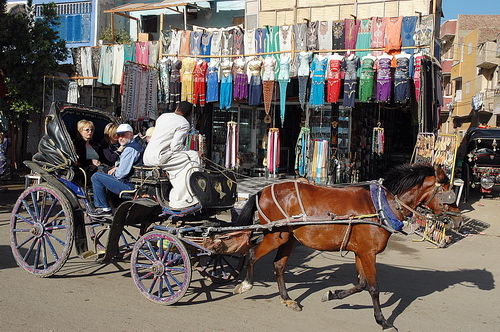
In every town along the Nile in Upper Egypt (the south) buildings crowd the river. This scene is from Edfu.

Shops at Edfu in Upper Egypt. Photo by Ferrell Jenkins.

Shops at Edfu in Upper Egypt. Photo by Ferrell Jenkins.