Category Archives: Archaeology

Summary of the blogs

Over at the Biblical Studies Info Page, under Scholarly, then Blogs, I keep a list of several blogs that I regularly check. Here is a brief summary of some current items you might find of interest.

Todd Bolen calls attention to the continuation of the Western Wall excavations here. This excavation is on the extreme western side of the Western Wall plaza.

Aren Maer gives a wrap-up of the recent excavations at Gath (Tell es-Safi) here.

Ben Witherington includes a seminar paper by one of his doctoral students in review of Barth Ehrman’s Lost Christianities here. This has to do with the formation of the canon.

Mark Copeland has posted good photographs of 299 Sermon Charts pained by Steve Hudgins here. Steve pained a few charts for me, and some of my tour banners, years back. This shows the type of visual aids that some of us used. It was before flannel boards, opaque projections, overhead projections, and PowerPoint. The biggest problem is that the audience knew when we were only half finished! I doubt any of you will want to use a chart like this now, but you can get some great ideas for sermon starters, put them in PowerPoint, and see if they will gel.

Claude Mariottini has called attention to the problem of Fake Degrees, even among ministers and professors of biblical studies, here. Every now and then I see some preacher who wouldn’t know how to write a research paper advertising himself as Dr. So-and-so. Shameful.

Tutankhamum and the World of the Pharaohs

The premier exhibition of Tutankhamum and the World of the Pharaohs is current open in Vienna. Maybe you will not be able to get to Vienna, but there are some wonderful photos on line. The exhibit web page is here.

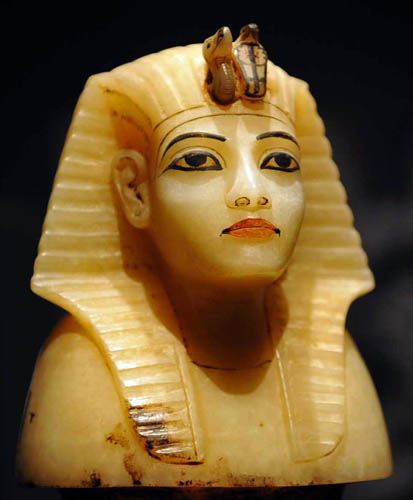
To get to the photos click on the English (UK) flag at the top of the page. (Pay attention. This will not work on the German page.) Then click on Press and Media. The photo here shows the top of one of the canopic jars in the the King Tut tomb. This jar, made of alabaster, was used to store one of the major organs of the body. Click on the photo for a larger image.

The top of a canopic jar from the tomb of Tutanhkamum. Photo by Sandro Vannini.

The top of a canopic jar from the tomb of Tutanhkamum. Photo by Sandro Vannini.

Howard Carter discovered the intact tomb of King Tut in 1922. Tut lived between 1341 and 1323 B.C. This is about a century after Moses was in Egypt if we depend on the dates given in certain Old Testament references like 1 Kings 6:1.

Now it came about in the four hundred and eightieth year after the sons of Israel came out of the land of Egypt, in the fourth year of Solomon’s reign over Israel, in the month of Ziv which is the second month, that he began to build the house of the LORD.

The fourth year of Solomon’s reign would have been about 966 B.C.

When one sees the wealth represented in the tomb of King Tut he must be impressed with the statement made by the writer of Hebrews regarding the treasures of Egypt.

By faith Moses, when he had grown up, refused to be called the son of Pharaoh’s daughter, choosing rather to endure ill-treatment with the people of God than to enjoy the passing pleasures of sin, considering the reproach of Christ greater riches than the treasures of Egypt; for he was looking to the reward. (Hebrews 11:24-26 NASB)

Seal of Zedekiah’s minister found

The Jerusalem Post is reporting here on the discovery of a seal impression belonging to Gedalyahu ben Pashur (English versions have Gedaliah the son of Pashhur). The relevant text from Jeremiah reads,

Now Shephatiah the son of Mattan, Gedaliah the son of Pashhur, Jucal the son of Shelemiah, and Pashhur the son of Malchiah heard the words that Jeremiah was saying to all the people (Jeremiah 38:1 ESV)

Here are a few excepts from the Jerusalem Post article:

The seal impression, or bulla, with the name Gedalyahu ben Pashur, who served as minister to King Zedekiah (597-586 BCE) according to the Book of Jeremiah, was found just meters away from a separate seal impression of another of Zedekia’s ministers, Yehukual ben Shelemyahu, which was uncovered three years ago, said Prof. Eilat Mazar who is leading the dig at the site.

Other Biblical-era bullae were previously found a quarter century ago at the City of David site. In 1982, the Israeli archeologist Yigal Shiloh discovered a cache of bullae in a nearby site, including one with the name of Gemaryahu ben Shaphan – mentioned in the Bible as a minister and scribe during the reign of King Jehoiakim (608-597 BCE).

Hopefully a nice photo of the seal with be forthcoming shortly.

HT: Paleojudaica

Update. For a photo of the inscription check the Trumpet.

The ESV Study Bible

Quite a bit of attention is being given to the forthcoming (October 15) English Standard Version Study Bible. Dr. Leen Ritmeyer has served as archaeological and architectural editor for the new study Bible. On his blog he calls attention to two interviews with Justin Taylor, Project Director and Managing Editor of the ESV Study Bible.

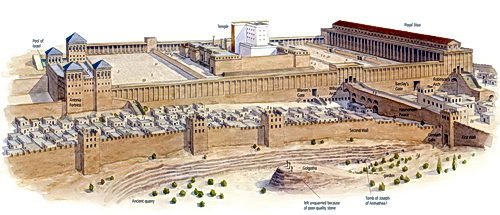
The first interview is “What Did Calvary Look Like?” Evidence for the Church of the Holy Sepulcher and the Garden Tomb is summarized. Golgotha on this drawing is now the site of the Church of the Holy Sepulcher.

Drawing showing Golgotha.

Drawing showing Golgotha.

The second interview is “What Did Jesus’ Tomb Look Like?”

If you teach the Bible you will want to download the large drawings associated with these interviews. Some sample pages in PDF (Introductions to Luke, Revelation, and Psalms) are available for download here.

Taylor explains the high quality of these drawings (“paintings”):

Using Dr. Ritmeyer’s extensive research and new drawings, we then turned to the illustration firm Maltings Partnership (in Derby, England) to produce the final, full-color paintings. We knew of Maltings’ superb work from their reconstruction drawings in the DK Travel Guides and the National Geographic Traveler guides. We could not be happier with the final results.

Second Temple Model in new location

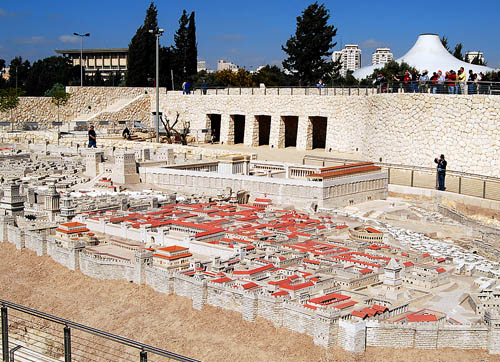
For years the model of Jerusalem from the time of the second temple was displayed on the grounds of the Holyland Hotel in Jerusalem. When the hotel needed the space to enlarge, the decision was made to relocate the model on the grounds of the Israel Museum. This was a wonderful decision. It is now possible to visit the model, the Shrine of the Book, and the archaeology museum with one stop. Also, the Bible Lands Museum is across the road.

Second Temple at the time of Herod and Christ? I know that Bible students wonder about this designation. In our Bible classes we often point out that the temple was first built by Solomon, king of Israel (970-931 B.C.). That temple was destroyed by the Babylonians in 586 B.C. The temple was rebuilt after the return from the Babylonian Exile in the days of the Persian King Darius (520-516 B.C.). If we consider Herod’s work a remodeling of the second temple, then I suppose we could think of it as the second temple. Herod’s work was so massive that we probably should think of it as the third temple. Herod began this work about 19/20 B.C. There is a reference to the long project in the gospel of John.

John 2:19-22  Jesus answered them, “Destroy this temple, and in three days I will raise it up.”  20 The Jews then said, “It took forty-six years to build this temple, and will You raise it up in three days?”  21 But He was speaking of the temple of His body.  22 So when He was raised from the dead, His disciples remembered that He said this; and they believed the Scripture and the word which Jesus had spoken. (John 2:19-22)

Here is a photo I made in April of the model which is based on available literary and archaeological evidence. In the background you see the Knesset of Israel and the Shrine of the Book where some of the Dead Sea Scrolls are displayed.

Second Temple Model of Jerusalem at its new location

Absalom, John the Baptist, and Zechariah

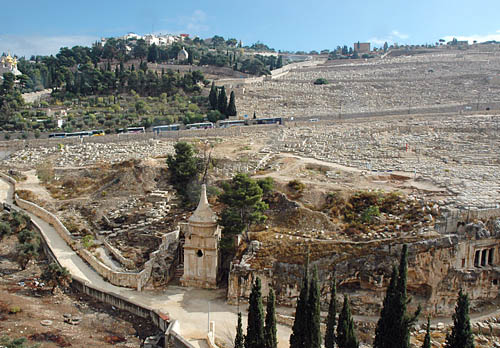
The Kidron Valley in Jerusalem has several ancient tombs in it. The Bible records that Absalom, son of King David, built a monument for himself in the King’s Valley.

Now Absalom in his lifetime had taken and set up for himself the pillar that is in the King’s Valley, for he said, “I have no son to keep my name in remembrance.” He called the pillar after his own name, and it is called Absalom’s monument to this day. (2 Samuel 18:18 ESV)

The so-called Absalmon's Monument in the Kidron Valley

In AD 1170 Benjamin of Tudela associated one of the monuments in the Kidron Valley with the monument of Absalom. The monument actually belongs to the early first century B.C. It is a funerary monument in front of an eight-chambered tomb.

Joe Zias, of Hebrew University, was able to locate an inscription on the right side of the monument in 2002. The inscription is written in Byzantine Greek of the fourth century AD and reads,

This is the tomb of Zacharias, martyr, very pious priest, father of John.

Could this be the priest Zacharias (also spelled Zechariah in English versions) who was the father of John the Baptist? I think the best we can do is agree with Murphy-O’Connor,

Such Byzantine identifications reflect the piety of the period and have no historical value.

An archaeology joke

Claude Mariottini calls attention to a funny archaeology joke. At least he thinks it is funny, and I agree.

An archaeologist was digging in the Negev desert in Israel and came upon a casket containing a mummy. After examining it, he called the curator of a prestigious natural history museum.

“I’ve just discovered a 3,000 year old mummy of a man who died of heart failure!” the excited explorer exclaimed.

The curator replied, “Bring him in. We will check it out and see if your calculations are correct.”

A week later, the amazed curator called the archaeologist. “I don’t know how you guessed so accurately, but you were right on target about the mummy’s age and cause of death. How in the world did you know?”

Like Dr. Mariottini did, I will send you here for the punch line.

John the Baptist at Machaerus

All four of the Gospels make some reference to the imprisonment of John the Baptist (Matthew 14:3,10; Mark 6:17; Luke 3:20; John 3:24). This must have been a significant and traumatic event for both the disciples of John and the disciples of Jesus.

Mark, the shortest gospel,  gives the most complete account of why Herod Antipas arrested and executed John. See Mark 6:17-32.

Josephus, the late first century Jewish historian, includes a long section about John in Antiquities 18:116-119. Perhaps another time we will take a closer look at all of it. For now, I am concerned with the place of execution.

Accordingly he was sent as prisoner, out of Herod’s suspicious temper, to Machaerus [or spell it Macherus], the citadel I before mentioned, and was there put to death. Now the Jews had an opinion that the destruction of this army was sent as a punishment upon Herod, and a mark of God’s displeasure to him. (Antiquities 18:119)

Josephus also records that Herod’s wife, the daughter of Aretas IV, king of Petra (the Nabateans), learned of his plan to divorce her and marry Herodias. Without telling Antipas that she knew, she asked for permission to be sent to Machaerus.I suspect that Herod was glad to get her out of town. She was no dummy. She had made arrangements for her father’s army to bring her safely [from Machaerus] to Arabia [perhaps Petra]. This event led to a war between the armies of Aretas and Herod Antipas. Herod’s army was destroyed. See Antiquities 18:109-115 for the full story.

Here is a brief summary about Machaerus.

  • Built by Alexander Jannaeus (102-75 B.C.).
  • Rebuilt by Herod the Great. This fortress is the eastern parallel to Masada.
  • Assigned to Herod Antipas at the death of Herod the Great (4 B.C.).
  • Destroyed by the Romans (A.D. 57).
  • Occupied by Jewish rebels (A.D. 66).
  • Captured by the Romans (A.D. 71).

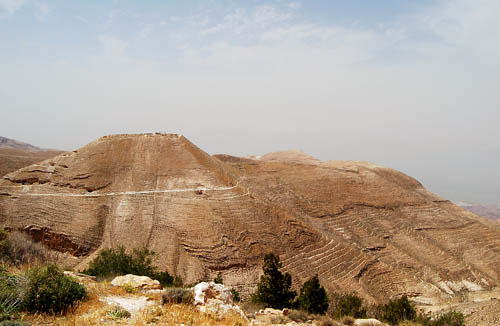
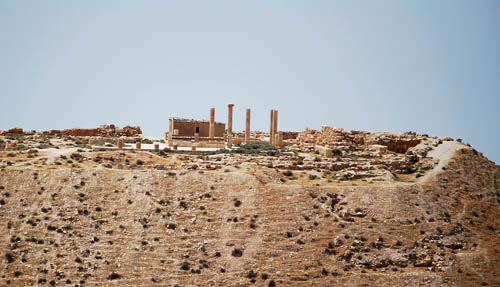
Machaerus has an impressive location overlooking the Dead Sea from the east. There was so much haze (eastern sand) in the air the day we visited last April that it was not possible to see the Dead Sea below. This photo gives some idea of the terrain. The citadel is located about 2300 feet above sea level. This would make it about 3600 feet above the Dead Sea. The hill to the east, where I stood, is about 60 feet higher than the citadel.

Here is a view of some of the reconstructed ruins at the top.

Where was John buried? Mark tells us that his disciples “came and took away his body and laid it in a tomb” (6:29). Did they bury him at Machaerus? At Samaria? Neither the Bible nor Josephus inform us.

If you could use some nice photos of Machaerus to illustrate Bible lessons, I suggest you check out those by David Padfield here.

Pella of the Decapolis

The Jerusalem Post recently published an article about Pella under the title “Head for the hills.” The article is interesting, but is mostly speculation over whether Christians from Jerusalem found refuge in the Pella area at the time of the Roman destruction of Jerusalem (A.D. 70). It is not uncommon to find serious mistakes in articles of this type. They seem to be done hurriedly to meet a deadline. The article leaves the impression that Christ instructed the disciples “to reside for a while at Pella.” Here is the quotation:

“Christ having instructed them to leave Jerusalem and retire from it on account of the impending siege… to reside for a while at Pella.”

In fact, Eusebius says that the disciples were warned in advance, and that they fled to Pella. I have no stock in Eusebius, but see no reason to doubt what he says about this. Here is the statement from Eusebius:

The whole body, however, of the church at Jerusalem, having been commanded by a divine revelation, given to men of approved piety there before the war, removed from the city, and dwelt at a certain town beyond the Jordan, called Pella.

Anyway, if you would like to read the JP article, click here.

A few months back I prepared a short article for Biblical Insights about Pella, and thought I would share it with you here.

————

Pella was one of the cities of the Decapolis (Mt. 4:25; Mk. 5:20; 7:31). Pella is not mentioned in the Bible by name, but the location on the eastern side of the Jordan (Perea; “beyond the Jordan”) makes it likely that Jesus visited the area (Mt. 19:1; Mk. 10:1).

The term Decapolis was used to describe a group of ten cities established by the Greeks. Many of them claimed to have been founded by Alexander the Great. The number of cities may have been ten at some time, but the exact number varies from list to list. The cities include Abila [Lysanias was tetrarch of Abilene, Lk. 3:1], Gadara [Umm Qeis], Gerasa [Jerash], Hippos, Philadelphia [Amman], Scythopolis [Beth-shan], Pella, et al. These cities are located mostly south of the Sea of Galilee, and all except Scythopolis are east of the Jordan River. Damascus is included in some lists. In the first century A.D. they were part of the Roman province of Syria.

The cities of the Decapolis reflected the Hellenistic culture that had dominated the area since the days of Alexander. Jesus’ ministry took him “beyond the Jordan [east]” to “Galilee of the Gentiles” (Mt. 4:15; Isa. 9:1). It is here that we find a sizable number of swine (Mt. 8:28-34).

When Paul left Damascus to go away into Arabia, he would have traveled through the Decapolis area. And again on the return (Gal. 1:17).

Eusebius, the fourth century church historian of Caesarea Maritima, says that the church at Jerusalem, having been previously commanded by a divine revelation, left the city before the Romans destroyed it in A.D. 70. He says they fled to Pella (HE 3.5.5). This would have been in response to the teaching of Jesus recorded in Matthew 24, Mark 13, and Luke 21.

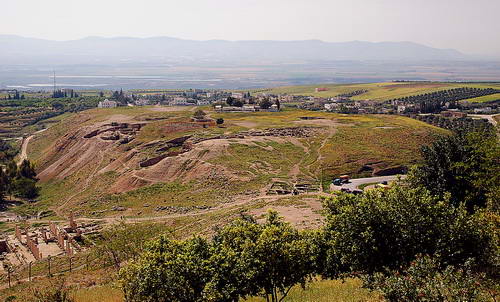
From a rest house above the mound one has a wonderful view of the tell and of the area to the west. From that point one can see (in the haze) Mount Gilboa, the Jezreel Valley (to the far right in our photo), and the city of Beth-shan across the Jordan Valley. The valley on the south side of Pella may have been the valley through which the Midianites fled from Gideon (Jud. 7). Surely the inhabitants of Jabesh-gilead would have come through this valley to take the body of Saul and his sons from the wall of Beth-Shan (1 Sam. 31:11-12).

Sunset at Lachish

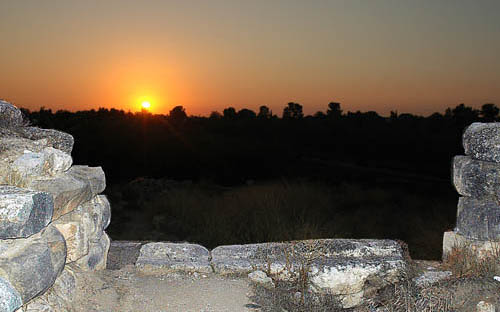
This photo was made from inside the gate at Lachish looking west toward the Mediterranean Sea. The city faced two significant sunsets. It fell to the Babylonians in 587 B.C. The Lachish Letters were found immediately outside this gate in a room on the left. My friend and colleague, the late Phil Roberts, worked in the gate when we were at Lachish in 1980. Phil continued to work there each year until the excavation came to a close. When the prophet Jeremiah wrote, only Lachish and Azekah remained of the fortified cities of Judah (Jeremiah 34:7).

Lachish fell to the Assyrians more than a hundred years earlier in 701 B.C.The Bible records the events after the fall of Samaria this way,

Now in the fourteenth year of King Hezekiah, Sennacherib king of Assyria came up against all the fortified cities of Judah and seized them. Then Hezekiah king of Judah sent to the king of Assyria at Lachish, saying, “I have done wrong. Withdraw from me; whatever you impose on me I will bear.” So the king of Assyria required of Hezekiah king of Judah three hundred talents of silver and thirty talents of gold. Hezekiah gave him all the silver which was found in the house of the LORD, and in the treasuries of the king’s house. At that time Hezekiah cut off the gold from the doors of the temple of the LORD, and from the doorposts which Hezekiah king of Judah had overlaid, and gave it to the king of Assyria. Then the king of Assyria sent Tartan and Rab-saris and Rabshakeh from Lachish to King Hezekiah with a large army to Jerusalem. So they went up and came to Jerusalem. And when they went up, they came and stood by the conduit of the upper pool, which is on the highway of the fuller’s field. (2 Kings 18:13-17)

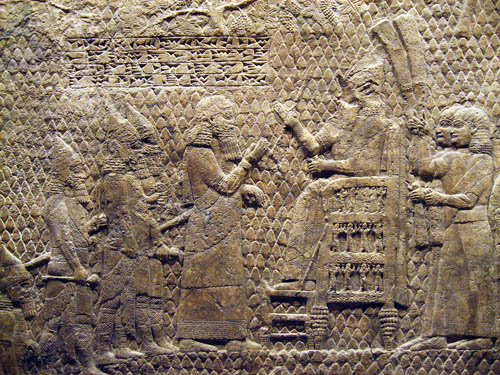
Sennacherib was unable to capture Jerusalem. I take it that the destruction of Lachish was his greatest achievement because he plastered the walls of his palace in Nineveh. This photo shows the king receiving the surrender of Lachish.

The cuneiform inscription reads as follows:

Sennacherib, king of the world, king of Assyria, sat upon a (nîmedu) -throne and passed in review the booty (taken) from Lachish (La-ki-su). (ANET 288).