
The Israel Antiquities Authority announced a few days ago the discovery of a figurine in the image of a bearded man, probably a boxer. The artifact was uncovered in the Givati car park excavation south of the Dung Gate, and is dated to the second or third century A.D.
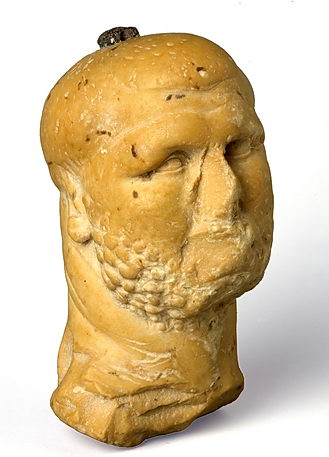
Head of Roman Boxer found at Jerusalem. Photo: Clara Amit, IAA.
Notice a few comments from the press release.
The stylistic motifs that are manifested in the image, such as its short hair style, the prominent lobes and curves of the ears, as well as the almond-shaped eyes suggest that the object most likely portrays an athlete, probably a boxer. Boxing was one of the most popular fields of heavy athletics in Roman culture and more than once Roman authors mention the demand by the Roman public in general, and the elite in particular, for boxing matches. Besides the prestige and the substantial amounts of money the victors of boxing competitions won, they were also afforded the support of the emperor himself, as in the famous case of Melancomas who was Titus’ favorite boxer.
According to the researchers the two tiny holes that were drilled in its nape and which contained the remains of metal that was inserted in them indicate that this is a suspended weight that was used with hanging scales that are characteristic of the Roman period. Miniature bronze images of athletes, philosophers, satyrs etc were among the most popular of the suspended weights that were used in the regions that were under the control of the Roman Empire – from Pompeii to Sepphoris.
I have seen busts of boxers or wrestlers with “cauliflower ears” in museums. One such bust is in the museum at Thessalonica.
In a different setting, writing to the church in Greco-Roman Corinth, Paul says,
Therefore I run in such a way, as not without aim; I box in such a way, as not beating the air; but I discipline my body and make it my slave, so that, after I have preached to others, I myself will not be disqualified. (1 Corinthians 9:26-27).
Read the complete report here.
 Ferrell's Travel Blog
You must be logged in to post a comment.