Tag Archives: Ministry of Jesus

The cost of discipleship: “foxes have holes”

Jesus used simple illustrations to reach the heart. When someone said, “I will follow You wherever You go,” He responded this way:

As they were going along the road, someone said to Him, “I will follow You wherever You go.” And Jesus said to him, “The foxes have holes and the birds of the air have nests, but the Son of Man has nowhere to lay His head.” (Luke 9:57-58 NASu; see Matthew 8:19-20)

Foxes have holes. Photo at Hai Bar Nature Reserve by Ferrell Jenkins.

Foxes have holes. Photo at Hai Bar Nature Reserve by Ferrell Jenkins.

William Barclay, in The Daily Study Bible, comments on this account at Matthew 8:19-20.

It is as if Jesus said to this man: “Before you follow me—think what you are doing. Before you follow me—count the cost.

Jesus did not want followers who were swept away by a moment of emotion, which quickly blazed and just as quickly died. He did not want men who were carried away by a tide of mere feeling, which quickly flowed and just as quickly ebbed. He wanted men who knew what they were doing. He talked about taking up a cross (Matthew 10:38). He talked about setting himself above the dearest relationships in life (Luke 14:26); he talked about giving away everything to the poor (Matthew 19:21). He was always saying to men: “Yes, I know that your heart is running out to me, but—do you love me enough for that?”

Jesus still demands full allegiance.
IBR discussions on Jesus now online

Members of the Institute for Biblical Research who specialize in historical Jesus research have been meeting for the past 10 years to discuss essays written by group members. You may recognize the names of Darrell Bock, Craig Evans, Grant Osborne, Michael Wilkins, et al. During June, 2008, several members of the group met in Jerusalem. While there they were filmed at various sites discussing the relevant issues.

These scholars did not start with the assumption that the Bible is the world of God. Rather, they asked, is the Bible consistent with other documents of the first century? How would one go about to establish the historicity of Alexander the Great, Julius Caesar, or Jesus?

The Day of Discovery TV program filmed these scholars on site in Israel discussing the various issues involved. Jesus: Man, Messiah, or More? is the theme of the presentations. The first was filmed in the Synagogue in Capernaum; the second from Caesarea Philippi. From now through early April there will be a total of eight presentations. These will certainly be a fresh breath of air compared to the usual Easter fare on cable and network TV.

Enter the discussion here.

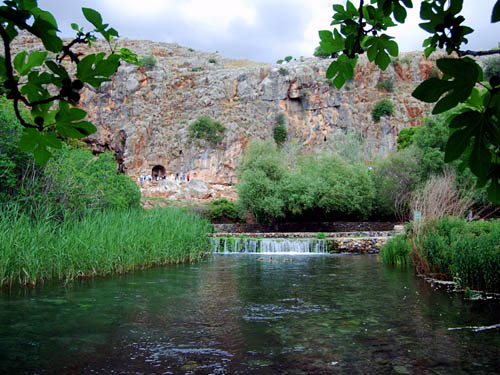
This photo shows the Banias River, one of the major sources of the Jordan River, at the site of Caesarea Philippi. It was in this region that Jesus was confessed to be the Son of the Living God by the apostle Peter (Matthew 16:13-20).

The Banias River at Caesarea Philippi. Photo by Ferrell Jenkins.

The Banias River at Caesarea Philippi. Photo by Ferrell Jenkins.

HT: Primetime Jesus

Jesus visited the town of Nain

The town of Nain is mentioned only once in the New Testament.

Soon afterward Jesus went to a town called Nain, and his disciples and a large crowd went with him. (Luke 7:11 NET)

In the full account, Luke (7:11-17) reports that as Jesus approached the town gate a funeral procession was in progress. When Jesus saw the widow He had compassion and told her to stop weeping. Luke, the physician (Colossians 4:14), reports that Jesus touched the bier and said, “Young man, I say to you, get up!” Then, as a simple matter of fact, Luke says,

So the dead man sat up and began to speak, and Jesus gave him back to his mother. (verse 15)

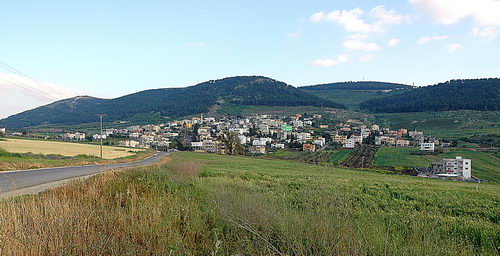
Nain is identified with the Arab village of Nein on the north slope of the Hill of Moreh. Nein is said to mean pleasant.

The town of Nein on the north slope of the Hill of Moreh. Photo by Ferrell Jenkins.

The town of Nein on the north slope of the Hill of Moreh. Photo by Ferrell Jenkins.

Ralph Earle describes the pleasant location of Nain.

The town of Jesus’ day may have stood higher on the hill than the present village. It probably was named for the pleasant view that the site affords across the plain of Esdraelon. To the west one can see Mt. Carmel, and to the north the hills behind Nazareth stand out, about 91/2 km (6 mi) away. To the northeast one can look past nearby Tabor (3 km [2 mi] away) to snowcapped Mt. Hermon in the distance. Southward lies Mt. Gilboa. (The International Standard Bible Encyclopedia, Revised, 3:480)