Tag Archives: Italy

Nero’s revolving dining room found

Numerous news sources have reported the discovery of a revolving dining room from the time of the Emperor Nero in the Roman Forum.

The AP report, as found at CBS News, says,

Archaeologists say they have unveiled what they believe to be remains of the “dining room” of the Roman emperor Nero, part of his palatial residence built in the first century.

Lead archaeologist Francoise Villedieu says her team discovered part of a circular room, which experts believe rotated day and night to imitate the Earth’s movement and impress guests.

Villedieu told journalists Tuesday that the room on the ancient Palatine Hill was supported by a pillar with a diameter of 4 meters (more than 13 feet). She says only the foundation of the room was recovered during the four-month excavation.

The Golden Palace, also known by its Latin name Domus Aurea, rose over the ruins of a fire that destroyed much of Rome in 64 A.D. and was completed in 68 A.D.

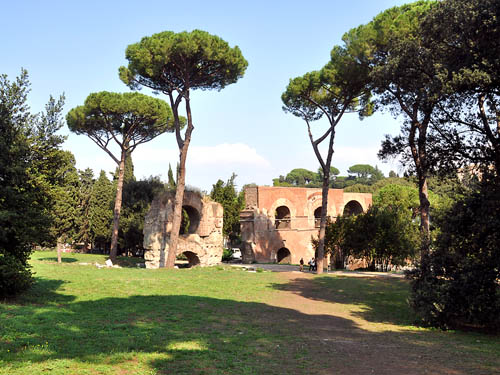
I was rather surprised to see several places in the Forum, and on the Palatine Hill, where excavations are in progress. I don’t know exactly where this new discovery was made, but I thought you might get some indication of the massive amount of work going on by noting the scaffolding in this photo.
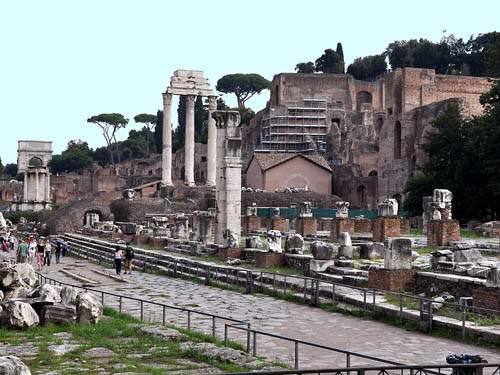
Roman Forum and Palatine Hill. Note the scaffolding on the hill. Photo by Ferrell Jenkins.

Roman Forum and Palatine Hill. Note scaffolding on the hill. Photo by F. Jenkins.

The London Daily Mail online has a much longer article with good photos, diagrams, and a video here.

Biblical and historical information indicates that both Paul and Peter were put to death during the reign of Nero.
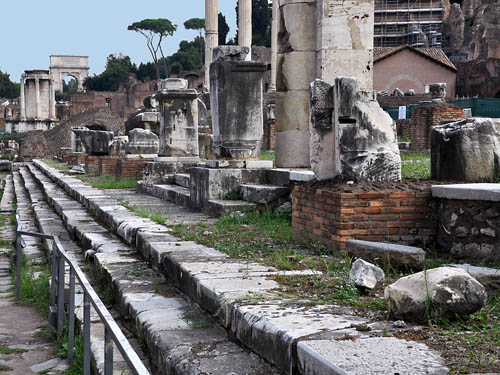
The Basilica Julia in the Roman Forum

Paul had come to Rome as a prisoner. While at Caesarea he exercised his right as a Roman citizen to appeal to Caesar (Acts 25:11; 28:19).

If then I am a wrongdoer and have committed anything for which I deserve to die, I do not seek to escape death. But if there is nothing to their charges against me, no one can give me up to them. I appeal to Caesar. (Act 25:11 ESV)

Only the large platform of the Basilica Julia remains in the Roman Forum. The building was not completed when it was dedicated by Julius Caesar in 46 B.C. The building burned and was reconstructed by Augustus in A.D. 12. Amanda Claridge, Rome: An Oxford Archaeological Guide, describes the Basilica Julia in the following words:

The basilica was the seat of the Court of the Hundred (the centumviri), a special civil court which generally dealt with matters of inheritance and actually numbered 180 judges when they all sat together at an important trial. Pliny the Younger describes the scene at one where he pleaded on behalf of a senatorial lady suing her 80-year-old father, who had disinherited her ten days after he took a new wife. In addition to the judges the place was packed with onlookers. Both parties had brought in large numbers of seats for their supporters, behind which were rows of people standing as far as the outer walls, and the crowd spilled upwards in the galleries, hanging over the rails in their efforts to hear the proceedings. (89-90)

Some scholars suggest that this is where Paul’s appeal before Caesar would have been heard (Wycliffe Historical Geography 545).

The steps leading to the Basilica Julia in Roman Forum. Photo by Ferrell Jenkins.

The steps leading to the Basilica Julia in Roman Forum. Photo by Ferrell Jenkins.

The information above describing the crowds that came to the court might provide some understanding of Paul’s statement to Timothy.

Do your best to come to me soon. For Demas, in love with this present world, has deserted me and gone to Thessalonica. Crescens has gone to Galatia, Titus to Dalmatia. Luke alone is with me. Get Mark and bring him with you, for he is very useful to me for ministry. Tychicus I have sent to Ephesus. When you come, bring the cloak that I left with Carpus at Troas, also the books, and above all the parchments. Alexander the coppersmith did me great harm; the Lord will repay him according to his deeds. Beware of him yourself, for he strongly opposed our message. At my first defense no one came to stand by me, but all deserted me. May it not be charged against them! But the Lord stood by me and strengthened me, so that through me the message might be fully proclaimed and all the Gentiles might hear it. So I was rescued from the lion’s mouth. The Lord will rescue me from every evil deed and bring me safely into his heavenly kingdom. To him be the glory forever and ever. Amen. (2 Timothy 4:9-18 ESV)

The Brethren, the Roman Forum and the Palatine Hill

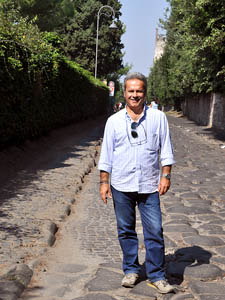
Stefano Corazza on the Appian Way

Stefano Corazza on the Appian Way

This morning I spoke again for La Chiesa di Christo in Rome. Stefano Corazzo translated my lesson on the subject “Can I trust my Bible?” I used PowerPoint slides with both English and Italian captions. Several of the brothers and sisters speak English at well as Italian.

Saturday and Sunday were beautiful sunny days in Rome. I tried to take advantage of the light to make some photos that would be helpful in teaching various New Testament subjects, especially pertaining to the book of Acts, the epistle to the Romans, the Prison Epistles (Ephessians, Colossians, Philemon, and Phillippians), and 2 Timothy, which seems to be the last prison epistle.

When I decided to return to the Roman Forum I did so at an entry with immediate access to the Palatine Hill. When I reached the ticket window I was told that tickets were free for Saturday and Sunday. Then I noticed that this included the Colosseum as well as the Palatine Hill and Forum. That was a saving of €12, about $18. My lucky day!

The Palatine Hill is a flat top hill of about 25 acres. Palatial residences of the emperors were built here during the Imperial period. Some of the structures date to a period after the time of Paul. Domitian (A.D. 81–96) modified the hill with new buildings. Two great complexes, called the House of Flavia and the House of Augustus grace the hill. A Stadium was used for minor games and entertainment.

The Palatine Hill in Rome. Photo by Ferrell Jenkins.

The Palatine Hill in Rome. Photo by Ferrell Jenkins.

The Roman Forum was the hub of Roman life — religious, political, economic, social. One structure of significance for the study of the life and work of Paul is the Julian Basilica — the seat of the tribunal of the centumiri, who judged civil cases. Here between the Palatine and Capitoline hills Paul probably stood trial before Caesar.

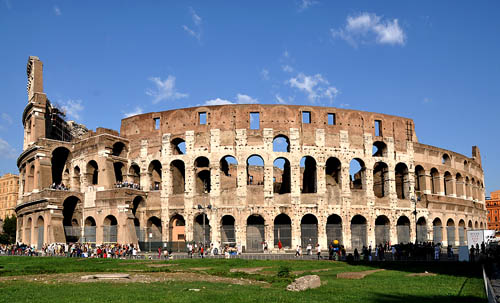
The Colosseum in Rome

The Colosseum in Rome was built in A.D. 80 by the Emperor Titus. He used 10,000 of the slaves from Judea in this work. Titus was in command of the Roman army when Jerusalem was burned in A.D. 70.

I know that this photo will make some of our tour members jealous  🙂 , but I thought I would share a photo I made of the Colosseum Friday afternoon. You may recall that our group visited the Colosseum and Forum in the rain a week ago.

The Colosseum in Rome. Photo by Ferrell Jenkins.

The Colosseum in Rome. Photo by Ferrell Jenkins.

It is true that Christians were persecuted and even put to death in Rome, but there is no evidence that this occurred in the Colosseum. The persecution under Nero took place in the Circus of Nero. That is where St. Peter’s now stands. The persecution in the days of Claudius took place at least 30 years before the Colosseum was built. Luke describes Paul’s first visit to Corinth,

After these things he left Athens and went to Corinth.  And he found a Jew named Aquila, a native of Pontus, having recently come from Italy with his wife Priscilla, because Claudius had commanded all the Jews to leave Rome. He came to them,  and because he was of the same trade, he stayed with them and they were working, for by trade they were tent-makers. (Acts 18:1-3)

“And thus we came to Rome”

Luke records that he and Paul found some brethren at Puetoli and remained for seven days. By this time the prisoner on behalf of the Gentiles had made such a good impression that he is allowed considerable freedom. Then he says, “and thus we came to Rome” (Acts 28:14 NAU). He hastens to add that brethren from Rome came south to meet them.

And the brethren, when they heard about us, came from there as far as the Market of Appius and Three Inns to meet us; and when Paul saw them, he thanked God and took courage. When we entered Rome, Paul was allowed to stay by himself, with the soldier who was guarding him. (Acts 28:15-16 NAU)

Under considerably different circumstances we came back to Rome yesterday after being away for five days. The brethren here invited me to speak last Sunday and again on September 27.  Yesterday and today we had wonderful sunny weather for photographs. I will share a few of the photographs that we were able to make.

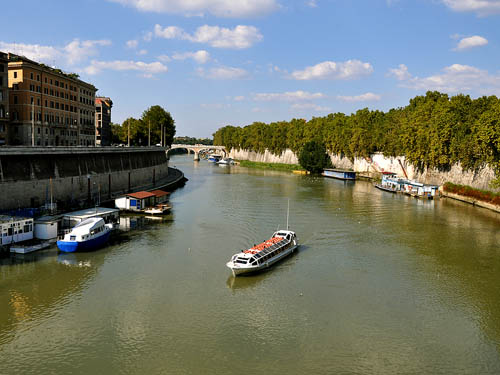
Rome was founded about 753 B.C. on the banks of the Tiber River. Here is one of the many views of the Tiber that one may see in Rome.

The Tiber River in Rome. Photo by Ferrell Jenkins.

The Tiber River in Rome. Photo by Ferrell Jenkins.

Rome once ruled the world. In the days of Caesar Augustus something happened in far away Palestine that would really change the Roman world and more.

Now in those days a decree went out from Caesar Augustus, that a census be taken of all the inhabited earth. (Luke 2:1 NAU)

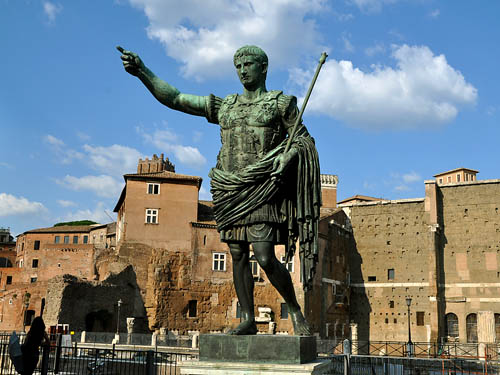
Statues of Roman Emperors may be seen all over the city of Rome. This one shows Emperor Augustus across from the Roman Forum.

The Emperor Augustus. Photo by Ferrell Jenkins.

The Emperor Augustus. Photo by Ferrell Jenkins.

This morning I visited with my friend and former student,  Stefano, as we had opportunity to visit the Appian Way and a few other sites in Rome. Stefano grew up in Rome. He spoke about how, as a kid, he played ball beside the ancient walls of Rome with no thought of the historical importance of the ruins. Now, of course, it is different. We thought about the Apostle Paul and the difficulties he faced in coming to Rome. And we discussed the work of the Lord in Italy and in America. I had lunch with Stefano and his parents, Sandro and Elisabetta.

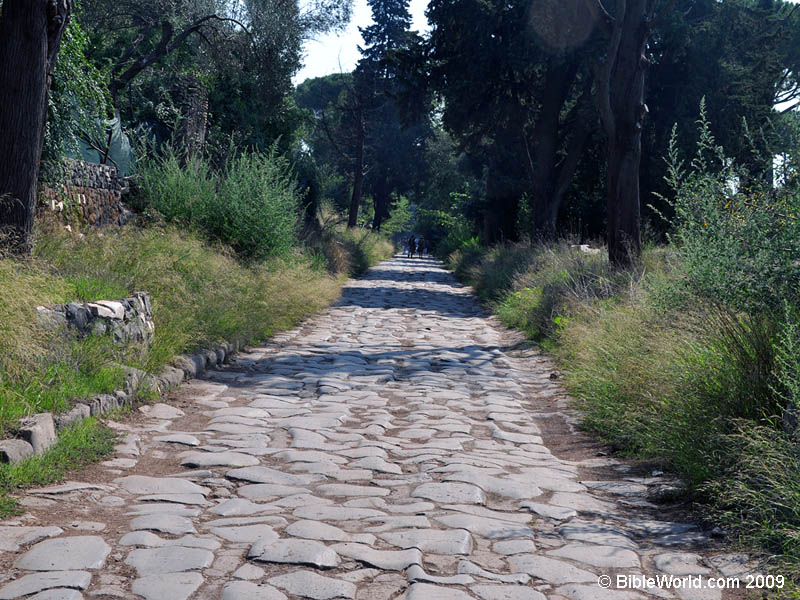
Here is a view of the Appian Way south of Rome. There is every reason to believe that Paul traveled this road. I have made this photo a little larger because I know that many teachers and preachers would like to use it in teaching the book of Acts. Just click on the photo for the larger version.

Paul traveled the Ancient Appian Way to get to Rome. Photo by Ferrell Jenkins.

Paul traveled the Ancient Appian Way to get to Rome. Photo by Ferrell Jenkins.

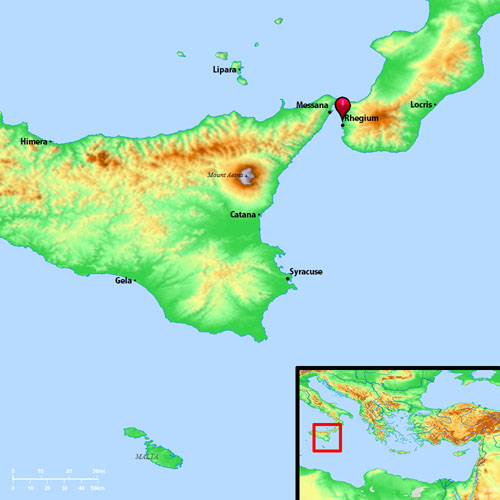
Map showing Rhegium and Syracuse

Here is a nice map from BibleAtlas showing the location of Rhegium on the toe of Italy, and Syracuse along the eastern coast of Sicily. Check BibleAtlas.org for more information, a larger copy of this map, and other maps.

The location of Rhegium and Syracuse. BibleAtlas.org.

The location of Rhegium and Syracuse. BibleAtlas.org.

Reggio di Calabria is Rhegium of Acts 28:13

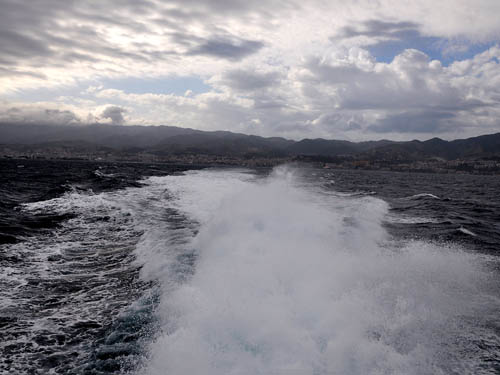
Yesterday I mentioned crossing the Strait of Messina by hydrofoil. Here is a rather unusual photo that I made from the stern of the hydrofoil as we left Messina, Sicily, toward Reggio di Calabria in Italy.

Crossing the Strait of Messina by hydrofoil. Photo by Ferrell Jenkins.

Crossing the Strait of Messina by hydrofoil. Photo by Ferrell Jenkins.

Once we arrived in Reggio we walked a few meters to our 3-star hotel. This little hotel, the Continental, has been recently refurbished. The elevator was new, and everything in the room, including the bathroom, was also new. The biggest disadvantage is that they did not have any Internet connection. I think this is the first hotel on this entire trip that did not provide some kind of access to the Internet. Eventually I paid 5 Euro (about $7.50) for one hour on the Internet at another hotel. But that is a good price compared to the hotel I am in tonight in Rome. The charge for one hour is 10 Euro (about $15.00).

We walked into town to visit the Archaeological museum and find something to eat. The museum, like the one in Syracuse, had nice displays of small items. I did not see anything of great helpfulness.

Reggio is situated along the strait and up the slope of a mountain. Only the main street and the promenade is level. Local advertising says that the area has been described as “the most beautiful kilometer in Italy.” From my limited experience in Italy, I would agree.

According to Luke, the Alexandrian ship Paul was on stayed only one day in Rhegium before a south wind allowed them to sail north through the Strait of Messina. It must have been a good wind. The next stop was Puteoli which is located in the Naples area.

We put in at Syracuse and stayed there three days. From there we cast off and arrived at Rhegium, and after one day a south wind sprang up and on the second day we came to Puteoli. (Acts 28:12-13 NET)

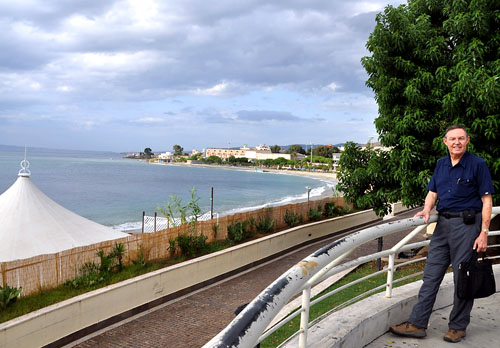
The modern port at Reggio is an artificial one. I tried to get some photos to illustrate where the natural port might have been. Elizabeth made this photo, look north along the Italian coast.

Looking north along the Italian coast at Reggio. Photo by Elizabeth Jenkins.

Looking north along the Italian coast at Reggio. Photo by Elizabeth Jenkins.

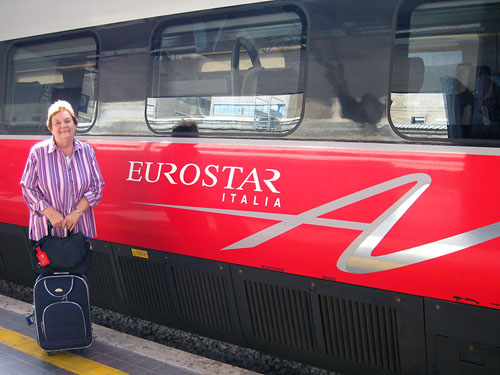
This morning we got up early and took the 6:46 a.m. Eurostar train from Reggio to Rome. The trip took a little over 5 and one half hours. We had about 6 brief stops between Reggio and Naples. From there it was non-stop to Rome. Mount Vesuvius was visible from the window of the train. Obviously I wished that time would permit a stop in Naples to visit Puteoli, Pompeii, and Mount Vesuvius.

Elizabeth and I enjoyed the Eurostar trip. Photo by Ferrell Jenkins.

Elizabeth and I enjoyed the Eurostar trip. Photo by Ferrell Jenkins.

This afternoon we were able to visit several sites in Rome with good sunshine and clouds. Maybe tomorrow we will be able to share some of those photos.

Thanks for following along with us on this journey.

Leaving Syracuse and Crossing the Strait of Messina

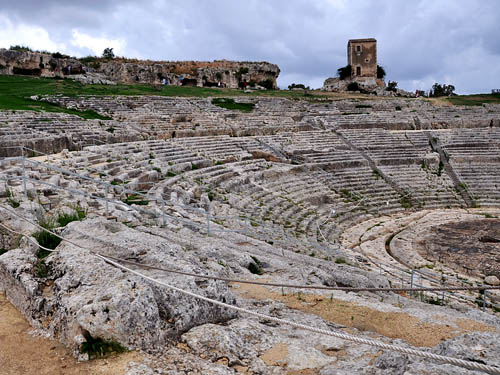
In Syracuse we visited the Archaeological Park. Here is a photo of the Greek theater which dates back to the 3rd century B.C. We know that it is something that was in existence at the time Paul stopped in the city. It doesn’t seem likely that a prisoner would be allowed to go sightseeing in the city.

The 3rd Century Greek theater at Syracuse. Photo by Ferrell Jenkins.

The 3rd Century Greek theater at Syracuse. Photo by Ferrell Jenkins.

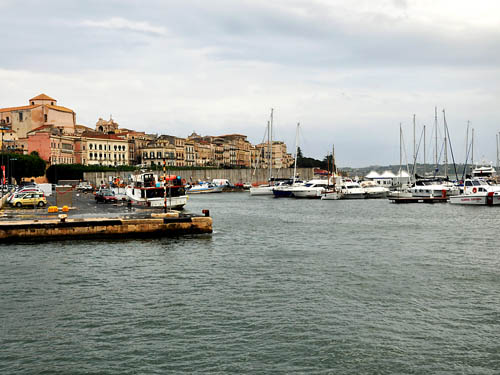
This morning before leaving I tried to catch a few minutes of sunshine to get some photos at the Grand Harbor. This is a natural harbor that was likely in use at the time of Paul.

The Grand Harbor at Syracuse. Photo by Ferrell Jenkins.

The Grand Harbor at Syracuse. Photo by Ferrell Jenkins.

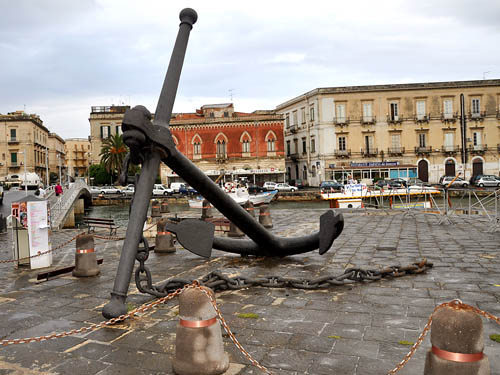
Here is another shot that I thought conveyed the idea of this being the harbor of the city.

A large anchor at the Grand Harbor of Syracuse. Photo by Ferrell Jenkins.

A large anchor at the Grand Harbor of Syracuse. Photo by Ferrell Jenkins.

Incidentally, the sun did not shine until we were in the taxi headed from the hotel to the train station. Life is fun.

Crossing the Strait of Messina. Today we left Syracuse by train intending to go as far as Villa San Giovani in Italy. Then we would take a train to Reggio di Calabria (Rhegium of the New Testament). Instead, we left the train at Messina and took the hydrafoil direct to Reggio. This was a real thrill to me to be able to actually cross this body of water at this point. It is sort of like being on the Sea of Galilee. You know it happened somewhere nearby. “It” being either something Jesus did, or something Paul did.

We put in at Syracuse and stayed there three days.  From there we cast off and arrived at Rhegium, and after one day a south wind sprang up and on the second day we came to Puteoli. (Acts 28:12-13 NET).

Tonight we are in Reggio. Early tomorrow morning we take the train to Rome. Puteoli is near Naples. I wish we had time to stop there and photograph the Colosseum, but time does not allow that on this trip. I was at Puteoli some years back, but would like to get better photographs.

Vatican City and the Vatican Museum

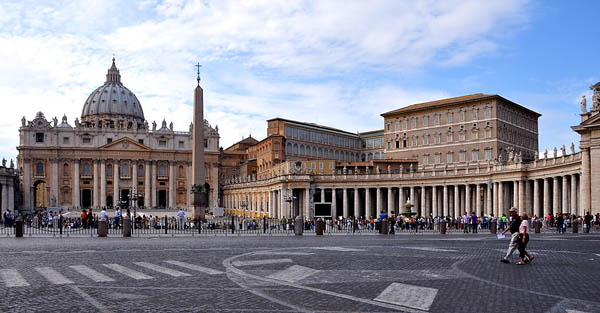
We had a busy day Saturday in Rome. In the morning we visited St. Peter’s Basilica in Vatican City. Vatican is an independent state within Italy. This is the largest church building in the world. Thousands of people visit it each day. There probably isn’t anyone who reads this blog who had not been here or seen photos or video of the building and its art treasures.

St. Peter's basilica in Vatican City. Photo by Ferrell Jenkins.

St. Peter's basilica in Vatican City. Photo by Ferrell Jenkins.

St. Peter’s is located on the site of Nero’s Circus. Nero’s persecution of Christians was in his circus, A.D. 64.  (Tacitus, Annales, XV, 44).

St. Peter’s was financed through the sale of indulgences in the 16th century. The reaction to this practice was an important factor in the Reformation Movement. Dr. Dan Petty explains a little about Martin Luther’s role.

Doctrinal Issues and Religious Authority. The immediate issue that prompted Martin Luther to post his 95 propositions for debate in 1517 was the abuse of the Roman Catholic system of indulgences. The doctrine of indulgences, first formulated in the thirteenth century, was associated with the sacrament of penance and the doctrine of purgatory. While the sacrament was believed to provide forgiveness of sin and eternal punishment, it was thought that there was a temporal satisfaction that the repentant sinner must fulfill in this life or in purgatory. The indulgence was a document that one could purchase for a sum of money that would free him from the temporal penalty of sin. The excess merits of Christ and the saints were believed to be stored up in a heavenly “treasury of merit” which the pope could draw from on behalf of the living.  In 1517 the Dominican Johann Tetzel was selling a special plenary indulgence (promising complete forgiveness of all sin) to raise money for the church. Half of the money was to be given to Archbishop Albert, to whom the pope had given a special dispensation to hold two offices. The rest would help finance the completion of Saint Peter’s cathedral in Rome. Luther’s protest initially was against what he saw as the abuse of the system of indulgence. It was also a challenge to the papal authority that made such abuses possible.

After the visit to St. Peter’s we went to the Vatican Museum. I broke away from the group to make some photos in the Roman section of the museum. Tremendous crowds visit this museum. I have been here several times since my first visit in 1967, and I have never seen the crowds worse than today.

In the afternoon the group went to the catacombs, I took leave to return to the hotel and continue work on my lesson for the Sunday service at La Chiesa di Christo, via Sannio 69 (Roma).

Learning the Bible in the Middle Ages

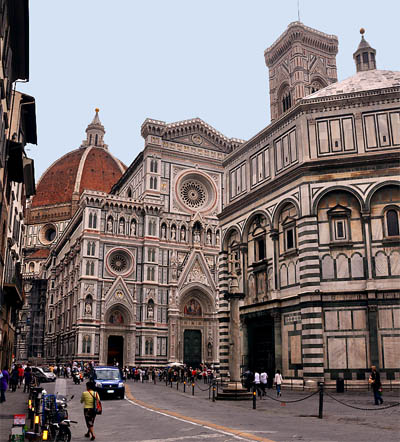
Duomo, Baptistery, and Campanile. Photo by Ferrell Jenkins.

The Cathedral (or Duomo) of Florence is of the Gothic style and dates to the 12th century A.D. The church, along with the baptistery, and the campanile (bell tower) have been designated a UNESCO World Heritage Site. The bronze baptistery doors, often designated as the Gates of Paradise, was designed by Lorenzo Ghiberti in the early 1400s. The gates we see today are reproductions.

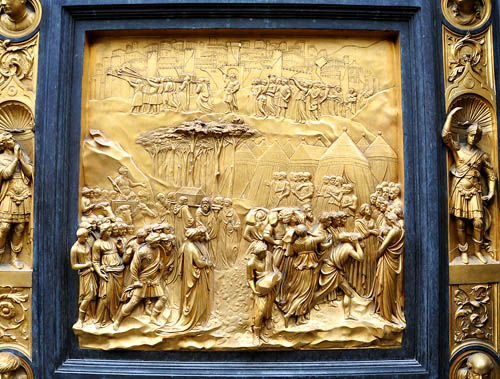
In the Middle Ages Bibles were not available to the common people. One of the ways the Bible was taught was through the stained glass windows, wood carvings, and cast works such as the doors of the baptistery. The panel in the photo below shows the Israelites crossing the Jordan, and the capture of Jericho (Joshua 3-6). Remember that for the Western World those were the Dark Ages.

Baptistery panel showing capture of Jeriocho. Photo by Ferrell Jenkins.

There is more that should be said about Florence, but we arrived in Rome last evening. Today and tomorrow will be filled with activity in Rome.