Category Archives: Old Testament

In Eastern Turkey

I saw our group off at the Istanbul airport early yesterday morning. Elizabeth informs me that everyone made it to New York safely. A few hours later I left for Van in Eastern Turkey with Leon Mauldin, David Padfield, and Gene Taylor. We will be visiting numerous OT sites in the east. In Van we picked up a rental vehicle and headed for Dogubayazit. This is the small town closest to Mount Ararat. This entire area of Turkey is the ancient Urartu, the land of Ararat. The Bible tells us that the ark landed in the mountains of Ararat (Genesis 8:4). The specific peak is not mentioned and there are several contenders for the mountain of the Bible. Mount Ararat is the one best known.

On the way north from Van we stopped at the Muradiye falls. The terrain you see in the photos if typical of that area of Ararat. Here is a photo of the falls.
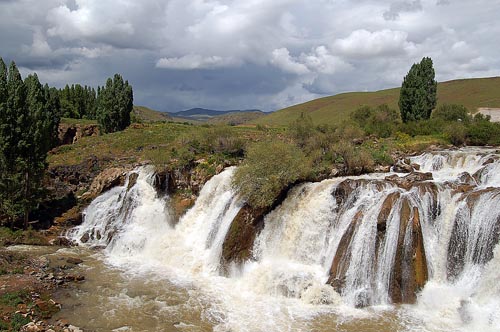
Muradiye Falls in Eastern Turkey. Photo by Ferrell Jenkins.

My only other trip to this area was in 1995, so I am excited about the possibility of getting hi-res digital photos of the area.

Between Muradiye and Dogubeyazit we reached an elevation of about 8,000 feet, saw lots of snow still on the mountains, and encountered a little rain. There were shepherds with sheep all through this area. When we arrived our hotel facing Mount Ararat the mountain was totally covered in dark clouds. Within two hours we were able to go out and made wonderful photos of the mountains. We even saw a rainbow. No kidding! The photo below iS of Greater Ararat. We never saw Lesser Ararat completely cloudless. We drove to the check point at the border with Iran. I was surprised to find about 3 tours groups at the hotel. The last time I was there my companions and I were the only ones in the hotel. Here is one of the photos I made yesterday.
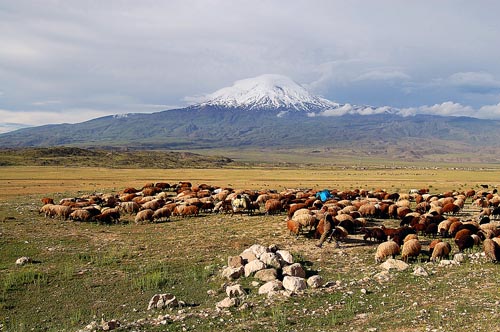
Mount Ararat in Eastern Turkey near the Iranian border. Photo by Ferrell Jenkins.

 This morning we made more photos and visited a few places nearby.  In the afternoon we drove back to Van. We went to the museum but it was closed for restoration. We did make photos of some items in the courtyard. We also visited the Rock in Van. We are now at our hotel on the shore of Lake Van.
Wonderful Day in Istanbul. The tour is completed.

We had a great day visiting the sites of Istanbul. The city is important in secular and church history. A few of us spent almost the entire day in the marvelous Archaeological Museum. I made more than 500 hi-res digital photos today. Tonight at dinner we celebrated a birthday and an anniversary. Not enough time to post any photos, but will plan to do that later.

As the group returns home I will be departing for Eastern Turkey with three friends. We will spend a week in that part visiting some of the important Old Testament sights.

We probably will not have Internet access tomorrow night from Mount Ararat, but we may have access the following night. I will post some notes whenever possible. Keep checking back.

Passing Through the Cilician Gate

After worship we visited the village of Ortahisar, and made another photo stop in Cappadocia. We stopped in Avanos to make a photo of the Halys River. The river marked the boundary of the early Hittite kingdom. Avanos is noted for its pottery making. In Turkey, as in many parts of the world, the old hand skills such as pottery making are being taken over by machinery. In this small town many of the people still make pottery by hand.
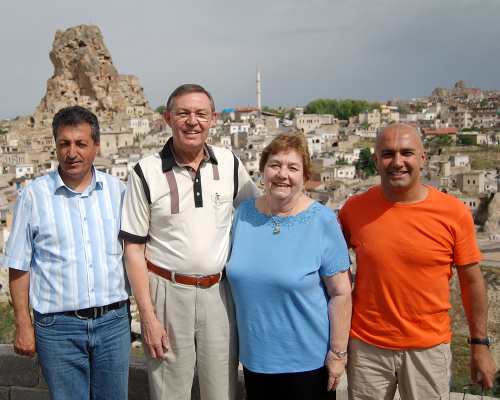
Elizabeth and I are joined by our driver and our guide, Orhan Ongu, for this photo at Ortahisar in Cappadocia. This is Orhan’s home town, but he now lives in Istanbul. He is a knowledgeable and personable guide. The group is enjoying his help and information.

Ferrell and Elizabeth with driver and guide in at Ortahisar, Turkey.

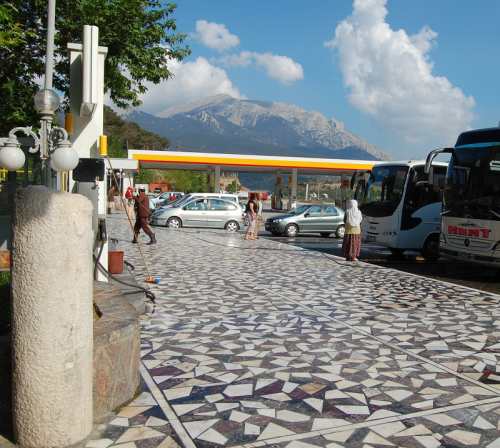
In the afternoon we drove south to Adana through the famous Cilician Gate, the pass through the Taurus Mountains. This pass was used by famous rulers such as Xerxes, Darius, Cyrus, and Alexander the Great. This route seems to be the one taken by Paul and Silas on the second journey (Acts 15:46 – 15:1). It would have been the route used by the Romans and the Crusaders. There is a feeling of participating in history as one travels this road. The ancient road has been replaced by a modern multi-lane highway. The photo below shows the Taurus Mountains from a rest stop north of the Cilician Gates. On the left is a Roman milestone dating to A.D. 231.

The Taurus Mountains and the Cilician Gate.

We passed near Tarsus, the native home of Paul, and turned east to Adana. This was the Old Testament region of Que (Kue) and the New Testament region of Cilicia. The earliest letter of the New Testament is the one contained in Acts 15:23-29. This letter is addressed “to the brethren in Antioch and Syria and Cilicia who are from the Gentiles.” Paul and Silas traveled through the region, strengthening the churches (Acts 15:40-41). Who established these churches?

Tomorrow we will explore Tarsus, home of the Apostle Paul.

Ankara, the capital of Turkey

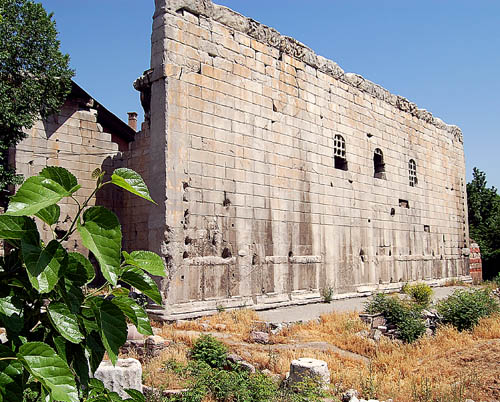
Temple of Emperor Augustus, Ankara, Turkey.

In addition to some of the highlights of the modern city, we visited the Temple of Augustus and the priceless collection of Hittite artifacts in the Museum of Anatolian Civilizations. This museum is often referred to as the Hittite Museum. The Temple of Augustus, shown above, was built about 20 B.C. when Ankara was known as Ancyra and was in the province of Galatia. The deeds of Augustus are recorded on the outside wall in Greek, and on the inside wall in Latin. Augustus is referred to as DIVI in Latin and THEOS in Greek. Worship of the emperors was widespread in Asia Minor. This information helps us with our understanding of the setting of the book of Revelation.

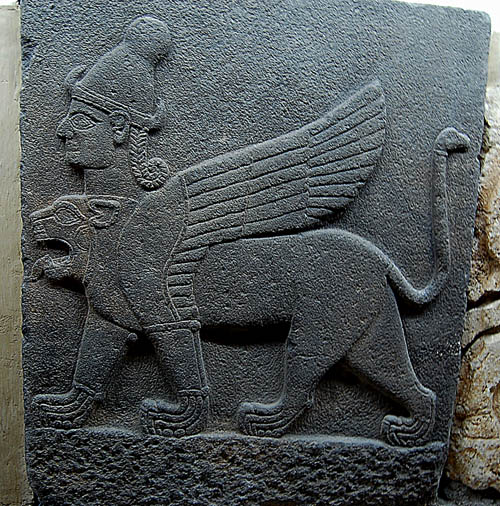
The Museum of Anatolian Civilizations is a small, but very impressive museum. This is because of the great collection of Hittie artifacts. There is one large room devoted to Neo-Hittite reliefs from Carchemish on the Euphrates River. Carchemish was the site of the defeat of the Assyrian Empire in 605 B.C. The photo below shows a three-head sphinx. It is a winged lion with the head of a bird of prey on the tail. On top of the head is a human head wearing a conical hat. Composite images such as this were common during Old Testament times. An understanding of this helps us with our study of the apocalyptic books of the Bible, Ezekiel, Daniel, Zechariah, and Revelation.

Three-head sphinx from Carchemish on the Euphrates. Photo by Ferrell Jenkins.

In the afternoon we headed south to the region of Cappadocia, or as they call it s here, Kappadokia. More tomorrow, hopefully.


The Hittites


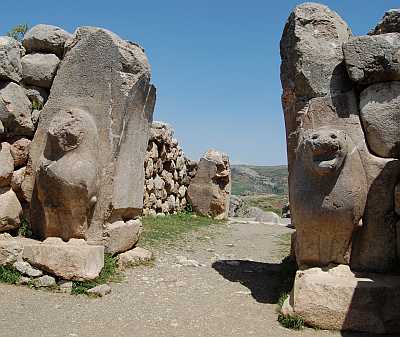
Lion’s Gate at Ancient Hattusas

We made a full day excursion from Ankara to the Hittite sites of Hattusas (now Bogazkale) and the open air sanctuary of Yazilikaya where the Hittite gods are depicted in relief on the rock. During Old Testament days Turkey was the home of the ancient Hittites, once thought by critics of the Bible to be an example of the inaccuracy of the Bible. In 1906 archaeologists began to uncover the Hittite civilization at Boghazkoy (now Bogazkale). The Hittites had numerous contacts with the people of the Bible from the time of Abraham onward (Gen. 15:20; Josh. 1:4; 2 Sam. 11:3; 1 Kings 10:29; See National Geographic, July, 1977). Our trip, including the sightseeing, took about 11 hours. The weather was warm, in the mid-80s, and the sky was beautiful. This made for a good photographic day. The photo above is of the Lion’s Gate.

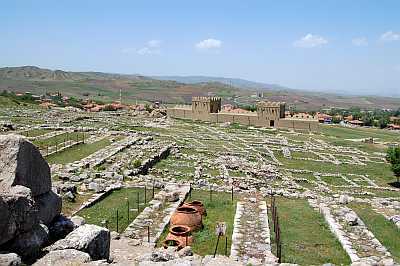
The photo below shows some of the temple area and a portion of reconstructed wall. This also provides a view of the typical Anatolian landscape around Hattusas.

Tomorrow we will visit the famous Hittite Museum in Ankara, and continue to Cappadocia.

View of Hattusas toward reconstructed wall.