Category Archives: New Testament

The Arch of Constantine

The Arch of Constantine was dedicated to the Emperor by the Senate and the People of Rome in A.D. 315. Constantine served as Emperor from A.D. 306 to 337. By the time of Constantine the church had made major departures from the New Testament pattern of church organization. The Emperor attended the Council of Nicea, but allowed the eastern bishops to preside over the meeting.

Grant comments on the question of Constantine’s conversion:

The question as to whether he was a “genuine” Christian or not depends on somewhat subjective definitions. (Encyclopedia of Early Christianity, 227).

The Arch of Constantine and the Colosseum. Photo by Ferrell Jenkins.

The Arch of Constantine and the Colosseum. Photo by Ferrell Jenkins.

Helena, the mother of Constantine, was responsible for the construction of many of the well-known churches of the Holy Land. Rosenberg says,

Her role in church history was due to her partnership in Constantine’s program of church building at Bethlehem and Jerusalem and to her discovery of what she believed to be the true cross, both of which led to the revival of Jerusalem and the encouragement of pilgrimage to the Holy Land. (Encyclopedia of Early Christianity 417).

The Pyramid of Caius Cestius

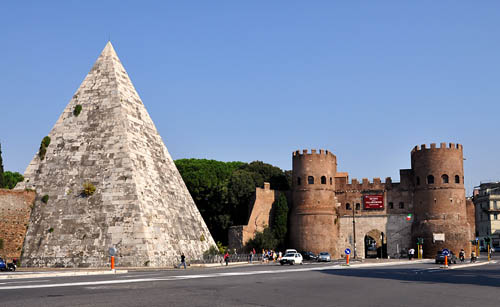
The Pyramid of Caius Cestius, erected in 43 B.C., is located in the Aurelian wall near the Gate of St. Paul in Rome.

Pyramid of Caius Cestius and the Gate of St. Paul. Photo by Ferrell Jenkins.

Pyramid of Caius Cestius and the Gate of St. Paul. Photo by Ferrell Jenkins.

Caius Cestius was an insignificant first century B.C. magistrate, but it is possible that Paul saw his Pyramid.

How big is the Canon? Depends on who you ask.

Bible Study Magazine has made available a chart comparing various canons of Scripture. Those included are the SamWhat's in Your Bible? Find out at BibleStudyMagazine.comaritan Bible, Hebrew Bible, Greek Orthodox, Roman Catholic, Syriac, Ethiopian, and Protestant. By clicking on the small chart you will be taken to the complete large chart in Bible Study Magazine.

Buying the best Bible Software

Logos_iconAs time permits I am trying to catch up on some of the blogs that I follow. I see that C. Michael Patton has a post at Parchment and Pen (I love that title) on “The Other Best Bible Software.” He is talking about Logos Bible Software. The other one he reviewed earlier is BibleWorks 8. Michael says he uses both. So do I.

Every young preacher should stop buying junk, ready-mixed pabulum, and get some real tools. Another advantage is that you will have no books to loan! Read Patton’s review here.

You will find some comments about the free software that so many preachers and teachers use.

The earlier review about BibleWorks 8 is here.

David Instone-Brewer, Tyndale Tech, has also written recently about Logos Libronix 3 here.

Morris Proctor is an (the?) authorized trainer for Logos Bible Software. His Tips and Tricks are helpful. You might also find a helpful note at the Logos Blog.

You will also find notes about both of these programs at Biblical Studies and Technological Tools.

Recently I wrote here about the problem of having to use Pradis to have access to Zondervan publications. In recent weeks, Zondervan and Logos announced that Zondervan books will be available from Logos. Good news. Now we must wait to see have much (or little?) we will have to pay for the conversion of the programs we already have.

Do your best to present yourself to God as one approved, a worker who has no need to be ashamed, rightly handling the word of truth. (2 Timothy 2:15 ESV)

Make every effort to present yourself before God as a proven worker who does not need to be ashamed, teaching the message of truth accurately. (2 Timothy 2:15 NET)

Nero’s revolving dining room found

Numerous news sources have reported the discovery of a revolving dining room from the time of the Emperor Nero in the Roman Forum.

The AP report, as found at CBS News, says,

Archaeologists say they have unveiled what they believe to be remains of the “dining room” of the Roman emperor Nero, part of his palatial residence built in the first century.

Lead archaeologist Francoise Villedieu says her team discovered part of a circular room, which experts believe rotated day and night to imitate the Earth’s movement and impress guests.

Villedieu told journalists Tuesday that the room on the ancient Palatine Hill was supported by a pillar with a diameter of 4 meters (more than 13 feet). She says only the foundation of the room was recovered during the four-month excavation.

The Golden Palace, also known by its Latin name Domus Aurea, rose over the ruins of a fire that destroyed much of Rome in 64 A.D. and was completed in 68 A.D.

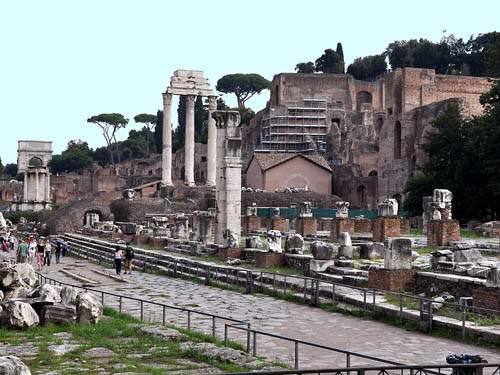
I was rather surprised to see several places in the Forum, and on the Palatine Hill, where excavations are in progress. I don’t know exactly where this new discovery was made, but I thought you might get some indication of the massive amount of work going on by noting the scaffolding in this photo.

Roman Forum and Palatine Hill. Note the scaffolding on the hill. Photo by Ferrell Jenkins.

Roman Forum and Palatine Hill. Note scaffolding on the hill. Photo by F. Jenkins.

The London Daily Mail online has a much longer article with good photos, diagrams, and a video here.

Biblical and historical information indicates that both Paul and Peter were put to death during the reign of Nero.

The Basilica Julia in the Roman Forum

Paul had come to Rome as a prisoner. While at Caesarea he exercised his right as a Roman citizen to appeal to Caesar (Acts 25:11; 28:19).

If then I am a wrongdoer and have committed anything for which I deserve to die, I do not seek to escape death. But if there is nothing to their charges against me, no one can give me up to them. I appeal to Caesar. (Act 25:11 ESV)

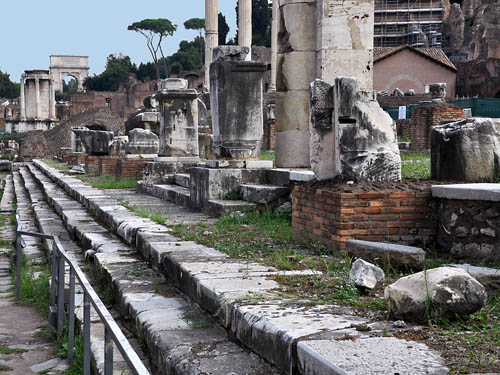
Only the large platform of the Basilica Julia remains in the Roman Forum. The building was not completed when it was dedicated by Julius Caesar in 46 B.C. The building burned and was reconstructed by Augustus in A.D. 12. Amanda Claridge, Rome: An Oxford Archaeological Guide, describes the Basilica Julia in the following words:

The basilica was the seat of the Court of the Hundred (the centumviri), a special civil court which generally dealt with matters of inheritance and actually numbered 180 judges when they all sat together at an important trial. Pliny the Younger describes the scene at one where he pleaded on behalf of a senatorial lady suing her 80-year-old father, who had disinherited her ten days after he took a new wife. In addition to the judges the place was packed with onlookers. Both parties had brought in large numbers of seats for their supporters, behind which were rows of people standing as far as the outer walls, and the crowd spilled upwards in the galleries, hanging over the rails in their efforts to hear the proceedings. (89-90)

Some scholars suggest that this is where Paul’s appeal before Caesar would have been heard (Wycliffe Historical Geography 545).

The steps leading to the Basilica Julia in Roman Forum. Photo by Ferrell Jenkins.

The steps leading to the Basilica Julia in Roman Forum. Photo by Ferrell Jenkins.

The information above describing the crowds that came to the court might provide some understanding of Paul’s statement to Timothy.

Do your best to come to me soon. For Demas, in love with this present world, has deserted me and gone to Thessalonica. Crescens has gone to Galatia, Titus to Dalmatia. Luke alone is with me. Get Mark and bring him with you, for he is very useful to me for ministry. Tychicus I have sent to Ephesus. When you come, bring the cloak that I left with Carpus at Troas, also the books, and above all the parchments. Alexander the coppersmith did me great harm; the Lord will repay him according to his deeds. Beware of him yourself, for he strongly opposed our message. At my first defense no one came to stand by me, but all deserted me. May it not be charged against them! But the Lord stood by me and strengthened me, so that through me the message might be fully proclaimed and all the Gentiles might hear it. So I was rescued from the lion’s mouth. The Lord will rescue me from every evil deed and bring me safely into his heavenly kingdom. To him be the glory forever and ever. Amen. (2 Timothy 4:9-18 ESV)

The Brethren, the Roman Forum and the Palatine Hill

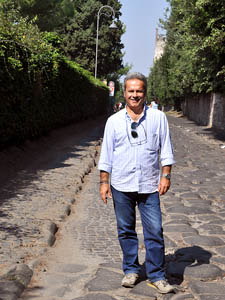
Stefano Corazza on the Appian Way

Stefano Corazza on the Appian Way

This morning I spoke again for La Chiesa di Christo in Rome. Stefano Corazzo translated my lesson on the subject “Can I trust my Bible?” I used PowerPoint slides with both English and Italian captions. Several of the brothers and sisters speak English at well as Italian.

Saturday and Sunday were beautiful sunny days in Rome. I tried to take advantage of the light to make some photos that would be helpful in teaching various New Testament subjects, especially pertaining to the book of Acts, the epistle to the Romans, the Prison Epistles (Ephessians, Colossians, Philemon, and Phillippians), and 2 Timothy, which seems to be the last prison epistle.

When I decided to return to the Roman Forum I did so at an entry with immediate access to the Palatine Hill. When I reached the ticket window I was told that tickets were free for Saturday and Sunday. Then I noticed that this included the Colosseum as well as the Palatine Hill and Forum. That was a saving of €12, about $18. My lucky day!

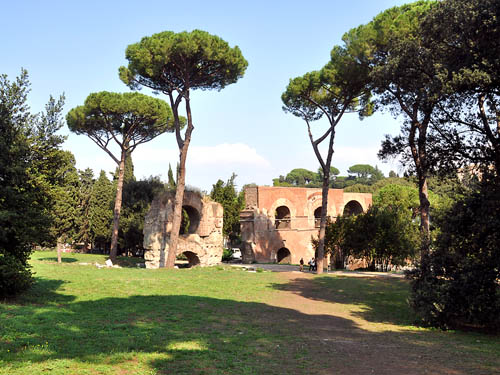
The Palatine Hill is a flat top hill of about 25 acres. Palatial residences of the emperors were built here during the Imperial period. Some of the structures date to a period after the time of Paul. Domitian (A.D. 81–96) modified the hill with new buildings. Two great complexes, called the House of Flavia and the House of Augustus grace the hill. A Stadium was used for minor games and entertainment.

The Palatine Hill in Rome. Photo by Ferrell Jenkins.

The Palatine Hill in Rome. Photo by Ferrell Jenkins.

The Roman Forum was the hub of Roman life — religious, political, economic, social. One structure of significance for the study of the life and work of Paul is the Julian Basilica — the seat of the tribunal of the centumiri, who judged civil cases. Here between the Palatine and Capitoline hills Paul probably stood trial before Caesar.

The Colosseum in Rome

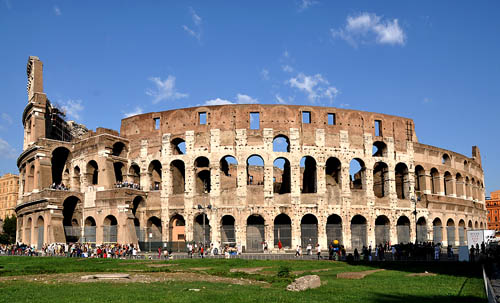
The Colosseum in Rome was built in A.D. 80 by the Emperor Titus. He used 10,000 of the slaves from Judea in this work. Titus was in command of the Roman army when Jerusalem was burned in A.D. 70.

I know that this photo will make some of our tour members jealous  🙂 , but I thought I would share a photo I made of the Colosseum Friday afternoon. You may recall that our group visited the Colosseum and Forum in the rain a week ago.

The Colosseum in Rome. Photo by Ferrell Jenkins.

The Colosseum in Rome. Photo by Ferrell Jenkins.

It is true that Christians were persecuted and even put to death in Rome, but there is no evidence that this occurred in the Colosseum. The persecution under Nero took place in the Circus of Nero. That is where St. Peter’s now stands. The persecution in the days of Claudius took place at least 30 years before the Colosseum was built. Luke describes Paul’s first visit to Corinth,

After these things he left Athens and went to Corinth.  And he found a Jew named Aquila, a native of Pontus, having recently come from Italy with his wife Priscilla, because Claudius had commanded all the Jews to leave Rome. He came to them,  and because he was of the same trade, he stayed with them and they were working, for by trade they were tent-makers. (Acts 18:1-3)

“And thus we came to Rome”

Luke records that he and Paul found some brethren at Puetoli and remained for seven days. By this time the prisoner on behalf of the Gentiles had made such a good impression that he is allowed considerable freedom. Then he says, “and thus we came to Rome” (Acts 28:14 NAU). He hastens to add that brethren from Rome came south to meet them.

And the brethren, when they heard about us, came from there as far as the Market of Appius and Three Inns to meet us; and when Paul saw them, he thanked God and took courage. When we entered Rome, Paul was allowed to stay by himself, with the soldier who was guarding him. (Acts 28:15-16 NAU)

Under considerably different circumstances we came back to Rome yesterday after being away for five days. The brethren here invited me to speak last Sunday and again on September 27.  Yesterday and today we had wonderful sunny weather for photographs. I will share a few of the photographs that we were able to make.

Rome was founded about 753 B.C. on the banks of the Tiber River. Here is one of the many views of the Tiber that one may see in Rome.
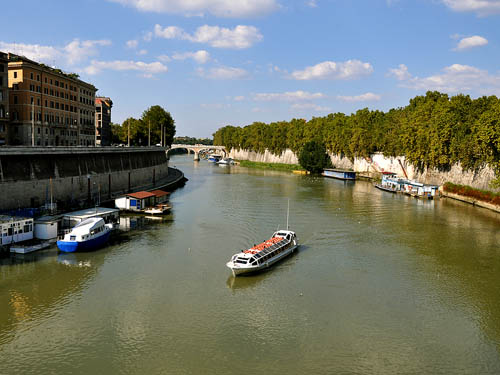
The Tiber River in Rome. Photo by Ferrell Jenkins.

The Tiber River in Rome. Photo by Ferrell Jenkins.

Rome once ruled the world. In the days of Caesar Augustus something happened in far away Palestine that would really change the Roman world and more.

Now in those days a decree went out from Caesar Augustus, that a census be taken of all the inhabited earth. (Luke 2:1 NAU)

Statues of Roman Emperors may be seen all over the city of Rome. This one shows Emperor Augustus across from the Roman Forum.
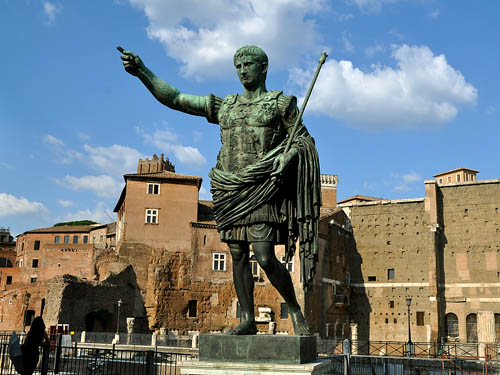
The Emperor Augustus. Photo by Ferrell Jenkins.

The Emperor Augustus. Photo by Ferrell Jenkins.

This morning I visited with my friend and former student,  Stefano, as we had opportunity to visit the Appian Way and a few other sites in Rome. Stefano grew up in Rome. He spoke about how, as a kid, he played ball beside the ancient walls of Rome with no thought of the historical importance of the ruins. Now, of course, it is different. We thought about the Apostle Paul and the difficulties he faced in coming to Rome. And we discussed the work of the Lord in Italy and in America. I had lunch with Stefano and his parents, Sandro and Elisabetta.

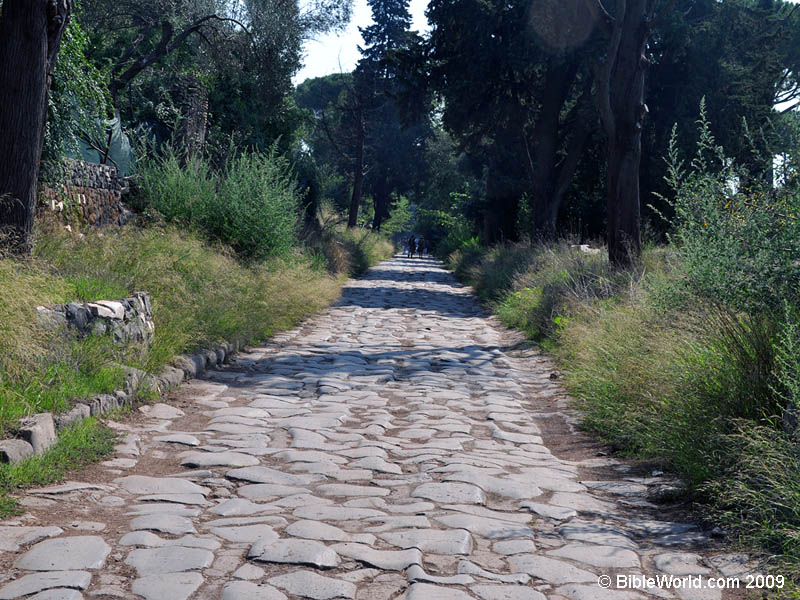
Here is a view of the Appian Way south of Rome. There is every reason to believe that Paul traveled this road. I have made this photo a little larger because I know that many teachers and preachers would like to use it in teaching the book of Acts. Just click on the photo for the larger version.
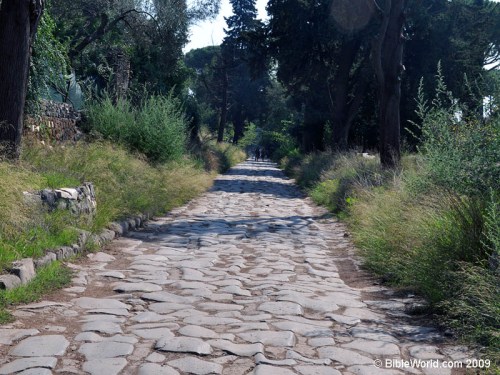
Paul traveled the Ancient Appian Way to get to Rome. Photo by Ferrell Jenkins.

Paul traveled the Ancient Appian Way to get to Rome. Photo by Ferrell Jenkins.
Map showing Rhegium and Syracuse

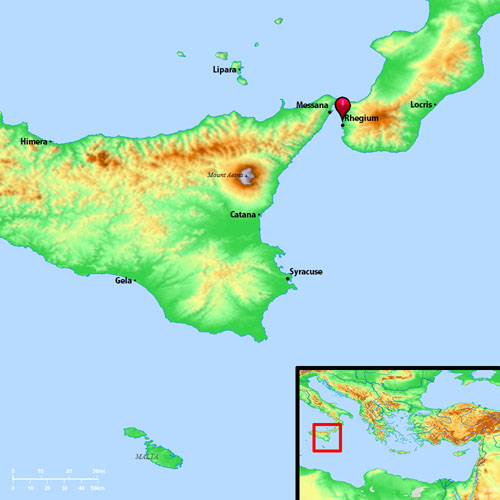
Here is a nice map from BibleAtlas showing the location of Rhegium on the toe of Italy, and Syracuse along the eastern coast of Sicily. Check BibleAtlas.org for more information, a larger copy of this map, and other maps.

The location of Rhegium and Syracuse. BibleAtlas.org.

The location of Rhegium and Syracuse. BibleAtlas.org.