
Category Archives: Egypt

Dog River in Lebanon

The Nahr el Kelb, the River of the Dog, flows into the Mediterranean Sea about nine miles north of Beirut, Lebanon. In antiquity the river was known as the Lycus. Many important armies have traveled through this pass in the Lebanon mountains leaving their inscriptions on the cliffs.

There are inscriptions or reliefs from the following ancient rulers:

  • Egyptian Pharaoh Ramses II.
  • Assyrian kings Shalmaneser III and Esarhaddon.
  • Babylonian king Nebuchadnezzar.

Shalmaneser III took tribute from Jehu, the king of Israel,  841 B.C. Wright says,

“The tribute was evidently received after Shalmaneser’s fifth attack on Damascus, following which he had marched his army into Phoenicia. While there he says that he received the tribute of Tyre, Sidon, and Jehu, and placed his portrait on the cliff of Ba’ lira’ si. This portrait, along with those of other kings, including Rameses II of Egypt…” is located at Dog River, north of Beirut. (Biblical Archaeology, 158-159).

Jehu was king of Israel in the 9th century B.C. (2 Kings 9). The Bible does not record this event, but the annals of Shalmaneser III record the following information:

“…I (also) marched as far as the mountains of Ba’li-ra’si which is a promontory (lit.: at the side of the sea) and erected there a stela with my image as king. At that time I received the tribute of the inhabitants of Tyre, Sidon and of Jehu, son of Ornri.” (ANET, 280)

This photo, made in 2002, shows the reliefs left by Salmaneser III and Ramses (right).
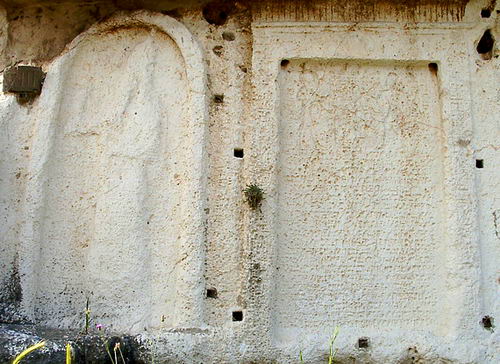
Reliefs of Shalmaneser III and Pharaoh Ramses at Dog River. Photo by Ferrell Jenkins.
Reliefs of Shalmaneser III and Pharaoh Ramses at Dog River. Photo by Ferrell Jenkins.

Ben Ezra Synagogue in Old Cairo

As the term implies, Old Cairo is the oldest section of Cairo, Egypt. It is sometimes called Coptic Cairo. Visitors may see the Coptic Museum where some of the Nag Hammadi Gnostic texts are displayed. The last time I was in Cairo, in 2005, the museum was closed for some restoration. I am hopeful this will not be the case the next time.

The Church of St. Sergius is located in the Coptic area. Legend has it that Joseph, Mary, and the infant Jesus stayed here when they fled from Herod the Great. The New Testament records all we really know about their stay in Egypt.

Now when they had departed, behold, an angel of the Lord appeared to Joseph in a dream and said, “Rise, take the child and his mother, and flee to Egypt, and remain there until I tell you, for Herod is about to search for the child, to destroy him.” And he rose and took the child and his mother by night and departed to Egypt and remained there until the death of Herod. This was to fulfill what the Lord had spoken by the prophet, “Out of Egypt I called my son.” (Matthew 2:13-15 ESV)

The Romans built a fortress in the area of Old Cairo called Babylon. Some remnants of the fortress can be seen.

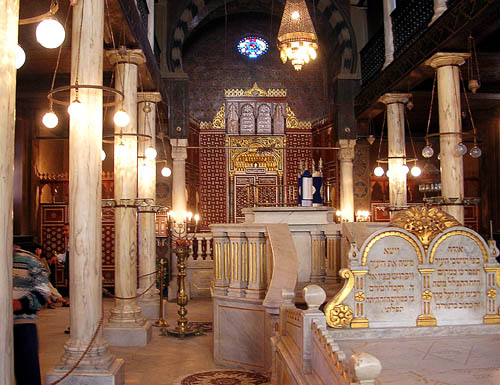
Of special interest is the Ben Ezra Synagogue. It was here that the 140,000 Cairo Geniza fragments of Hebrew and Jewish literature were found. The collection of material dating back to as early as the 9th and 10th century A.D. is now housed in Cambridge, England. This link will take you to some good information about the collection. Until the discovery of the Dead Sea Scrolls these biblical fragments represented our oldest examples of the Hebrew biblical text.

This photo shows the interior of the restored Synagogue. Of course, few Jews live in Egypt now.

Ben Ezra Synagogue after restoration. Photo by Ferrell Jenkins.

Ben Ezra Synagogue after restoration. Photo by Ferrell Jenkins.

Aswan, Egypt

Aswan is the location of the first cataract of the Nile River. This made it an ideal location for the Aswan Dam which was built between 1898 and 1902. This created a small lake south of the dam, but it was nothing to compare with Lake Nasser which has been formed as a result of the building of the new high dam at Aswan between 1960 and 1971.

The new high dam was constructed at a time when the Soviet Union was providing technical, economic and military support to Egypt. I remember staying in a hotel in Egypt in 1973 filled with Soviet tourists. In the following years we saw none of them. Lake Nasser stretches south for more than 300 miles. Many of the Nubians who lived in this area had to be resettled by the Egyptian government.

Kitchener’s Island, shown below, was given to Lord Horatio Kitchener for his service in the Sudan Campaign. It now is owned by the state and is the site of a beautiful botanical garden. The Mausoleum of the Aga Khan is visible on the top of the hill in the photo below.

Some scholars identify the Arabic name Aswan with the Syene of Ezekiel 29:10 and 30:6. It may be identified with the Sinim of Isaiah 49:12.

Kitchener's Island at Aswan, Egypt. Photo by Ferrell Jenkins.

The Nile River at Aswan. Photo by Ferrell Jenkins.