Category Archives: Archaeology

Antioch of Syria — Now in Turkey

We made a full day excursion to Antakya (biblical Antioch of Syria). Turning south along the Mediterranean we passed the plain of Issus where the armies of Alexander and Darius fought in 333 B.C. Further south we passed Iskenderun (Turkish word for Alexandria) which was founded by Alexander the Great. It was along this land bridge that many ancient powers, Hittities, Macedonian, Romans, and Crusaders, made their way to ancient Canaan (Israel, Palestine). Antioch of Syria on the Orontes River was founded by Seleucus I Nicator in 300 B.C. Antioch became a Roman city in 64 B.C. and capital of the new province of Syria. It became the third largest city of the Roman Empire after Rome and Alexandria. After Jerusalem, Antioch was the second great center of Christianity in New Testament times and where the disciples of Christ were first called Christians (Acts 11:19-30; 13:1-3; 14:26-28; 15:1-41; 18:22-23; Gal. 2). A church called the Cave Church of St. Peter honors Peter’s visit to the city (Gal. 2).. From here the great journeys of Paul began. This photo shows part of the modern city from Mount Silpius.

Antioch of Syria (now in Turkey) from Mount Silpius. Photo by Ferrell Jenkins.

The museum has a fine collection of 4th century A.D. mosaics from nearby Daphne. After lunch we visited the site of the port of Seleucia (near Samandag) which was founded by Seleucus I Nicator in 300 B.C. and served as the seaport of Antioch. From here Barnabas and Saul sailed for Cyprus (Acts 13:4). We saw the tunnel built by the Roman emperors Vespasian and Titus to control flooding in the area. The photo below is of the Besikil Cave, a rock cut tomb monument dating to as early as the first century A.D.
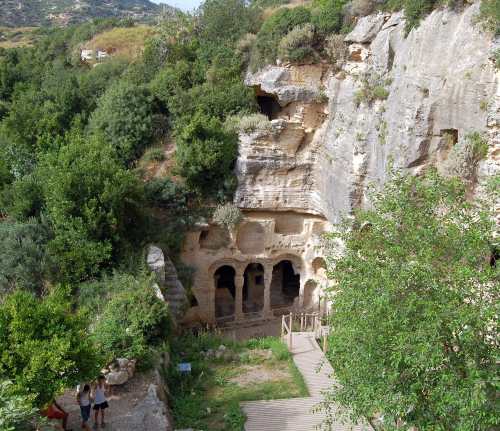
Besikil Cave Monument at Seleucia. Photo by Ferrell Jenkins.

Tomorrow we visit Derbe, Lystra, and Iconium (modern Konya).
Tarsus in Cilicia

This morning we went to Tarsus, the native home of the apostle Paul. Tarsus is located near the Mediterranean Sea about 30 miles below the Cilician Gates. Tarsus in Cilicia served as one of the great crossroads of history. Paul described it as “no insignificant city” (Acts 21:39; 9:11; 22:3). Cleopatra once came up the River Cydnus to Tarsus to meet Mark Antony. The city now has a population of about 212,000. The fertile land of the Cilician plain near the city is suitable for growing many kinds of fruit, including citrus. North of the city in the hill country vineyards and wheat fields are abundant.

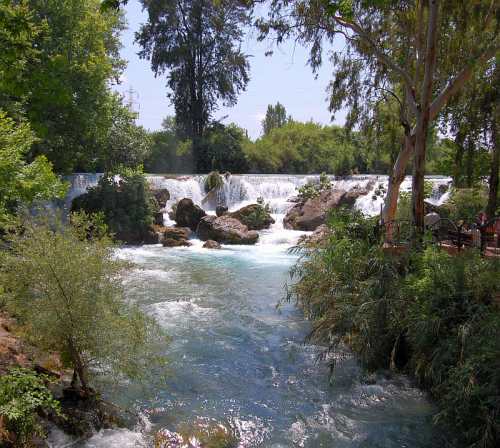
In Tarsus we saw a gate called Cleopatra’s Gate (or St. Paul’s Gate), sites associated with Paul (whether authentic or not), the recent excavation of the Roman street, and the Roman bath. There has been a recent discovery of a Roman bridge that once spanned the river. It is underneath a mosque that claims to contain the tomb of the prophet Daniel. I know of no historical reason to connect Daniel with Tarsus. We had lunch at the beautiful waterfalls on the outskirts of the city. It is difficult to imagine Paul not seeing these falls many times during his years in Tarsus.

Tarsus Waterfall. Photo by Ferrell Jenkins.

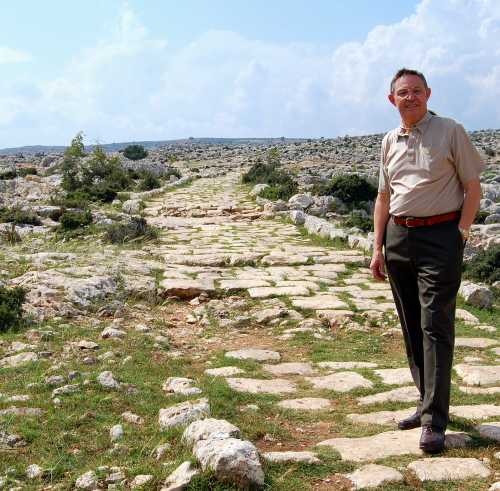
About 12 miles north of the city, near the village of Saglikli, there is a wonderful stretch of Roman road. This road, the Roma Yolu in Turkish, was the road that connected Tarsus with the Cilician Gates. We walked almost the full length (about 1.5 miles) of this road. On previous trips I had been unable to get to this road, but thanks to directions from Dr. Mark Wilson, a friend who spends about half of each year doing research in Turkey, I was able to locate it. This was the first time our experienced guide of 18 years had seen the road. Take a look at Dr. Wilson’s web page, Seven Churches Network for some good resources on biblical Turkey. I think every member of our group enjoyed walking on this road that was constructed in about A.D. 200 during the reign of the Emperor Septimius Severus. Did Paul and Silas follow this same route on an earlier road during the second journey?

The Roman Road from Tarsus to the Cilician Gates. Photo by David Padfield.

Today we really traveled ancient roads. Tomorrow we have plans to go to Syrian Antioch (now in Turkey) and Seleucia.

Passing Through the Cilician Gate

After worship we visited the village of Ortahisar, and made another photo stop in Cappadocia. We stopped in Avanos to make a photo of the Halys River. The river marked the boundary of the early Hittite kingdom. Avanos is noted for its pottery making. In Turkey, as in many parts of the world, the old hand skills such as pottery making are being taken over by machinery. In this small town many of the people still make pottery by hand.
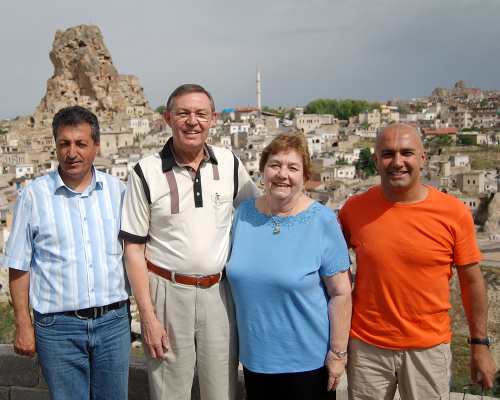
Elizabeth and I are joined by our driver and our guide, Orhan Ongu, for this photo at Ortahisar in Cappadocia. This is Orhan’s home town, but he now lives in Istanbul. He is a knowledgeable and personable guide. The group is enjoying his help and information.

Ferrell and Elizabeth with driver and guide in at Ortahisar, Turkey.

In the afternoon we drove south to Adana through the famous Cilician Gate, the pass through the Taurus Mountains. This pass was used by famous rulers such as Xerxes, Darius, Cyrus, and Alexander the Great. This route seems to be the one taken by Paul and Silas on the second journey (Acts 15:46 – 15:1). It would have been the route used by the Romans and the Crusaders. There is a feeling of participating in history as one travels this road. The ancient road has been replaced by a modern multi-lane highway. The photo below shows the Taurus Mountains from a rest stop north of the Cilician Gates. On the left is a Roman milestone dating to A.D. 231.

The Taurus Mountains and the Cilician Gate.

We passed near Tarsus, the native home of Paul, and turned east to Adana. This was the Old Testament region of Que (Kue) and the New Testament region of Cilicia. The earliest letter of the New Testament is the one contained in Acts 15:23-29. This letter is addressed “to the brethren in Antioch and Syria and Cilicia who are from the Gentiles.” Paul and Silas traveled through the region, strengthening the churches (Acts 15:40-41). Who established these churches?

Tomorrow we will explore Tarsus, home of the Apostle Paul.

Ankara, the capital of Turkey

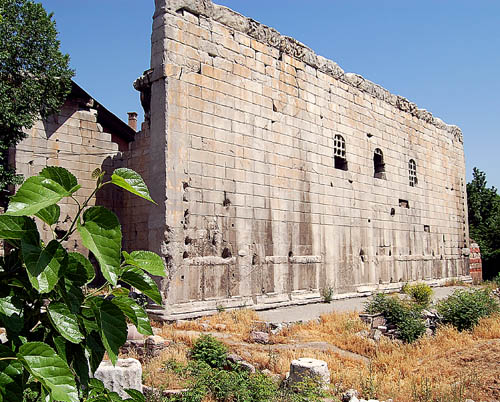
Temple of Emperor Augustus, Ankara, Turkey.

In addition to some of the highlights of the modern city, we visited the Temple of Augustus and the priceless collection of Hittite artifacts in the Museum of Anatolian Civilizations. This museum is often referred to as the Hittite Museum. The Temple of Augustus, shown above, was built about 20 B.C. when Ankara was known as Ancyra and was in the province of Galatia. The deeds of Augustus are recorded on the outside wall in Greek, and on the inside wall in Latin. Augustus is referred to as DIVI in Latin and THEOS in Greek. Worship of the emperors was widespread in Asia Minor. This information helps us with our understanding of the setting of the book of Revelation.

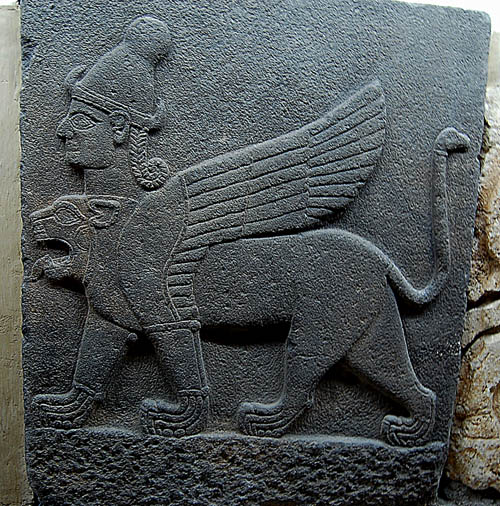
The Museum of Anatolian Civilizations is a small, but very impressive museum. This is because of the great collection of Hittie artifacts. There is one large room devoted to Neo-Hittite reliefs from Carchemish on the Euphrates River. Carchemish was the site of the defeat of the Assyrian Empire in 605 B.C. The photo below shows a three-head sphinx. It is a winged lion with the head of a bird of prey on the tail. On top of the head is a human head wearing a conical hat. Composite images such as this were common during Old Testament times. An understanding of this helps us with our study of the apocalyptic books of the Bible, Ezekiel, Daniel, Zechariah, and Revelation.

Three-head sphinx from Carchemish on the Euphrates. Photo by Ferrell Jenkins.

In the afternoon we headed south to the region of Cappadocia, or as they call it s here, Kappadokia. More tomorrow, hopefully.


The Hittites


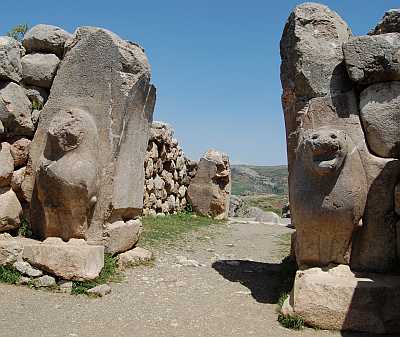
Lion’s Gate at Ancient Hattusas

We made a full day excursion from Ankara to the Hittite sites of Hattusas (now Bogazkale) and the open air sanctuary of Yazilikaya where the Hittite gods are depicted in relief on the rock. During Old Testament days Turkey was the home of the ancient Hittites, once thought by critics of the Bible to be an example of the inaccuracy of the Bible. In 1906 archaeologists began to uncover the Hittite civilization at Boghazkoy (now Bogazkale). The Hittites had numerous contacts with the people of the Bible from the time of Abraham onward (Gen. 15:20; Josh. 1:4; 2 Sam. 11:3; 1 Kings 10:29; See National Geographic, July, 1977). Our trip, including the sightseeing, took about 11 hours. The weather was warm, in the mid-80s, and the sky was beautiful. This made for a good photographic day. The photo above is of the Lion’s Gate.

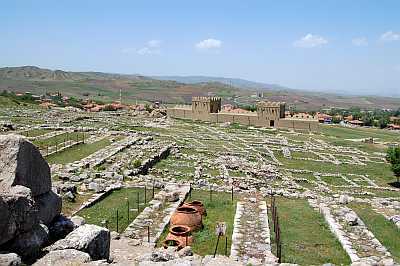
The photo below shows some of the temple area and a portion of reconstructed wall. This also provides a view of the typical Anatolian landscape around Hattusas.

Tomorrow we will visit the famous Hittite Museum in Ankara, and continue to Cappadocia.

View of Hattusas toward reconstructed wall.