
The town of Nain is mentioned only once in the New Testament.
Soon afterward Jesus went to a town called Nain, and his disciples and a large crowd went with him. (Luke 7:11 NET)
In the full account, Luke (7:11-17) reports that as Jesus approached the town gate a funeral procession was in progress. When Jesus saw the widow He had compassion and told her to stop weeping. Luke, the physician (Colossians 4:14), reports that Jesus touched the bier and said, “Young man, I say to you, get up!” Then, as a simple matter of fact, Luke says,
So the dead man sat up and began to speak, and Jesus gave him back to his mother. (verse 15)
Nain is identified with the Arab village of Nein on the north slope of the Hill of Moreh. Nein is said to mean pleasant. Nain was a city of Issachar in Old Testament times. Here is a photo I made of the little Arab village last May.
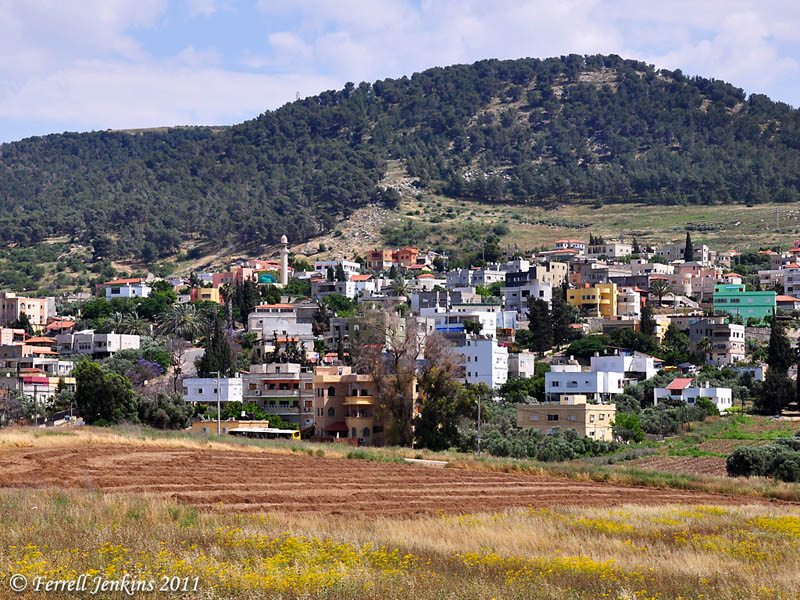
The Village of Nein on the north slope of the Hill of Moreh. Photo by Ferrell Jenkins.
Ralph Earle describes the pleasant location of Nain.
The town of Jesus’ day may have stood higher on the hill than the present village. It probably was named for the pleasant view that the site affords across the plain of Esdraelon. To the west one can see Mt. Carmel, and to the north the hills behind Nazareth stand out, about 9½ km [6 mi] away. To the northeast one can look past nearby Tabor (3 km [2 mi] away) to snowcapped Mt. Hermon in the distance. Southward lies Mt. Gilboa. (The International Standard Bible Encyclopedia, Revised, 3:480)
Our new header, which we will use for a while, is a 3-image panorama of Nain and the north side of the Hill of Moreh.
 Ferrell's Travel Blog
You must be logged in to post a comment.