
by Ferrell Jenkins
Corinth is located on the Isthmus that connects the mainland of Greece with the Peloponnese, making it an important center for commerce and travel. Murphy-O’Connor says “Strabo put it very succinctly” with these words: “It is situated on the Isthmus and is master of two harbours, of which the one [Cenchreae] leads straight to Asia, and the other [Lechaeum] to Italy” (Geography 6.8.20; BA 47:3).
Lechaeum was the western port located on the Corinthian Gulf where ships sailed to and from Europe. Cenchrea was the eastern port located on the Saronic Gulf where ships sailed to and from Asia and Egypt.
There are numerous spellings of Cenchrea. In Greek the name is Kenchreai (with a variety of spellings). Cenchrea is mentioned by name only twice in the New Testament. When Paul completed 18 months of work at Corinth, he, along with Priscilla and Aquila “put out to sea for [the Roman province of] Syria” (Acts 18:18). The first stop named is Ephesus, where Priscilla and Aquila remained, but Paul continued his voyage to Caesarea (Acts 18:21-22). Before leaving Cenchrea Paul (or Aquila) got a hair cut because he had made a vow. The traditional view is that this reference is to Paul, but the Greek text makes it impossible to know for certain.
The second reference to Cenchrea is in Romans 16:1-2, where Paul commends Phoebe, “a servant (diakonon) of the church which is at Cenchrea.” He urges the saints at Rome to receive her and to help her. He says, “for she herself has also been a helper of many, and of myself as well.” We think Paul wrote Romans from Corinth during his three month stay in Greece on the third journey (Acts 20:2-3), and that Phoebe carried the letter to Rome.
Paul was ready to sail for Syria but because of a plot against him by the Jews he decided to return through Macedonia (Acts 20:3). Cenchrea is not named, but is implied in this text.
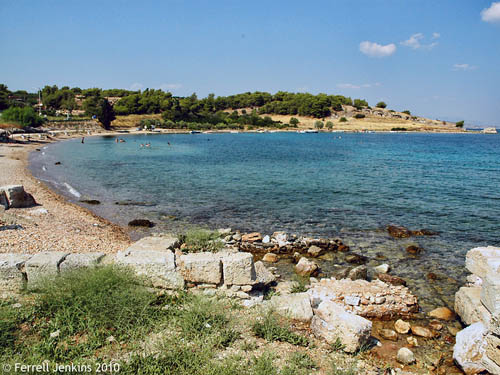
Cenchrea continued as a city until the sixth century A.D., but no buildings remain around the harbor today. In addition to the artificial breakwaters which “are now submerged because of subsidence and/or a relative sea level rise of about 2 meters since their construction, the Roman harbor was distinguished by various warehouses and support buildings, monumental statues, and several temples…” (Hohlfelder in ABD). Ruins of the Sanctuary of Aphrodite, the Temple of Isis, a Byzantine church, warehouses, and commercial fish tanks have been discovered.
Our photo is made from the south pier looking across the harbor to the north. From here Paul, Aquila, Priscilla, and likely the brethren who took the contribution from Macedonia and Achaia, sailed. Phoebe lived, and the church gathered, somewhere nearby.
Photo © Ferrell Jenkins 2006. First published in Biblical Insights.
 Ferrell's Travel Blog
Mr. Jenkins, thank you for creating this post. We shared the link to it with the students in class.
A lot of restoration work has been done since 2023. Here’s a pic of the 6th century CE basilica (built over a 4/5th one).
https://scrollandscreen.com/images/Cenchrea2025.jpg
I met an archaeologist at a lecture in Nashville who was doing work excavating the hillside in the background of this picture in the blogpost of Cenchrea a number of years ago. He works (worked?) at Vanderbilt. We had quite the talk, since he was amazed someone in his audience had been there in person! ____________________ Gene Wright Gene.Wright.143@gmail.com