
Monthly Archives: March 2025

Question About Date of Destruction of Jerusalem

A reader of the previous post (Click to read: https://wp.me/p1zOp-5FC ) wonders how we know Jerusalem was not destroyed later than A.D. 70.

It is a good question. The New Testament, including the records of the life and ministry of Christ, is rooted in history. Notice how Luke, a gentile physician, emphasizes the historicity of the work of John the Baptist and the beginning of the baptism and ministry of Jesus.

Luke 3:1 In the fifteenth year of the reign of Tiberius Caesar, Pontius Pilate being governor of Judea, and Herod being tetrarch of Galilee, and his brother Philip tetrarch of the region of Ituraea and Trachonitis, and Lysanias tetrarch of Abilene, 2 during the high priesthood of Annas and Caiaphas, the word of God came to John the son of Zechariah in the wilderness. 3 And he went into all the region around the Jordan, proclaiming a baptism of repentance for the forgiveness of sins. (Lk. 3:1-3 ESV)
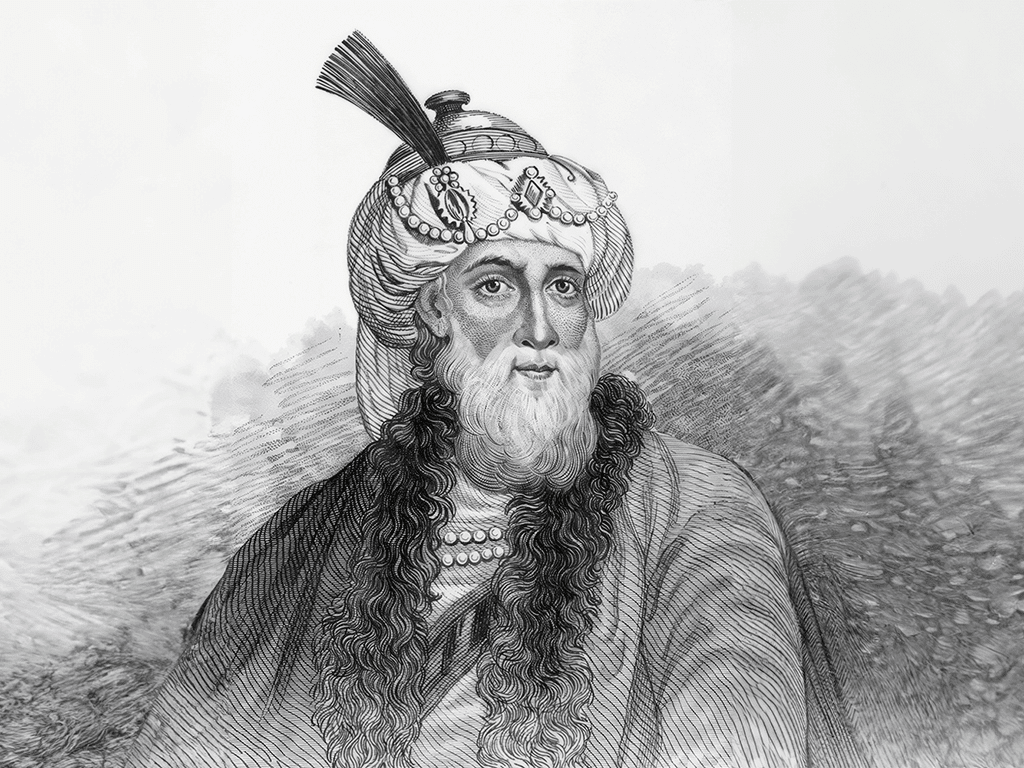
We don’t know what Josephus looked like, but older English versions of his works sometimes included a line drawing. David Padfield, at Padfield.com, had one of those old drawings enhanced by AI and shared the drawing with me. I suggest you visit Padfield.com for more good material.

Josephus, the Jewish historian, who was contemporaneous with these events, and an eye witness of many of them, tells us much about the movement of the Romans as they came near the city of Jerusalem. Vespasian had been leading the plans to attack Jerusalem. When he learned of the death of Emperor Nero (A.D. 68) he returned to Rome to become emperor. His son Titus became the leader of the effort. Josephus, a native of Yodfat, now in north western Israel, was an eye witness to many of the events of the Roman invasion of the country. Not only did he write the History of the Jews, but also the Wars of the Jews. He provides specific information about the movement of the Romans as they approached the city of Jerusalem. As the army began to be seen in plain view, Josephus records the events.

JOE Wars of the Jews 2:528: He then pitched his camp upon the elevation called Scopus [or watch tower], which was about a mile from the city; yet did not he assault them in three days’ time, out of expectation that those within might perhaps yield a little; and in the meantime he sent out a great many of his soldiers into neighboring villages, to seize their grain; and on the fourth day, which was the thirtieth of the month Hyperbereteus, [Tisri], when he had put his army in array, he brought it into the city. (Wars 2:528) This might be a reference to the temple which was in the city.

Accordingly, this place, on the north quarter of the city, and joining thereto, was a plain, and very properly named Scopus [the prospect];
68 and was no more than a mile from the city And here it was that Titus ordered a camp to be fortified for two legions that were to be together; but ordered another camp to be fortified, six hundred yards behind them, for the fifth legion; for he thought that, by marching in the night, they might be tired, and might deserve to be covered from the enemy, and with less fear might fortify themselves; (Wars 5:67-68)

The photo below shows a view of the Old City of Jerusalem made from the slope of Mount Scopus. Notice the Dome of the Rock, the gold domed building with the sun shining on it. It is located approximately where Herod’s temple was stood from its completion until the destruction in A.D. 70. If you click on the image it should enlarge to allow you to see everything better.
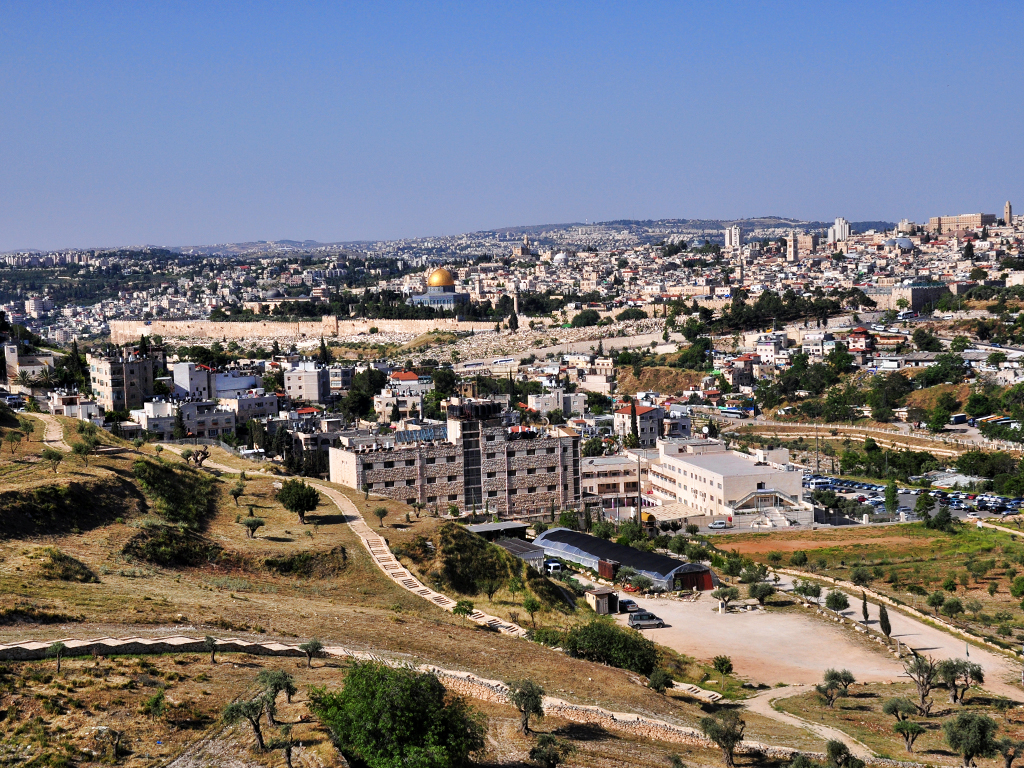
(c)FerrelllJenkins2013______________

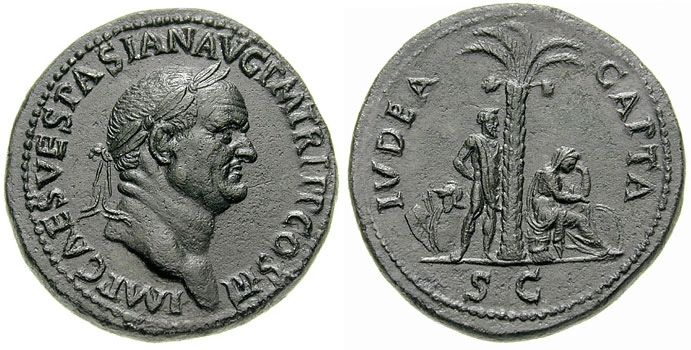
The images below show an example of the coins minted by Vespasian and Titus to commemorate the capture of Judea. The obverse [heads] shows a laureate head of image of Caesar Vespasian. The reverse[tails ] had the wording Judea Capta and shows a mourning Jewess under a palm tree. David Hendin, Guide to Biblical Coins, Fifth Edition, shows a variety of this coin minted by different emperors at various places.
Merrill C. Tenney, New Testament Times, includes a chart of the various Roman and Herodian rulers in connection with the events in Judea. Good Bible dictionaries and Encyclopedias will also provide this type of information.

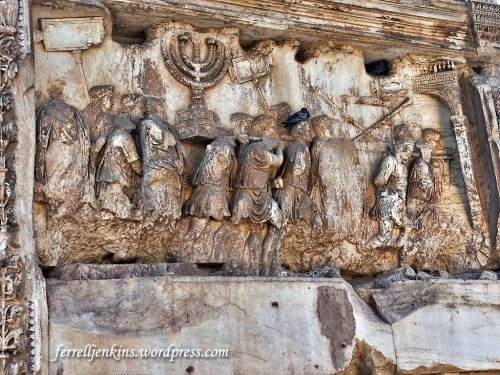
During A.D. 68 and 69 three men, Galba, Otho, and Vitellius, ruled. Vespasian was Emperor of Rome A.D. 69-79. Titus was emperor 79-81. The Arch of Titus on one end of the Roman forum commemorates this event. Carvings on the inside of the arch show the Roman soldiers taking away the ark of the covenant and the table of showbread from the Jerusalem temple.
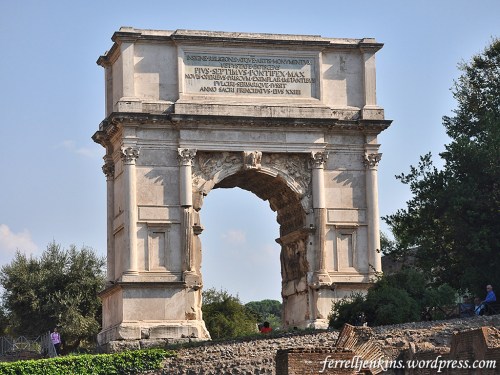
The Arch of Titus in the Roman Forum commemorates the Roman victory of the Jews in A.D. 70. Photo by Ferrell Jenkins.
Arch of Titus relief showing Roman soldiers carrying the items taken from the Temple in Jerusalem in A.D. 70. Photo by Ferrell Jenkins.

Jews now celebrate a holiday called Tisha B’Av [The 9th of the Jewish month of Av] (roughly our August). Tjhis day commemorates the destruction of the first temple which was built by Solomon was destroyed by the Babylonians in 586 B.C., and the destruction of the temple built by Herod the Great was destroyed by the Romans on Tisha B’av in A.D. 70.

Jerusalem was destroyed in A.D. 70, or as the Jews would say 70 C.E..

Tags

The new slogan coming out of Washington

After checking my financial account beginning about a week ago, I decided that the new slogan out of Washington must be “Make America Poor again”! I understand that neither of the guys who are doing this have ever been poor, but my situation was different.

I was born in cotton country in north Alabama. Families got by on what they could grow in their gardens and an occasional chicken or squirrel. My grandmother and my mother knew how to make biscuits and cornbread.

I remember my father taking the last Silver Dollar he had saved and buying some food from the Peddler who came down 16th Section Road about once a week.

My Grandfather was a sharecropper. He lived in the big house on the property. The two smaller houses were occupied by the families of two married daughters.. One daughter, my mother, lived in one of the houses with her family. One of her sisters lived in the other house with her family. I think you could say that we sharecropped with a sharecropper!

We lived about two miles from the two country stores and cotton gins that served the community. We had one Aladin lamp and a couple of coal oil lamps. My grandparents had a four-party telephone. There were no secrets on our road.

The closest doctor was 16 miles away in Huntsville, a little town of about 16,00 population at that time.

Eventually the Federal government decided to take advantage of the Tennessee River to help the people. Dams were built on the river to generate power. By the time I was 9 or 10 we had at least one electric bulb hanging in each of the four rooms. The Federal Government helped the citizens ln those days. To get water we had to walk quiet a distance to draw a gallon of water from the deep well and bring it back to the house. There was no running water. Baths were once a week using a pan and wash cloth. Everyone understood what it meant to “go out back.” Corn cobs and last year’s Sears Roebuck catalog came in handy.

Eventually we had one cow to provide milk, and a few chickens for eggs and occasional meat.

I had one aunt who went to Nashville to attend a business school. I was the first of my family to go to college. The little school that I attended at Harvest had eight grades in four rooms.

Even though alcoholism is a serious problem in our time I think most folks are more interested in the price of eggs and bread than in French wine.

Social Security. By the time I was 17 I was investing a small amount with the government in a program called Social Security. When my father died and I cleaned out the chifrobe I found a small piece of paper showing that my father had paid .13 cents of his weekly salary of about $12 into Old Age Benefits. He did better financially as the years passed, but he died of a heart attack after drawing only two checks from Social Security.

I have also invested in insurance from time to time. I trusted the government to take care of my Social Security money and see that it grew enough to help me when I was older and had only income from my savings. In 2021 the government owed me money due to overpayment. I have gone through all kind of hoops with the IRS to get my refund. I am still waiting. When I saw he headline that the department should be cut I wondered if I will ever receive what I am owed.

I have been blessed abundantly to live in this country and I dislike seeing it torn down. I have sought to serve God and to teach others to do so.

I appreciate men and women who seek to serve their country though public service but I don’t think very highly of political men or women who love their party more than their constituents.

 “Better is a poor man who walks in his integrity than a rich man who is crooked in his ways.” (Prov. 28:6 ESV)

The man who says or acts as if he needs no one is truly a poor man!

Righteousness exalts a nation, but sin is a reproach to any people.” (Prov. 14:34 ESV)

See our earlier post, The Arrogance of Rulers Leads to the Fall of Nations here: https://ferrelljenkins.blog/2024/07/11/the-arrogance-of-rulers-leads-to-the-fall-of-nations/